- →UR scores a single URL, DR scores a whole domain: a UR 5 article on a DR 70 media outlet passes very little, and that gap is the most common blind spot in placement selection.
- →UR is a logarithmic PageRank-style computation run on Ahrefs' own crawl, so it is a model of link flow, not a Google signal, and no other vendor exposes a strictly comparable page-level metric.
- →The number that predicts value is not the UR of the page today, it is the UR that page will hold in six months once the publisher stops linking to it internally.
- →Ahrefs added spam badges and a « Non-spammy links » filter to its backlink reports on 30 May 2026, which is a clearer quality read than any UR threshold you could set.
- →Editorial.Link's survey of 518 SEO professionals (March to May 2025) found 64.1 % use DR and UR as their primary authority metrics, which is exactly why a UR threshold is easy for sellers to engineer.
- →Use UR to sort a prospect list and to spot internal-linking failures on your own money pages, then close the decision on relevance, editorial context and traffic.
What UR measures, and what it quietly ignores
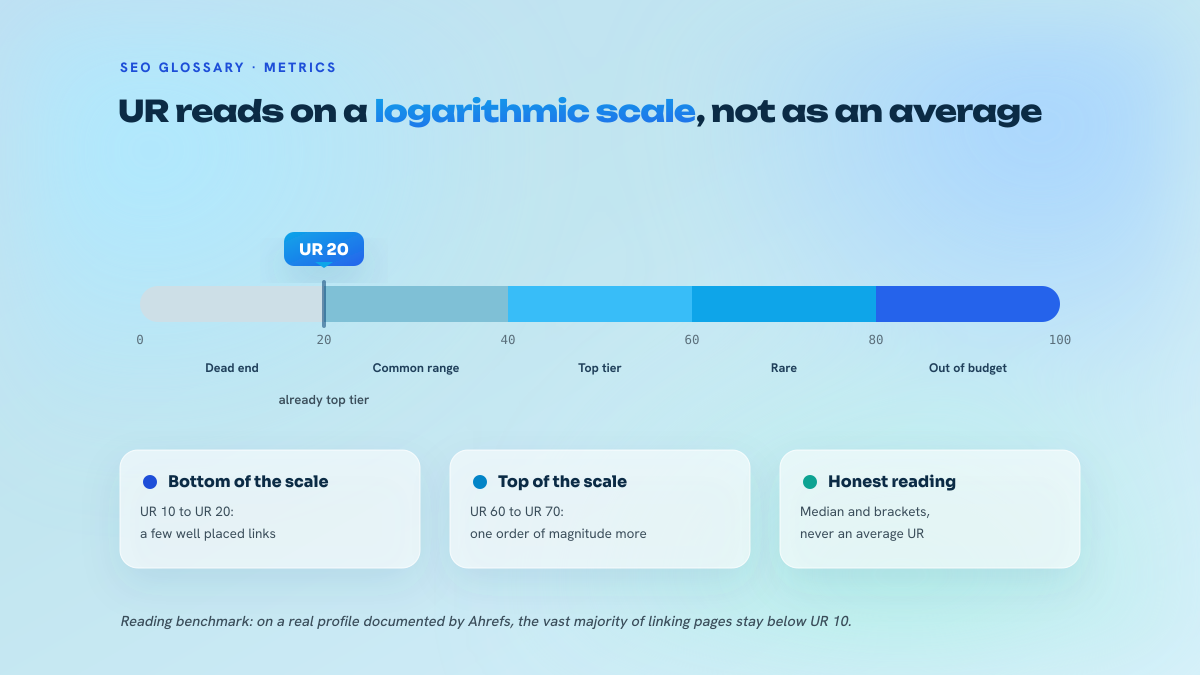
UR stands for URL Rating, the U being the same one as in Uniform Resource Locator, and that pedantic detail carries the whole point of the metric: it scores one address, not one website. Ahrefs computes it on a 0 to 100 logarithmic scale from the backlinks pointing at that exact page, both external and internal, and the score climbs far harder between 40 and 50 than it does between 10 and 20. A page at UR 30 does not hold twice the link strength of a page at UR 15. It holds considerably more, on a curve the vendor has never published in full.
What UR ignores is more instructive than what it captures. It knows nothing about the topical relevance of the linking pages, nothing about whether the page ranks for anything, nothing about whether a human reads it. A press release syndicated across two hundred low-quality outlets will lift a URL's rating without moving a single ranking. Conversely, a genuinely authoritative page on a niche trade publication can sit at UR 8 because nobody has ever linked to that individual article, only to the homepage. Both cases are routine, and both are invisible if the only column you sort on is the rating.
The metric also has a shelf life problem that nobody selling links wants to discuss. A recently published article often carries an inflated UR because the publisher is pushing it from the homepage, the category page and the sidebar. Three months later, when the internal links have rotated to newer content, the same URL can lose most of its rating without a single external link disappearing. That decay is normal, predictable, and rarely accounted for when a placement is priced.
How the score is built in 2026
Ahrefs describes UR as a PageRank-style calculation run over its own link index. The mechanics follow the classic model: each linking page distributes a share of its own strength across its outbound links, a damping factor bleeds off a fraction at each hop, and the receiving URL accumulates whatever reaches it. Nofollow links are excluded from the flow, dofollow links are counted, and both internal and external links participate, which is the detail that separates UR from most competing page-level scores.
Two consequences follow directly from that design. First, a link from a page with few outbound links is worth more than a link from a page with sixty, all else being equal, because the same pool of strength is divided fewer ways. Second, UR is only ever as good as the crawl behind it. If Ahrefs has not seen a link, that link contributes nothing to the rating, and index coverage between vendors diverges enough that a page can look strong in one tool and unremarkable in another. This is the honest answer to a question the ranking pages tend to dodge: there is no independent, methodologically comparable page-level score. Majestic works at URL level too but on entirely different axes, and translating between the two is guesswork rather than conversion.
The tooling around the metric moved in 2026. Ahrefs added spam badges and a « Non-spammy links » filter to its backlink reports and Site Explorer overview on 30 May 2026, and extended backlink reports to include links from YouTube videos on 1 August 2026 (Ahrefs changelog). The spam filter matters more than it sounds: it gives you a quality read on the referring pages that no UR threshold can produce, because a page can be spammy and highly rated at the same time. Ahrefs' own documentation on the UR distribution graph illustrates the shape of a normal profile, with an example showing 9,915 backlinks (0.2 %) coming from pages rated UR 10 to 19 and 1,107 (0.1 %) from pages rated UR 20 to 29, everything below UR 10 relegated to a footnote. The overwhelming mass of any real backlink profile sits at the bottom of the scale, which is worth remembering the next time someone quotes a UR 30 minimum as if it were a normal ask.
UR against DR and against PageRank
The distinction between UR and the domain-level rating most buyers anchor on is the single most operationally useful thing in this entry. DR aggregates the link profile of an entire website into one number. UR isolates one page. A DR 72 national news site whose article about your client sits at UR 4, buried three clicks deep with no internal links and no external ones, passes a fraction of what the DR suggests. The domain figure describes the neighbourhood. The page figure describes the house.
Both are models of the same underlying idea, which is the original link-graph algorithm Google patented in 1998. UR is closer to that ancestor than DR is: same recursive distribution, same damping, same page-level granularity. The differences are that Google runs on its own vastly larger index, applies decades of layered filtering on top, and has not published a PageRank figure since the toolbar died in 2016. So UR approximates a signal Google no longer shows, using data Google does not use, filtered by rules Google does not apply. It remains useful. It is not a proxy for how Google will treat the link, and the recent update cadence makes that gap wider rather than narrower. The March 2026 spam update ran for 19 hours and 30 minutes and the June 2026 spam update for 2 days and 1 hour (Google Search Status Dashboard), short deployments that nonetheless reshuffle which link patterns get devalued. No page-level rating anticipates that.
Where UR earns its place in a campaign
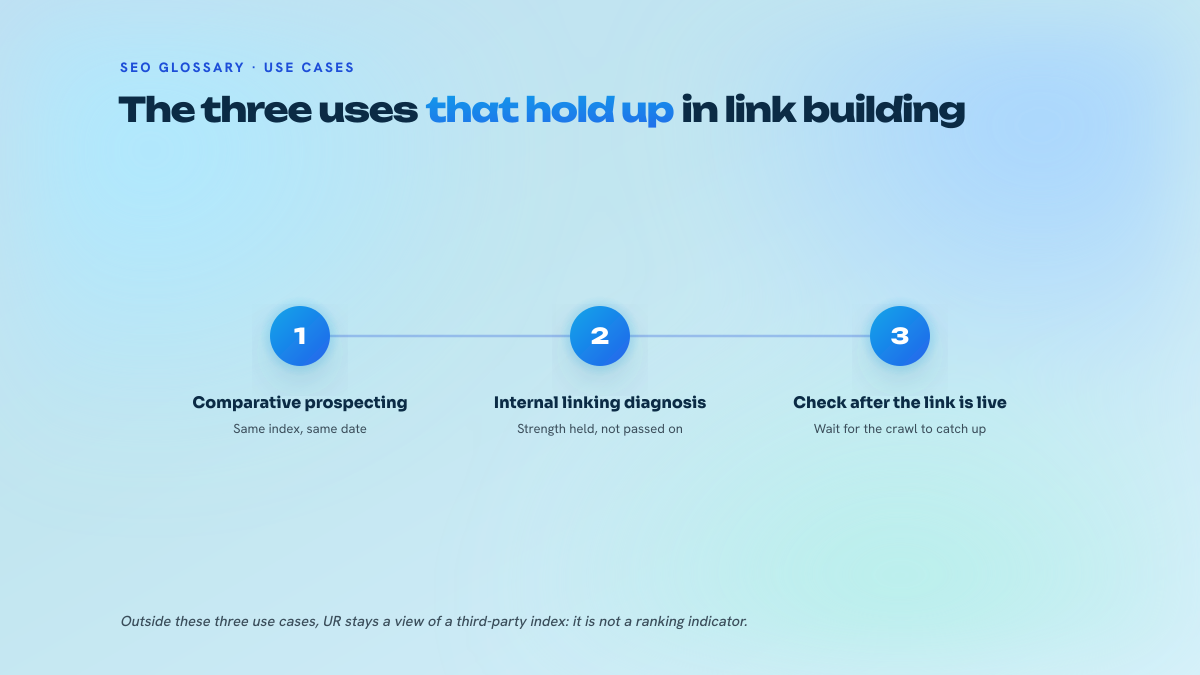
UR does real work in three places. The first is prospect triage. When you have four hundred candidate pages and time to evaluate thirty, sorting on UR removes the pages that have never received a link from anyone, which is a legitimate first cut. The second is diagnosing your own site. Pull the UR of your commercial pages against the UR of your blog and you get an immediate map of where internal link equity is pooling and where it is not. A money page rated below its own category page is an internal linking failure, fixable in an afternoon for free, and it will move rankings more reliably than the next three links you buy. The third is post-campaign verification: watching the UR of a target page climb after a wave of placements confirms the links were crawled and counted, which is a crawl check rather than a performance check.
Where UR does not belong is in the purchase decision itself. This is why the media catalogue we publish with its metrics visible before you order shows the domain, the traffic and the editorial context rather than promising a UR floor on the article that has not been written yet. The article you commission starts at UR 0 by definition. Its eventual rating is a function of how the publisher links to it internally and whether anyone else picks it up, so guaranteeing a number in advance would be selling something the seller does not control. On the French editorial media Nautilinks runs in-house, the honest variable to look at is how the site links its own archive, because that is what determines whether a new article ends up at UR 12 or UR 3 six months out.
For clients who need to place a link on a specific page rather than just a domain, the useful conversation is about the destination page too. The UR of the page you point at tells you how much of the incoming strength will still be there to redistribute internally. Sending every link to a homepage already rated UR 45 buys you a marginal gain, whereas the same link aimed at a category page sitting at UR 6 can shift it visibly. Money spent against a rating threshold instead of against a gap in your own profile is money that produces a chart, not rankings, and what a placement actually costs deserves that arbitrage. Editorial.Link's survey of 518 SEO professionals conducted between March and May 2025 put the average acceptable price for a single high-quality backlink at 508.95 dollars, and Reporter Outreach's Q1 2026 survey of 500 professionals found 76 % willing to pay 300 dollars or more. At those levels, filtering on a proprietary number that the seller can engineer is an expensive habit.
What goes wrong when UR drives the decision
The failure mode we see most often in audits is the engineered rating. Because 64.1 % of respondents in the Editorial.Link survey named DR and UR as their primary authority metrics, sellers optimise for exactly those two numbers. Pumping a page's UR is cheap: a burst of links from a private network, a sitewide footer link, a few thousand low-grade profiles. The rating responds within a crawl cycle. Relevance, traffic and editorial credibility do not respond at all, and Google's spam systems increasingly read the pattern rather than the score. Any metric that is both public and easy to influence stops being a quality signal and becomes a target.
The second failure is threshold theatre. Teams set a rule such as « nothing below UR 15 » and then spend the campaign hunting for pages that clear the bar rather than pages that make sense. Reporter Outreach's Q1 2026 data shows 53 % of respondents targeting a DR 40 to 60 band, a narrow window that hundreds of buyers are competing for simultaneously, which pushes prices up on exactly the inventory everyone else is buying. The same crowding happens one level down with UR.
The third is confusing a rating change with a ranking change. UR updates when Ahrefs recrawls, on its own schedule, and it can move for reasons that have nothing to do with your campaign, including a competitor losing links or the vendor adjusting its index. Meanwhile the outcome layer has actually improved: Google launched Search Generative AI performance reports in Search Console on 3 June 2026, exposing impressions from AI Overviews and AI Mode alongside the URLs appearing in those features. There are now first-party ways to see whether a page gained visibility. Reporting on a third-party page score instead is a choice, and not a defensible one.
Checking UR properly, and what a good score looks like
The score lives in Ahrefs. Paste any URL into Site Explorer and the rating appears in the overview next to the domain figure, alongside the count of distinct sites linking to it, which is the number you should read in the same glance. The free URL Rating checkers circulating online either query a stale cache or return a rough estimate of their own, and for a purchase decision that is not good enough. Ahrefs' pricing page dated 9 March 2026 lists Starter at 29 dollars a month with 100 credits, Lite at 129 dollars with 500, and Standard at 249 dollars with unlimited credits plus Batch Analysis. Serious bulk comparison of URLs starts at Standard. Below that, every lookup burns a credit and prospecting at scale becomes arithmetic rather than analysis.
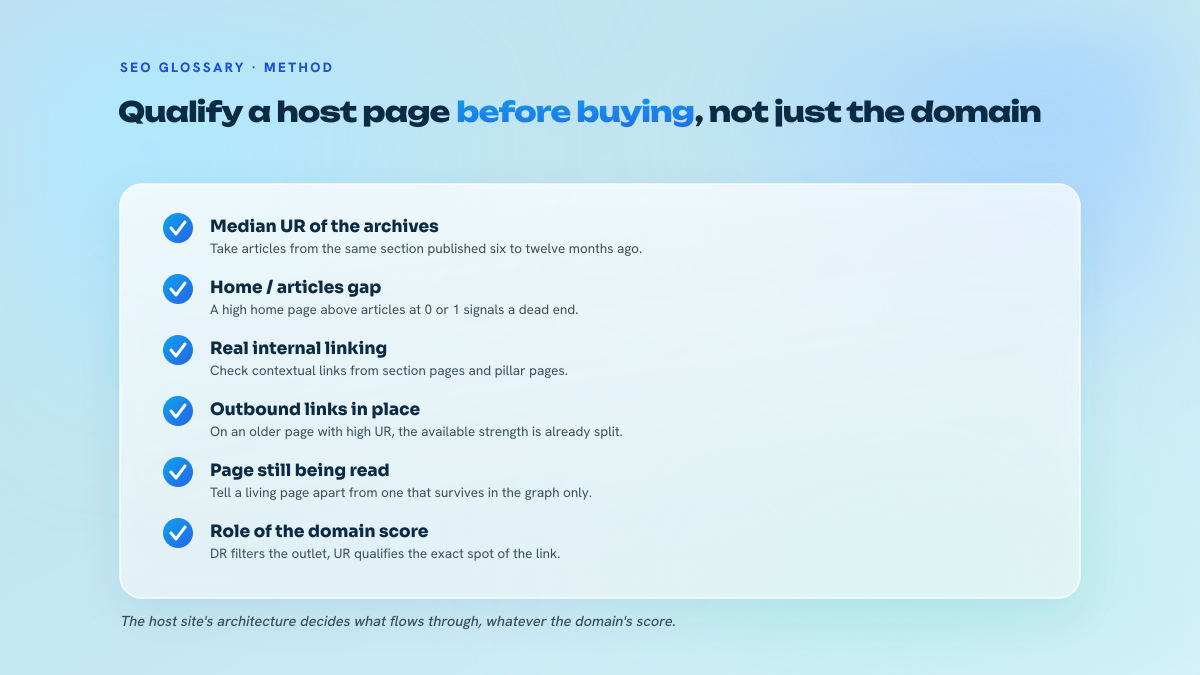
As for what counts as a good rating, the only honest answer is relative. Read the UR of a candidate page against the UR of comparable pages on the same site: an article rated 14 on a site whose articles typically sit at 4 is genuinely well linked internally, while an article rated 14 on a site whose homepage sits at 68 is being ignored by its own publisher. Then check whether the page has organic traffic, whether it sits in a topical neighbourhood adjacent to yours, and whether the outbound link count is reasonable. Those three checks predict outcomes better than any threshold, and unlike the rating they cannot be manufactured over a weekend.
Nautilinks operates an owned network of editorial media. In-house written articles, transparency disclosures respected, anchor mix calibrated.
Frequently asked questions
Is UR a Google metric, and does it influence rankings directly?
No on both counts. UR is Ahrefs' own computation over Ahrefs' own crawl, modelled on PageRank but built from different data and without any of the filtering layers Google applies. It correlates with rankings because both respond to the same underlying link graph, which is not the same as causation. Raising a page's UR through low-quality links raises the number and nothing else. Treat it as an indicator of link flow inside one vendor's index, not as a ranking factor.
Should I filter prospects on UR or on DR?
Use DR to qualify the site and UR to qualify the page, in that order. DR tells you whether the domain is a credible host. UR tells you whether the specific page you are being offered actually holds any strength. The common mistake is stopping at DR and accepting a UR 2 page on a DR 65 site, which passes close to nothing. For a new sponsored article neither figure exists yet, so judge the site's internal linking habits instead.
How often does UR update, and why did mine drop without losing links?
UR refreshes when Ahrefs recrawls the pages linking to yours, which happens on the vendor's schedule rather than yours. A drop with no lost backlinks usually means internal links changed: the publisher rotated its homepage or category modules to newer content, so your article stopped receiving internal flow. It can also reflect an index adjustment on Ahrefs' side. Compare against a control set of pages before treating a movement as a signal about your own campaign.
Can UR be manipulated, and can I tell when a seller has done it?
Yes, easily. A burst of links from a link network or a sitewide placement lifts a page's rating within a crawl cycle. The signature is a rating that is high relative to the page's referring domain count, no organic traffic, and a referring profile concentrated on a handful of sources. Ahrefs' spam badges and « Non-spammy links » filter, added on 30 May 2026, surface most of it quickly. Check traffic and referring domain diversity alongside the score, never the score alone.
Is a UR threshold worth writing into a link-buying brief?
Only as a floor to exclude pages that have literally never been linked, and only for existing pages. Writing « minimum UR 20 » into a brief for articles that have not been published yet is asking a seller to guarantee something they do not control, and the ones who agree are usually the ones planning to manufacture it. For new placements, specify the site, the section, the internal linking commitment and the editorial context instead.
What is the equivalent of UR in other tools?
There is no strict equivalent. Majestic works at URL level with Trust Flow and Citation Flow, but those measure link trust and link volume on separate axes rather than modelling flow into a single score. Moz publishes Page Authority, which is a page-level score built on its own index and a different model. None of them convert cleanly into one another, so pick one vendor for your thresholds and stay with it rather than averaging across tools.
Test your knowledge
Quiz: URL Rating (UR)
1/3A candidate placement sits on a DR 70 media site, but the target article is rated UR 3. What does that combination most likely indicate?