- →Citation Flow is a volume proxy, not a quality signal: it estimates how much link equity reaches a URL, with zero opinion on whether those links come from trusted sources.
- →Never read CF as an absolute score. A CF that is high relative to Trust Flow is the single fastest red flag for an inflated, farm-built profile (AgencyAnalytics, February 2026).
- →CF is a Majestic metric, not a Google one. It replaced Majestic’s old ACRank and has no direct equivalent inside Google’s ranking systems.
- →Google’s March 2026 spam update explicitly targeted link schemes and expired-domain abuse, exactly the tactics that inflate CF without moving TF or traffic (Digital Applied 2026 timeline).
- →Fresh vs Historic index changes the number: always note which index a CF score comes from before comparing two domains or two dates.
- →Use CF as a denominator in vendor triage, never as a KPI for a campaign. Traffic and referring domain quality are what you actually buy.

What Citation Flow really measures
Citation Flow answers one question: how much link equity, in raw volume, flows into this URL or domain. It is Majestic’s proprietary score on a 0 to 100 logarithmic scale, computed from the quantity and equity of links pointing at a target, and it deliberately ignores whether those links come from respectable sources. That last part is the whole point of the metric, and the part most buyers of links forget when they see a big number on a seller’s listing.
Two clarifications worth restating in 2026, because both keep resurfacing in audits. First, Citation Flow is not a Google metric and never was. It replaced Majestic’s older ACRank score, a lineage FHSEOHub’s February 2026 explainer takes care to spell out, probably because the word « citation » now collides with AI answer-engine citations and confuses half the briefs we receive. A page cited by ChatGPT and a page with CF 60 have strictly nothing in common. Second, CF is a modeled estimate over Majestic’s own crawl, not an observation of anything Google does. When public PageRank disappeared, TF and CF became the reference pair for link intelligence by adoption, not by endorsement.
The operational definition, then: CF is a fast, cheap proxy for « how much linking activity points here », useful precisely because it is indifferent to quality. That indifference makes it a great triage input and a terrible objective.
How Majestic computes it in 2026
Mechanically, Citation Flow works like an iterative flow calculation over Majestic’s link graph: equity flows from page to page through links, dampened at each hop, and the accumulated inflow is compressed onto the 0 to 100 scale. Because the scale is logarithmic, moving from CF 20 to CF 30 requires far more inflow than moving from 10 to 20. A one-point difference between two prospects is measurement noise; a fifteen-point difference is a real structural gap.
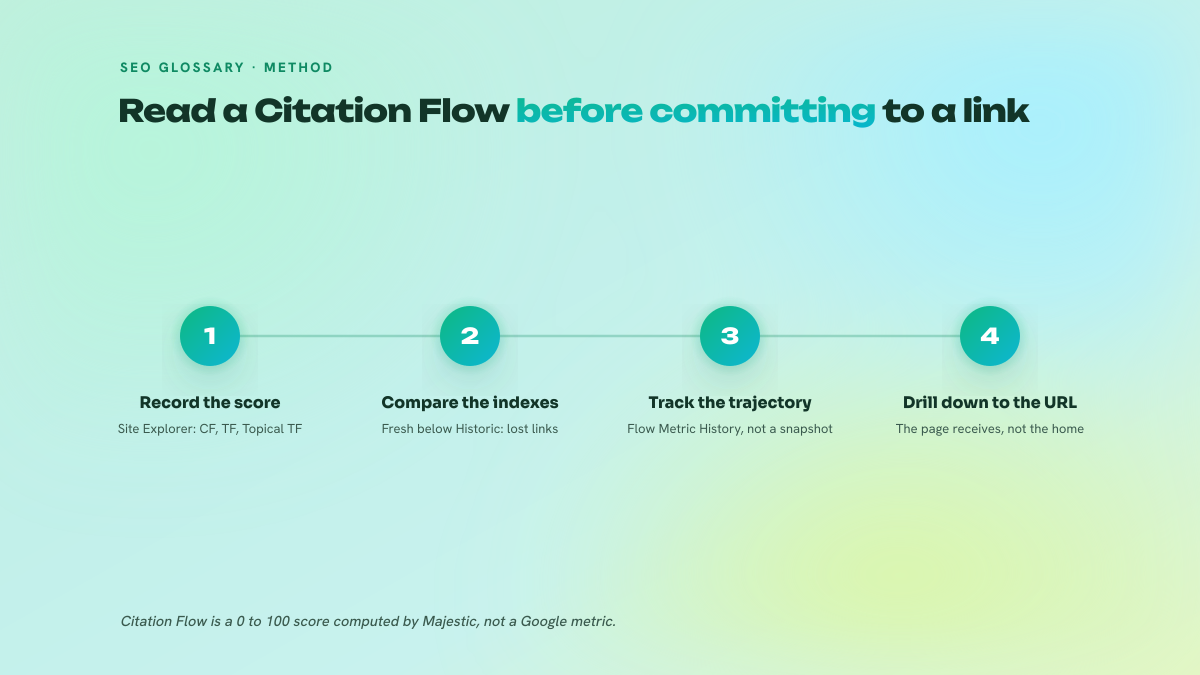
The index matters as much as the formula. Majestic maintains a Fresh index covering recent crawl data and a Historic index reaching years back, and the same domain routinely shows different CF values in each. An expired domain with a rich past and a dead present can look strong in Historic and hollow in Fresh. If you evaluate domains for netlinking, the Fresh figure is the one that describes what you are buying today; the Historic one describes what the domain used to be. Majestic’s API documentation, last updated in August 2025, still exposes Trust Flow and Citation Flow as primary data fields, which tells you the company considers the pair core infrastructure rather than legacy, and reviews through early 2026 note a Flow Metric History view that charts both scores over time instead of giving you a static snapshot.
One more mechanical point: CF correlates strongly with the raw count of referring domains, but the two are not interchangeable. A single high-equity link can move CF more than fifty forum profiles, and fifty forum profiles can move it more than one honest editorial mention. The metric flattens those very different realities into one number, which is exactly why it needs a counterweight.
Citation Flow vs Trust Flow: the ratio does the work
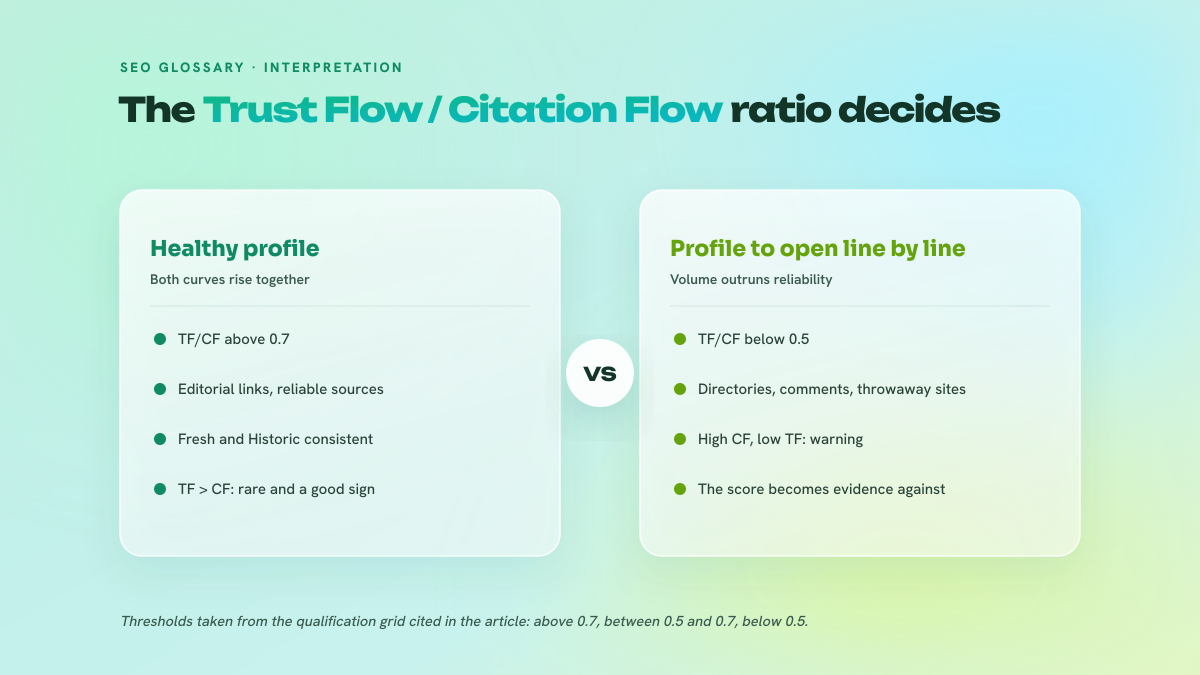
Trust Flow measures proximity to a seed set of manually reviewed, trusted sites; Citation Flow measures inflow volume. Neither score means much alone. Together they form the most information-dense pair of numbers you can get in five seconds on an unknown domain. A profile where the two travel together, say CF 35 and TF 28, usually reflects organic, editorially earned links. A profile where CF towers over TF, CF 45 against TF 8, almost always reflects volume tactics: directory blasts, comment spam, expired-domain redirects, automated tiers. AgencyAnalytics’ February 2026 explainer for agencies makes the same call from the reporting side: high CF with low TF is the red flag pattern worth surfacing to a client, while growing both together is the evidence a campaign is actually working.
This short video from Majestic itself walks through how the two flow metrics interact and why they are designed to be read as a pair:
Our stance, after years of auditing link sellers: Citation Flow is the most gamed metric on the link market, precisely because it is the cheapest to inflate. Building CF costs almost nothing; building TF requires links from genuinely trusted neighborhoods, which is expensive to fake. So when a marketplace listing leads with CF and buries everything else, treat that as a disclosure. Before you filter media on metrics that resist manipulation, traffic, referring domain quality, topical fit, the CF/TF spread has already told you which sellers to skip.
Checking Citation Flow in a live operation
The primary surface is Majestic Site Explorer: query a domain or a specific URL and TF, CF and Topical Trust Flow sit at the top of the report. For prospecting at scale, the Bulk Backlink Checker returns flow metrics for up to 400 URLs through the interface, or up to a million via file upload, which is the realistic workflow when you are triaging a vendor catalogue or an expired-domain list rather than admiring one site. A browser extension gives page-level scores inline while you prospect. On pricing, ToolJunction’s May 2026 breakdown puts Majestic’s Lite plan at $49.99 per month and Pro at $99.99, the tier you need for the Historic index, so budget for Pro if expired domains are part of your sourcing.
Majestic’s official walkthrough of its flow metrics is worth fifteen minutes if you are calibrating a team on how to read the scores:
Two calibration rules. First, never mix metrics across tools. Ahrefs’ Domain Rating, Moz’s DA and Majestic’s CF are computed on different crawls with different formulas; a CF 30 and a DR 30 are not the same statement, and averaging them produces a number with no meaning. Pick one primary index per workflow and stay in it. Second, flow metrics describe the link graph, not the outcome. On our own network we publish first-party GSC and traffic data for every media, because a buyer comparing a catalogue where each site shows its real search performance against a CF score quickly learns which of the two predicts anything. Flow metrics are the pre-filter; performance data is the decision.
Where we see Citation Flow go wrong
The most common failure is treating CF as a campaign KPI. It is trivially easy to make CF go up: buy volume. It is also increasingly pointless. Google’s March 2026 spam update explicitly targeted link schemes, expired-domain abuse and parasite placements (Digital Applied’s 2026 update timeline), which is a near-perfect description of the tactics that raise CF without raising TF or traffic. Volume-first link building now produces a metric that climbs while the thing it was supposed to proxy, ranking ability, stays flat or degrades.
The second failure is the inverse: dismissing CF entirely because it is « just quantity ». A BrandStory case study from April 2026 tracked an e-commerce site whose Citation Flow rose from 22 to 45 over twelve months of guest posting and resource-page link building, alongside roughly 60% organic traffic growth and first-page rankings on about 40 target keywords. The author is careful to frame CF as correlational rather than causal, and that is the correct reading: the CF growth did not cause the rankings, but it was an honest thermometer of a real acquisition effort. A CF that never moves during a supposedly active campaign is a question your vendor should answer.
Rounding out the list of recurring mistakes: comparing a Fresh-index score to a Historic-index score and calling the difference a trend; benchmarking your CF against sites in unrelated verticals; and setting CF targets like « reach 50 by Q4 », which incentivizes exactly the volume tactics the spam updates punish. The scale is logarithmic and top-heavy; past a certain point, chasing points means chasing links no honest editor would place.
Tactical use for a working SEO
Where Citation Flow earns its place in a 2026 workflow: bulk triage of unknown domains, sanity-checking seller claims, and monitoring the shape of a profile over time. Run the CF/TF pair on every prospect before any manual review; discard the extreme divergences; spend your human attention on the survivors. In vendor negotiations, use CF as a denominator: a price justified by CF alone is a price justified by the cheapest metric to fake. And when you operate campaigns over months rather than one-off placements, track both flow scores as a background series, the way a netlinking platform run without hidden intermediaries should let you do by default, then judge the campaign on traffic and rankings, not on the thermometer. Citation Flow is a fine instrument as long as nobody in the room mistakes it for the weather.
Nautilinks operates an owned network of editorial media. In-house written articles, transparency disclosures respected, anchor mix calibrated.
Frequently asked questions
Is Citation Flow a Google ranking factor?
No. Citation Flow is computed by Majestic on its own crawl and has no presence inside Google’s systems. It replaced Majestic’s older ACRank metric. Any correlation with rankings runs through what CF proxies, the volume of link equity a site accumulates, not through Google reading the score. Recent guides, including UppercutSEO’s December 2025 piece, restate this explicitly because the confusion keeps resurfacing, amplified lately by the unrelated use of « citations » in AI search.
What CF/TF ratio should trigger a rejection when buying links?
There is no universal cutoff, and anyone selling you one is simplifying. What matters is divergence: when Citation Flow sits several multiples above Trust Flow, the profile was almost certainly built on volume tactics such as directories, comments or automated tiers. AgencyAnalytics’ February 2026 guidance treats high CF with low TF as the primary red-flag pattern. Judge the spread in context, then confirm with the actual backlink report and traffic data before rejecting or paying.
Why does the same domain show different Citation Flow values on different days or tools?
Three causes. Majestic maintains separate Fresh and Historic indexes, and the same domain scores differently in each, especially expired domains with a strong past. The Fresh index also recrawls continuously, so scores drift as links are found or dropped. Finally, other tools’ metrics such as Ahrefs DR or Moz DA are entirely different computations on different crawls: a CF 30 and a DR 30 are not comparable statements, so never mix them in one benchmark.
Can I raise Citation Flow without raising Trust Flow, and should I?
You can, cheaply, and you should not. CF responds to link volume regardless of source quality, so directory blasts and forum profiles inflate it while TF stays flat. That divergent shape is exactly what experienced buyers and auditors screen against, and Google’s March 2026 spam update targeted the underlying tactics, link schemes and expired-domain abuse, directly. Building CF alone produces a profile that looks worse to professionals and riskier to algorithms simultaneously.
Is Citation Flow still worth tracking in 2026, given the shift to traffic-based evaluation?
Yes, but demoted. The 2025 to 2026 update cycle pushed evaluation toward quality, topical authority and real engagement, and first-party traffic data beats any third-party score for final decisions. CF remains useful upstream: it is instant, available for any domain, and excellent for bulk triage before human review. BrandStory’s April 2026 case study is the fair framing: CF tracked a real campaign honestly, as a correlational thermometer, not as the cause of the results.
Which Majestic plan do I actually need for netlinking work?
Per ToolJunction’s May 2026 breakdown, the Lite plan at $49.99 per month covers Site Explorer and Fresh-index flow metrics, enough for day-to-day prospect triage. The Pro tier at $99.99 unlocks the Historic index and Clique Hunter, which matter if you evaluate expired domains or need to see what a site’s link profile looked like years ago. For pure spot checks, the browser extension surfaces page-level TF and CF while you browse.
Test your knowledge
Quiz: Citation Flow
1/3What does Citation Flow actually estimate?