- →Budget per new referring domain, not per link: Backlinko's 2025 re-analysis of 11.8M results puts page-level RD at r = 0.38 with rankings, the strongest measured off-page factor, ahead of Domain Rating at 0.31.
- →RD counts are tool-relative. Ahrefs, Majestic and Semrush crawl different indexes with different dedup rules; track the trend inside one tool and never compare absolute numbers across tools.
- →Since the 2025-2026 spam update cycle, RD velocity and clustering are risk signals: a sudden spike of unrelated referring domains now reads as manipulation to SpamBrain, not as growth.
- →Evaluate a referring domain like a media buyer: topical adjacency, real organic traffic and a clean outbound link profile beat any third-party toxicity score.
- →Lost referring domains are the cheapest wins in the profile: reclaiming a dead link from a domain that already vouched for you costs a fraction of earning a new one.
- →For AI visibility, RD is not the lever people assume: per BuzzStream's June 2026 aggregation, branded web mentions correlate more strongly with AI Overviews presence than referring domains do.
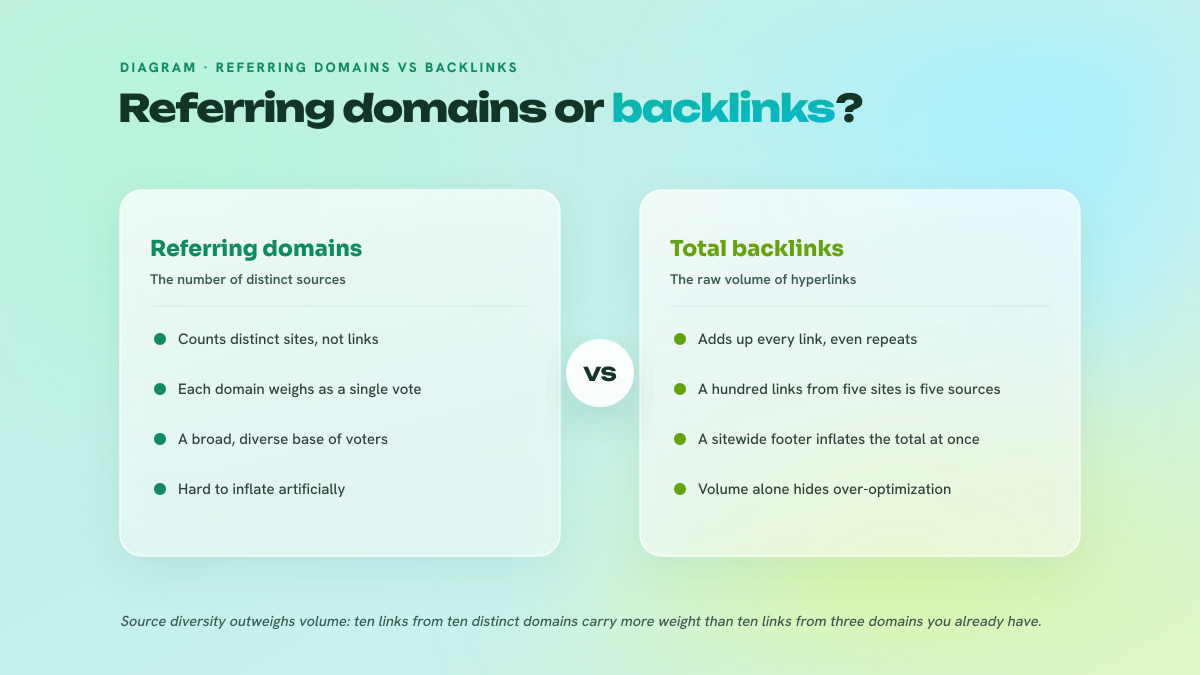
What a referring domain actually measures
A referring domain is a deduplicated count of the unique websites linking to you: four hundred sitewide footer links from one partner blog collapse into a single referring domain, exactly like one clean editorial link would. That deduplication is the entire point of the metric. The value curve of repeated links from the same domain flattens fast, and the first link from a fresh domain carries most of the signal the fortieth never will. Counting RD instead of backlinks strips out precisely the noise that inflates raw link totals, which is why it is the first column a serious auditor reads and the last one a link reseller wants you to look at.
The distinction between URLs, root domains, backlinks and referring domains still trips up experienced teams, and this short walkthrough settles it visually:
The reason working SEOs plan campaigns in RD rather than in links is empirical, not stylistic. Backlinko's 2025 re-analysis of 11.8 million Google results, widely summarized in 2026 industry roundups, found the number of referring domains pointing at a page correlated with rankings at r = 0.38, the strongest of all factors examined, ahead of Domain Rating at 0.31. The same dataset shows the average number one result attracting roughly 3.2 times more referring domains than positions two through ten. Correlation is not causation, and nobody serious claims otherwise, but when the same pattern holds across every large-scale study since 2024, you plan your budget around it.
One definitional trap: what counts as a domain. Most tools deduplicate at the registrable root, so blog.example.com and www.example.com merge into one RD, while platforms with user subdomains may be counted separately depending on the tool's public suffix handling. If your RD count jumps inexplicably, check whether a subdomain cluster just got reclassified before celebrating.
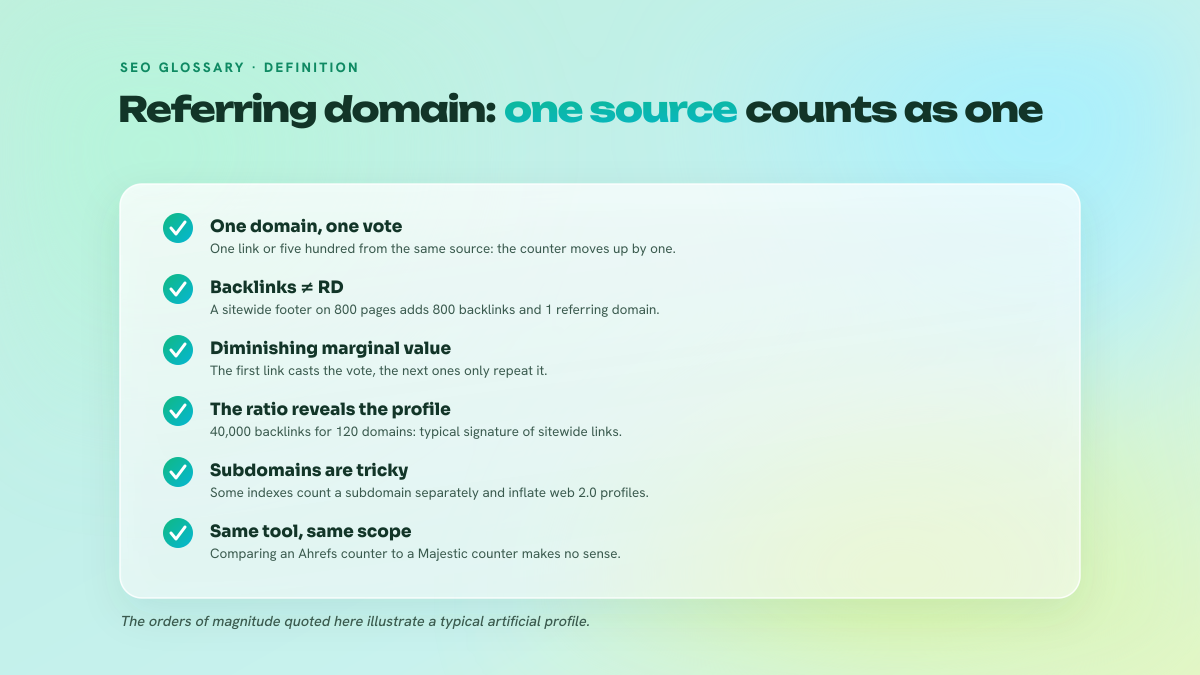
How tools count referring domains in 2026
There is no canonical RD number, only tool-specific estimates. Ahrefs, Majestic and Semrush each run their own crawler, their own index refresh cadence and their own deduplication rules, so the same site can show 420 referring domains in one tool and 260 in another without either being wrong. Majestic alone splits its data into a Fresh index and a Historic one, which can double or halve the figure depending on which you read. Comparing your Ahrefs RD count to a competitor's Majestic number is a category error we still see in audit documents from agencies that should know better.
Google Search Console is not the safe fallback it appears to be. Its Links report only samples what Google chooses to expose, and it spent the first half of 2026 broken: SEOs documented large drops in reported links and linking domains on January 5 and 6, 2026, and the report was only fixed on June 12, 2026, when counts returned to typical levels. Anyone who panicked over a collapsing RD graph in February was reacting to a reporting bug, not a link loss. Use GSC to spot-check that a specific referring domain is seen by Google, not to trend the profile.
The operational answer is boring and correct: pick one third-party tool, track the first derivative, and stop caring about the absolute number. What matters is whether your count of unique linking domains grows steadily, plateaus, or bleeds, and how that trend compares to the two or three competitors you benchmark in the same tool. Absolute RD counts are for sales decks; deltas are for decisions.
RD diversity in a netlinking operation
In campaign planning, the referring domain is the unit you should be pricing. Semrush's 2024 ranking factors study ranked referring domain diversity as the twelfth most influential factor it measured, and its follow-up analysis confirmed that earning links from unique domains matters at both page and domain level. Translated into procurement terms: a second or third link from a domain that already links to you buys reinforcement, while a link from a new relevant domain buys ground. Budget accordingly, in cost per new referring domain, not cost per link.
RD growth is also the main lever behind domain-level authority scores, as this walkthrough on raising site authority illustrates:
This is why third-party scores like Domain Rating move almost mechanically with RD acquisition: they are largely functions of the linking domain graph. Chasing the score directly is backwards; build the referring domain profile and the score follows. The gap analysis that actually informs a campaign is page level: pull the referring domains of the URLs ranking top five on your target query and count the unique, topically relevant ones. That number, not a domain-wide vanity total, is your bracket for the keyword.
This is also where sourcing discipline pays. When you buy placements, the RD math only works if each placement is a genuinely distinct, independently operated site rather than the same network under twelve wrappers. It is one reason we publish the full metrics of the owned media we operate at Nautilinks: a buyer should be able to check a site's referring domain profile before committing to a placement, not after the invoice.
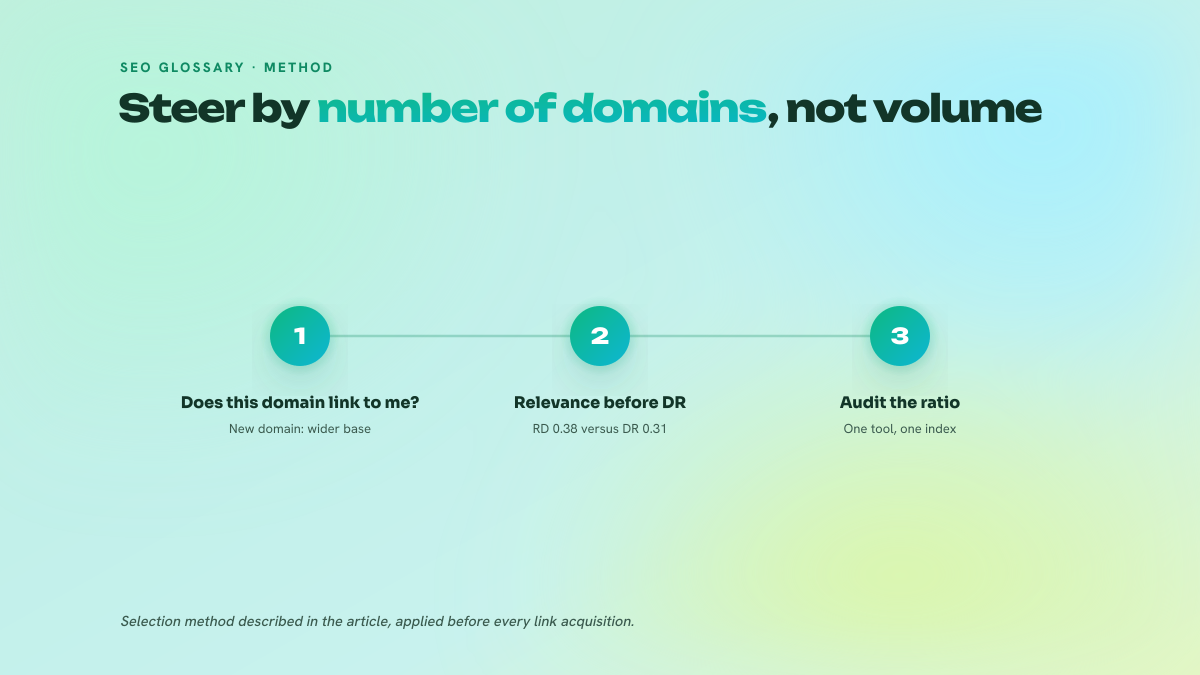
Auditing referring domain quality
Quality evaluation starts from a simple premise: a referring domain is worth what its own profile says it is. Three checks cover most of the decision. Topical adjacency first, because a link from a site in your semantic neighborhood transfers relevance a generic directory never will. Real organic traffic second, because a domain that ranks for nothing vouches for nothing. Outbound profile third: open the site's recent posts and count how many external commercial links it places per article; a domain linking out to casinos, CBD and plumbing services in the same week matches a pattern every spam classifier already models.
For the hands-on part, this tutorial walks through analyzing backlinks and referring domains in the standard tools:
The 2025 and 2026 update cycle turned RD patterns into an explicit risk surface. Sterling Sky's case study of the August 2025 spam update documents sites with rising referring domain counts and falling traffic: older manipulative guest post and PBN-style links lost value while the RD graph kept climbing. Search Engine Land's 2026 explainer on spam updates is blunt about the mechanism, describing thousands of backlinks gained from unrelated domains within a month as a strong manipulation pattern. Google's March 2026 spam update explicitly targets link manipulation and expired domain abuse, and the recovery guidance that circulated with it recommends auditing sudden referring domain spikes and disavowing at domain level where an entire referring domain is spam. A growing RD curve is no longer self-evidently good news; the composition of the growth decides.
In practice we run this audit quarterly on every site we operate, the same way a buyer should audit any inventory, whether it comes from outreach or from a catalogue where each media's traffic and link data are public. Third-party toxicity indicators such as spam scoring metrics are a starting filter, not a verdict: they flag candidates for the manual check above, and disavowing on the score alone destroys value about as often as it protects it.
Mistakes that burn RD budgets
The most expensive mistake is treating the RD count as the KPI rather than a proxy. A dashboard where the referring domains line goes up satisfies a client and moves nothing if the new domains are the same fifty platforms every competitor in the vertical already bought. Overlapping RD profiles are one of the quiet reasons two sites with similar counts rank very differently: the marginal referring domain your competitor does not have is worth several that you both share.
Second, ignoring attrition. Referring domains die constantly: sites shut down, articles get pruned, links get stripped in redesigns. Reclaiming a lost link from a domain that already chose to cite you is the cheapest referring domain you will ever acquire, and most teams never open the lost report. A monthly pass over lost referring domains, filtered to the ones with real traffic, routinely outperforms a month of cold outreach on cost per RD recovered.
Third, over-extrapolating RD into AI visibility. BuzzStream's June 30, 2026 aggregation of 2025 data found referring domains and backlinks only lightly correlated with appearing in Google's AI Overviews, while branded web mentions correlated more strongly. RD still gates the organic rankings that AI systems retrieve from, so it is not irrelevant, but if the goal is being cited by assistants, mention building and brand presence are the direct lever, not another hundred referring domains.
Finally, the procurement error: buying links without seeing the inventory. If a seller will not show you the site, its traffic and its existing link profile before you pay, the referring domain you are buying is probably one you do not want. The market is slowly correcting toward ordering editorial links with the metrics on the table rather than through blind intermediary catalogues, and RD-literate buyers are the reason.
Nautilinks operates an owned network of editorial media. In-house written articles, transparency disclosures respected, anchor mix calibrated.
Frequently asked questions
Is a second or third link from the same referring domain worthless?
Not worthless, just heavily discounted. Additional links from an existing referring domain can reinforce different target pages, diversify anchors and pass fresh contextual relevance, but they do not add to your RD count and carry a fraction of the first link's signal. In budget terms, treat repeat placements as reinforcement plays on strategic pages, and reserve the bulk of spend for domains that have never linked to you.
How many referring domains do I need to rank on a given keyword?
There is no universal benchmark, only a per-query bracket. Pull the page-level referring domains of the top five ranking URLs and take the median of the topically relevant ones: that is your target zone. Backlinko's 2025 data shows the number one result averaging roughly 3.2 times more referring domains than positions two through ten, so expect the top spot to demand a real gap, not a marginal one.
Why do Ahrefs, Majestic and Semrush show different RD counts for the same site?
Each tool runs its own crawler, index size, refresh cadence and deduplication rules, and they treat subdomains differently. Majestic additionally splits Fresh and Historic indexes, which alone changes the figure dramatically. None of them is ground truth; they are samples. Pick one tool, benchmark competitors inside that same tool, and track the trend rather than the absolute number.
Should I still disavow toxic referring domains in 2026?
For most profiles, no: Google devalues rather than penalizes ordinary junk. The exception is the pattern the March 2026 spam update targets, a sudden spike of referring domains from PBNs or unrelated foreign-language sites, especially if you or a past provider built them. In that case, audit the spike and disavow at domain level for domains that are entirely spam, per Google's own recovery guidance.
Do referring domains help me get cited in AI Overviews and assistants?
Only indirectly. BuzzStream's June 30, 2026 aggregation of 2025 data found referring domains and backlinks lightly correlated with AI Overviews presence, while branded web mentions correlated more strongly. RD still drives the organic rankings that AI systems retrieve and cite from, so it remains foundational, but for direct AI visibility the working lever is brand mentions and citations, not RD volume.
Can I rely on Search Console to monitor my referring domains?
Use it for verification, not trending. The Links report samples what Google exposes, and it was demonstrably unreliable in 2026: SEOs documented major drops in reported linking domains on January 5 and 6, 2026, and the report was only fixed on June 12, 2026. Cross-check GSC against one third-party index, and treat sudden GSC-only movements as probable reporting artifacts until confirmed elsewhere.
Test your knowledge
Quiz: Referring Domains
1/3In Backlinko's 2025 re-analysis of 11.8 million Google results, what correlation did page-level referring domains show with rankings?