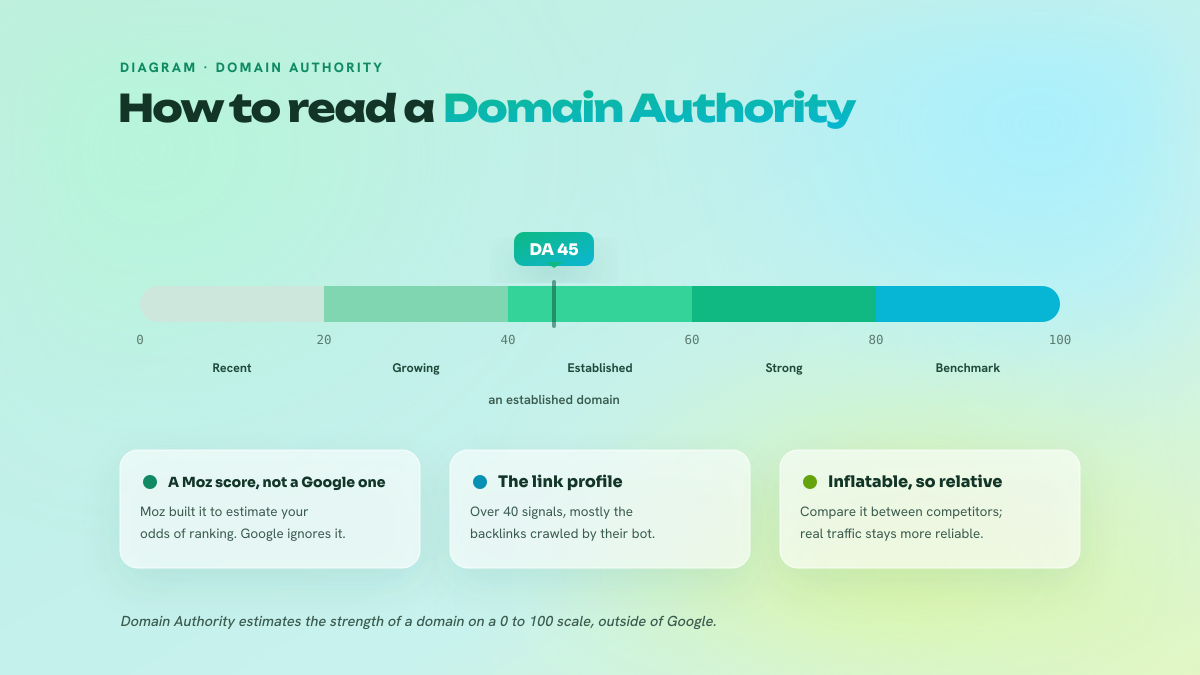
- →Domain Authority (DA) is a 0-100 score invented by Moz to estimate the likelihood that a site ranks in Google. It is not used by Google.
- →Moz computes it from more than 40 signals derived from the web crawled by their bot (Mozscape), mainly the inbound link profile.
- →It's a useful proxy for quickly comparing two sites but artificially inflatable. Real organic traffic remains a better indicator of SEO health.
- →Improving DA comes through acquiring quality backlinks from sites with high DA that are topically aligned with yours.
Definition of Domain Authority
Domain Authority, abbreviated DA, is a score developed by Moz and launched in 2012. It comes as a number from 0 to 100, where 100 represents the maximum likelihood of ranking in Google's results pages for a given site. The metric was designed to answer a recurring SEO request: a single indicator to compare the overall strength of two domains without having to dig through their link profiles in detail.
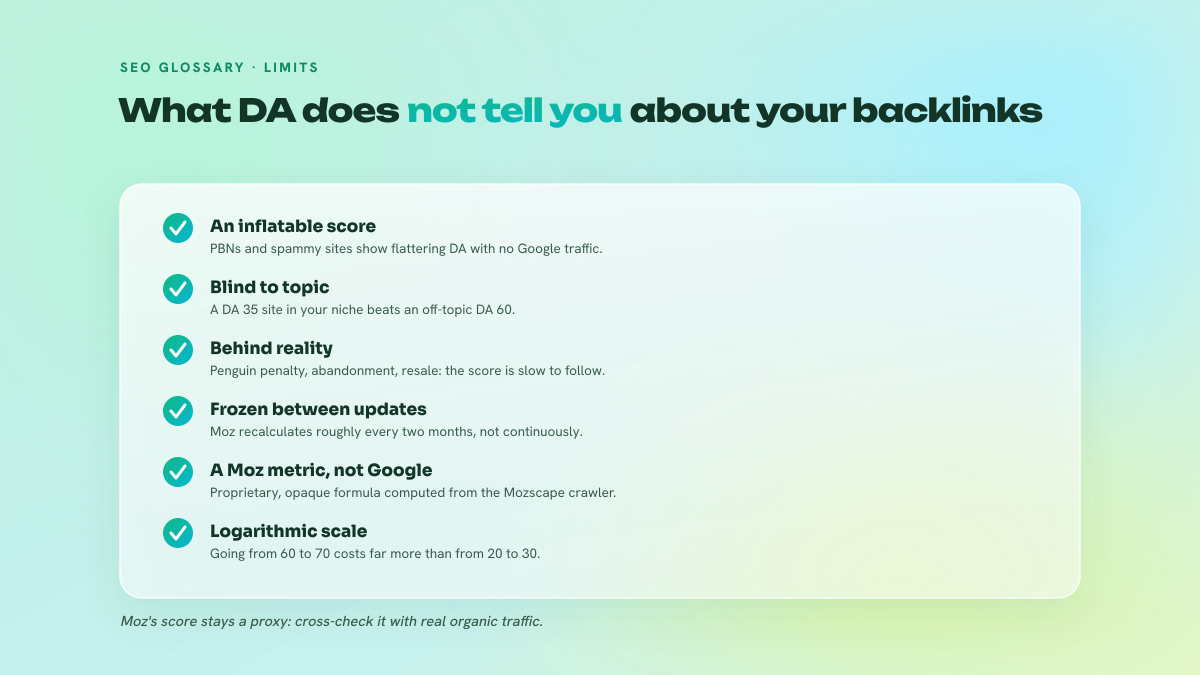
This score is computed from data gathered by Mozscape, Moz's crawler, which continuously walks the web to reconstruct the graph of links between domains. DA is therefore not a Google-provided metric. It is entirely proprietary and the exact formula remains opaque, as is the case for most scores of this kind.
How Moz calculates DA
Moz has published the broad outline of its calculation. The score relies on more than forty signals, the heaviest being the total number of distinct referring domains, the quality of those domains (themselves weighted by their own DA), the geographic and topical diversity of the profile, and the overall quality of the linked content. The formula uses a machine-learning model trained to correlate those signals with the actual positions observed in Google.
The result is a logarithmic scale: moving from DA 20 to DA 30 takes far less work than moving from DA 60 to DA 70. That property explains why young sites can climb quickly through the early tiers, then watch their progression slow as they approach established media.
Moz refreshes its scores at regular intervals, roughly every two months. Between updates, the score stays frozen even if your link profile evolves. It's a quirk to keep in mind when monitoring a netlinking strategy over time.
Real usefulness for netlinking
DA remains useful for two main use cases. First, the rapid filtering of a catalogue of sites for netlinking. With fifty potential placement candidates, comparing their DA at a glance helps eliminate the manifestly weak options before investing in deeper analysis. On marketplaces and netlinking platforms, DA is often shown next to each site for that reason, which is why we expose the metric on every entry of our editorial network catalogue so buyers can filter media by authority before booking.
Second, tracking your own evolution. Comparing your own DA every six months gives a rough indication of your link profile's trajectory. If DA stagnates despite sustained acquisition activity, that can signal that the obtained links are low quality, or too concentrated on a single source type.
The limits of the score
DA suffers from several weaknesses that limit its predictive value. First, it can be inflated artificially. Buying a large volume of links from sites that themselves have high DA mechanically lifts the score, even if those links are dubious in quality. Many PBNs and spammy site networks display flattering DAs without any real Google traffic.
Second, DA does not capture topical fit. Two sites with the same DA but in very different niches are not equally valuable as backlink sources for you. A DA-35 site in your exact niche transmits more signal than a DA-60 site off-topic.
Third, DA lags behind reality. Google algorithmic penalties, ownership changes, site abandonment all take time to show up in the Moz score. You can buy a link on a DA-50 site that just took a Penguin penalty and has no value left.
How to improve your DA
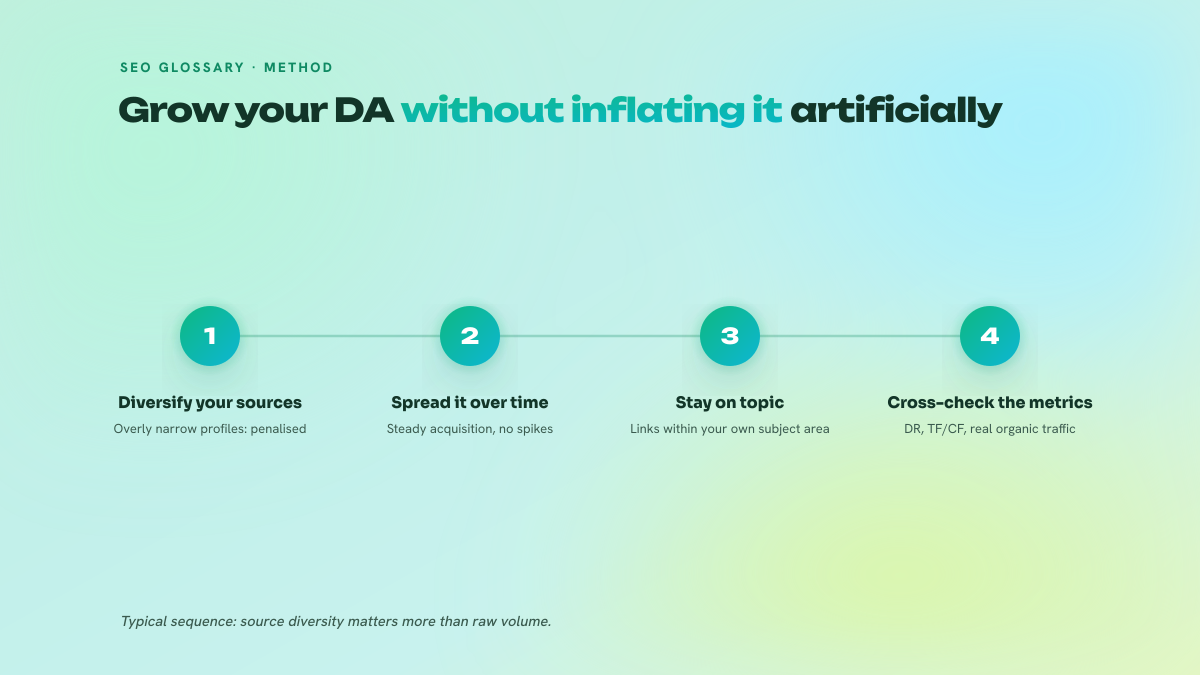
Improving Domain Authority follows the same principles as moving your site up in Google. You need to acquire inbound links from credible, diverse, topically aligned sources, spread out over time. Concrete levers include publishing guest articles on media in your niche, digital PR operations with a strong editorial angle, partnerships with other actors in the sector, or the option to buy a backlink on a hand-picked publisher when the editorial fit is strong and the audience is real.
Particular attention should go to source diversity. Receiving a hundred links from the same network operator, even at high DA, raises your score less than a mix of fifty links from varied sources. Moz penalises overly concentrated profiles.
Alternatives to Domain Authority
The market offers several equivalent metrics. Ahrefs' Domain Rating is probably the most-used competitor. It relies on its own crawler, generally more up-to-date than Moz's, and applies a similar calculation logic. Many SEOs prefer DR for that reason.
Majestic's Trust Flow and Citation Flow approach the question differently. Trust Flow measures link quality (from a core of trusted sites), while Citation Flow measures their quantity. The TF/CF ratio gives an indication of profile naturalness. Combined, those two scores often produce a finer signal than DA alone.
Free tools like Moz's Page Authority (page-level equivalent), Spam Score, or Search Console indicators on Google's side complete the toolkit. None of these scores is perfect. The right reflex is to cross-reference several and always check real organic traffic, which remains the least manipulable signal.
Nautilinks operates an owned network of editorial media. In-house written articles, transparency disclosures respected, anchor mix calibrated.
Frequently asked questions
Is Domain Authority a Google ranking factor?
No. DA is a Moz-proprietary score, computed from a crawl independent of the web. Google does not use it and communicates no official equivalent. The only Google score of that nature, the PageRank Toolbar, has not been publicly updated since 2016. DA remains an external proxy, useful for comparing two sites but with no direct influence on ranking.
How do I check the Domain Authority of a site?
The official tool is called Link Explorer (formerly Open Site Explorer) and belongs to Moz. Several free tools such as MozBar, Ahrefs or Semrush also expose the score. Cross-checking two sources is advised: DA varies from one crawler to another because each tool sees a different slice of the web.
What score is considered good?
It depends on your niche. A site in a tight niche with a DA of 25 can be sturdier than a generalist site with a DA of 50 but no qualified audience. As benchmarks, established sites in French netlinking-market niches typically sit between 20 and 50. Above 60, you're talking about audience-driven media.
Can DA go down?
Yes. If Moz detects a loss of links, a degradation of profile quality, or rolls out an algorithm update, the score can drop overnight without the site doing anything wrong. That's one of the reasons not to drive an SEO strategy on DA alone.
Is it better to look at DA or DR?
Ahrefs' Domain Rating and Moz's DA rest on similar philosophies but different indexes. Ahrefs is generally more up to date and captures recent link profiles better. For a serious analysis, use both. For a quick glance, DR is often more reliable in 2026.
Test your knowledge
Quiz: Domain Authority
1/3A prospect brags about a DA of 70 but their site shows almost no organic traffic in third-party tools. What's the most likely explanation?