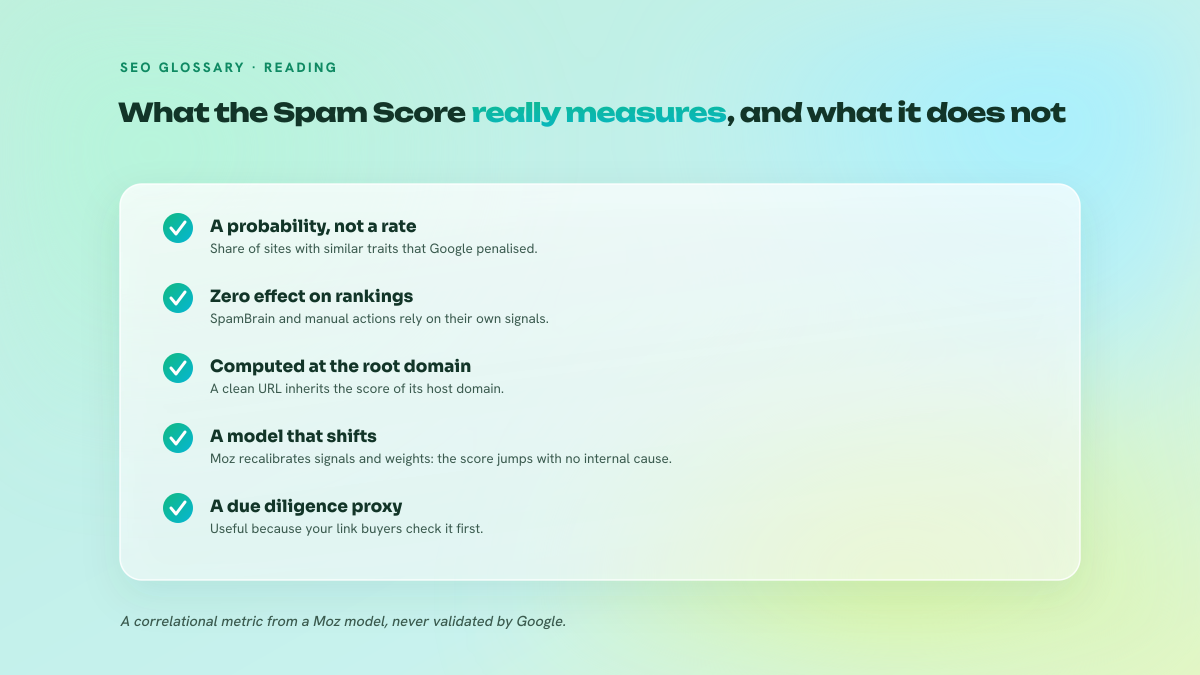
- →Spam Score is a resemblance model trained on penalized sites: 27 machine-learning signals producing a 0-100% probability-shaped number, with no causal link to Google's systems.
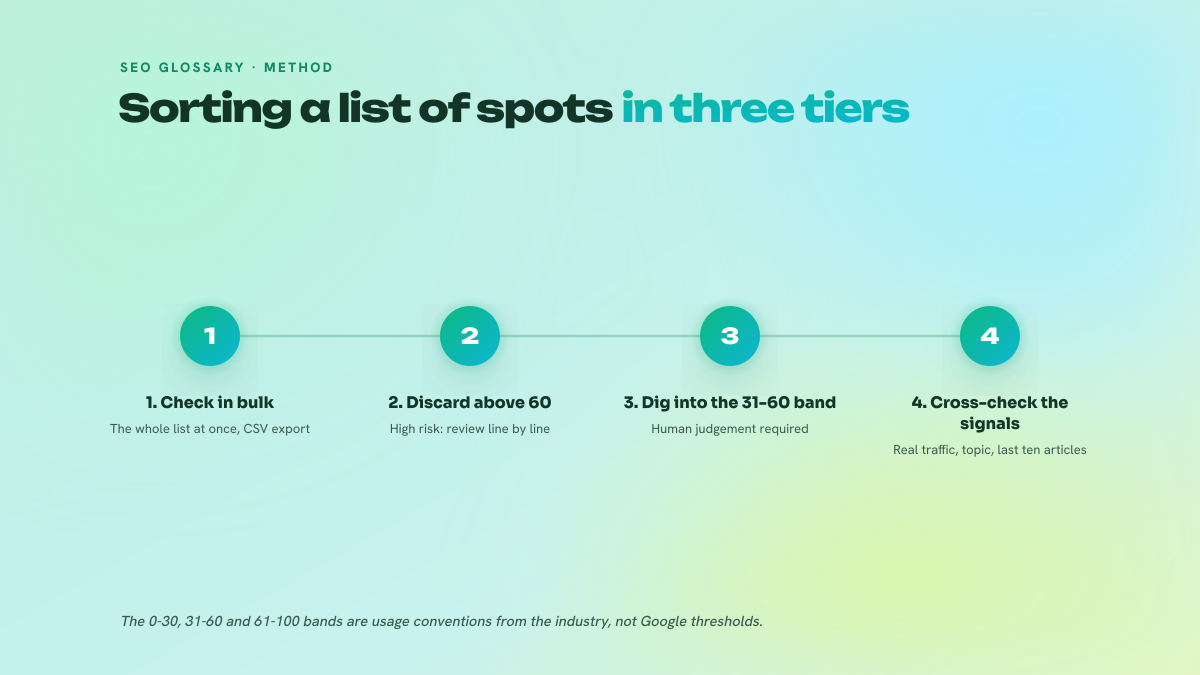
- →Treat the 0-30 / 31-60 / 61-100 tiers as sorting bins for prospect triage, never as accept or reject verdicts; the high tier goes to manual review, not to the trash.
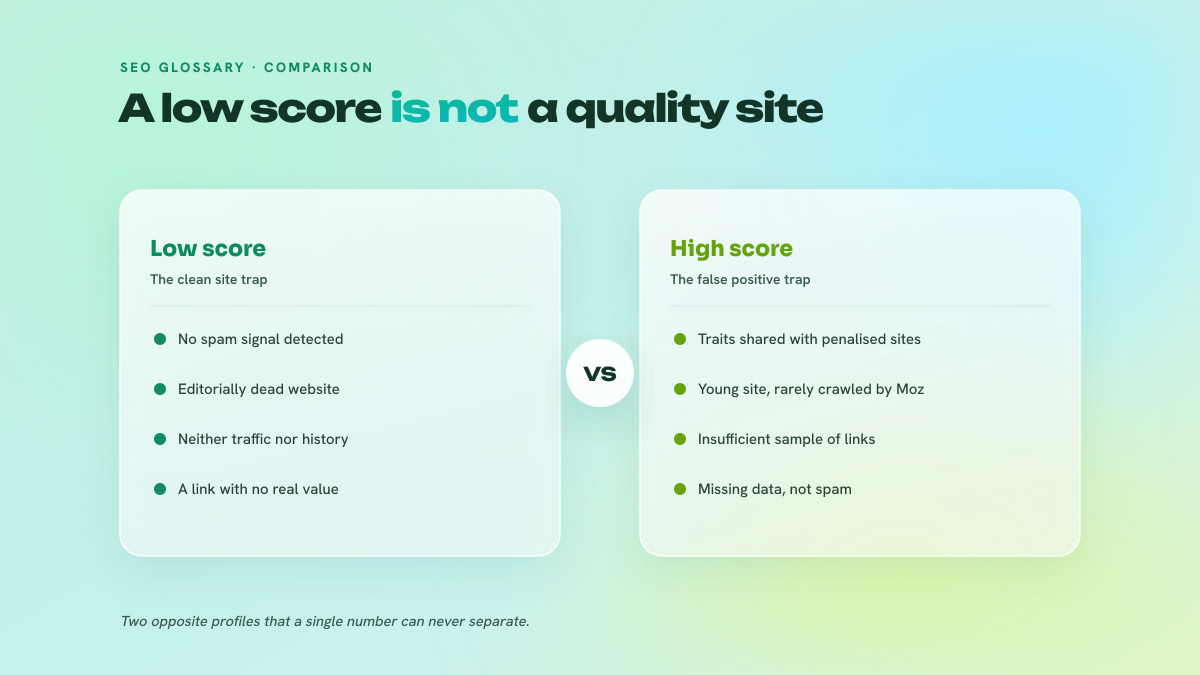
- →Moz's index, reported around 45.5 trillion links in 2026 tool comparisons, is smaller than Google's view; low-coverage niche domains regularly show inflated scores caused by thin data, not real spam.
- →Scores move when Moz retrains its model; a fleet-wide jump with zero profile changes is model drift, not a cleanup emergency, so log scores at audit time to tell the two apart.
- →Never disavow on score alone: the disavow tool exists for manual actions or a clear paid-link history, and SpamBrain demotions arrive silently either way.
A resemblance model, not a penalty meter
Strip away the dashboard framing and Moz Spam Score is a classifier. Moz trained a machine-learning model on what it describes as millions of penalized and banned websites, and the score expresses how closely a given domain resembles those casualties. The current model evaluates 27 signals, up from the 17 binary flags of the original 2015 launch. That lineage matters: the old version counted how many red flags a site tripped, while the current one outputs a probability-shaped number between 0 and 100%. It reads like a diagnosis, which is exactly why it gets misread.
What the score does not measure is anything Google has actually done. Google's enforcement runs on SpamBrain and manual actions, built on Google's own crawl and behavioral data, and Moz has no visibility into either. Technical guides published across 2025 and 2026 repeat the same caveat: Spam Score is strictly correlational to penalties, never a ranking input. A domain sitting at 45% has not been « half-penalized ». It looks, statistically, like sites that got burned. Sometimes that resemblance is meaningful. Sometimes it is an artifact of thin data, which we will get to.
For a working SEO the operational reframe is simple. Spam Score answers one question, « how much does this domain pattern-match known spam », and nothing else. That makes it a useful triage instrument, precisely because it is cheap to compute at scale, and a dangerous one the moment someone in the chain treats it as a verdict.
How the score is computed in 2026
The 27 signals cluster into recognizable families: linking signals such as link diversity, anchor-text patterns and the ratio of dofollow to nofollow links, plus low-trust indicators like certain TLD choices, per the signal breakdown published by Keywords Everywhere in 2026. Moz keeps the exact weights proprietary, and that opacity is a feature of the product, not an oversight: a fully documented spam model is a fully gameable one.
Two mechanical properties shape how you should read the number. First, Moz periodically retrains the weights and the signal set. Explainers published between March and June 2026 document domains whose score jumped or dropped without a single change on the site itself, purely because Moz's classification model moved underneath them. A Spam Score is a snapshot of the model as much as of the domain. Second, the granular view sits behind a paywall: guides from December 2025 note that detailed spam metrics require Moz Pro and Link Explorer, with a 7-day trial for new accounts.
Access widened noticeably in 2026, though. Keywords Everywhere launched a free Spam Score checker on 15 June 2026 that exposes the Moz metric in bulk, up to 10,000 domains per lookup with CSV export, classified into Good (0-30), Medium (31-60) and High (61-100) tiers. The interesting signal is less the tool than the consumption pattern it reveals: teams whose primary suite is Ahrefs or Semrush now pull Moz's score through third-party dashboards for triage, because no other major platform replicates Moz's exact methodology.
Thresholds, index bias, and cross-tool disagreement
The honest threshold reading: below 30 rarely deserves a second look, the 31-60 band means investigate, and above 60 means assume spam until the domain proves otherwise. But the tier labels hide a structural weakness, which is index coverage. Moz's link index is reported at roughly 45.5 trillion links in 2026 tool comparisons, large in absolute terms and still materially smaller than what Google crawls. On low-coverage domains the model works with too little data, and 2026 explainers document high Spam Scores caused by sparse Moz data rather than by actual spam patterns. Small legitimate niche sites, exactly the inventory a French netlinking operation screens every week, are over-represented among those false positives.
Cross-tool disagreement is the second reality to internalize. Semrush's Authority Score, as documented in January 2025 and reiterated in 2026 comparisons, explicitly blends spam factors into its calculation: imbalance between link volume and real traffic, an unusually high share of dofollow domains, referring domains clustered on the same IP. A domain can therefore carry a flattering DA and a mediocre Authority Score simultaneously, because the two models punish different things. Authority metrics such as Domain Rating answer « how strong is this profile » while Spam Score answers « how suspicious does it look », and neither substitutes for the other. In our audits we always read the score against the referring domains curve and organic visibility before concluding anything: a clean RD growth line paired with real keyword rankings outweighs a mid-tier Spam Score every single time.
Where it fits in a netlinking operation
In a link operation, Spam Score earns its keep at exactly one stage: prospect triage. When you screen a list of 500 candidate domains, bulk-checking the score sorts the pile in minutes and concentrates human attention where it pays. The discipline is to use the tiers as sorting bins, not verdicts. The high tier goes to manual review, meaning SERP presence, traffic estimation and link-profile forensics; it does not go to the trash. Auto-rejecting on score alone throws away legitimate niche media penalized by index coverage, and in a market where solid French placements are scarce, that is budget left on the table.
The deeper point is that third-party risk scores exist because most of the link market is opaque. When you buy through brokers and resellers you often cannot see who operates the site, how it is maintained, or what else it links out to, so you outsource your suspicion to a classifier. That is the specific problem an owned network removes: on the French media we operate in-house, the editorial history, the maintenance and the outbound linking policy are controlled rather than guessed at. The same logic drives how we expose data. Instead of asking buyers to trust yet another proprietary risk model, the catalogue makes every media's metrics public, so you apply your own thresholds. And if your workflow screens candidates metric by metric before committing spend, you can vet each media on its real numbers before ordering a placement instead of reverse-engineering risk from a third-party score.
The mistakes we keep seeing
The most expensive mistake is reading Spam Score as a penalty detector. Google runs its own enforcement on its own calendar, and that calendar is public: the August 2025 spam update ran 27 days, from August 26 to September 22, one of the longest on record; March 2026 brought the fastest spam update ever logged, completed in under 24 hours; and on 24 June 2026 Google announced a further SpamBrain upgrade targeting scaled content abuse and link spam. None of those events registers in Moz's number, and SpamBrain demotions arrive silently, with no Search Console notification. If you want to know whether a domain was hit, look at its visibility curve around those dates, not at a third-party score.
Second mistake: disavowing on the score alone. The disavow tool exists for sites under a manual action or carrying a clear history of paid links that cannot be removed. Feeding every domain above 60 into a disavow file, a pattern we still see in inherited audits, adds risk and delivers no upside, especially when a chunk of those domains scored high because Moz simply lacks data on them.
Third: buying « Spam Score reduction » as a deliverable. The score follows the profile, not the other way around. You fix the underlying links and content, and the number catches up at whatever cadence Moz retrains. Which leads directly to the fourth mistake, panicking on re-baselines: when Moz updates its model and a whole portfolio jumps 15 points overnight with no profile change, the correct move is to re-check a sample against independent data, not to launch a cleanup sprint on the strength of a third-party model refresh.
Tactical takeaways
Run Spam Score as a bulk pre-filter on prospect lists and cap the time you spend on it there. Confirm anything the high tier flags with independent evidence: rankings, traffic, the referring domains trend, outbound-link hygiene. Never veto a placement or disavow a link on the score alone, and never promise a client a score reduction as an outcome. Log scores at audit time so that when Moz re-baselines, you can distinguish model drift from profile drift. And when the same domain shows green in one tool and red in another, trust neither: pull the link profile and look for yourself.
Nautilinks operates an owned network of editorial media. In-house written articles, transparency disclosures respected, anchor mix calibrated.
Frequently asked questions
What counts as a good Spam Score when vetting link prospects?
The 2026 tier convention, formalized by the Keywords Everywhere checker launched in June 2026, reads 0-30 as low risk, 31-60 as worth investigating, and 61-100 as high risk. Treat those bands as triage bins, not pass or fail grades. A 40 on a well-covered domain means something; a 40 on a small niche site with thin Moz index coverage often means nothing at all. Always confirm mid and high tiers against rankings, traffic and the referring domains trend.
Does a high Spam Score mean Google has penalized the domain?
No. The model is trained on sites Moz observed being penalized or banned, so it measures resemblance to that population, nothing more. Google's enforcement runs independently through SpamBrain and manual actions, and SpamBrain demotions are silent, with no Search Console message. The reliable way to detect a hit is the domain's visibility curve around known spam update windows, such as the 27-day update of August-September 2025 or the June 2026 SpamBrain upgrade.
Why did a domain's Spam Score change when nothing changed on the site?
Because Moz periodically retrains the model, updating both signal weights and the signal set itself. Explainers published between March and June 2026 document exactly this: scores jumping from low to high, or the reverse, with zero on-site changes, purely from re-baselining. A Spam Score is a snapshot of Moz's classifier as much as of the domain. If a whole portfolio moves at once, suspect model drift first and verify a sample against independent data.
Should I disavow links from every high Spam Score domain?
No, and this is the costliest reflex we correct in inherited audits. The disavow tool exists for sites under a manual action or with a clear paid-link history that cannot be cleaned up. Bulk-disavowing everything above 60 removes links Google may be counting in your favor, and a share of those domains score high only because Moz's index holds too little data on them, not because they are actually spam.
How do I check Spam Score at scale without a Moz Pro subscription?
Until mid-2026 the detailed metric sat behind Moz Pro and Link Explorer, with only a 7-day trial as a workaround. Since 15 June 2026, the Keywords Everywhere Spam Score Checker exposes the Moz metric for free, accepts bulk lookups up to 10,000 domains, and exports to CSV or Excel with the 0-30, 31-60 and 61-100 risk tiers attached. For prospect-list triage, that bulk path is now the standard workflow even in teams running Ahrefs or Semrush as their primary suite.
How does Moz Spam Score relate to Semrush's spam handling?
They are different models measuring different things, and disagreement between them is normal. Semrush folds spam factors directly into Authority Score, as documented in January 2025 and reiterated in 2026 comparisons: link-to-traffic imbalance, an abnormal dofollow share, referring domains packed on the same IP. Moz keeps spam as a separate 27-signal metric alongside DA. A spammy high-volume profile can show an inflated DA yet a weak Authority Score. Cross-check both, then decide on the raw link profile.
Test your knowledge
Quiz: Moz Spam Score
1/3How many signals feed the current Moz Spam Score model?