- →Majestic is an instrument, not a suite: buy it for expired domain due diligence, penalty forensics and link qualification, never as your only tool.
- →Trust Flow alone is a weak buying signal because it is cheap to pump; the TF/CF ratio plus the Topical Trust Flow sub-category is where the actual information sits.
- →The Historic Index is Pro-only ($99.99/month on majestic.com's plans page), so the $49.99 Lite tier is useless for the forensic work most people buy Majestic for.
- →Cross-vendor index size comparisons are mostly noise: vendors count links, unique URLs and referring domains differently, so a bigger number does not mean better coverage on your niche.
- →A link absent from Majestic is not proof the link does not exist; French mid-tail and crawl-restricted sites are systematically under-covered, and Majestic's own 2025-2026 crawler roadmap acknowledges the problem.
- →Topical Trust Flow's taxonomy is coarse and English-centric: read it as a directional signal on French properties, not as a relevance verdict.
What Majestic actually is in a 2026 stack
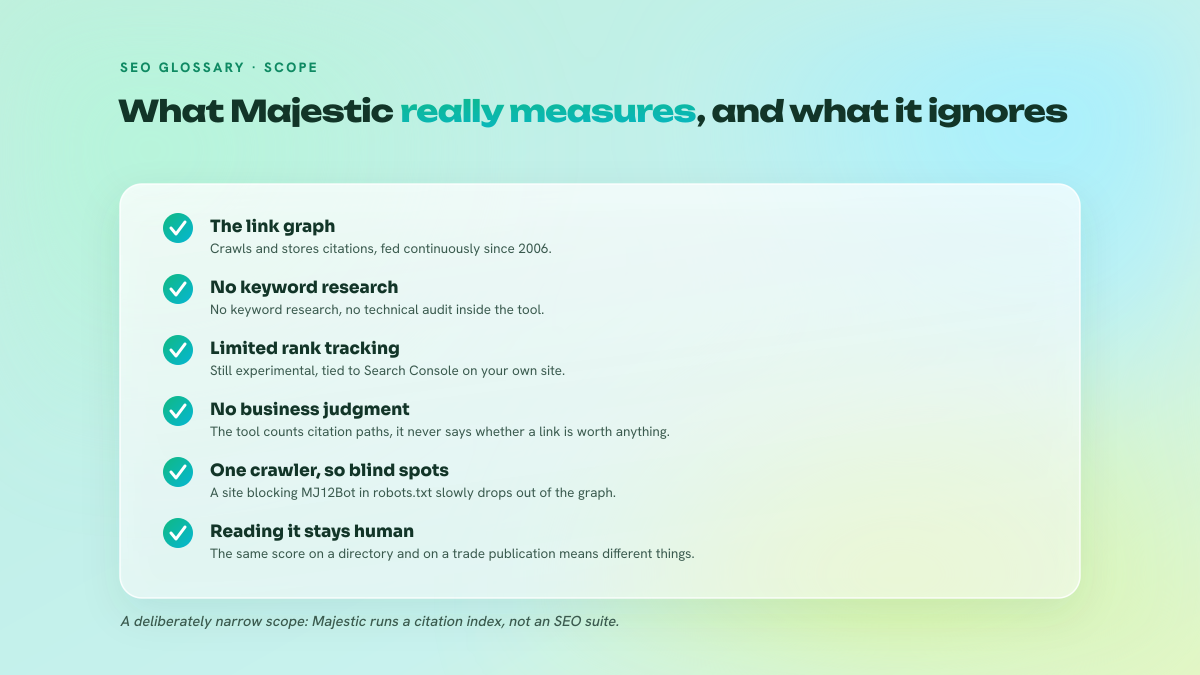
Majestic is a link index with metrics bolted on top, and that is the entire product. It runs its own crawler rather than licensing someone else's data, stores what it finds in two separate indexes, and exposes three proprietary scores: Citation Flow, Trust Flow and Topical Trust Flow. There is no keyword research worth the name, no technical site audit, and the rank tracker is still labelled experimental and depends on connecting your Search Console property. Tool reviews published through 2026 converge on the same verdict, and it is not a criticism so much as a description: narrow scope, dated interface, unmatched depth on the one job it does.
That narrowness used to be the industry default. For a long stretch there was Majestic and there was little else. In 2026 the picture has flipped: Ahrefs and Semrush have grown their link data far enough that a generalist team gets most of what it needs without a second subscription. A Capterra profile from 2026 reports that 74 % of reviewers use Majestic primarily for SEO work, which reads less like praise than like a boundary marker. Nobody opens Majestic to do anything except look at links.
Our position is blunt. If your work is content, technical SEO and reporting, you do not need Majestic in 2026 and paying for it is nostalgia. If part of your work is buying links, valuing expired domains, unwinding a manual action or auditing someone else's acquisition, operating without a deep historic link archive means working from a partial file. Those are two different jobs and the tool only serves one of them.
One practical note that saves time before you go further: the bare query for the word majestic is not a tool query for Google. It surfaces a UK wine retailer, a garage and house producer, and the adjective itself. The SEO product ranks on qualified variants like majestic seo, majestic backlinks or trust flow. If you are tracking brand visibility for the tool, or writing about it, the head term is contested by unrelated entities and chasing it is wasted budget.
Trust Flow, Citation Flow and the only score that still matters
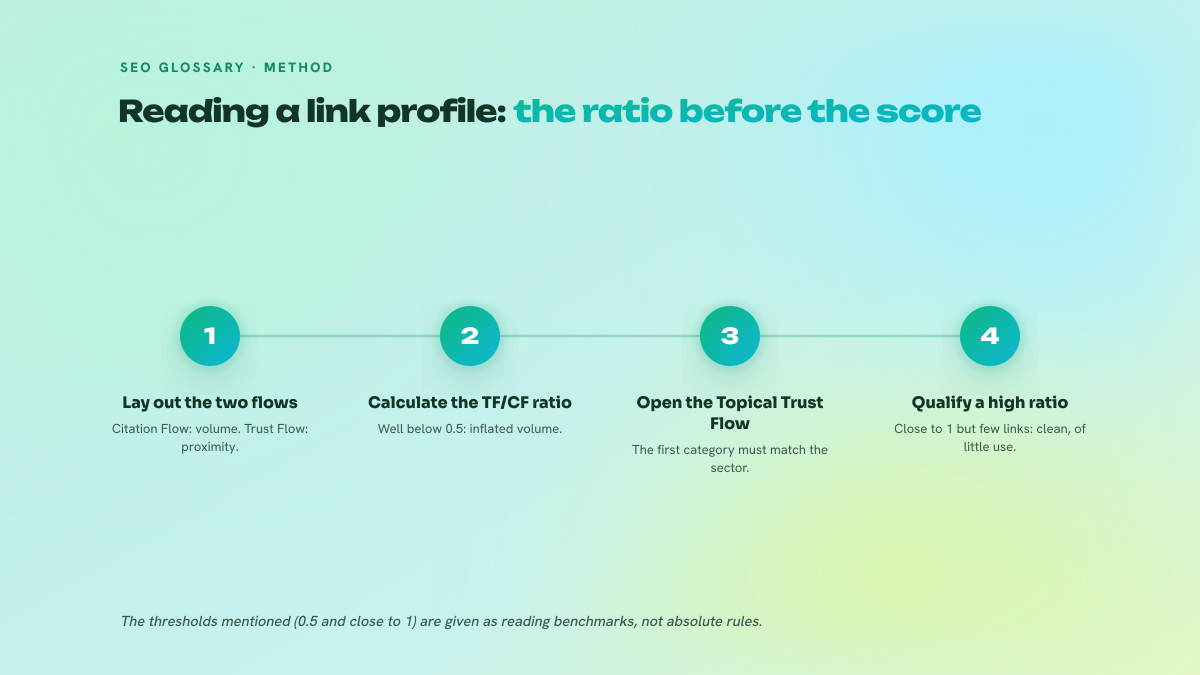
Citation Flow measures link volume weighted by propagation. Trust Flow measures proximity to a hand-picked seed set of trusted sites. Both are logarithmic scores out of 100, and taken alone both are close to useless as a buying criterion. The information lives in the relationship between them.
The operational reading we use in audits: a domain showing high Citation Flow against low Trust Flow is carrying volume it did not earn. A Citation Flow in the thirties with a Trust Flow under ten is the standard signature of a site that has been fed by a link farm, a scraped footprint or a redirect chain. The reverse case, Trust Flow close to Citation Flow, usually means a small, coherent profile. Neither reading is a rule you can automate, because both scores respond to manipulation. Pointing a batch of expired domains at a target lifts Trust Flow within a couple of index refreshes, and that trick has been in circulation long enough that treating a raw TF number as a quality gate is naive.
Topical Trust Flow is the score with real value, and it is the one people skip. Instead of asking how trusted the referring profile is, it asks which topical seeds that trust flows from. A domain with Trust Flow 25 concentrated in a single relevant sub-category is worth more than a Trust Flow 40 spread across generic news and directory seeds. The caveat matters on French properties: the taxonomy is coarse, English-centric, and buckets a surprising number of French editorial sites into categories that have nothing to do with what they publish. Read the sub-category, never the level-zero label, and treat the result as directional rather than as a verdict.
Link Context, which 2026 reviews single out as the feature that genuinely separates Majestic from the rest, is the antidote to score-only thinking. It shows the surrounding text and the placement for each backlink, so you can see whether a link sits in an editorial paragraph or in a footer block, without opening thirty tabs. That is the check that actually predicts value, and it is why we tell clients to open the media catalogue and read the sites themselves before filtering anything on a metric.
Fresh Index vs Historic Index: two products in one login
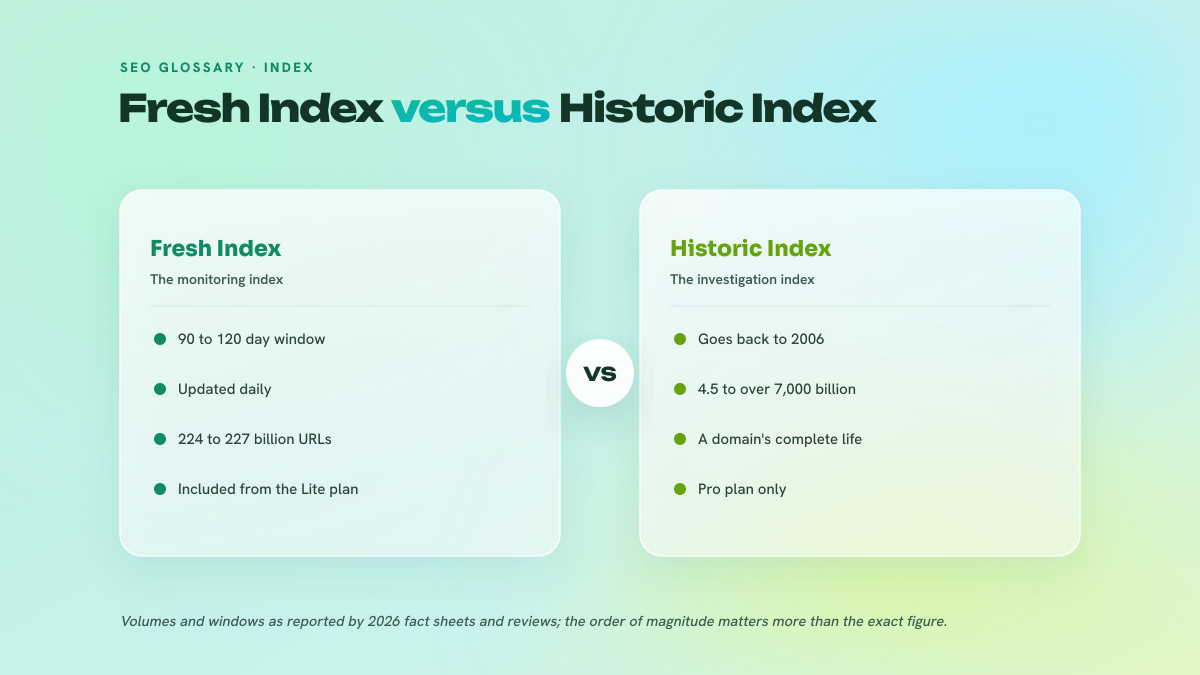
Majestic maintains two indexes and confusing them is the most common source of wrong conclusions. The Fresh Index covers a rolling window of roughly the last 90 to 120 days, refreshes at least daily, and 2026 figures put it in the range of 224 to 227 billion unique URLs. The Historic Index reaches back to 2006 and is described across 2025-2026 sources at anywhere between 4.5 and 7 trillion URLs depending on the source and the date.
They answer different questions. The Fresh Index is where you monitor an ongoing campaign: acquisition rhythm, whether a placement got crawled, whether a partner actually published. The Historic Index is where you do archaeology: what a domain linked to in 2014, which network it belonged to before it dropped, what disappeared right before traffic collapsed. Expired domain valuation without the Historic Index is guesswork, and that is the single strongest argument for the subscription.
Do not spend energy on index size comparisons. An agency study covering 47 client domains between September 2025 and February 2026 (LinkGathering) reported Ahrefs at 35.8 trillion known links against Majestic at 25.9 trillion at agency tiers, while noting that Majestic remained the preferred tool for deep audits on hard cases. Those figures count links; the 4.5 to 7 trillion figure counts URLs. They are not the same unit, vendors define referring domains differently, and none of it tells you whether a given tool has crawled the twenty French sites you are actually evaluating. Run the same target through Majestic and through the index you already pay for and compare the overlap on your own niche. That answer is worth more than any published total.
We apply the same test internally. Before an expired domain joins the French editorial media we operate in-house, its Historic Index profile gets read line by line, because a domain that spent three years inside a PBN carries that history whether or not the current index shows it.
Where Majestic earns its seat in a netlinking operation
Four workflows justify the cost, and they are all specialist.
Expired domain due diligence comes first. You are buying a link graph, not a domain name, and the Historic Index is the only affordable way to see that graph across its whole life. Second, penalty and toxicity forensics: reconstructing what was pointing at a site before the drop, including links that no longer resolve. Third, competitor overlap, where Clique Hunter surfaces the domains linking to several competitors at once, which is the fastest legitimate prospecting list you will build. Fourth, bulk pre-qualification: the Bulk Backlink Checker covers the top 10 billion most-linked-to URLs in the database, which is enough to triage an outreach list of a few thousand domains in one pass instead of one by one.
On features, two 2026 updates are worth knowing. Advanced Filters rolled out across Site Explorer toward the end of 2025 and were promoted as new for 2026 on Majestic's own blog: they bring API-level filtering into the interface, so you can cut a backlinks report by Trust Flow, topical category or link attribute without exporting to a spreadsheet. Author Explorer, which ties backlinks to named authors and social handles, launched in April 2024 and was still in beta as of mid-2026. Two years in beta is a signal. It is interesting, and you should not build a repeatable process on it.
Pricing, from majestic.com's plans page in 2026: Lite at $49.99 per month, Pro at $99.99, API at $399.99. The distinction that matters is that the Historic Index sits behind Pro, along with Clique Hunter, Backlink History, Flow Metric History and raw exports. Lite gives you the Fresh Index only, which means the $49.99 tier does not do the job most people buy Majestic for. Note also that the official page lists 1 million analysis units per month on Lite while some 2026 reviews quote 5 million, so check the quota on the plans page before you commit. The same arithmetic is worth running one level up: a $99.99 monthly subscription is a rounding error next to a link budget, which is why we keep what a placement actually costs on our side public rather than quoted case by case.
What we see go wrong
Buying on Trust Flow alone is the expensive mistake. A TF 30 homepage with a profile built on generic news seeds and no topical coherence is worth less than a TF 12 site that publishes weekly in your field, and the buyer who filters a catalogue at TF greater than 20 will systematically pay more for less. If a vendor's only argument is a Flow metric, the placement is being sold on a number, not on an audience.
Second, reading a Fresh Index absence as a removal. A link placed four months ago that no longer appears in the Fresh Index has simply aged out of the rolling window. Check the Historic Index before you email a publisher accusing them of pulling your link.
Third, treating index absence as non-existence. Majestic's crawl coverage on French mid-tail publishers is thinner than its headline totals suggest, and its own 2025-2026 crawler roadmap, published in August 2025, explicitly frames crawler evolution and crawl-sensitive sites as open work. A link you can see in the browser and in your server logs exists whether or not it shows up in the tool.
Fourth, buying Majestic as a suite. It will not do your keyword research, it will not audit your templates, and its rank tracking is experimental. Teams that try to consolidate onto it end up with a second subscription within a quarter.
Last, a note on market signals. A March 2026 alternatives piece estimated Majestic's site at roughly 530,000 monthly visits against more than 19 million for Ahrefs and more than 17 million for Semrush, and read that as a decline. It is a decline in reach, not in data quality. A smaller audience for a specialist instrument is what you would expect once the generalist need is served elsewhere. Judge the tool on whether it answers the four questions above better than what you already own, and ignore the traffic charts.
Nautilinks operates an owned network of editorial media. In-house written articles, transparency disclosures respected, anchor mix calibrated.
Frequently asked questions
Is Trust Flow still a useful signal in 2026 now that Ahrefs and Semrush have comparable link data?
As a standalone buying filter, no. Trust Flow responds to manipulation within a couple of index refreshes, so a high score tells you someone invested in links, not that the site deserves your budget. What still holds value is the pairing: Citation Flow well above Trust Flow flags an inflated profile, and the Topical Trust Flow sub-category tells you which seeds that trust comes from. Read those two together and ignore the headline number.
Which Majestic plan do you actually need for link forensics?
Pro, at $99.99 per month on majestic.com's 2026 plans page. The Historic Index, Clique Hunter, Backlink History, Flow Metric History and raw data exports all sit behind that tier. Lite at $49.99 gives you the Fresh Index only, a rolling window of roughly 90 to 120 days, which cannot answer any question about a domain's past. The $399.99 API tier is only worth it if you are wiring Majestic into your own pipeline.
Why do Majestic and Ahrefs report completely different link counts for the same domain?
Because they crawl different subsets of the web and count different objects. Published totals mix links, unique URLs and referring domains, so a headline like 35.8 trillion versus 25.9 trillion is not a like-for-like comparison. Crawl priorities also differ by language and by site type, and French mid-tail publishers are covered unevenly. The only comparison worth running is your own: same target, both tools, measure the overlap on the niche you work in.
When someone searches for Majestic, do they mean the SEO tool?
Usually not. The bare term is dominated by a UK wine retailer and by a garage and house producer, plus the ordinary adjective. The SEO product owns the qualified variants: majestic seo, majestic backlinks, trust flow. This matters operationally if you write about the tool or track brand visibility around it, because ranking for the head term means competing against unrelated entities for traffic that will never convert.
Can Topical Trust Flow be trusted for evaluating French-language sites?
Directionally, with care. The taxonomy is coarse and built around English-language seeds, and French editorial sites are regularly filed under categories that do not match what they publish. Use the sub-category rather than the top-level label, and always cross-check against the site itself and against Link Context, which shows the surrounding text for each backlink. Treat a mismatch as a prompt to read the site, not as a disqualification.
Is Author Explorer worth building a process around?
Not yet. It launched in April 2024, ties backlinks to named authors and social handles, and was still in beta as of mid-2026. Two years without a general release is a signal about how much investment it is getting. It is genuinely useful for exploratory work on digital PR targets and for spotting an author who places links across several properties, but do not make it a dependency in a workflow you run every week.
Test your knowledge
Quiz: Majestic
1/3What time window does Majestic's Fresh Index cover?