- →DA is a prediction calibrated against live SERPs, not a Google signal: a DA drop after a recalibration says nothing about your link profile, and a DA gain says nothing about traffic.
- →The scale is logarithmic, so a rule like « we only buy DA 40+ » applies an arbitrary cut to a curve whose steps are not equal. Use DA to order a prospect list, never to price a placement.
- →Index-size claims are unusable as published: 44 trillion links (ManyTools, July 2026), 45.5 trillion (TheMarketingAgency, February 2026), 4.7 trillion URLs against Ahrefs at about 3 trillion (agency write-up, March 2026). Different units, no comparison.
- →MozCast plus the Google Algorithm Change History is the part of Moz we still open weekly: the 2025 core updates ran 13, just under 17, and about 18 days, which is exactly why day-four panic readings are worthless.
- →In 2026 Moz Pro is mostly bought because a contract demands DA in the report or because Moz Local matters (ClaroRank, June 2026). Buy it for that reason, not as a research suite: Starter caps at 50 keyword queries a month and 20 tracked keywords.
- →The $5 per month API is the cheapest honest line in the catalogue: pull DA and PA into your own qualification sheet and skip the seat licence entirely.
What Moz actually is in a 2026 stack
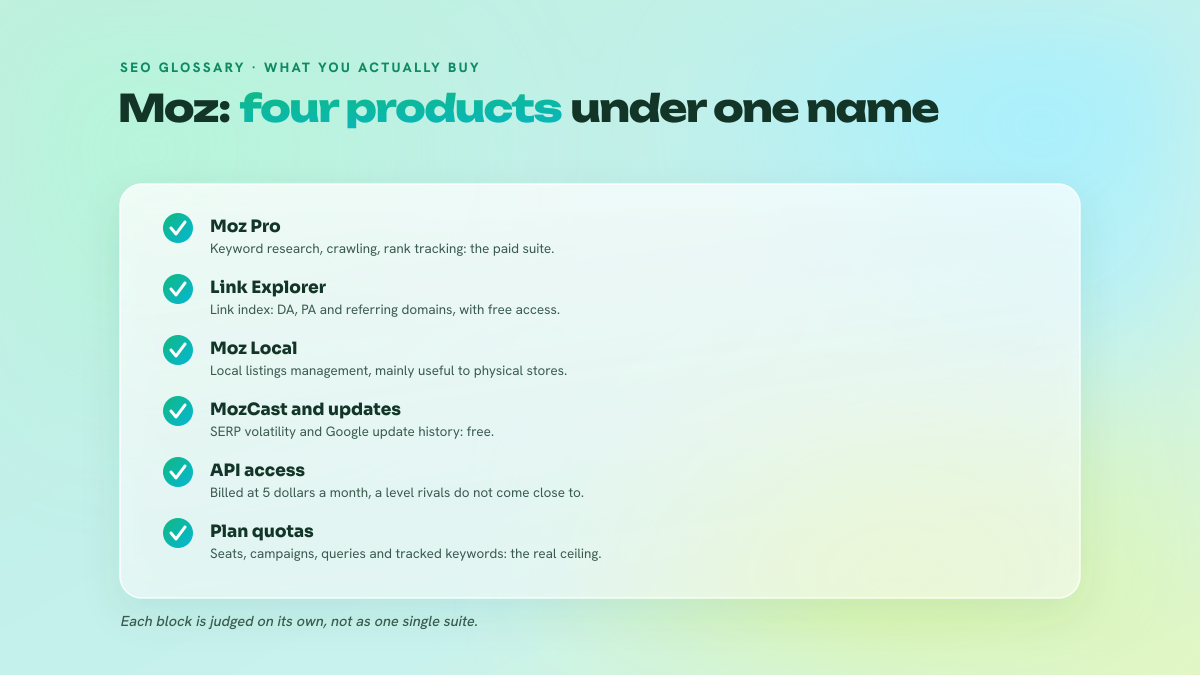
Moz is three products behind one login, and confusing them is how teams end up paying monthly for something nobody opens. Moz Pro bundles Keyword Explorer, Link Explorer, Site Crawl and rank tracking. Moz Local distributes business listings to directories. STAT remains the enterprise rank tracker, sold apart. Moz's own products page, updated 6 May 2026, still presents those three as the pillars of the line, which tells you the company never merged them into a single workflow.
Pricing is stable enough to plan around. Reviews across 2025 and 2026, from ViPearner's 2025 teardown to TheMarketingAgency's February 2026 review, converge on a $49 to $299 per month band for Moz Pro with roughly 20 % off annual billing. The entry tier is thin: a Toolsurf buyer's guide from 18 May 2026 lists Moz Pro Starter at one seat, one campaign, 50 keyword queries per month, 20 tracked keywords per campaign and 5 000 pages crawled. A Morningscore comparison of 31 March 2026 notes the Standard plan tracks 300 keywords a month, short for any team publishing weekly across several sites. The one genuinely cheap line in the catalogue is API access at $5 a month, which TheMarketingAgency flagged in February 2026 as far below competitor pricing.
The stance worth holding: almost nobody picks Moz in 2026 for keyword research or crawling. A ClaroRank head-to-head from 5 June 2026 says it directly, Moz Pro still wins the seat when a client requires Domain Authority in reporting, or when tight Moz Local integration matters for local SEO. That is a distribution position inherited from years of DA being the default number in agency decks, not a product edge. Buy accordingly, and if all you need is the number, the API costs less than a coffee.
Domain Authority: a model, not a measurement
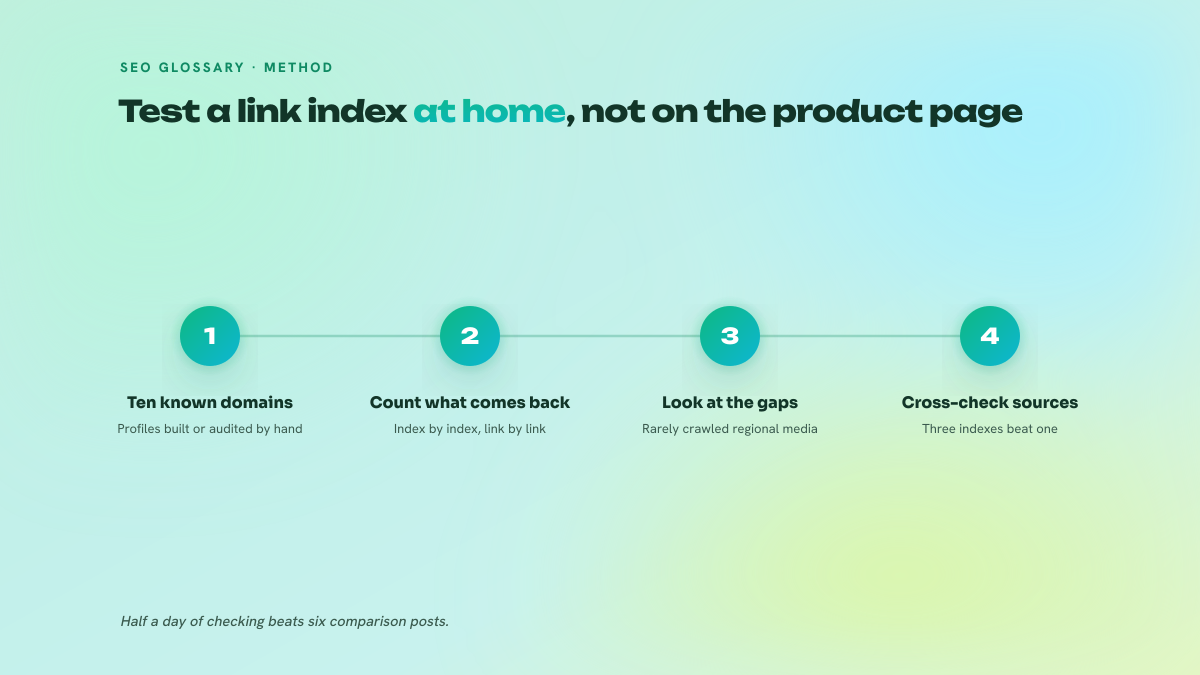
DA is a machine-learned prediction of how likely a domain is to rank, expressed on a logarithmic 0 to 100 scale and calibrated against live search results. Three consequences follow, and nearly every misuse in the wild comes from ignoring at least one of them.
It is relative before it is absolute. When Moz recalibrates the model against a changed index, scores move across the whole population, so a site can shed points while its link profile improved. Every recalibration produces a wave of clients convinced they were penalised. They were not, and treating a DA drop as a penalty signal is the fastest way to waste a quarter chasing a ghost.
It is logarithmic. Climbing from 20 to 30 is not the same work as climbing from 60 to 70, which makes a purchasing rule like a flat DA 40 floor an arbitrary cut through an uneven curve. It filters out perfectly good small French media while waving through inflated shells.
It is a third-party model with no privileged access to Google. Nothing in Search Central documentation references a vendor score, and DA has never been an input to ranking. It predicts an outcome, it does not explain one. That distinction matters the day a page ranks against a lower-DA competitor and someone asks why.
What DA is genuinely good for is ordering a prospect list fast and for free. Link Explorer's free tier exposes DA, PA and linking domains without a subscription, per Moz's own Link Explorer page updated 5 August 2025, so a few hundred candidates can be sorted before a euro is spent. What it is bad for is being a KPI, a price anchor, or a proxy for traffic. Inflating DA is trivial and industrialised: the model sees links, so point enough farm domains at a shell and the number moves. The cheapest tell in an audit is a domain with a respectable score, no branded search volume, no visible publishing rhythm and an outbound profile shaped like a directory. That is why we prefer to read a media's metrics next to its actual publishing history rather than sort a catalogue by a single column.
Link Explorer and the trillion-link claims
Link Explorer replaced Open Site Explorer in 2018 with a fully rebuilt index, and that rebuild is still the reference point Moz uses when describing its link data. The tool outputs total backlinks, linking root domains and the follow versus nofollow split, which is the working minimum for prospect qualification.
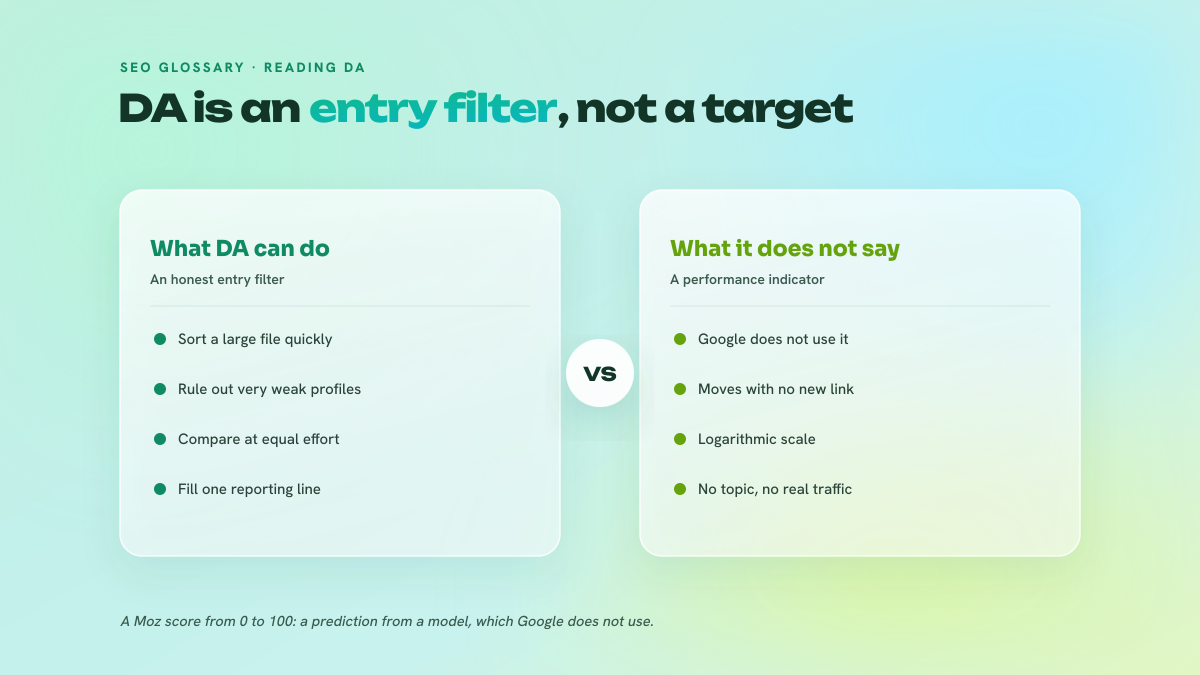
The index-size numbers published around it deserve open scepticism, because reviewers do not even agree on the unit. A ManyTools review of 4 July 2026 cites 44 trillion links. TheMarketingAgency's 18 February 2026 review claims 45.5 trillion and states this exceeds Ahrefs and Semrush based on their own tests. An agency write-up of 25 March 2026 describes the rebuilt index as 20 times larger than the previous one, then compares Ahrefs at roughly 3 trillion URLs against Moz at 4.7 trillion URLs. Links, URLs and crawled pages are three different things, and quoting one vendor's links against another vendor's URLs proves nothing at all. Any index-size figure is a marketing artefact until you have tested it against a domain whose backlink profile you already know by heart.
The criteria that actually decide the tool are duller. Freshness first: an Improvado guide of 14 July 2026 notes the link index updates continuously, which is what makes new and lost link tracking usable for campaign monitoring, and the same guide recommends weighting links by quality rather than counting them, using DA and PA to qualify prospects. Date filtering came next, with ManyTools highlighting date-based backlink filtering in July 2026 as a real improvement for recent-link discovery. On French media specifically, our experience is that Moz's discovery trails the index most teams already use for prospecting, and that the trust and citation split from Majestic's topical metrics still resolves cases a single blended score flattens. One index is never enough for a link audit, whichever vendor you pay.
MozCast, and the free tool worth keeping
MozCast and the Google Algorithm Change History are the parts of Moz we open without a subscription, and they earn their place. Moz still links MozCast from its free tools hub, updated 30 April 2026, and presents it as a daily weather report on search turbulence.
The 2025 record is the useful part. Moz's algorithm history logs three core updates that year: the first rolling out 13 March 2025 over 13 days, the second from 30 June 2025 over just under 17 days with a MozCast volatility peak of 124.4 degrees on 9 July and a second spike at the end of rollout on 17 July, the third from 11 December 2025 over about 18 days with a 122 degree spike on 12 December. Those durations are the operational payload. When a core update runs 17 or 18 days with two distinct volatility peaks, reading anything into day-four movement is reading noise, and a client email sent on day four commits you to a story the final state may contradict.
The second use is defensive. When traffic moves and nobody knows why, checking a volatility index answers the only question that matters first, which is whether the movement was yours or everyone's. Moz frames it in exactly those terms in its Search Engines blog category, alongside a late-2025 observation that AI Overviews frequency was falling on informational queries and that AI results appeared below position one in some of the data they analysed. Moz also shipped a Professional's Guide to SEO on 2 December 2025, an advanced counterpart to the old Beginner's Guide, with chapters on the algorithm, the SERPs, E-E-A-T and AI Overviews. It is a better free reference than most paid courses, and it costs nothing.
Where Moz fits in a netlinking operation
In a working netlinking process, Moz belongs at the end of the qualification chain, not the start. The order that survives contact with reality is topical fit first, then evidence of real publishing over time, then traffic history and its shape, then the outbound link pattern of the host, then metrics as a tiebreaker between two candidates that already passed. Inverting that order is how a buyer ends up with a DA 45 shell that has published nothing human in two years.
The client-facing reality is less pure. If a contract stipulates DA reporting, you report DA, and you attach a second read next to it so the number never travels alone: organic traffic curve, publication cadence, the ratio of editorial to sponsored output. On the French media we operate in-house at Stringer, the metric is published because buyers ask for it, but it is never the reason a placement works, and the list of sites we run ourselves is deliberately readable without any tool subscription. The same logic applies to budget: a score does not set a price, editorial reality does, which is why what a placement costs is published openly rather than derived from a vendor metric that anyone can inflate.
What we see go wrong
Buying to a DA floor is the classic. It selects for whatever the model rewards, which is link volume, and quietly rejects small specialist media with real readers and low scores. Panicking on a DA drop is the second, and it usually coincides with a recalibration rather than anything on the site. Reading a page-level score as a domain-level one is the third, and it happens weekly: PA and DA answer different questions and a strong PA on a single viral page tells you nothing about the domain's ability to pass value from a new article.
On the subscription side, the recurring error is treating Moz Pro Starter as a research stack. Fifty keyword queries a month and 20 tracked keywords cover one small site and nothing else, and teams discover the ceiling in week two. On Moz Local, a Tekpon breakdown of 6 April 2026 puts the Lite tier at $20 per month per location, around $16 with annual billing, distributing to 90 or more directories, and a June 2026 analysis notes the same Lite tier at $16 while pointing out that Moz Local handles listing distribution and a 0 to 100 listing score for NAP consistency, not rank tracking and not review management. Per-location pricing across a multi-site portfolio adds up fast, and half the directories it feeds may already carry your data.
The last one is comparing DA across markets. A French regional media and a US national outlet with the same score are not interchangeable assets, because the link graphs they sit in have completely different densities. The number is comparable inside a market and misleading across markets, and no amount of tooling fixes that.
Nautilinks operates an owned network of editorial media. In-house written articles, transparency disclosures respected, anchor mix calibrated.
Frequently asked questions
Is DA still worth reporting to clients in 2026, or should I move everyone to a different metric?
Report it if the contract says so, but never alone. DA is a prediction calibrated against live SERPs, so it moves with recalibrations that have nothing to do with your work. Pair it with the organic traffic curve and publication cadence of the host, and state in the deck that it is a third-party model with no input into Google ranking. Clients accept that framing once, and it protects you the quarter a recalibration wipes five points off a healthy portfolio.
Moz claims a bigger backlink index than Ahrefs. Should I switch my prospecting?
No, and the claims themselves show why. A February 2026 review cites 45.5 trillion links as larger than Ahrefs and Semrush, a July 2026 review cites 44 trillion, and a March 2026 write-up compares 4.7 trillion Moz URLs against about 3 trillion for Ahrefs. Links and URLs are not the same unit. Test both indexes against a domain whose profile you already know, in your own market, and judge on what each one actually surfaces rather than on a headline number.
How do I spot a domain whose DA has been inflated artificially?
Look for the mismatch between the score and every non-link signal. No branded search volume, no publication in months, thin author signals, and an outbound profile that reads like a directory. The model only sees links, so a farm can move it without moving anything a reader would notice. Cross-check the linking root domains against a second index and look at how many of them share hosting patterns or launch dates. Inflation is cheap to buy and cheap to detect.
Does MozCast tell me anything Search Console cannot?
It tells you whether the movement was yours or everyone's, which Search Console cannot. Moz logged three core updates in 2025, rolling out over 13 days from 13 March, just under 17 days from 30 June with a 124.4 degree volatility peak on 9 July, and about 18 days from 11 December with a 122 degree spike on 12 December. Knowing a rollout is mid-flight stops you from rewriting a strategy on partial data and from emailing a client a conclusion you will retract.
Is the $5 Moz API worth it if I already use another suite?
Often yes, and it is the only Moz line we recommend without hesitation. If your reporting needs DA and PA columns but your prospecting lives in another tool, the API pulls the numbers into your own qualification sheet without buying a seat licence. TheMarketingAgency flagged the pricing in February 2026 as unusually low against competitors. Treat it as a data feed to satisfy a reporting requirement, not as a reason to build a workflow inside Moz.
Test your knowledge
Quiz: Moz
1/3A portfolio of healthy sites all lose four to six DA points in the same week, with no traffic change. What is the most likely explanation?