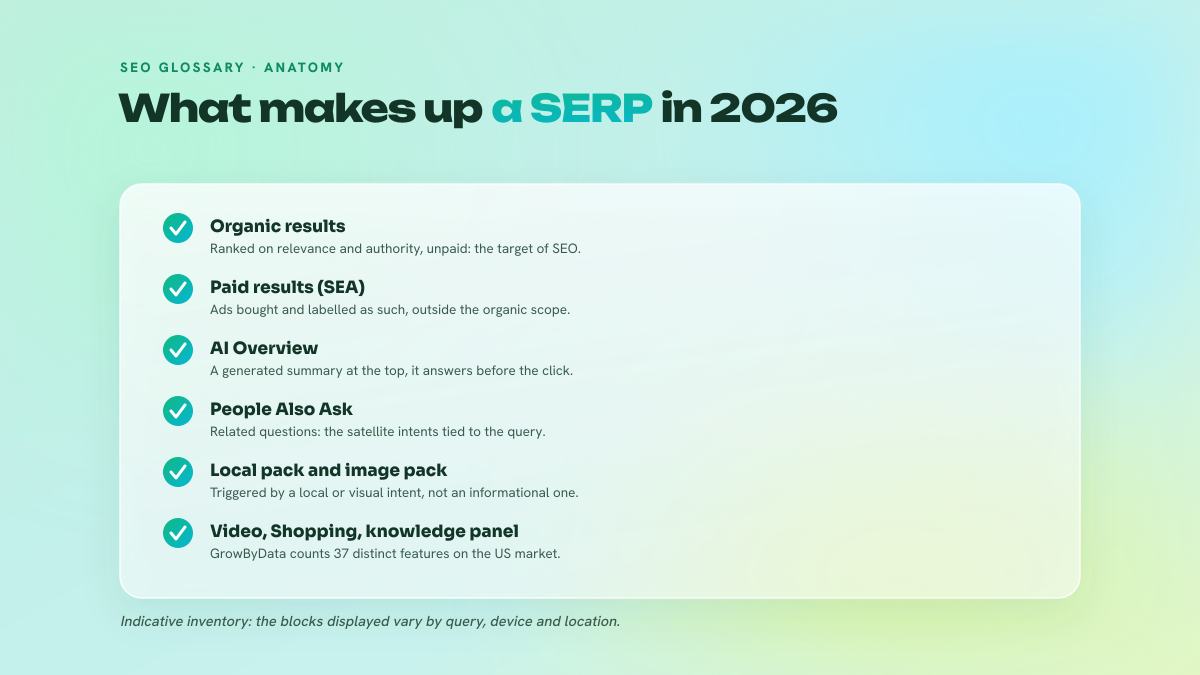
- →A SERP is a layout, not a list: GrowByData counts 37 distinct Google SERP features in the US in 2026, so ranking first no longer means being seen first.
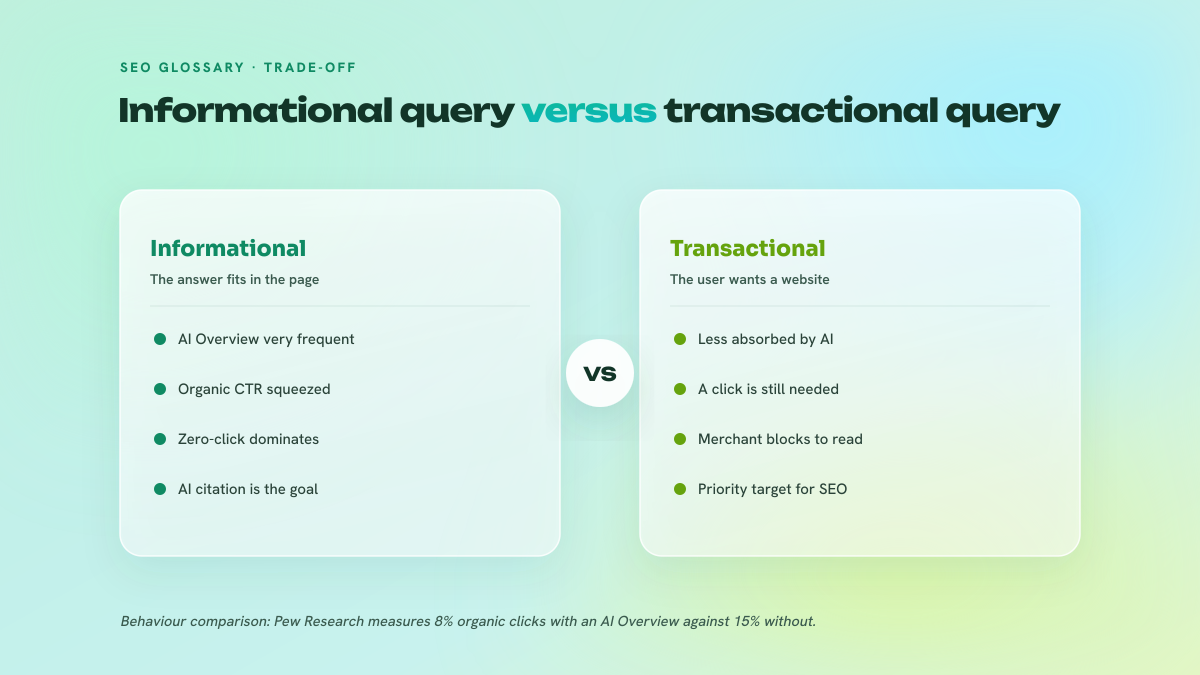
- →AI Overviews now sit on roughly half of queries (WordStream cites 47% as of April 2026), and where they appear organic click share collapses, per Pew Research, from 15% to 8%.
- →Featured snippets are no longer a safe target: SEMrush Sensor logged a drop of more than 90% in featured snippet appearances between April 2025 and July 2026 as AI Overviews absorbed that space.
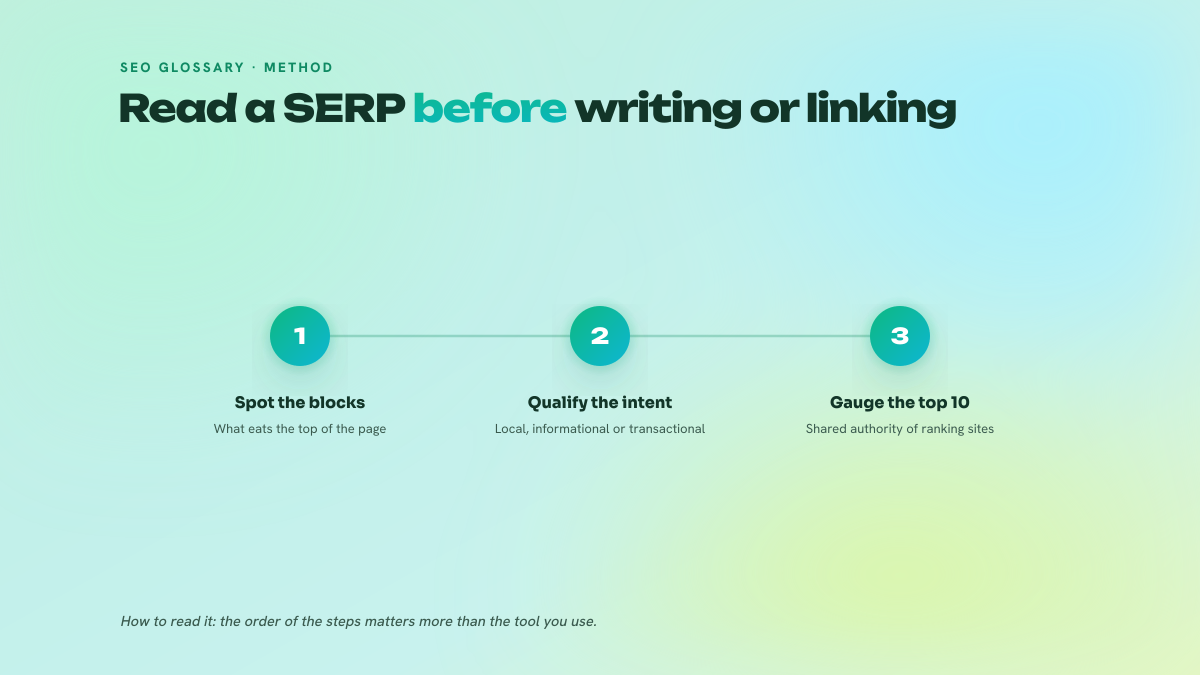
- →Track pixel depth and feature presence, not just numeric position: a position-1 ranking under an AI Overview and a PAA block behaves nothing like a clean position-1.
- →SERP visibility is downstream of authority: netlinking still moves organic rank, but only after you have confirmed the query renders a clickable organic slot worth fighting for.
What a SERP actually is in 2026
A SERP, or search engine results page, is the page a search engine returns for a given query. That definition was accurate in 2015 and it is close to useless today. The operational reality is that a Google SERP is now a composed interface, where the classic organic results compete for space with an AI Overview, a People Also Ask block, a local pack, video carousels and shopping modules. The organic result you rank for may sit well below the fold on the first scroll. For anyone running an SEO or netlinking operation, the SERP is not a list, it is a layout, and the first job is to understand which slots your target query actually renders.
This short video frames the base concept cleanly before we get into the mechanics.
The scale of that fragmentation is easy to underestimate. GrowByData counted 37 distinct Google SERP features in the US in 2026, from AI Overviews and AI Mode to Things to Know, merchant listings and local packs. The consequence is a market that has been drifting toward zero-click for years: the SparkToro and Datos study of 2024 found that 58.5% of US Google searches ended without a click to any external site, rising to roughly 77% on mobile. A SERP, in other words, is increasingly a destination rather than a doorway, and treating it as a simple ranked list is the fastest way to misread your own traffic.
How a Google SERP is assembled
Under the surface the pipeline is still the same three stages: crawling, indexing, then ranking at query time. When a user types a query, Google does not read the live web, it scores its index against hundreds of signals and assembles a page in real time. That page splits into organic results, earned through relevance and authority, and paid results, the text ads at the top and bottom and the shopping units. The two are governed by entirely different systems, and conflating them is a beginner error that still shows up in senior audits.
The video below walks through the assembly of a Google SERP in a few minutes, which pairs well with the mechanics we are describing.
Two variables make the same query produce different pages for different people: personalization and volatility. Personalization means the results are filtered by location and, to a lesser degree, search history, so a local query renders a local pack for one user and a plain organic list for another. Volatility means the ranking algorithms themselves keep moving. Search Engine Land counted three broad core updates and one spam update across 2025, and the March 27 to mid-April 2026 broad core update was described by multiple trackers as the most volatile core update on record at that point, with about 24% of URLs in the top 10 dropping beyond position 100. A SERP is a snapshot of a moving system, which is exactly why position tracking has to be continuous, not a one-off screenshot.
The feature inventory that decides visibility
The single biggest shift of the last two years is the AI Overview. It launched in the US in May 2024 and expanded globally through 2025, and by 2026 it sits on a large share of queries: WordStream cites 47% of searches carrying an AI Overview as of April 2026, and a twelve-month analysis to February 2026 found they triggered on nearly 48% of tracked queries, up 58% year over year. When an AI Overview renders, it pushes every classic feature down the page, and some of them never recover. Confirming whether your own pages actually get cited inside that panel, rather than assuming a strong classic ranking covers you, is exactly the gap our AI-answer visibility tracking is built to close.
The clearest casualty is the featured snippet, historically the coveted answer box at the top of the page. A SEMrush Sensor comparison between April 2025 and July 2026 recorded featured snippet appearances dropping by more than 90% on both desktop and mobile, as the AI Overview absorbed the direct-answer real estate. Over the same window video carousels rose by 2168% on desktop from a near-zero base, a signal that Google is pushing video hard. The answer box that used to sit above the organic results is no longer a stable target, and the expandable People Also Ask block has partly migrated its function into the AI Overview panel itself.
Local packs, knowledge panels and shopping carousels round out the modern inventory, each with its own eligibility rules. This is where a netlinking operation earns its keep: organic rank and, indirectly, feature eligibility are still downstream of authority, and authority is still moved by relevant links. When we place editorial links, paced over months, across the owned French media we operate in-house, the point is not to chase a vanity position, it is to lift a page into the narrow organic slots that a feature-heavy SERP still leaves clickable. That only works when you have first confirmed the query renders such a slot.
Optimizing and tracking your position
Optimizing for a modern SERP starts with the same structured data discipline it always did. Marking up your pages with schema.org types, from Article to FAQ to Product, gives Google the machine-readable signals it needs to consider a page for rich results and, increasingly, for citation inside an AI Overview. Local businesses layer their Google Business Profile and consistent NAP data on top to compete for the local pack, and content aimed at direct-answer slots is written to answer a question in the first two sentences, even though the snippet payoff has shrunk.
This practical walkthrough on analyzing a SERP to improve rankings is a good companion for the tracking discipline we describe next.
Tracking is where most operations still lag reality. A numeric position on its own is a weak signal in 2026: you need to record which features appear, whether an AI Overview is present, and how far down the page your organic slot actually falls in pixels. That is the level of detail a serious rank monitor should surface, and it is why we tie our media selection to a view that follows every result-page slot, not just the blue link. When you plan the budget behind that work, be honest about the horizon: SERP visibility built through links compounds over months, so weigh what sustained link acquisition actually costs against the traffic a clickable position genuinely returns.
What we see go wrong
The most common mistake we see in audits is celebrating position 1 without checking what sits above it. Pew Research, in a July 2025 study of 68,879 searches, found that when an AI Overview was present only 8% of users clicked an organic result, against 15% when it was absent, a relative drop of roughly 47%. An Ahrefs study updated in December 2025 across the same 300,000-keyword framework put the position-1 CTR reduction attributable to AI Overviews at about 58% in relative terms. A position-1 ranking under an AI Overview is not the asset it was, and reporting it as a flat win misleads the client and yourself.
The second failure is chasing features that no longer pay. Teams still pour effort into featured snippet formatting for queries where the snippet has been replaced by an AI Overview, or they optimize for a local pack on a query that renders none. The fix is to read the live SERP for the exact query first, then decide the tactic, which is the same discipline that makes a link campaign calibrated over the long run worth more than a burst of activity: you spend authority where a clickable slot exists, not where the layout has already been eaten.
The third is treating the SERP as static. Personalization and constant algorithm movement mean the page you screenshot today is not the page your buyer sees tomorrow, or from another city. Build your tracking to sample continuously and by location, keep an eye on the update calendar, and read every position as a probability, not a fact. That posture, more than any single tactic, separates an operator who understands the results page from one who still thinks of it as ten links in a column.
Nautilinks operates an owned network of editorial media. In-house written articles, transparency disclosures respected, anchor mix calibrated.
Frequently asked questions
What is the difference between SERP and SEO?
A SERP is the actual page a search engine returns for a query, the layout of organic results, ads and features. SEO is the discipline of getting your pages onto that page in a visible, clickable position. Put simply, the SERP is the battlefield and SEO is how you fight on it. You track SERPs to measure the outcome; you do SEO, including netlinking and on-page work, to change it.
Does ranking position 1 still matter now that AI Overviews are everywhere?
It still matters, but it means less than it did. Pew Research found in July 2025 that only 8% of users clicked an organic result when an AI Overview was present, versus 15% without one, and Ahrefs put the relative position-1 CTR loss on AI Overview queries at around 58% in its December 2025 study. Position 1 is still the best organic slot, you just have to read it in context of everything rendered above it.
What does SERP mean in a pension context?
It is an unrelated acronym. In UK pensions, SERP stands for the State Earnings-Related Pension Scheme, an additional state pension that ran until it was replaced by the Second State Pension. It has nothing to do with search. If you are reading an SEO glossary, SERP always means the search engine results page, but the collision is worth knowing so you do not misread a finance source.
Is it still worth optimizing for featured snippets?
Selectively. SEMrush Sensor recorded featured snippet appearances dropping more than 90% between April 2025 and July 2026 as AI Overviews absorbed that space, so a blanket snippet strategy is outdated. Check the live SERP for each target query: where a snippet still renders and no AI Overview crowds it out, the concise answer format is worth the effort. Where the AI Overview has taken over, put that energy into the organic slot instead.
How many SERP features should a serious tracker monitor?
As many as your queries actually render. GrowByData counted 37 distinct Google SERP features in the US in 2026, so a tracker that only reports numeric position is blind to most of the page. At minimum, log the presence of AI Overviews, People Also Ask, local packs and video carousels for each query, plus how far down the organic result falls in pixels. That feature map is what tells you whether a ranking is genuinely visible.
Test your knowledge
Quiz: SERP
1/3According to Pew Research (July 2025), how did the presence of an AI Overview affect organic click share?