- →Schema.org is a shared type vocabulary (schema, org, Product, Article, Organization), not a Google feature; Google, Bing and increasingly AI engines are consumers of it, not owners.
- →In 2026 the rich-result surface is shrinking: Google stopped showing FAQ rich results on 7 May 2026 and dropped rich results for seven schema types in June 2025, framed as visual changes with no ranking impact.
- →Adding schema is not an AI-citation lever on already-visible pages: an Ahrefs study of 1,885 pages found no meaningful uplift, and a small negative effect (-4.6%) on Google AI Overviews.
- →JSON-LD is the format to standardize on; validate in both validator.schema.org (v30.0, released 19 March 2026) and Google's Rich Results Test because they catch different error classes.
- →The durable win is entity clarity for ambiguous or new entities, not decoration of pages already sitting on 100+ citations.
- →Structured data still belongs in your technical baseline; Search Engine Journal is right that Google is not diminishing its use, but stop selling it internally as a growth channel.
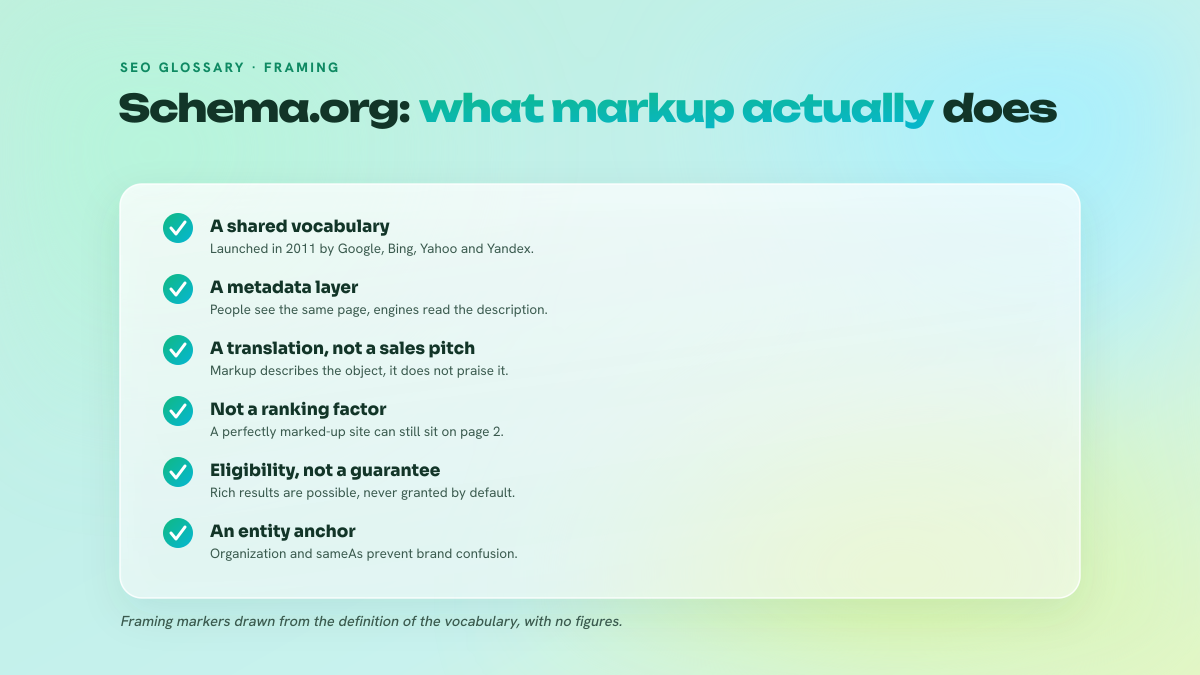
Beyond the vocabulary: what Schema.org really is
Schema.org is a shared vocabulary maintained by a consortium (Google, Microsoft, Yahoo, Yandex) that lets you annotate a page with the type of thing it describes: a Product, an Article, an Organization, a LocalBusiness. The dictionary line stops there. The operational point a senior SEO needs is different: schema.org is not a Google product and not a ranking signal. It is a contract. You declare, in a vocabulary that search engines agreed to read, that this itemprop is a name, that value is a price, this block is a review. Google, Bing and now the AI answer engines are consumers of that contract, free to use it, ignore it, or deprecate the feature it powered.
That distinction matters because most briefs still treat markup as a lever you pull for traffic. It is closer to plumbing: invisible when it works, expensive when it leaks. Below, a plain-language primer that pairs well with the mechanics we cover next.
The vocabulary itself keeps moving. Schema.org version 30.0 shipped on 19 March 2026, after v29.4 on 8 December 2025, adding a Credential class for professional certifications, an Error class with an errorCode property, a floorLevel property for multi-storey locations, and equivalence mappings to GS1, Dublin Core and Open Graph. Those mappings are the quietly important part: they make cross-graph entity alignment easier, which is where schema still earns its keep in 2026.
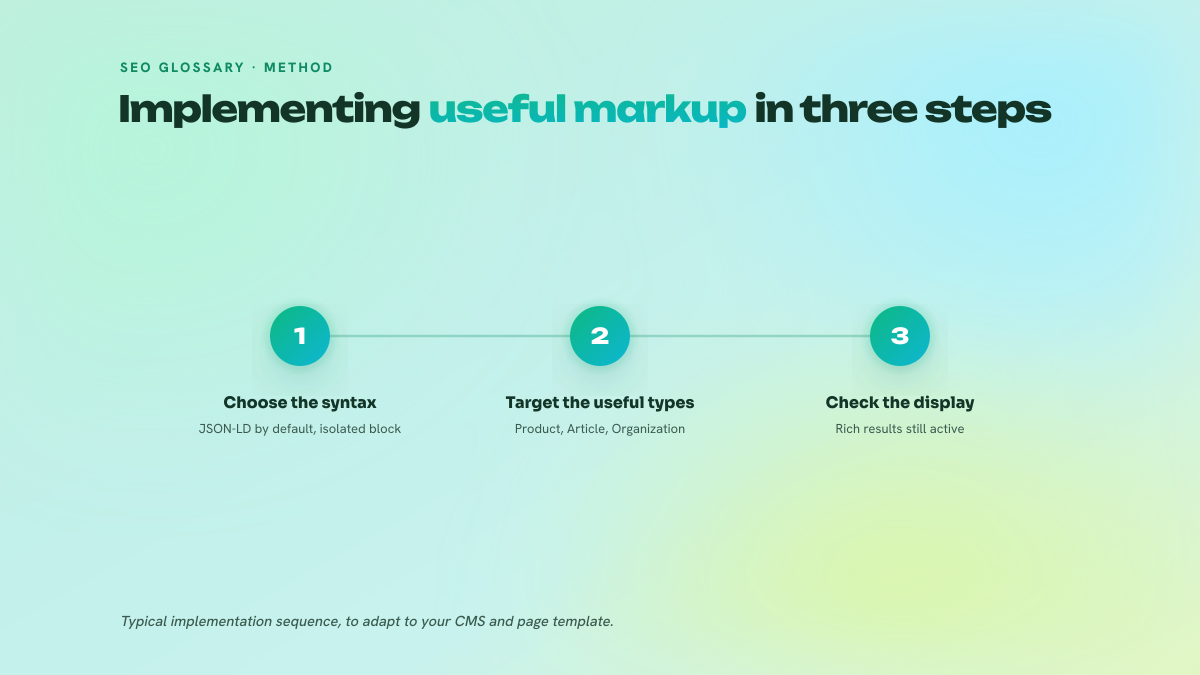
How schema markup works in 2026
Mechanically, you attach type and property annotations to your content in one of three formats. Microdata and RDFa embed attributes (itemscope, itemtype, itemprop) directly into your HTML. JSON-LD sits in a separate script block and describes the entity independently of the markup. Standardize on the JSON-LD approach Google recommends: it decouples the data layer from the template, so a CMS or tag manager can inject it without touching the DOM, and it is far less fragile than inline microdata when a front-end team refactors.
This short explainer covers the how and the SEO rationale without the jargon:
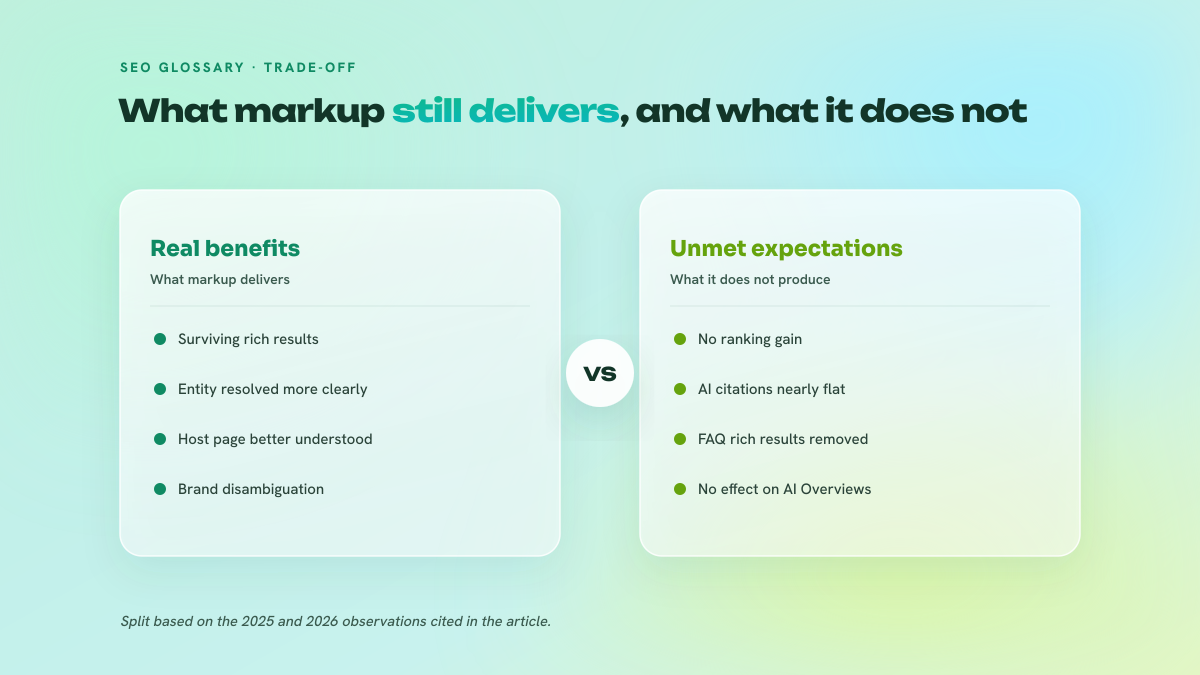
The 2026 reality is that the output of that contract has been shrinking. Google removed rich results for seven schema types in June 2025, including Course and ClaimReview, and described it explicitly as a visual and functional change with no ranking impact; the only loss is click-through from reduced visual prominence. Then FAQ rich results stopped appearing in Google Search as of 7 May 2026 per Google Search Central, with the FAQ report and Rich Results Test support removed in June 2026 and Search Console API support ending August 2026. Google is clear that FAQPage markup can remain and may still be used to understand content or by other engines, it just no longer paints the SERP accordion. If you have automated Search Console API pulls, update them before August 2026 or you will read null data as a drop.
So what still measurably works? Product markup (name, description, gtin, offer, aggregateRating) still drives merchant-eligible results. Article and Organization markup still feed entity understanding. And a documentation change on Google's side in early 2026 confirmed it uses both schema.org image markup and og:image to pick thumbnails for Search and Discover. The property surface is deep (a single Product type exposes dozens of properties, and value alone shows up across offers, ratings and quantitative fields) but the feature surface it powers is narrower than in 2022.
Where schema fits in a netlinking operation
For a netlinking or SEO operation, schema is a technical hygiene item, not an acquisition channel. It does not move authority, and it does not substitute for links. Where it earns attention is entity resolution: consistent Organization markup across your properties, with sameAs references and identifiers, helps a search engine collapse your brand into one Knowledge Graph node instead of scattering it. That is the layer where a link campaign and a schema layer actually compound, because a clean entity is easier to attribute inbound links to.
This is also where the 2026 evidence forces a stance against a popular pitch: that schema wins you AI citations. An Ahrefs study analyzed 1,885 pages that added JSON-LD between August 2025 and March 2026, matched against 4,000 control pages with similar prior citation levels. Over a 30-day difference-in-differences window, Google AI Mode moved +2.4% and ChatGPT +2.2% (both statistically indistinguishable from zero), while Google AI Overviews actually fell 4.6%, roughly 12 fewer daily citations per page. Ahrefs' own summary: adding schema produced no major uplift on any platform. The honest caveat, which Ahrefs states, is that every tested page already had 100+ AI Overview citations, so the study measures already-visible content and does not test whether schema helps a new or ambiguous entity become resolvable. That caveat is exactly the use case where schema still pays: making a thin or new entity legible, not decorating one that already ranks. Actually earning citations for an entity that is already resolved is a different job, closer to our work on AI answer visibility than to markup, and it increasingly means covering the sub-queries a generative engine fans out from a single prompt, not just the head term schema happens to describe.
When you plan the budget for a campaign, price the links, not the markup. Schema is a fixed technical cost your dev team absorbs once; the variable spend is acquisition. If you want to see what a placement actually costs on owned media, that is where the money goes. Across the owned French editorial media we operate in-house at Nautilinks, schema is baked into the template layer precisely because it belongs in the baseline, not in the campaign line item.
Implementing without the cargo cult
Implementation is mundane, which is why so many teams over-invest emotionally in it. Pick the type that genuinely matches the page, write the JSON-LD, inject it, then validate. The following walkthrough demonstrates the mechanical steps end to end and pairs with the written version:
Two validators, on purpose. Run the markup through validator.schema.org for v30.0 vocabulary compliance and through Google's Rich Results Test for feature eligibility, because they catch different error classes. A page can be perfectly valid per the schema.org spec yet ineligible for a Google rich result, and the reverse happens too. Treating the Rich Results Test as your only check is how teams ship syntactically broken markup that Google silently tolerates and other engines reject.
Keep the markup honest. Every property you assert should reflect content a human can see on the page. Marking up reviews that are not visible, or an aggregateRating your page does not actually host, is a structured-data policy violation and a footprint. The discipline is the same one we apply to a link profile: declare only what is real, because a catalogue of media you can inspect before you buy and a schema block you can defend to a manual reviewer share the same principle, no hidden claims. For the broader picture of how these annotations relate to each other, our entry on the wider structured-data layer maps the vocabulary against the formats.
What we see go wrong
From what we see in audits, four failure patterns recur. First, teams chase deprecated features: still building elaborate FAQPage blocks in mid-2026 expecting the SERP accordion, months after Google stopped rendering it. The markup is not harmful, but the effort is misallocated. Second, schema-value confusion: pouring engineering hours into markup on pages that have no links and no crawl priority, then blaming schema when nothing moves. Structured data amplifies clarity, it does not manufacture demand. Third, validation theatre: passing the Rich Results Test and calling it done, while the schema.org validator flags type errors that break entity parsing for non-Google consumers, including the AI engines that increasingly read the graph. Fourth, over-claiming: injecting ratings, prices or offers that do not exist on the visible page, which is the fastest route to a structured-data manual action.
The 2026 stance, then, is unromantic. Search Engine Journal put it correctly in early 2026: Google is not diminishing the use of structured data, it is removing reporting and feature support for specific types while keeping markup a recommended baseline. So keep it in your technical foundation, standardize on JSON-LD, validate twice, and stop selling schema internally as a growth lever. The growth comes from entities that deserve to rank and links that make them authoritative. Schema just makes sure the machine reads your page as the thing it actually is.
Nautilinks operates an owned network of editorial media. In-house written articles, transparency disclosures respected, anchor mix calibrated.
Frequently asked questions
Is Schema.org still relevant in 2026?
Yes, but for a narrower job than five years ago. Its ranking value was always indirect, and the rich-result surface it powers is shrinking: Google dropped seven schema types in June 2025 and stopped FAQ rich results on 7 May 2026. What stays relevant is entity clarity for search and AI engines, plus eligibility for the rich results Google still renders, notably Product. Treat it as technical baseline, not a growth channel.
Does adding schema improve SEO rankings directly?
No. Google has repeatedly described feature and rich-result changes tied to schema as visual with no ranking impact. Structured data can lift click-through when it earns a rich result, and it helps entity understanding, but it is not a ranking factor you pull for position. The Ahrefs 2026 study on 1,885 pages found adding schema produced no meaningful citation uplift on AI platforms either, and a small negative effect on AI Overviews for already-visible pages.
Which format should we use: microdata, RDFa or JSON-LD?
JSON-LD, and it is not close. Google recommends it, and it decouples the data layer from your HTML so a CMS or tag manager injects it without touching the DOM. Microdata and RDFa embed attributes inline, which breaks more easily when a front-end team refactors templates. Standardize on JSON-LD across the site and manage it in one place rather than scattering annotations through your markup.
Do we still need FAQPage markup now that rich results are gone?
You can keep it, but lower your expectations. Google confirmed FAQPage structured data can remain and may still be used to understand content or by other search engines, it simply no longer renders the SERP accordion since 7 May 2026. If you rely on Search Console API data for FAQ appearances, update those calls before August 2026, when API support ends, or you will misread null values as a traffic drop.
Does schema help us get cited in AI Overviews or ChatGPT?
Not as a lever on pages that already rank. The Ahrefs study covering August 2025 to March 2026 found no major uplift, with Google AI Mode and ChatGPT effectively flat and AI Overviews down 4.6%. The caveat matters: every tested page already had 100+ citations, so the study does not test whether schema helps a new or ambiguous entity become resolvable. For unclear entities, clean markup still plausibly helps; for already-visible ones, it does not move citations.
Why validate in two different tools?
Because validator.schema.org and Google's Rich Results Test check different things. The schema.org validator confirms compliance with the current vocabulary (v30.0, released 19 March 2026) and catches type errors that break parsing for any consumer, including AI engines. Google's Rich Results Test checks eligibility for Google's specific features. A page can pass one and fail the other, so passing only the Google tool ships spec-invalid markup that non-Google consumers reject.
Test your knowledge
Quiz: Schema.org
1/3According to the Ahrefs 2026 study on 1,885 pages that added JSON-LD, what happened to Google AI Overview citations?