- →Google removed breadcrumb paths from mobile search results on 23 January 2025, globally. The display argument for BreadcrumbList now covers desktop only, so any CTR forecast built on it applies to a fraction of your traffic.
- →BreadcrumbList survived the structured-data pruning of 12 June 2025 (seven types deprecated) and the Practice Problem removal announced 5 November 2025. It sits in the durable set alongside Product, Review snippet and Video.
- →The markup is a declaration, not a mechanism: it never moves link equity by itself. The visible trail of real anchors in the HTML does that, and the two must describe the same path.
- →A vendor audit of 5,000 production sites published 26 April 2026 found BreadcrumbList on 38% of sites and a 49-percentage-point gap between deployment and validation. Deployed and valid are not the same population.
- →The +47% AI Overview citation figure from that same study pairs Article and BreadcrumbList with validation status. It is observational, not proof that breadcrumb markup causes citations, and Google's own 2026 guidance says no schema is required for generative AI Search.
- →GSC impressions were inaccurately reported from 13 May 2025 to 27 April 2026 and were never reconstructed. Any before/after study of a schema rollout crossing that window is unusable on impressions.
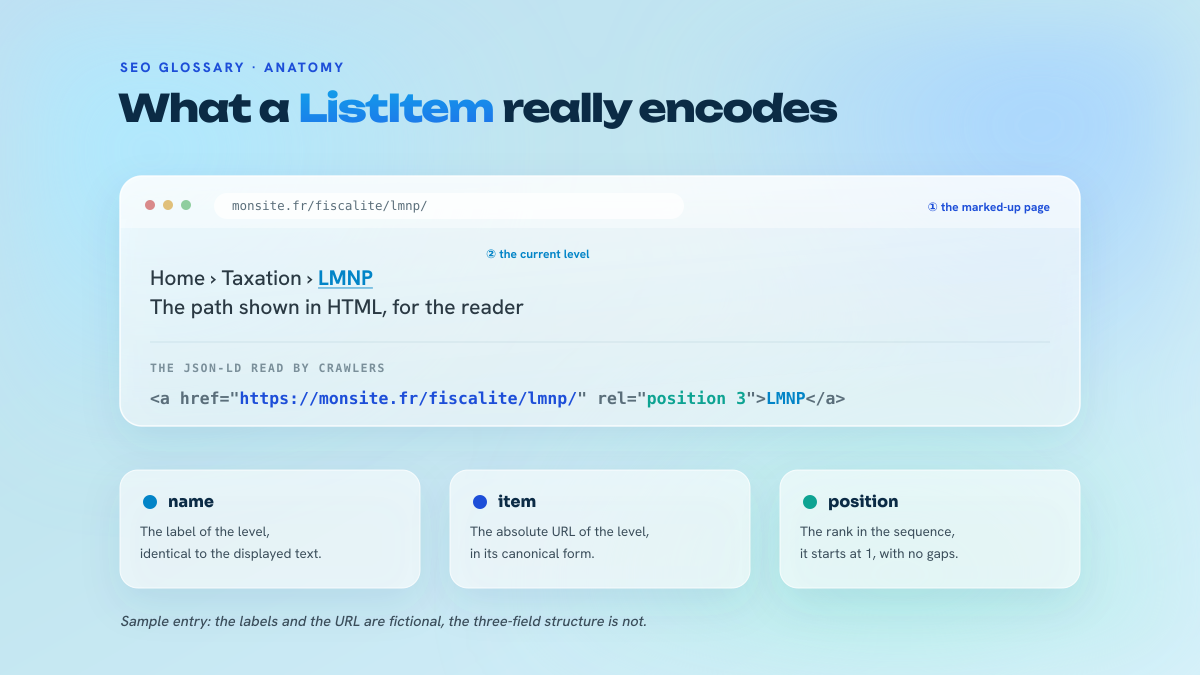
What the markup actually declares
A BreadcrumbList is an assertion about position, nothing more. You are telling a parser that this URL is the third node of a path that starts at a root, passes through a category, and ends here. The schema.org type is a plain ordered list: a BreadcrumbList containing ListItem nodes, each with a position integer and an item reference plus a name. Google accepts the final item without a URL, since it is the page you are already on. That is the whole vocabulary.
Two things get conflated constantly. The visible breadcrumb trail is an HTML navigation pattern that users click and crawlers follow. The BreadcrumbList markup is a parallel, invisible statement about the same path. You can ship one without the other, and plenty of sites do, which is exactly where the trouble starts. The markup on its own gives a search engine a hierarchy claim it cannot verify against anything. The trail on its own passes real signals through your internal link graph but leaves the hierarchy implicit. You want both, describing the same path, in the same order.
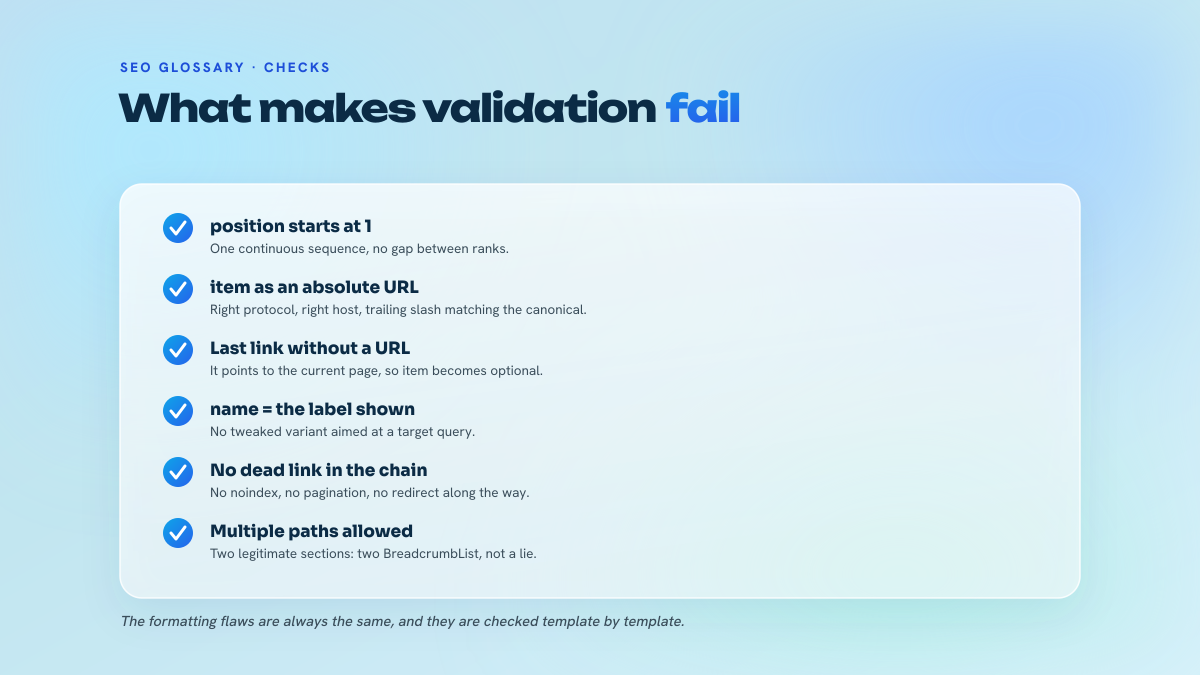
One under-used detail: a page reachable through several legitimate paths can carry several BreadcrumbList objects. A product sitting in two categories, an article that belongs to a theme and a series. Google supports multiple trails on one page. Most CMS implementations pick one arbitrarily and throw away a genuine piece of structural information. Serve the markup as a JSON-LD block in the head rather than microdata sprinkled through the template: it survives redesigns, it is diffable in version control, and it does not break the day a front-end developer refactors the nav component.
Desktop-only display since January 2025
On 23 January 2025 Google removed breadcrumb paths from mobile search results worldwide, keeping only the domain, on the grounds that the paths were often truncated and of limited use on a small screen. Desktop results kept them. The Breadcrumbs report in Search Console and the Rich Results Test both survived the change. That single decision cut the visible value of the markup roughly in half for most sites, and by considerably more than half for a mobile-heavy audience.
This matters because the entire commercial pitch around BreadcrumbList was cosmetic: a nicer-looking URL line, therefore a better click-through rate. The figures that circulate, a 2 to 3 percentage-point CTR lift, a 5% organic traffic uplift, a 5 to 10% CTR improvement, all trace back to agency and vendor case studies, not to an independently replicated experiment. Cite them as case studies if you must cite them at all. Selling a mobile-first client a CTR forecast built on a display Google deleted in January 2025 is the kind of thing that shows up in a post-mortem.
The reassuring part is that BreadcrumbList is not on the way out. Google's structured-data policy through 2025 and 2026 has been pruning, not retreat. On 12 June 2025 it deprecated seven low-use rich-result types, Book Actions, Course Info, Claim Review, Estimated Salary, Learning Video, Special Announcement and Vehicle Listing, with Search Console reporting ending 9 September 2025 and deprecated appearance fields returning null in bulk exports from 1 October 2025. Breadcrumbs were untouched. On 5 November 2025 Google announced the removal of Practice Problem support from January 2026 and clarified that Dataset markup serves Dataset Search rather than ordinary Search. Breadcrumbs again untouched, and third-party documentation tracking Google's active enhancement reports in June 2026 still lists Breadcrumbs among the surviving monitored features, next to Products, Review snippets and Video. If you are deciding where to spend engineering time on markup that will still exist in three years, this one is a safe bet.
What it does and does not do for AI search
Here is where the 2026 discourse goes off the rails. Google's own generative-AI optimization guidance states plainly that structured data is not required for inclusion in generative AI Search. It remains useful for eligibility for conventional rich results. That is the official position, and no announcement between August 2025 and August 2026 changed it.
Against that, a vendor audit of 5,000 production sites published on 26 April 2026 reported a correlation of +0.34 between valid schema and AI-search citation rate, and a 47% higher AI Overview citation frequency for editorial sites running valid Article plus BreadcrumbList markup compared with a no-schema group. Read the construction before you quote the number: it bundles two schema types with validation status, on an observational sample, with no control for the obvious confounder. Sites that ship valid structured data across their template also tend to have a coherent information architecture, a maintained CMS and an editorial team. The schema is a marker of operational hygiene at least as much as a cause of anything. Treat any claim that BreadcrumbList alone lifts AI Overview inclusion as unverified until someone runs a controlled test.
Measurement got better and worse at the same time. On 3 June 2026 Google launched dedicated Search Generative AI performance reports in Search Console, covering AI Overviews, AI Mode and generative features in Discover, with impressions broken down by page, country, device and date. Useful. But Search Console impressions were inaccurately reported from 13 May 2025 through 27 April 2026, an incident Google confirmed as resolved while stating that historical data would not be reconstructed. Clicks were not reported as affected. Practically: if your schema rollout sits anywhere inside that window, your year-over-year impression comparison is not evidence, and you should say so in the deliverable rather than let a client build a roadmap on it.
Where it earns its place in a netlinking operation
Strip away the SERP cosmetics and BreadcrumbList is an architecture instrument. It forces you to answer a question most sites answer badly: what is the canonical path to this page. Once that answer is written into a template, the visible trail, the URL structure and the markup all have to agree, and disagreements become visible bugs instead of vague unease. That discipline is worth more than any rich result.
For a netlinking operation the payoff is downstream. A category page that sits at the top of a coherent breadcrumb path across two hundred articles is a defensible landing target for external links, because the equity you send it has somewhere to go. A page floating outside any declared hierarchy absorbs the link and leaks most of its value. When we plan where to point links across the French editorial media we run in-house, the first structural check is whether the destination sits at a hierarchy node with genuine children, which is precisely what the breadcrumb encodes. The same logic applies to a client site: before buying a link to a page, look at what that page is the parent of. If you are picking hosts and destination pages, the catalogue of media you can browse before signing anything is easier to work through once you have decided which nodes of your architecture deserve the equity.
Breadcrumb markup also stabilises silos in the way a properly enforced thematic silo is supposed to work. A study of 180 e-commerce websites presented at BrightonSEO 2025 and reported in February 2026 found breadcrumb markup applied consistently across page types and niches, while LocalBusiness markup was comparatively underused. Consistency is the finding worth taking, not a causal gain: the report documents implementation, it does not establish a ranking or CTR effect for BreadcrumbList specifically.
What we see go wrong in audits
The same vendor audit of 5,000 sites from 26 April 2026 found BreadcrumbList present on 38% of sites, only 8% deploying five or more schema types correctly, and a 49-percentage-point gap between schema deployment and validation. That gap is the whole story of this term. Shipping the markup is a plugin toggle. Shipping markup that validates, matches the visible trail and survives the next template change is engineering work.
The recurring failure modes are dull and consistent. Markup that describes a path the user never sees, usually because the trail was redesigned and the JSON-LD block was not. Relative URLs in the item field, which invalidate the whole object. Positions starting at zero, or duplicated across items after a loop bug. Trails injected by client-side JavaScript that renders after the crawler has moved on. Breadcrumbs carrying faceted or tracking parameters in the item URLs, which quietly declares a filtered variant as canonical parent. And on multilingual sites, breadcrumb names left in the source language while the rest of the page is translated, an inconsistency that compounds whatever your hreflang cluster already gets wrong.
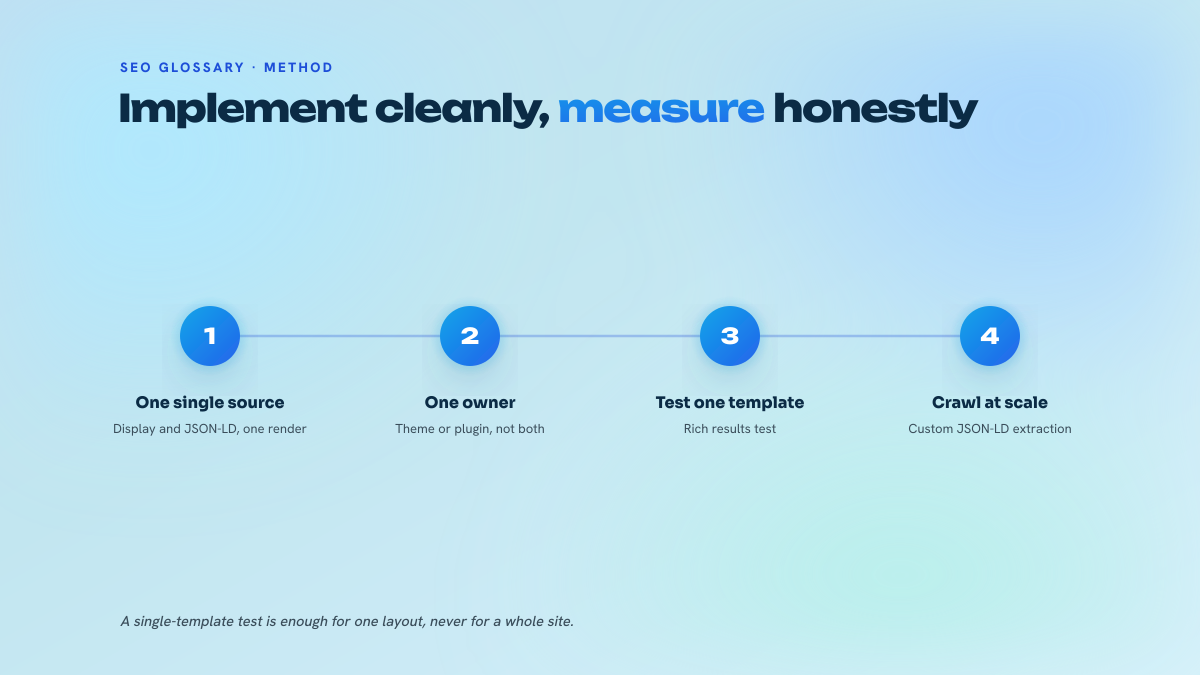
To catch them, crawl and extract rather than spot-check. Screaming Frog SEO Spider, reported at around 259 dollars a year in 2026, will pull every JSON-LD block on the site into a table where a mismatch between breadcrumb name and H1 is a sort, not an investigation. The Rich Results Test handles single URLs, the Search Console Breadcrumbs report surfaces what Google actually parsed, and the delta between your crawl and that report is the interesting number. On WordPress, the free Yoast SEO plugin still emits basic breadcrumb output, Rank Math includes schema and breadcrumb features in its free tier, and SEOPress Pro is reported at 49 dollars a year for unlimited sites against roughly 99 dollars a year per site for Yoast Premium. None of these will fix a hierarchy that is wrong to begin with.
Tactical takeaways
Treat BreadcrumbList as a hygiene item you fix once at template level, verify with a full-site extraction, and then leave alone. It belongs in the same maintenance bucket as your canonical tags: cheap to keep right, embarrassing when wrong, never the reason a page ranks. If a client audit puts it in the top three priorities, the audit is padding.
Budget accordingly. The marginal euro spent hand-crafting per-template breadcrumb JSON beyond validity returns almost nothing, while the same euro spent on a contextual link from a genuinely relevant editorial page moves a ranking you can measure. That arbitrage is visible the moment you compare an engineering day against what a single placement actually costs on a public price list. Fix the markup because a broken hierarchy declaration is a broken hierarchy, then spend the rest of the budget where the competition is.
Nautilinks operates an owned network of editorial media. In-house written articles, transparency disclosures respected, anchor mix calibrated.
Frequently asked questions
Is BreadcrumbList still worth implementing now that mobile SERPs no longer show the path?
Yes, but for structural reasons, not display. Since 23 January 2025 the path shows on desktop only, so the visual argument covers a shrinking share of impressions. What remains is a machine-readable hierarchy declaration that keeps your architecture honest and gives crawlers an explicit parent for every URL. It is cheap at template level and it survived every structured-data pruning round Google ran in 2025 and 2026, so it will not need re-doing.
Can a page carry several BreadcrumbList objects?
Google supports multiple trails on the same page, which is the right answer for a product in two categories or an article that belongs to both a theme and a series. Most CMS implementations pick one path arbitrarily and discard the rest, losing real structural information. If your taxonomy genuinely has several legitimate parents, declare them all rather than forcing a single canonical path that contradicts your navigation.
Does BreadcrumbList markup improve the odds of being cited in AI Overviews?
There is no verified causal evidence. Google's 2026 generative-AI optimization guidance states that structured data is not required for inclusion in generative AI Search. The 47% higher AI Overview citation frequency reported by a 5,000-site vendor audit on 26 April 2026 bundles Article markup, BreadcrumbList and validation status on an observational sample. Valid schema correlates with sites that are well maintained overall, which is a confounder nobody has controlled for yet.
How do I measure the impact of a breadcrumb schema rollout?
Compare your own crawl extraction against the Search Console Breadcrumbs report and treat the delta as the real deployment rate. For performance, be careful with dates: Search Console impressions were inaccurately reported from 13 May 2025 through 27 April 2026 and Google confirmed historical data would not be reconstructed. Clicks were unaffected, so run before/after on clicks and positions, and qualify any impression-based comparison crossing that window.
What is the single most common implementation defect you find?
Markup that no longer matches the visible trail, almost always because the navigation component was redesigned while the JSON-LD block stayed frozen in the old template. Close behind: relative URLs in the item field, positions that do not start at 1, and trails rendered client-side after the crawler has finished. A vendor audit of 5,000 sites in April 2026 found a 49-percentage-point gap between schema deployment and validation, and this family of defects explains most of it.
Should breadcrumb links be real anchors or is the markup enough?
Real anchors, always. The markup is a declaration a parser reads, it moves nothing on its own. The clickable trail in the HTML is what actually circulates signals through your internal link graph and gives users a lateral exit from a deep page. Shipping the JSON-LD without the visible trail gives you a hierarchy claim with no mechanism behind it, which is the least useful of the three possible configurations.
Test your knowledge
Quiz: BreadcrumbList schema
1/3What changed for breadcrumb paths in Google search results on 23 January 2025?