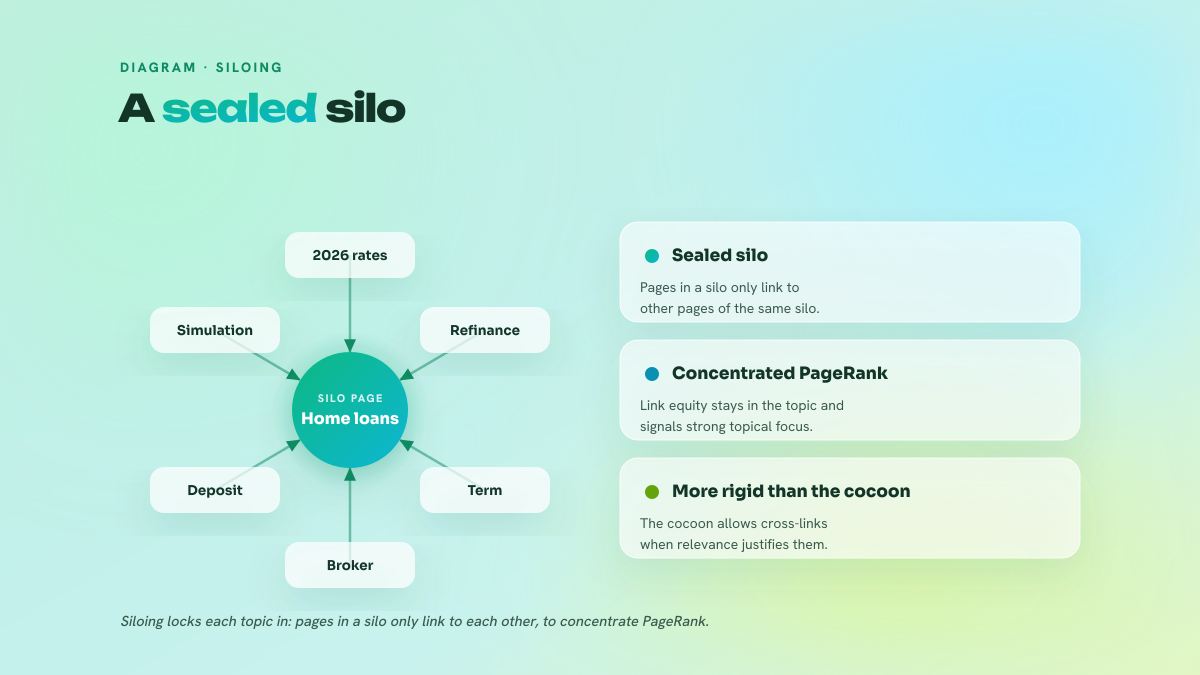
- →Siloing is an SEO architecture method that organises a site into watertight thematic silos. Pages in a silo only link to other pages in the same silo.
- →Goal: concentrate PageRank within each silo and signal strong topic specialisation to Google.
- →More rigid method than the topical cluster, which authorises bridges between silos when relevance justifies it.
- →Still useful on very large multi-topic sites, but largely supplanted by the topical cluster on modern editorial sites.
Definition of siloing
Siloing is an editorial SEO architecture method popularised in the 2000s. It consists in organising a site into watertight thematic silos, that is, groups of pages that link to each other inside the same silo, but do not link to pages of other silos.
The goal is twofold. First, concentrate PageRank within each silo: juice flows between pages on the same topic without diluting toward other topics on the site. Second, send Google a strong topic-specialisation signal: the rigid structure tells the engine that the site really covers these topics in depth, without dispersion.
The principles
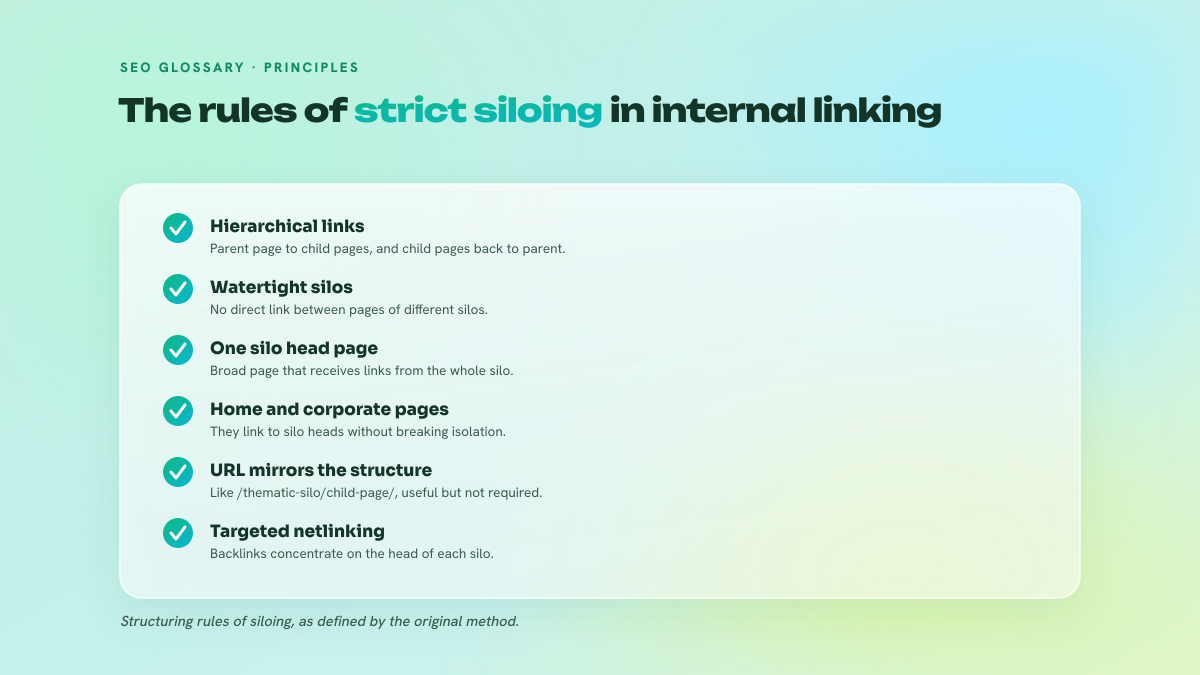
Siloing rests on three structuring rules. First: inside a silo, pages link to each other in a hierarchical logic (parent page to child pages, child pages back to the parent page). Second: no direct link between pages of different silos, even if semantic relevance might justify it. Third: the homepage and institutional pages can link to silo heads, but without breaking internal isolation.
That rigidity is the distinctive mark of strict siloing. It rests on the idea that Google interprets a site's topical consistency from the consistency of its internal link graph. The more compartmentalised the graph, the clearer the topic-specialisation signal.
How to build silos
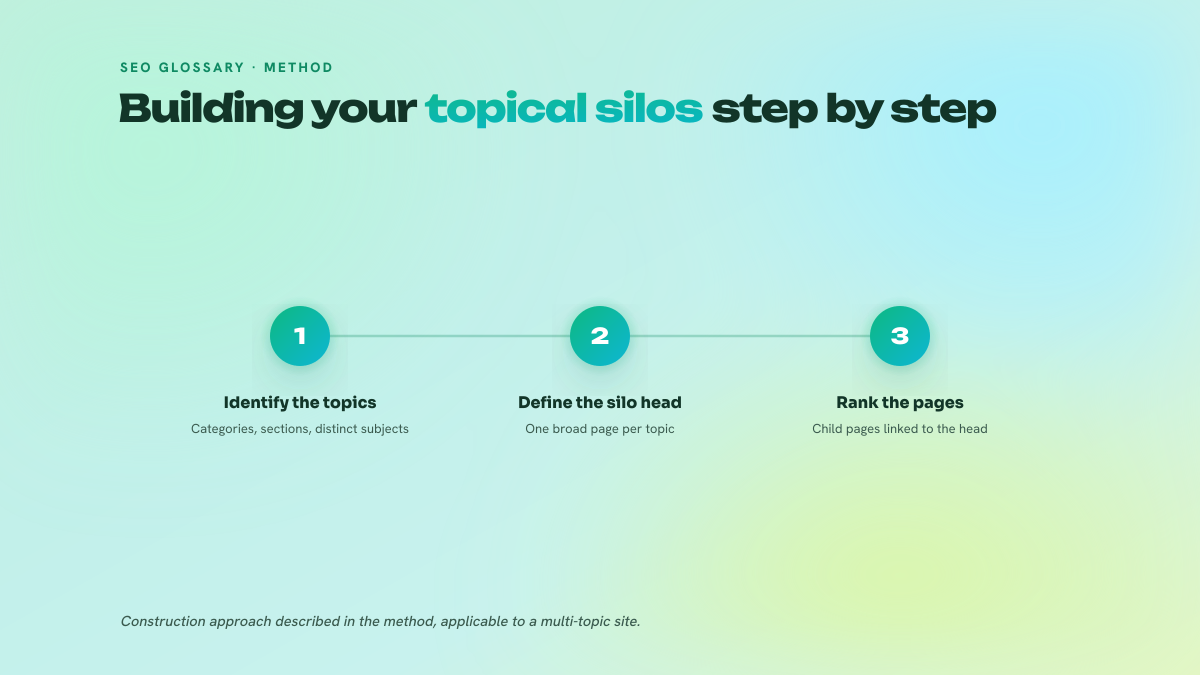
Construction starts by identifying the site's main distinct topics. On a multi-topic site, those topics become the silos. On an e-commerce, they're often the main product categories. On a media outlet, the editorial sections.
For each silo, you then define a silo-head page, equivalent to the pillar page in the topical cluster. That page treats the silo's topic broadly and receives links from all other pages in the silo. Secondary pages of the silo are hierarchised around that silo-head page.
The URL architecture ideally reflects the silos with a structure of the type /thematic-silo/child-page/. That practice helps crawlers read the graph, but it's not mandatory if internal linking respects the silo logic. When external authority is added on top of that architecture, a netlinking campaign with topical siloing distributes inbound links across silo heads rather than concentrating them on the homepage, so PageRank lands where it can flow into the silo it was meant for.
Limits of the method
Strict siloing creates several concrete problems. First, it penalises user experience. When a reader lands on a page and an adjacent topic would be relevant to mention, siloing forbids it. That rigidity goes against modern editorial best practices.
Second, Google has evolved. Modern algorithms value real semantic consistency more than the formal consistency of the link graph. A site that genuinely covers its topics in depth can tolerate bridges between silos without losing perceived topical relevance.
Third, siloing becomes unmanageable on sites that evolve. Adding a transversal page, retreating a topic from a different angle, creating a new silo: all this requires reviewing a rigid architecture that was meant as stable.
Siloing versus topical cluster
The topical cluster, a more recent method developed by Laurent Bourrelly, is a natural evolution of siloing. It keeps the central idea (concentrating PageRank by topic) but loosens the watertight rule. Within a layer, sibling pages link to each other, which produces denser, more natural linking. Between clusters, moderate bridges are allowed when semantic relevance justifies them.
In practice, the cluster is more natural to build and more robust against Google's evolutions. Strict siloing keeps supporters, but mainly on very large multi-topic sites where isolation between very distinct topics (for instance finance and cooking on the same domain) remains relevant. For most modern editorial sites, the topical cluster has replaced siloing.
Nautilinks operates an owned network of editorial media. In-house written articles, transparency disclosures respected, anchor mix calibrated.
Frequently asked questions
Is siloing still relevant in 2026?
Partly. The underlying logic (concentrating PageRank by topic) remains relevant. But strict siloing is progressively supplanted by the topical cluster, more flexible and better tolerated by Google's evolutions. Pure siloing keeps supporters on very large multi-topic sites where strict silo isolation prevents cannibalisation between distinct topics.
How many silos should a site have?
It depends on the site's topical diversity. A single-topic site doesn't need silos, it works entirely as one cluster. A multi-topic site (e-commerce with several distinct categories, generalist media with disjoint sections) benefits from as many silos as main topics.
Do URLs need to reflect the silos?
It's a good practice but not an algorithmic requirement. A URL like /finance/mortgage-credit/ signals topical hierarchy to the crawler. But Google today relies mostly on linking and content to understand silos, not on the URL alone. A flat URL structure also works if the linking is built correctly.
Does siloing impose only one external link per silo?
No, that's a caricature. The strict rule prohibits links between silos, not external links to other sites. A silo can link to as many external sources as relevant. What distinguishes siloing is the isolation between silos of the same site, not isolation from the wider web.
Can you hybridise siloing and cluster?
Yes, that's even the common practice in 2026. You keep a macroscopic silo structure for major distinct topics, but loosen the linking rules within each silo by allowing links between sibling pages. That's sometimes called cluster-mesh siloing or hybrid structure.
Test your knowledge
Quiz: Siloing
1/3What is the core linking rule that defines a strict silo architecture?