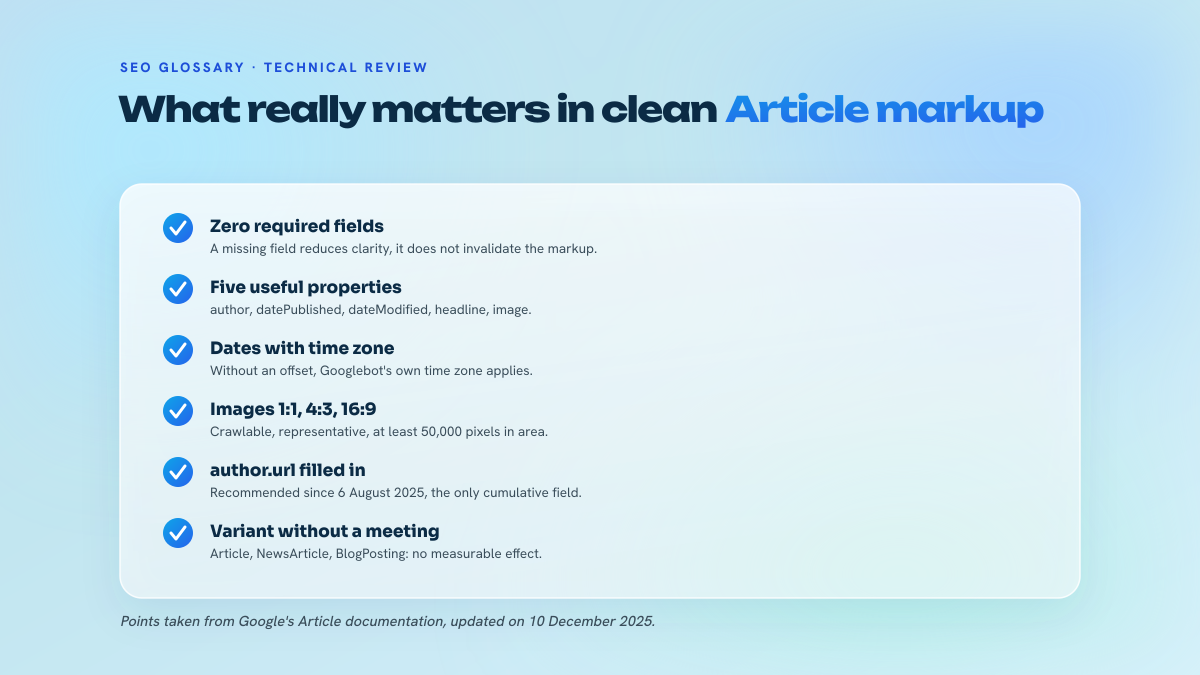
- →Google's Article documentation, last updated December 10, 2025, states there are no required properties: any list of « mandatory Article fields » circulating in SEO content is wrong.
- →Article markup is a content-understanding type, not a ranking lever and not a rich-result guarantee. Treat a schema-only deploy as an interpretation fix, never as a traffic tactic.
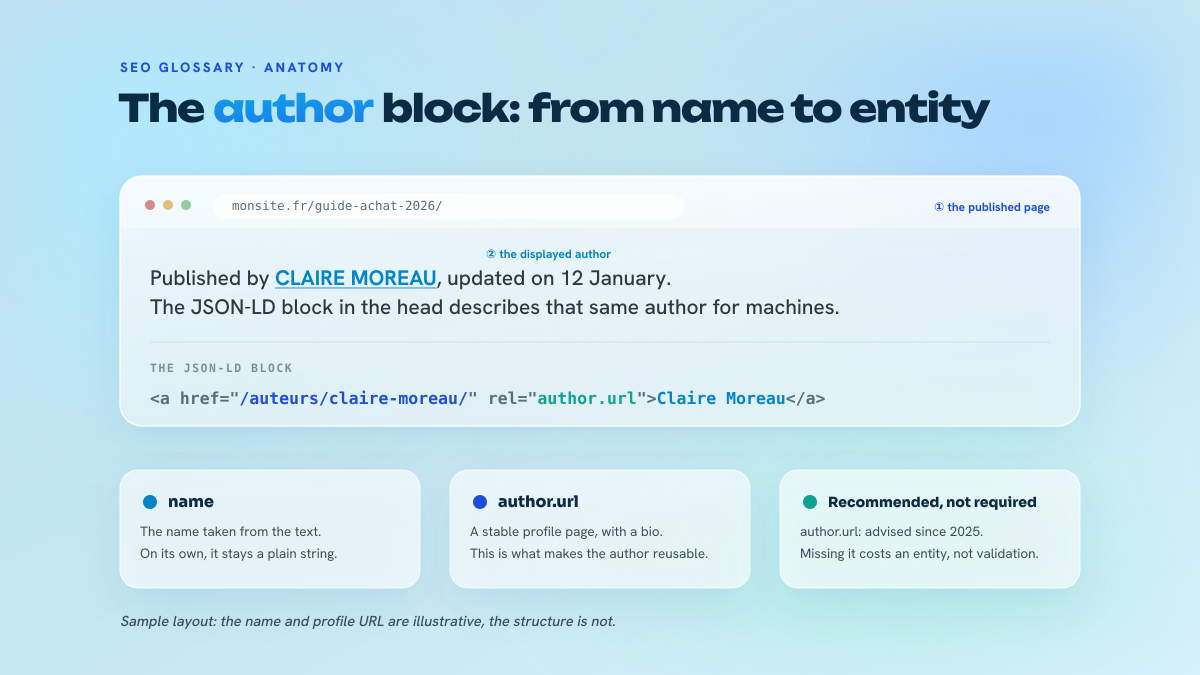
- →The recommended set that actually earns its keep: author with author.url pointing at a stable profile, datePublished and dateModified as ISO 8601 with a timezone offset, headline, and a crawlable image in several aspect ratios.
- →Since August 22, 2025 Google has clarified Article markup applies to all page types, so pick Article, NewsArticle or BlogPosting from the content itself rather than from the site's vertical.
- →The FAQ rich result disappearing from Search on May 7, 2026 is the pattern to internalise: markup whose only justification was a SERP ornament has a shelf life, markup that describes entities does not.
- →Google's May 15, 2026 generative-AI guidance says there is no special markup requirement for AI Overviews or AI Mode, so nobody selling « AI schema » has a Google source to point at.
What Article schema actually is once you strip the myth
Article schema is a vocabulary from the schema.org spec, expressed on a page in JSON-LD, that tells a parser three things it would otherwise have to guess: this document is an editorial article, a named entity authored it, and it carries publication and modification timestamps. Everything else in the type is optional decoration around that core claim. The reason it survives while other structured-data types are being retired is precisely that it does not ask Google for anything. It answers questions Google is already trying to answer with heuristics.
The persistent misreading is that Article markup is a lever. It is not. Deploying it does not add a ranking factor, does not unlock a SERP format on demand, and does not compensate for a page nobody would link to. What it does is reduce ambiguity. When a template exposes a byline in a div, a date in a French long format, and three images of unclear status, a crawler has to infer the author entity, parse the date, and pick a representative image. When the same page ships clean a JSON-LD block in the head, none of that is inference any more. On a single site the difference is marginal. Across a few hundred article templates it is the difference between a coherent author graph and noise.
The honest way to frame it: Article schema is a cheap insurance policy against misinterpretation, not an acquisition channel. Anyone selling it as the latter is selling a 2018 deck.
What Google actually asks for in 2026
Google's Article documentation on developers.google.com was last updated on December 10, 2025, and it says something most SEO content still gets wrong: there are zero required properties. Not « a short list », zero. Every checklist you have read claiming headline and image are mandatory is repeating a legacy assumption. Missing recommended fields can reduce clarity or feature eligibility, but they do not make the markup invalid, and the Rich Results Test will not fail you for them.
The recommended set is short and worth respecting on its merits: author, datePublished, dateModified, headline, image. Two refinements landed in this window and both are operationally useful. On August 6, 2025 Google added author.url as a recommended property, which is the single highest-value change in the whole set, because it turns a name string into a resolvable entity pointing at a stable profile, bio or social page. On August 22, 2025 Google clarified that Article markup is open to all types of pages, correcting the widespread belief that it was reserved for news publishers. Choose Article, NewsArticle or BlogPosting from what the content actually is, not from what your CMS defaulted to.
Two details separate a template that was configured from one that was copy-pasted. Google recommends timezone information on datePublished and dateModified: without an offset, Googlebot's own timezone is assumed, which quietly shifts your freshness signal by hours on a title where hours matter. And the image guidance asks for representative, crawlable images in 1:1, 4:3 and 16:9, with at least 50,000 pixels when width is multiplied by height. Most templates expose one Open Graph thumbnail and stop there, which is a fine default and a missed opportunity on anything competing on visual presentation.
The contraction of rich results, and what it teaches
The real structured-data story of the last twelve months is not about Article at all. It is Google deleting features. On September 9, 2025 the documentation for Course Info, Estimated Salary, Learning Video, Special Announcement and Vehicle Listing was removed, with Google stating those types were no longer shown in Search. Practice Problem left Search Console reporting and the Rich Results Test from January 2026, its documentation removed on April 20, 2026. Then the one that hurt: Google announced on May 8, 2026 that FAQ rich results had stopped appearing in Search as of May 7, 2026, and pulled the documentation on June 15, 2026.
Everyone who had built FAQ blocks into article templates purely to occupy vertical space in the SERP watched that investment go to zero in a day. The lesson is not « Google is unreliable », it is that two categories of markup on a page behave very differently over time. Markup that exists to trigger a visual SERP ornament is rented, and the landlord can end the lease. Markup that describes what a document and its author are is infrastructure, and it keeps paying in interpretation even when no format is attached to it. Article sits firmly in the second category, which is exactly why it survived a purge that took five types out in a single September update.
Practical consequence for a template audit: separate your schema inventory into ornament and description, and stop treating a green Rich Results Test as evidence of value. It only ever proved parseability.
Where it matters in a publishing and netlinking operation
Running editorial media at scale is where Article markup stops being a technical detail. Across the French editorial media we operate in-house, every article template ships the same core block, and the reason is not rich results. It is that a host site whose authors resolve to real profiles, whose dates are honest, and whose article type matches its content reads as a publication rather than as a link container. That is a signal of editorial identity assembled from small consistent facts, and schema is the cheapest place to state them unambiguously. If you evaluate host sites before placing anything, the state of their Article markup is a fast tell: a byline pointing at « Admin » with no author.url is not a disqualifier on its own, but it correlates with everything else being sloppy too. The same check is worth running on any catalogue of media you are about to buy from, and it costs nothing.
The AI angle deserves a blunt correction, because it is being oversold. Google's generative-AI guidance published May 15, 2026 says conventional SEO remains foundational and there is no additional eligibility requirement and no special schema for AI Overviews or AI Mode. Search Engine Journal summarised the same guidance as calling AEO and GEO « still SEO ». So when a vendor tells you Article markup is how you get cited by AI features, ask which Google document says so. There is none.
What the data does show is that citation sourcing has widened. Ahrefs' 2026 analysis of 863,000 keyword SERPs and 4 million AI Overview URLs found that 37.9% of cited URLs also appeared in the top 10 for the same query, 31.2% ranked positions 11 to 100 and 31.0% ranked beyond the top 100, against roughly 76% top-10 overlap measured in July 2025, with Ahrefs warning the two datasets are not perfectly comparable because of methodology changes. Page-one presence still matters and is still bought with links, not with markup, which is why budget conversations about what a placement actually costs remain more consequential than any schema sprint.
Measurement did improve. On June 3, 2026 Google launched dedicated Search Console reports for generative-AI visibility, covering AI Overviews, AI Mode and generative features in Discover for an initial subset of sites, exposing impressions, pages, countries, devices for Search, and hourly through monthly date granularity. Useful for before and after monitoring on article URLs. Useless for attributing a change to schema specifically, since it cannot isolate markup from content quality, links, authority, freshness or query mix. Anyone showing you a schema-attributed AI lift from that report is reading a correlation.
What we see go wrong in audits
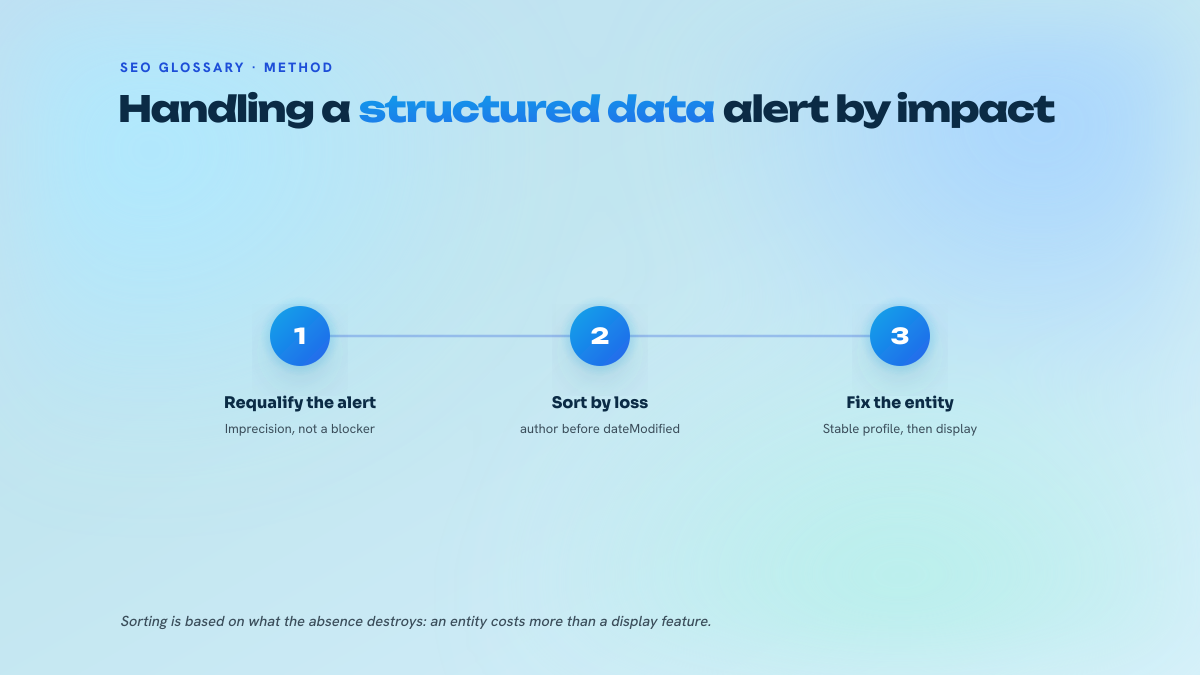
The most common defect is not a missing property, it is a lying one. Templates that write dateModified on every rebuild, so a static 2023 article claims it was updated this morning, are producing a freshness claim that contradicts the visible page. That is the sort of inconsistency worth fixing before adding anything new, because a wrong date is worse than no date.
Second: the author string with no identity behind it. A name that appears in markup, does not link anywhere, has no profile page, and is shared by forty articles across three sites gives a parser nothing to attach. Since author.url became recommended in August 2025, the fix is mechanical and most CMS templates still have not applied it.
Third: markup that contradicts the rendered page. A headline property rewritten for keywords while the visible main heading of the document says something else, an image property pointing at a logo rather than the article visual, a NewsArticle type on an evergreen guide. Schema is a description, and a description that disagrees with the thing it describes is a liability, not a signal.
Fourth, and the one that wastes the most time: schema sprints scheduled as a growth initiative. Adding Article markup to 400 URLs is a half-day of template work whose upside is interpretive cleanliness. Budgeting it as a traffic project guarantees a disappointing report, then a wrong conclusion that structured data does not work.
Tactical position for a working SEO
Ship one Article block per template, not per page, and make it derive every property from the same source of truth the page renders from. Point author at a real profile URL. Emit ISO 8601 timestamps with an offset. Set dateModified only when the body genuinely changed, and wire that to the editorial workflow rather than the build. Expose the article image in the ratios Google names, and let the rest go.
Then stop touching it. Article schema is a solved problem once configured correctly, and the hours you would spend polishing optional properties belong on the two things that still move rankings in 2026: content nobody else has, and links from sites with real editorial identity. Markup makes those two legible. It does not replace either.
Nautilinks operates an owned network of editorial media. In-house written articles, transparency disclosures respected, anchor mix calibrated.
Frequently asked questions
If there are zero required properties, is minimal Article markup enough?
Technically valid, operationally weak. Google's December 10, 2025 documentation confirms nothing is required, so a bare block will validate. But the recommended set exists because those fields answer the questions a parser is otherwise guessing at. Author with author.url, datePublished and dateModified with timezone offsets, headline and a representative image cover almost the entire value of the type. Adding optional properties past that point has produced no measurable return in our audits.
Should I remove FAQPage markup now that the rich result is gone?
No urgency either way. Google stopped showing FAQ rich results in Search from May 7, 2026 and removed the documentation on June 15, 2026, so the SERP upside is zero. Leaving valid FAQPage markup in place does no harm and still describes the content. What you should remove is the template pattern of bolting on FAQ blocks that nobody reads, written solely to trigger the format. That content debt outlives the markup.
Does Article schema help get cited in AI Overviews or AI Mode?
There is no Google statement supporting that. The generative-AI guidance published May 15, 2026 says conventional SEO remains foundational and states there are no additional eligibility requirements and no special schema for AI features. Markup can help a system understand a document, which is not nothing, but treating it as a citation lever is a vendor claim with no source. Ahrefs' 2026 data shows citation sourcing widening beyond the top 10, which is a content and visibility problem, not a markup one.
NewsArticle, BlogPosting or plain Article: does the subtype choice matter?
Pick from the content, which is exactly what Google clarified on August 22, 2025 when it confirmed Article markup applies to all page types. NewsArticle on evergreen guides is the frequent error, and it creates a mismatch between your declared type and everything else about the document, from the URL pattern to the absence of a news publication history. Plain Article is the safe default when a page is editorial but not news and not a blog post.
Can the June 2026 Search Console AI reports measure a schema change?
Not in isolation. The reports launched June 3, 2026 cover AI Overviews, AI Mode and generative features in Discover, with impressions, pages, countries, devices and date granularity from hourly to monthly. That gives you a clean before and after window on specific article URLs. It cannot separate a markup change from content edits, new links, freshness or query mix drift, and at launch it was an impression-visibility view rather than a full AI traffic report.
Is dateModified worth automating from the CMS?
Yes, but from editorial events, not from deploys. The failure we see most often is a build pipeline stamping dateModified on every rebuild, so archived pages claim daily updates while their visible content has not changed in two years. That makes the property meaningless and contradicts the rendered page. Wire it to an explicit content-change flag, keep the timezone offset, and accept that most articles will legitimately carry an old modification date.
Test your knowledge
Quiz: Article schema
1/3According to Google's Article documentation last updated on December 10, 2025, which properties are required?