- →Heading order is not a Google ranking factor (Gary Illyes, July 2024 Office Hours), but it is a strong signal for passage extraction and AI citations.
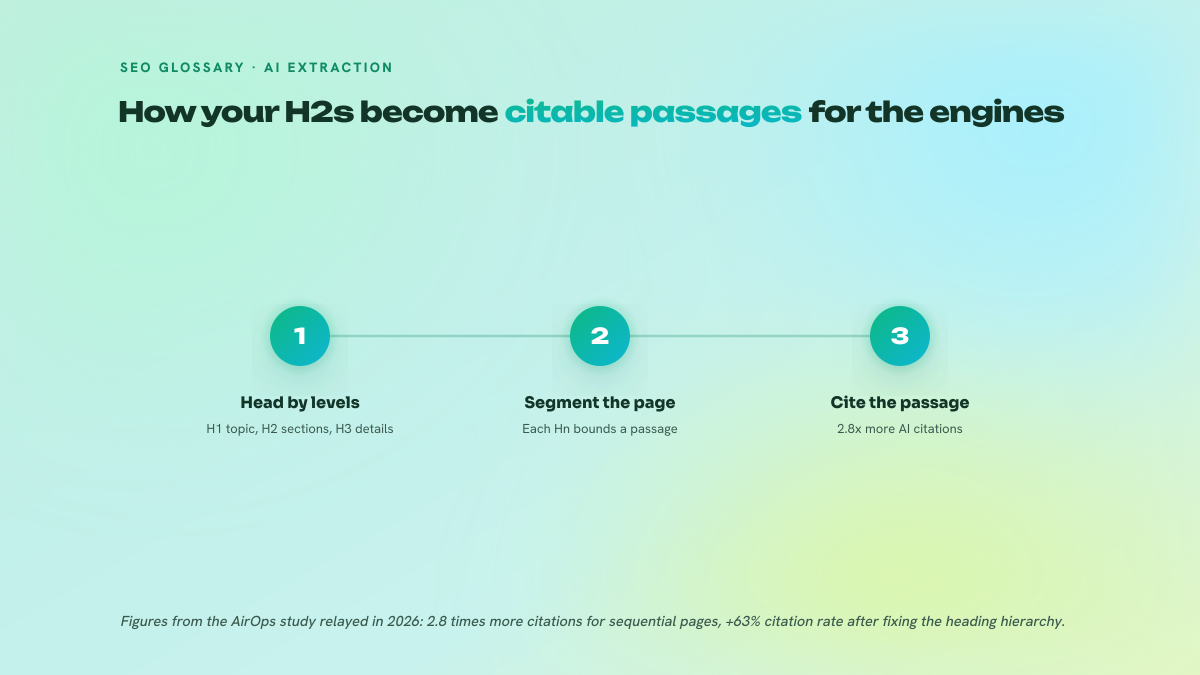
- →Pages with correct sequential H1→H2→H3 structure drew 2.8× more AI citations in a 2026 AirOps study (reported by BlckAlpaca): structure is now a GEO lever, not just tidy HTML.
- →36% of featured snippets pull an H2 as the snippet title (DigitalApplied, 10,000+ page analysis, updated April 2026): your H2 wording is snippet real estate.
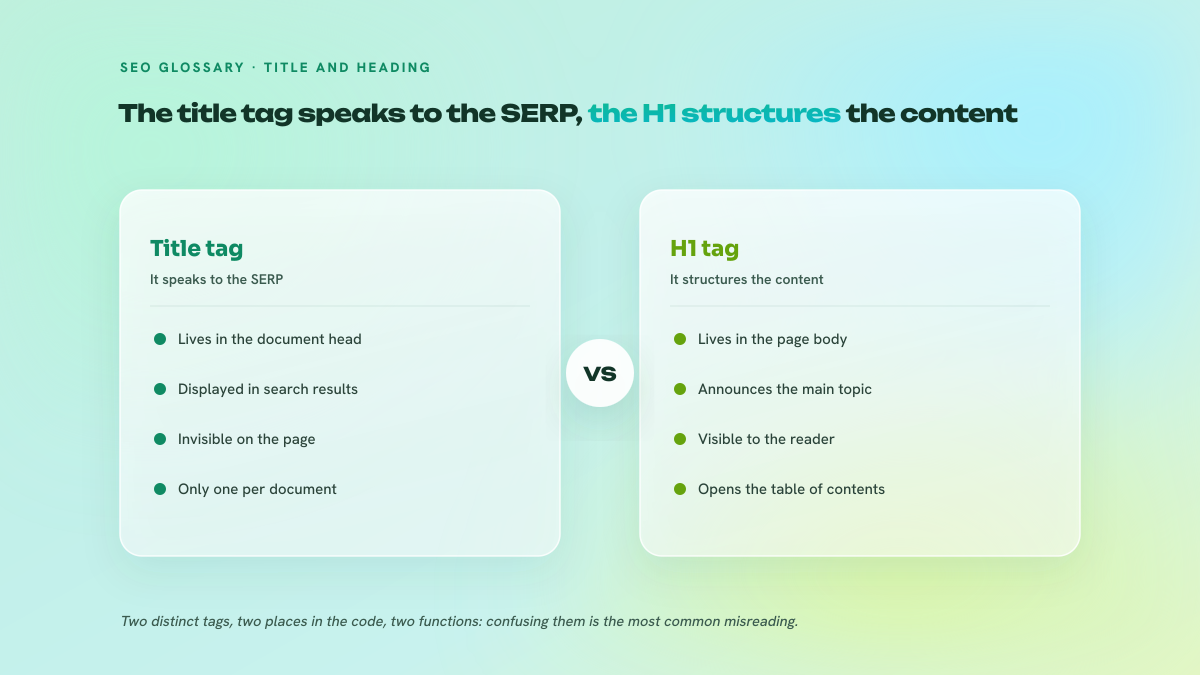
- →A « heading tag » (<h1>-<h6>) and a « header » (<header> landmark region) are not the same thing; conflating them is the most common conceptual error on this topic.
- →H4-H6 are chronically neglected (Web Almanac 2024: only 37% of desktop pages even use an H4); for long reference content that neglect is a real navigability and extraction gap.
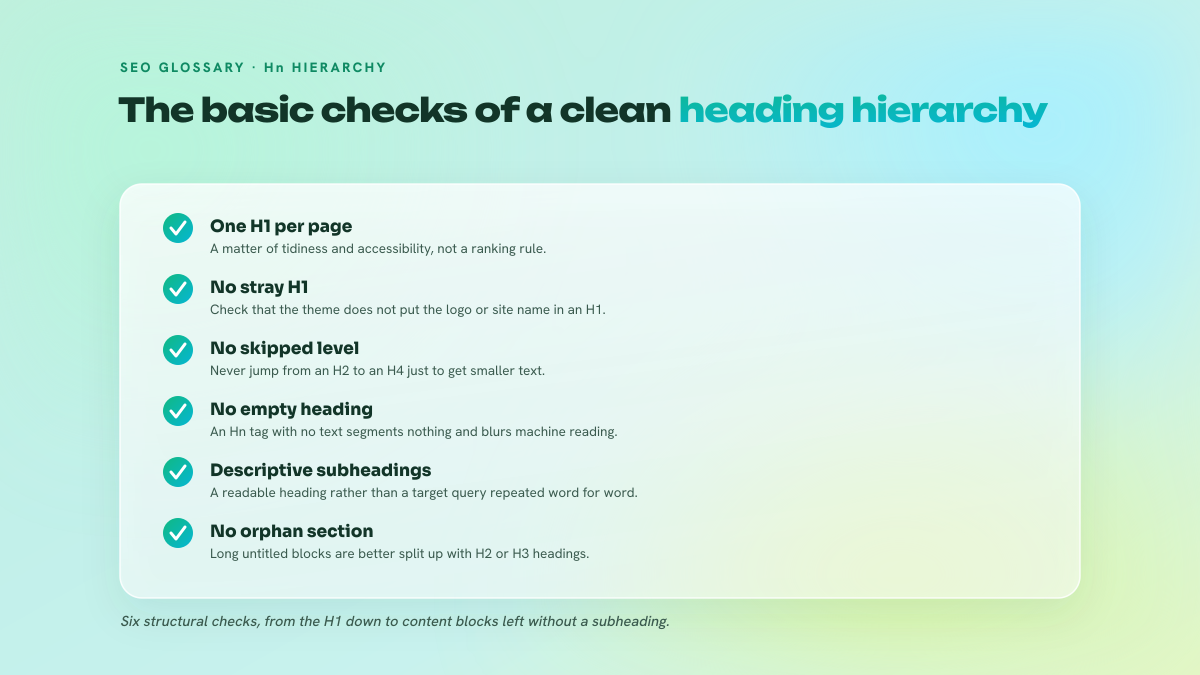
- →Semantics beat styling: a <div> made to look like a heading is invisible to screen readers and extractors, no matter how large the font.
Beyond the tag: what H1-H6 actually signal
Heading tags H1 through H6 are the six HTML elements that mark the heading of a section, from the page-level title down to the smallest subheading. The dictionary line stops there; the operational reality is that they do three separate jobs most tutorials blur together. They give sighted readers a scannable skeleton, they give screen readers a navigable outline, and they give parsers (Google's, and increasingly LLM-based extractors) a map of which text belongs to which topic.
Confusion persists because people conflate « heading tags », « header tags » and the <header> element. A heading tag is one of <h1> to <h6>, it defines a level in the content hierarchy. The <header> element is a landmark region, the introductory block of a site or an article. They are not interchangeable, and calling an <h1> a « header tag » is sloppy shorthand that hides the distinction between a semantic outline and a page region. Most competitor guides never clear this up, which is why the question keeps coming back.
The other job people forget is topical. When a heading defines what a section is about, it acts as a local relevance signal for the block of text underneath it. That matters far more for how a passage gets extracted than for any page-level ranking weight, which is the whole shift we describe below.
How they work in 2026: ranking vs extraction
Start with the ranking question, because it is where most effort is wasted. In a July 2024 SEO Office Hours session, Gary Illyes stated the hierarchical ordering of heading tags is not a ranking factor: Google can understand a page whether or not H1 precedes H2 precedes H3. Google reiterated in September 2024 that multiple H1s do not inherently cause SEO problems and can legitimately divide sections. So the legacy assumption « one H1, strict cascade, or you lose rankings » is outdated for classic organic ranking. Stop auditing for it as if it were a penalty.
What changed is the extraction layer. Content is increasingly consumed by systems that lift passages rather than rank whole documents: featured snippets, and AI Overviews and answer engines. A 2026 analysis by DigitalApplied of more than 10,000 top-ranking pages (updated April 30, 2026) found 36% of featured snippets use an H2 as the snippet title. And a 2026 study attributed to AirOps, reported by BlckAlpaca, found pages with correct sequential heading structure received 2.8× more AI citations than poorly structured pages, with correct heading structure alone lifting AI citation rates by 63%. The mechanism is not mysterious: a clean H2/H3 boundary tells an extractor where an answer starts and where it ends. Muddy the boundary and you make your own content harder to quote.
The semantic baseline is now codified in developer guidance. The Google Developer Documentation Style Guide, updated June 8, 2026, advises organising content hierarchically, giving each page a unique H1, and avoiding skipped levels or empty headings. That is a documentation style guide, not a Search Central ranking document, and it is worth being precise about that. But it captures exactly the structure that extraction and accessibility both reward, which is why practitioners cite it as the practical floor. If you want a page that is easy for answer engines to lift and cite, this is where the work lives, not in chasing a mythical heading-order ranking bonus.
Where headings matter in a netlinking operation
For a netlinking operation, headings matter in two under-discussed places. First, on the money pages you are building links toward. A page that wins a snippet or gets cited by an AI engine compounds the value of every backlink pointing at it: structure and links are complementary levers, not substitutes. Pouring authority into a page whose passages no extractor can cleanly quote wastes part of the campaign. This is also where headings pair with the page's title element, the H1 and the title tag should agree on subject without being carbon copies, so the snippet and the tab label reinforce the same intent.
Second, on the editorial content you place. When you run sponsored or editorial insertions, the article's own heading structure decides whether the host page reads as a coherent piece or a keyword dump. A bolted-on H2 stuffed with the target anchor's keyword is a footprint, the kind an experienced reviewer or an algorithm flags as a paid insert. Clean, descriptive headings are part of what keeps a placed article reading like native editorial. At Nautilinks we operate our own media in-house, and calibrated heading structure is part of what keeps a placement indistinguishable from the surrounding editorial rather than a stapled-on insert. That is an operational point, not a pitch: the sites that survive scrutiny are the ones whose structure was never gamed.
Headings also feed the internal links inside a page: descriptive H2s become natural jump-link destinations and give crawlers and readers a table of contents for free. A well-headed long-form page is easier to interlink precisely, which is quiet leverage most audits overlook.
What we see go wrong in audits
The adoption data sets the scene. Web Almanac 2024 reports 70% of desktop pages had an H1, 71% an H2, 59% an H3, and only 37% an H4. The tail thins fast, and the gap between « has an H1 » and « has a usable outline » is where most sites live. From what we see in audits, the recurring failures cluster:
<div>or<span>styled to look like a heading. Visually it reads as a heading, semantically it is invisible. Screen readers and extractors skip it entirely, so a big bold line contributes nothing to the outline.- Skipped levels, jumping H1 to H3. Not a ranking penalty per Illyes, but it breaks the accessibility outline and blurs the passage boundaries that snippet and AI systems depend on.
- Multiple H1s used carelessly. Allowed since 2024, but when every hero, sidebar and widget ships its own H1, the outline loses all meaning.
- Headings written for the crawler, not the reader. Keyword-stuffed H2s no human would scan, which is exactly what search intent alignment is supposed to prevent.
- Empty headings, or headings with no content beneath them, which the Google style guide now explicitly warns against.
The H4-H6 neglect is the differentiator almost nobody covers. Most guides stop at H3 and so do most authors. For a 3,000-word reference page, H4 and H5 are what turn a wall of H2s into something a reader, a screen reader and an extractor can all navigate. Treat the thin H4 adoption in the Web Almanac data as an opportunity, not a norm to copy.
Tactical takeaways for a working SEO
Write headings as answers, not labels. A question-based or definitional H2 that mirrors the query is what extraction systems reward, and the MQLMagnet 2026 header-tag analysis reports AI engines preferentially cite from sections under question-based and definitional H2s. Front-load the actual answer in the first sentence under each H2 so a passage lifter grabs a complete, self-contained response.
Keep one H1 that names the page's subject and shares intent with the title tag without being identical. Use H2 for the genuine sections, H3 for sub-points, and reach for H4 and beyond only when the depth of the content demands it. Do not skip levels, not because Google penalises it, but because both the accessibility outline and the passage map break when you do. Include the primary term where it reads naturally and stop there: intent match first, keyword second.
Audit the outline, not just the presence of tags. Browser dev tools let you inspect the rendered hierarchy, and an accessibility checker such as WAVE surfaces the heading tree and flags empty, skipped or out-of-order headings that a keyword tool will never catch. The point of headings in 2026 is not to satisfy a ranking rule that Google has told us does not exist; it is to make your content trivially easy to read, navigate and quote. That is the version of on-page structure that still moves numbers.
Nautilinks operates an owned network of editorial media. In-house written articles, transparency disclosures respected, anchor mix calibrated.
Frequently asked questions
Does having multiple H1 tags hurt SEO in 2026?
No. Google confirmed in September 2024 that multiple H1s do not inherently cause SEO problems, and Gary Illyes said heading order is not a ranking factor. The practical caveat is accessibility and extraction: a screen reader outline and an AI passage splitter both read cleaner with one dominant H1 that names the page. Use multiple H1s only when the layout genuinely has co-equal top-level sections, not by accident across hero, sidebar and widgets.
What is the difference between a heading tag and a header tag?
A heading tag is one of <h1> through <h6>, marking the heading of a content section and its level in the outline. « Header » usually means the HTML <header> element, a landmark region for introductory content like a site or article header. One defines the semantic hierarchy, the other defines a page region. They get conflated constantly, but an <h1> sitting inside a <header> are doing two entirely different jobs.
If heading order is not a ranking factor, why bother with hierarchy?
Because ranking is not the only consumer. Screen readers navigate by heading level, so a broken outline is an accessibility failure. And passage-based systems, featured snippets and AI Overviews, rely on clean H2/H3 boundaries to know where an answer begins and ends. A 2026 AirOps study reported by BlckAlpaca tied correct sequential structure to 2.8× more AI citations. Getting order right costs nothing and pays off in extraction, so there is no reason to skip it.
Should H2s contain the target keyword for a page we are building links to?
Include the primary term where it reads naturally, but write the H2 as an answer or a real section label, not a keyword slot. Extraction systems and snippet selection favour descriptive, query-matching H2s, and a stuffed heading reads as a footprint on any placed article while helping nobody. Match search intent first and keyword second, especially on a page you are pointing paid links at.
Do H4, H5 and H6 matter, or can I stop at H3?
For short pages, H1 to H3 is usually enough. For long reference content, stopping at H3 flattens a page that needs depth. Web Almanac 2024 found only 37% of desktop pages even use an H4, so proper H4-H5 nesting is both under-used and a real advantage: it makes a long page navigable for readers, screen readers and extractors alike. Use them when the content genuinely has sub-sub-sections, never to pad.
Test your knowledge
Quiz: Heading tags (H1-H6)
1/3What did Gary Illyes clarify about heading tag hierarchy in a July 2024 Office Hours session?