SEO Glossary · On-page

Alt text

Alt text is the string that replaces an image when the image is gone: unloaded, or read aloud by a screen reader. In 2026 that same string is also one of the few textual handles Google Images, Lens and AI answer engines have on your visuals. Written for the reader it works for search. Written for the crawler it fails both.

Key takeaways The essentials in 30 seconds
  • A missing alt attribute and an empty one are not the same defect: no attribute leaves screen readers announcing a filename, while alt="" tells them to skip a decorative image on purpose.
  • Short beats stuffed. An analysis of 17.5M images published by imageseo.io on 6 May 2026 found alt text under 40 characters outperformed longer keyword-heavy alt by 34% in Google Images impressions.
  • Alt text is context-dependent, so the same photo legitimately gets different alternative text in two different articles. Any workflow that stores one alt value per file is structurally wrong.
  • AI answer surfaces read images through their metadata: imageseo.io reports product images with optimized alt drew 3 to 6 times more citations across ChatGPT, Perplexity and Claude web tools in a Q3 2025 look at 40 e-commerce sites.
  • The accessibility framing is the operational one. Google's own line, per John Mueller in October 2025, is that alt choice is not primarily an SEO decision, and writing for the screen reader user happens to produce the description search engines want.
  • Auto-generated alt describes pixels, not purpose. Treat AI or Microsoft 365 output as a first draft for a legacy library, never as the shipped state on informative images.
3 questions to test your knowledge Read first, the quiz is waiting at the bottom.
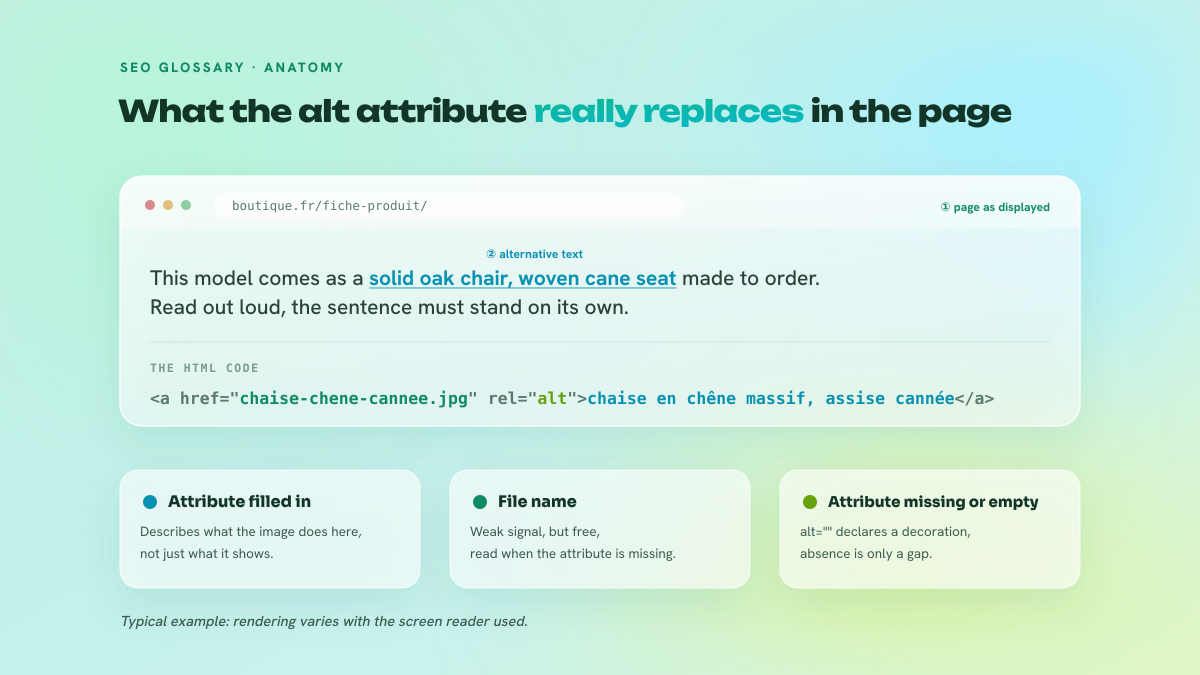
Diagram of a product page whose image is hidden: the alternative text takes its place in the spoken sentence, with the detailed HTML code below and a legend of the three attribute cases.
Alt text is a functional substitute for the image, not a keyword field.

What alt text really is

The alt attribute is not a caption, not a tooltip, and not a place to park keywords. It is the textual replacement rendered when the image is absent, and the string a screen reader announces instead of the visual. That replacement framing is the whole discipline: the test for good alternative text is not « does it contain my target term », it is « if I delete the image and drop this sentence in its place, does the paragraph still convey the same information ».

The spec side is short. WCAG 2.2 success criterion 1.1.1, Non-text Content, Level A, requires every non-text element to carry a text alternative serving an equivalent purpose, with named exceptions for decoration, controls, CAPTCHAs and tests. HTML requires the attribute on every img, it does not require content inside it. And an image with no alt attribute at all behaves differently from one with an empty attribute (alt=""): the first can be announced as a filename or a raw URL, the second is skipped silently by assistive technology. That one distinction resolves more accessibility findings than any generator ever will, because it separates « we forgot » from « this image is purely decorative and we said so ».

A two-minute primer on the concept, useful to hand to a client stakeholder who keeps confusing alt with caption:

Put it into practice?

Nautilinks operates an owned network of editorial media. In-house written articles, transparency disclosures respected, anchor mix calibrated.

See pricing → Buy backlinks service
BD
Benoit Demonchaux Founder · Nautilinks

Founder and operator of Nautilinks. Edits and writes the site's editorial glossary, as well as the content published across the Nautilinks network of editorial media.

Frequently asked questions

Does putting a keyword in alt text still influence rankings in 2026?

Marginally, and only when the term genuinely describes what is visible. Alt remains a primary text signal for the image itself, so a photo of a solar inverter described as a solar inverter reinforces topical relevance. What no longer works is engineering the string around a target phrase: the 17.5M-image analysis published by imageseo.io in May 2026 found short alt outperforming longer keyword-heavy alt by 34% in Google Images impressions. Describe first, and the keyword usually appears on its own.

When should alt be empty rather than descriptive?

When the image adds no information the surrounding text does not already carry. Decorative separators, background textures, mood shots that illustrate a paragraph without extending it, and icons sitting beside their own visible label all take an empty attribute. WCAG 2.2 explicitly allows this for decoration. The one case where empty is a bug: an image wrapped in a link, where the alt supplies the link's accessible name, so an empty value produces a link a screen reader cannot announce.

Is there a hard character limit?

No specification imposes one, and older claims about a fixed screen reader cut-off describe historical behaviour in specific tools rather than a standard. Practically, brevity wins on both fronts: the imageseo.io dataset points to alt under 40 characters performing better in image impressions, and listeners tire of long strings. If your description genuinely needs two sentences, that is a signal the image is complex and the detail belongs in on-page text or a data table instead.

Can I ship AI-generated alt text at scale?

As a first pass on an undescribed legacy library, yes. As a finished state on informative images, no. Generators describe what is in the frame without knowing why the image is in your paragraph, so they produce technically true descriptions that miss the point: the chart gets called a chart, not what it demonstrates. Our approach is to auto-draft, then have the writer rewrite anything informative in the same pass as the article. Automation gets you coverage, a human gets you equivalence.

Same image reused on ten pages: same alt everywhere?

No, and this is where most CMS media libraries fail structurally by storing one alt value per file. Alternative text describes the image's role in a specific context, so a workshop photo takes one description in a piece about craft technique and another in a piece about regional employment. Where the platform allows a per-insertion override, use it. Where it does not, write for the page that matters most and treat the rest as acceptable approximation.

How do I know whether alt work had any effect?

Filter the Search Console Performance report by Search type Image and watch impressions on the affected URL set against an untouched control group, over at least eight weeks. Do not expect a session curve to move: image search traffic is a small share of most B2B sites. Also crawl for missing and empty alt before and after, because the defect count is the part you fully control, whereas impressions depend on demand for those visuals.

Quiz

Test your knowledge

Quiz: Alt text

1/3

An image is wrapped in a link and given an empty alt attribute. What is the consequence?

Newsletter

GEO + SEO analyses and network case studies, in your inbox

Once or twice a month at most. No filler. One-click unsubscribe.

By subscribing you agree to receive our emails. See our privacy policy.

Checklist distinguishing the alt attribute, the empty alt attribute, the missing attribute, the title attribute, the visible caption and the file name.
These elements coexist and play different roles: confusing them skews the audit.

Why it matters more in 2026, not less

Google's public position has not moved: on 29 October 2025, John Mueller was quoted saying that the choice of alt text is not primarily an SEO decision, insisting on its accessibility purpose and warning against writing it for rankings (Stan Ventures, October 2025). Read that as a description of intent, not of weighting. Alt remains one of the few text signals available for an image file, and every serious 2026 image SEO guide still ranks filename plus alt as the two highest-impact image signals for Google Images and for reinforcing what a page is about.

What changed is where that string gets consumed. Visual search stopped being a niche: a 2026 image SEO roundup puts Google Lens at more than 20 billion visual searches per month, up 43% on 2024 volume. In parallel, the classic click is thinner. A SE Ranking study across 100,000 keywords found AI Overviews on roughly 28% of queries in May 2025, and Ahrefs' 2026 statistics compilation reports organic CTR on AI Overview queries falling from 1.76% in June 2024 to 0.61% in September 2025. When the answer is assembled above the links, being the image inside that answer is worth more than being the tenth blue link under it, and the selection layer reads your image through its surrounding text and its metadata.

There is early evidence that this is measurable. imageseo.io reports that across 40 e-commerce sites in Q3 2025, product images with optimized alternative text drew 3 to 6 times more citations in AI search tools including ChatGPT, Perplexity and Claude web integrations than images with missing or generic alt. On the accessibility side, AccessibilityChecker.org's 2026 analysis of more than 800 websites found 73.4% recorded increased organic traffic after accessibility work, averaging a 12% traffic gain within three months. Be honest about what that second number proves: those programmes bundled alt text with headings, contrast and structure fixes, so it is a correlation on a package, not a causal alt-text multiplier. Cite it as evidence that accessibility work pays, not as a promise that filling 400 alt attributes moves your curve 12%.

Alt text inside a real publishing operation

The organisational question decides quality: who writes the string. When alt text is a developer task, it becomes a build step and you get file descriptions. When it is a writer task, done in the same pass as the paragraph the image sits in, you get descriptions that carry the article's meaning, because only the writer knows why that visual is there. Across the 50 owned French editorial media we run in-house at Nautilinks, alternative text is written by the person writing the article, in the editor, before publication. It is not a post-hoc sweep, and it is not delegated to a plugin.

That matters beyond our own sites. If you place content on third-party media, whether through a network or a marketplace, the images that ship with your piece are part of the deliverable. A sponsored article published with its illustrations properly described earns image-search surface for the host page and reads as editorial rather than as dropped-in filler. Ask what happens to your alt attributes in the publisher's CMS: some strip them, some overwrite them with the media library default. On the media catalogue you can browse without creating an account, that kind of on-page hygiene is checkable before you commit, which is the point of transparency on the supply side.

Measurement is unglamorous and sufficient. Crawl the site and pull the missing-alt and empty-alt reports, then triage rather than bulk-fix: every informative image without an attribute is a defect, every decorative one with a description is noise. In Search Console, filter the Performance report by Search type Image to see whether the library is earning impressions at all, and watch it after a fix wave. Treat the same care you give a page title written for a human scanning a SERP as the standard for alt: both are short strings whose job is to describe, not to rank.

Three numbered steps: sort images by their role, describe what the image adds, then read the page aloud to validate the alternative text.
Sorting up front removes most of the writing work on a large catalogue.

Writing alternative text that holds up

Start from function, not from content. Ask what the image does in the page: does it carry information the prose does not, does it duplicate the prose, does it decorate, does it act as a link or a button. Informative images get a description of the information. Redundant ones get an empty attribute so screen reader users are not told the same thing twice. Linked images get the destination as their accessible name, because the alt becomes the link text.

Then be concise. The imageseo.io analysis of 17.5M images processed through its plugin, published 6 May 2026, found images with alt text under 40 characters outperformed longer, keyword-stuffed alt by 34% in Google Images impressions. Impressions, not clicks, and the comparison bundles brevity with the absence of stuffing, so the safe reading is: a tight description of what is visible beats a long descriptive sentence engineered around search terms. Skip « image of » and « photo of », the technology already announced that it is an image. Include your topic term only when it genuinely names what is on screen. And accept that alt is context-dependent: the same photo of a warehouse deserves one description in a logistics explainer and a different one in a piece about industrial architecture. Any pipeline that stores a single alt value per file, which is what most CMS media libraries do by default, is structurally unable to get this right.

A practical, example-driven walkthrough of the same principles, worth watching before you brief a content team:

What we see go wrong

The filename left in place, IMG_4821.jpg or capture-decran-2026-03-11.png, announced word by word to a user with a visual impairment. That is the single most common finding in audits, and it is worse than an empty attribute because it actively wastes the listener's time.

Then stuffing. Comma-separated keyword chains inside alt were a 2012 tactic and they now read as a spam signal to any reviewer, human or automated, while degrading the experience for the users the attribute exists for. Close behind: alt duplicating the caption verbatim, so the same sentence is read twice; decorative dividers, shadows and background flourishes given full descriptions, which pads the audio experience with nothing; and icons that sit next to their own text label, again described, again redundant. Empty alt is the right answer more often than teams expect.

The failure with real consequences is the linked image with an empty attribute. Wrap an img in an anchor, leave alt="", and you have shipped a link with no accessible name: a screen reader announces « link » with nothing after it. Automated checkers catch this, so it also shows up as a WCAG violation in any accessibility report a client commissions. In the United States alone, a 2026 accessibility SEO review counts more than 4,000 ADA website accessibility lawsuits filed in 2024, which is the compliance context this sits in.

Finally, automation treated as a finish line. Microsoft 365 generates automatic alt text in Office documents, and tools like AltText.ai do the same at scale for the web. They describe pixels competently and purpose not at all, because they cannot know why an image is in your paragraph. Use them to triage a legacy library of thousands of undescribed files, then have a human rewrite anything informative. Bulk-generating alt across an archive and closing the ticket produces a site that passes a count-based check while remaining unusable, and that is the version of compliance nobody should sign off.

Charts, infographics, icons: the hard cases

Complex visuals break the one-string model, and this is where most guides stop. The decision is a short chain. If the image carries no information absent from the surrounding text, it gets an empty attribute. If it carries information that fits in a phrase, the phrase is the alt. If it carries information that does not fit, the alt states the takeaway and a longer description carries the data.

For a chart, that means the alt says what the chart shows and what it concludes, something like « Line chart: French referring domain prices rising from 2020 to 2026 », while the underlying figures live in the page as an HTML table or a paragraph next to it. Do not attempt to voice a dataset inside an attribute. For an infographic, the alt is the infographic's title and the actual content belongs on the page as real text, which is also the only version search engines and AI answer surfaces can read. Logos take the brand name, and if the logo links home, the accessible name should express that destination. Screenshots get described by what the user is meant to notice in them, not by every element in the frame. Product photos take the model, the material and the angle, in that order of usefulness to someone deciding whether to buy.

Handled this way, the alternative text layer becomes part of the page's semantic structure rather than a compliance afterthought, in the same way that the way you connect pages to each other tells a crawler what your site is about. Different image types, walked through with examples:

The working rule for 2026: write the sentence you would say out loud to describe the image to someone who cannot see it, keep it short, and stop. That string will satisfy WCAG 1.1.1, feed Google Images and Lens, and give an AI answer engine something accurate to quote. Three outcomes, one piece of writing, no separate SEO version required.