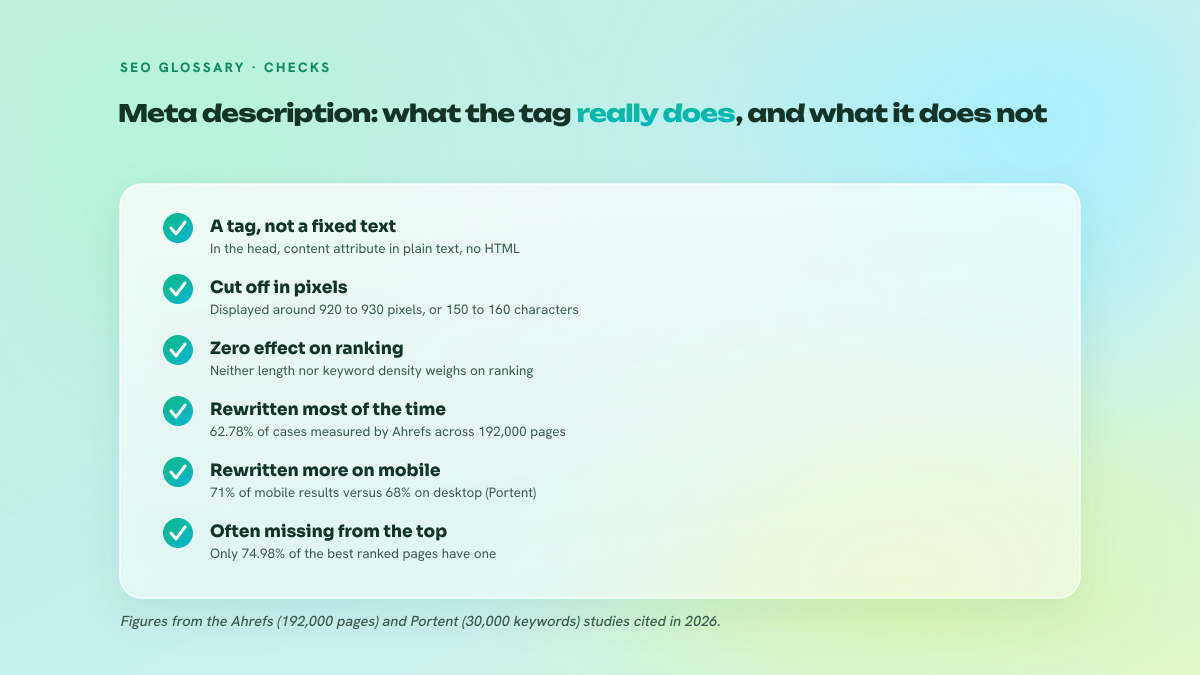
- →The meta description is not a ranking factor and never has been: it is a snippet proposal, and Ahrefs measured that Google overrides it 62.78% of the time across 192,000 pages.
- →Truncation is decided in pixels, not characters: roughly 920 to 930 pixels, which lands near 150 to 160 characters. Character counters in SEO plugins are approximations, not rules.
- →Prioritize by impressions, not by crawl completeness: hand-write descriptions for the pages that already earn SERP impressions in Search Console, template or skip the rest.
- →Rewrites are query-driven. A description gets replaced when it fails to match the query that triggered the impression, so write for the dominant query cluster of the page, not for the page in the abstract.
- →On publisher-side netlinking, snippet quality is not cosmetic: a linking page that never earns a click feeds weaker engagement signals, and click data demonstrably feeds Google systems like Navboost.
- →Fixing missing meta descriptions across an entire site is mostly audit theater. The measurable lever is CTR on the top 20 to 50 impression-earning URLs, everything else is hygiene.
What a meta description really is (and what it never was)
Strip the tutorial-blog framing and the meta description is a one-line pitch you submit to Google for display in the SERP, with no guarantee it gets used. Technically it is a single tag in the <head> of the page: <meta name="description" content="Your summary here.">. That is the entire specification. It renders nowhere on the page itself, users only ever meet it as the grey snippet text under your blue link, and increasingly they meet Google's own rewrite of it instead.
What it never was is a ranking factor. Google has been consistent on this for over a decade, and John Mueller reiterated it again in guidance widely relayed through 2026: descriptions are used as snippets, «not something that we would use for ranking». The confusion persists because the description sits next to the title tag, which does carry ranking weight, and because SEO plugins score both with the same traffic-light UI. They are not the same class of object. The title is an input to relevance scoring. The description is an input to a human decision: click or scroll past.
That distinction dictates the effort model. You do not optimize a meta description for an algorithm. You write it for the two seconds a searcher spends scanning ten results, on a page where your competitors' snippets sit four pixels away. The correct mental model is ad copy with a 60% chance of being replaced by the publisher.
How Google actually handles your description in 2026
Google Search Central's snippet documentation, refreshed in April 2026, is unambiguous: snippets are primarily generated from page content, and the meta description is used only when Google judges it a better summary than what it can extract itself. Google also states it cannot manually change snippets for individual sites. There is no appeal process. You propose, the query decides.
The numbers on how often your proposal loses are well established. Ahrefs' large-scale study of 192,000 pages found Google rewrote the meta description 62.78% of the time, and that only 74.98% of top-ranking pages even had one. Portent's analysis of 30,000 keywords found rewrites on 71% of mobile results and 68% of desktop results. More recent 2024 and 2025 measurements cited in industry syntheses push past 80% on some query sets. Whatever the exact figure on your vertical, the operational reading is the same: the majority of impressions show text you did not write.
For a walkthrough of how Google itself frames what a description should do, this is worth twelve minutes of your time:
The mechanics of truncation matter more than the folklore around them. The SERP allots roughly 920 to 930 pixels of snippet width, which lands near 150 to 160 characters for average letter widths, occasionally stretching toward 300 characters on some results and up to around 1500 pixels on question-shaped snippets, per 2026 measurements compiled by Morningscore and others. The takeaway is that there is no magic character count. Mueller has explicitly pushed back on plugin thresholds as arbitrary. Front-load the value in the first 120 characters and stop obsessing over the counter turning orange.
Why does Google rewrite at all? Because the snippet is assembled per query, not per page. A page ranks on dozens of query variants, and your single static description can only match one intent. When someone searches a long-tail variant, Google extracts the passage of your content that answers that variant. This is not a bug to fix. It is free per-query copywriting, and it explains why pages with strong, well-structured body content often get better snippets than pages with polished descriptions and thin content.
Writing descriptions that survive the rewrite
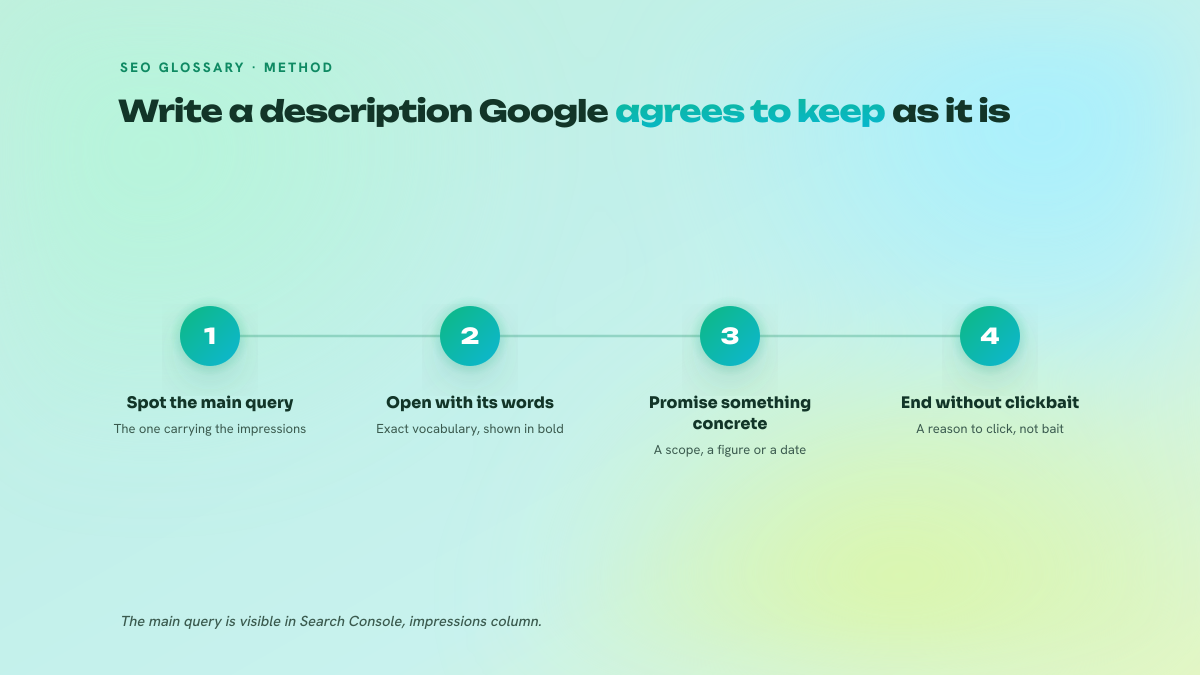
A description survives when it matches the dominant query cluster of the page better than anything Google can extract. That is the whole craft. Start from Search Console: identify the queries actually generating impressions for the URL, and write the description as a direct answer to the head query of that cluster. A description written for the page in the abstract, «Discover our complete guide to X», loses to extraction almost every time because it describes the page instead of answering the query.
This practical walkthrough covers the writing mechanics well:
What we see hold up in practice: include the primary keyword once, because Google bolds query-matching terms and the bolding draws the eye, not because it scores anything. Use active voice and a concrete claim rather than an invitation. State what the page delivers that the SERP competitors' snippets do not, which requires actually reading those snippets before writing yours. Keep one description per page, unique, and accept that uniqueness only matters on pages that earn impressions. And write the description last, after the content, because a description drafted before the content is a promise the page may not keep, and mismatch between snippet and landing content is what produces the pogo-sticking you spent the rest of your on-page work avoiding.
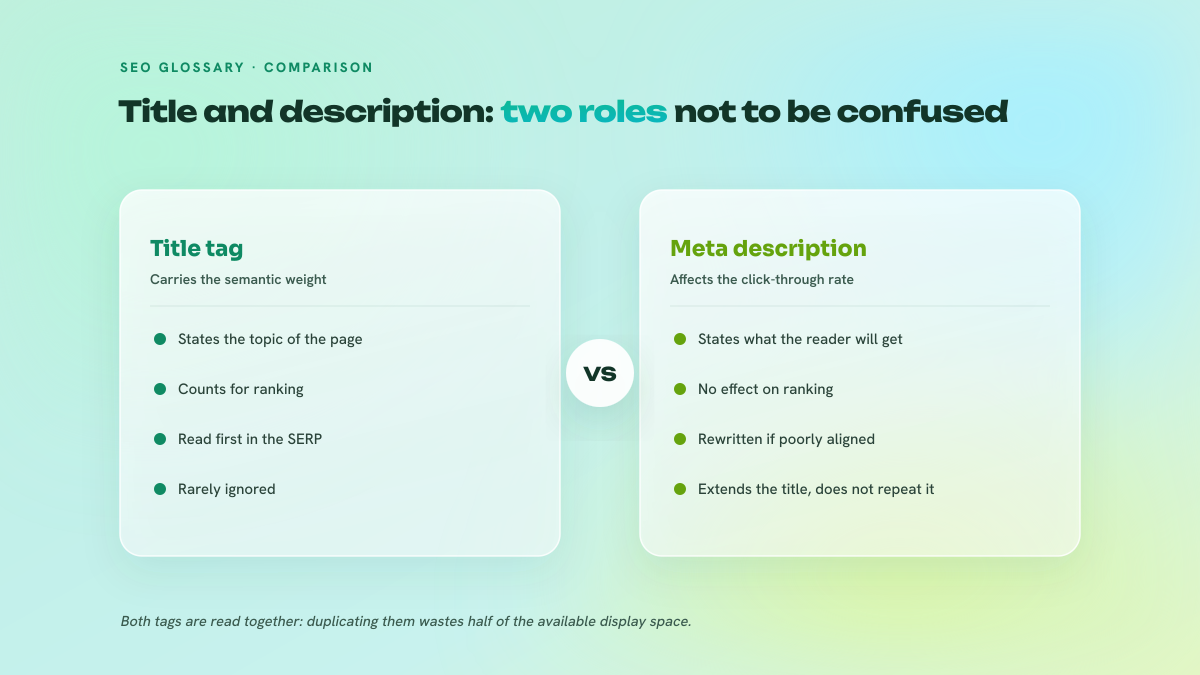
One structural note: the snippet is a system of two lines, not one. Title and description get read as a unit, so do not repeat the title's information in the description. The title claims the topic, the description makes the case. When both say «Best CRM software 2026», you have spent your two lines saying one thing.
Where meta descriptions fit in a netlinking operation
This is the angle the tutorial content never covers. In a link-selling or link-buying operation, the meta description sits on the publisher side of the value chain. A sponsored article that ranks but never gets clicked is a weaker asset than one that earns clicks: click behavior feeding Google's ranking systems is no longer speculative since the 2024 documentation leak put Navboost and click signals on the record. A linking page with a snippet that invites the click accumulates the engagement that keeps it indexed, crawled, and passing value.
Across the media we run in-house at Stringer, the policy is deliberately two-tier: article templates generate a serviceable default description from the lede, and human-written descriptions are reserved for the pages that Search Console shows earning real impressions. That is the honest cost-benefit line for any catalog of editorial sites, and it is the level of operational detail worth checking when you evaluate inventory: on a platform where every medium's metrics are public, you can verify whether a publisher's pages actually earn clicks or merely exist.
The same logic applies buyer-side. Before placing a link on a page, look at how that page presents in the SERP for its own queries. A hosting page with a missing or boilerplate description on a site full of them tells you something about how the publisher maintains inventory. Snippet hygiene is a cheap proxy for editorial seriousness, the same way the internal linking around the article slot tells you whether the page will keep receiving crawl attention after publication.
The mistakes we keep seeing in audits
The most expensive mistake is not a bad description, it is misallocated effort. The classic audit deliverable, «rewrite all 4,000 missing or duplicate meta descriptions», is mostly theater. Ahrefs found a quarter of top-ranking pages have no description at all, and they rank fine, because Google generates a snippet from content regardless. Rewriting descriptions on pages with zero impressions changes nothing measurable. The defensible version of that recommendation is: fix the top 20 to 50 URLs by impressions where CTR underperforms the position benchmark, template the rest.
After that, the recurring offenders are predictable. Boilerplate duplicated across paginated or faceted URLs, which wastes the one snippet those pages might earn. Keyword stuffing, which Google's own documentation calls out and which triggers rewrites at a higher rate, so the stuffed description does not even get displayed. Descriptions that promise what the page does not deliver, which win the click and lose the visit. And teams burning hours nudging descriptions from 162 to 158 characters because a plugin turned orange, on pages where Google was going to rewrite the snippet per query anyway.
There is also a measurement mistake worth naming: judging a description change by ranking movement. The tag does not rank. The only honest KPI is CTR at stable position in Search Console, compared over symmetric before-and-after windows. If you cannot isolate that, you cannot claim the win.
Tools, AI generation, and when to skip the tag entirely
The tooling stack is short. Search Console is the prioritization layer: impressions and CTR by URL tell you where a description is worth human time. Screaming Frog or any crawler handles the inventory layer: missing, duplicate, and truncation-length descriptions at scale. SERP feature trackers tell you when the point is moot because the query triggers an AI Overview or featured snippet that bypasses your description entirely.
AI generation is now the default for scale, and used correctly it is fine:
The correct use is templating the long tail: feed the model the page content plus the top Search Console queries for the URL, and you get a defensible default at near-zero cost. The incorrect use is generating 10,000 descriptions from titles alone, which produces exactly the interchangeable boilerplate that Google rewrites at the highest rates. The model does not fix the strategy error of writing descriptions nobody prioritized.
When to skip the tag entirely: on pages that rank exclusively on long-tail variants, Google's per-query extraction will outperform your static text, and the Search Central documentation effectively endorses letting it. Skipping is not negligence there, it is delegation. Where you should never skip: your commercial pages, your highest-impression informational pages, and any page competing in a SERP where every competitor's snippet is hand-written. In 2026, with rewrite rates above 60% and AI surfaces eating clicks at the top of the SERP, the meta description is a smaller lever than it was in 2016. It is not zero. It is fifteen minutes of copywriting on the pages where fifteen minutes pays for itself, and a template everywhere else.
Nautilinks operates an owned network of editorial media. In-house written articles, transparency disclosures respected, anchor mix calibrated.
Frequently asked questions
If Google rewrites more than 60% of descriptions, why write them at all?
Because the 30 to 40% that survive concentrate on your head queries, which are the impressions that pay. Ahrefs measured 62.78% rewrites across 192,000 pages, but survival is not random: descriptions that match the dominant query cluster survive far more often. Write them where impressions concentrate, let Google extract everywhere else. The cost-benefit is fifteen minutes per URL on your top 20 to 50 pages.
Is there any scenario where the meta description affects ranking?
Not directly, and Google has confirmed this repeatedly. Indirectly, yes: the description influences CTR, and click behavior feeds Google systems like Navboost, on the record since the 2024 documentation leak. The chain is description, click, engagement signal, and each link weakens the attribution. Treat it as a CTR lever with a plausible second-order effect, never as a ranking input you can tune.
How do I prove a description rewrite actually worked?
CTR at stable position in Search Console, over symmetric before-and-after windows. Filter the URL, check that average position held within a few decimals, then compare CTR. If position moved, the comparison is contaminated because CTR varies enormously by position. Also verify in the live SERP that Google is actually displaying your description for the queries you measured, otherwise you are measuring Google's rewrite, not your copy.
Should I bulk-generate descriptions with AI across a large site?
For the long tail, yes, with one condition: feed the model the page content plus the URL's actual Search Console queries, not just the title. Title-only generation produces boilerplate that Google rewrites at the highest rates, which makes the exercise pointless. Keep human-written descriptions for the pages where impressions concentrate. The model handles scale well, it does not handle prioritization at all.
Does description length matter, and what is the real limit?
The limit is pixel width, roughly 920 to 930 pixels, which approximates 150 to 160 characters depending on letter widths. Google has stated length is not a ranking factor and that plugin character thresholds are arbitrary. Practical rule: front-load the value in the first 120 characters so truncation never cuts the argument, and ignore the plugin's orange warning beyond that.
Do meta descriptions matter for AI answer engines and AI Overviews?
Marginally. AI surfaces synthesize from page content, not from your description tag, so the body content and its structure matter far more for being cited. The description's role is unchanged where classic blue links still show: winning the click that remains. On queries dominated by AI Overviews, snippet copywriting is not the lever, content extractability is.
Test your knowledge
Quiz: Meta description
1/3According to Ahrefs' study of 192,000 pages, how often does Google rewrite the meta description in its displayed snippets?