- →Google Search Central still says the HTML title element drives the displayed title link in more than 80% of cases, but a Q1 2025 study by John McAlpin measured 76.04% of titles rewritten, rising to about 79.23% on queries above 100,000 monthly searches.
- →Rewrites are predictable: Google removes an average of 2.71 words and keeps roughly 35% of the original, with brand name removal behind about 63% of them. Stop appending the site name to long tail pages.
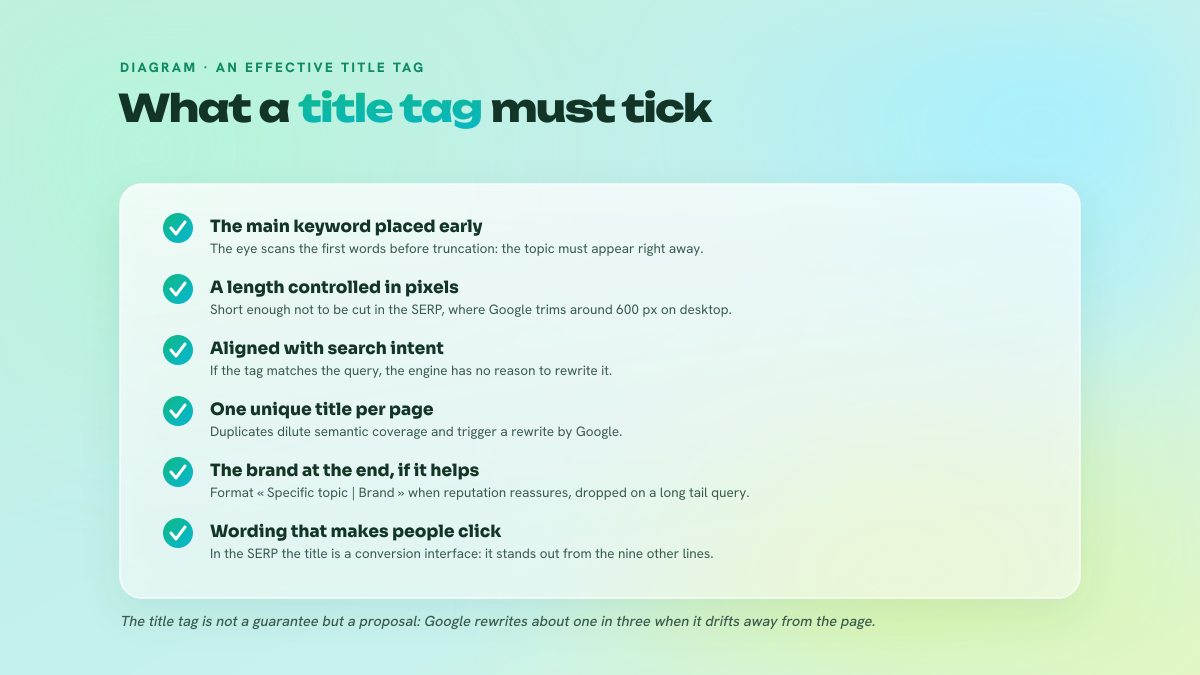
- →The safe band is 50 to 60 characters or 580 to 600 pixels on desktop, per Zyppy’s 2026 analysis of 81,000+ titles. Under 20 characters is almost always rewritten, above 70 characters is rewritten nearly 100% of the time.
- →Matching the H1 closely to the title is the single strongest anti rewrite lever in Zyppy’s data, pushing rewrite rates down toward 20%. Square brackets do the opposite, at roughly 77.6% versus 61.9% for parentheses.
- →AI generated headlines went permanent in Discover in January 2026 and are being tested in Search: the AI layer writes novel text rather than recombining on-page strings, so seeding a better alternative in the DOM no longer works.
- →Concentrate title effort where it still pays: Seer Interactive measured click through rate at 0.61% where AI Overviews appear in its September 2025 study, recovering to 2.4% by February 2026 against 3.8% on non AIO queries, so segment by AIO presence before rewriting anything.
The title tag is a suggestion, not a label
The title tag is the HTML <title> element in the head of a page, and every SEO course stops there. The part that matters operationally in 2026 is what happens to that string afterwards: it is an input to Google’s title link generation, not the output. Google Search Central states that the HTML title element is used in more than 80% of cases to generate the title link shown in search. Read that sentence the way a senior consultant reads it. It is both an argument for writing the tag carefully and an admission that what you ship is a candidate, one Google is free to overwrite.
Before going further, this two-minute overview is a clean primer if you want the visual version of the basics.
That single element does three separate jobs, and confusing them is where most title work goes sideways. It is a relevance signal for the ranking system, weighted heavily because it is the most explicit statement a page makes about its own topic. It is the clickable line in the results page, which makes it a conversion asset. And it is the browser tab label plus the fallback for social previews when no og:title is set. Those three jobs pull in different directions: the classifier wants unambiguous keyword context, the human wants a reason to click, the tab wants brevity.
On ranking weight, be sceptical of precise numbers. FirstPageSage’s 2025 ranking factor study places « keyword in meta title tag » second overall at roughly 14% of total algorithmic weight, behind consistent publication of high quality content. Nobody outside Google can decompose a ranking system into clean percentages, so treat that figure as directional rather than literal. What does hold up across audits is simpler: on a page by page basis, the title is the highest leverage single string you control, because no other element moves both relevance and click rate at once. The description snippet underneath it influences clicks only, and the heading structure inside the page influences understanding only.
How Google rewrites titles in 2026
Google has been rewriting title links since 2021, and the rate has climbed. Zyppy’s large scale analysis of 80,959 titles across 2,370 sites found 61.6% of page titles rewritten at least partially. A Q1 2025 study by John McAlpin, run across commercial, informational and YMYL queries, put the figure at 76.04%, rising to around 79.23% on queries above 100,000 monthly searches. Four titles in five, on the queries that matter most commercially, are not displayed as written.
The shape of those rewrites is more useful than the headline rate. McAlpin’s data shows Google removes an average of 2.71 words per rewrite and retains roughly 35% of the original title content. The dominant trigger is brand name removal, present in about 63% of rewrites, followed by readability and clarity edits at roughly 30%, then query specific intent alignment. In other words, the most common thing Google deletes is the part you appended for brand consistency, and the second most common is the part you appended for keyword coverage.
Sector matters. In financial YMYL results, only about 14.57% of surviving titles still contain the target keyword, against 19.68% in legal and 22.26% in health, per the same body of 2025 analysis. If you work a regulated vertical, plan on the displayed title being a Google composition and make sure the on-page context it will draw from is clean.
The 2026 change is qualitative, not quantitative. Google made AI generated headlines a permanent feature in Discover in January 2026 after testing through 2025, and has since begun testing AI headline rewrites directly in Search, English markets first. The distinction is worth internalising: the older rules based system recombined text that already existed on the page, the H1, anchor text, header content. The AI layer generates novel title text. That removes the last reliable lever SEOs had, which was seeding Google with a better alternative string somewhere in the DOM. Combined with the February 2026 core update’s focus on AI content quality and topical authority, the strategic read is straightforward: stop optimising the title for the display slot and optimise it for the classifier, then treat the displayed line as a variable you monitor rather than control.
Length, pixels and rewrite risk
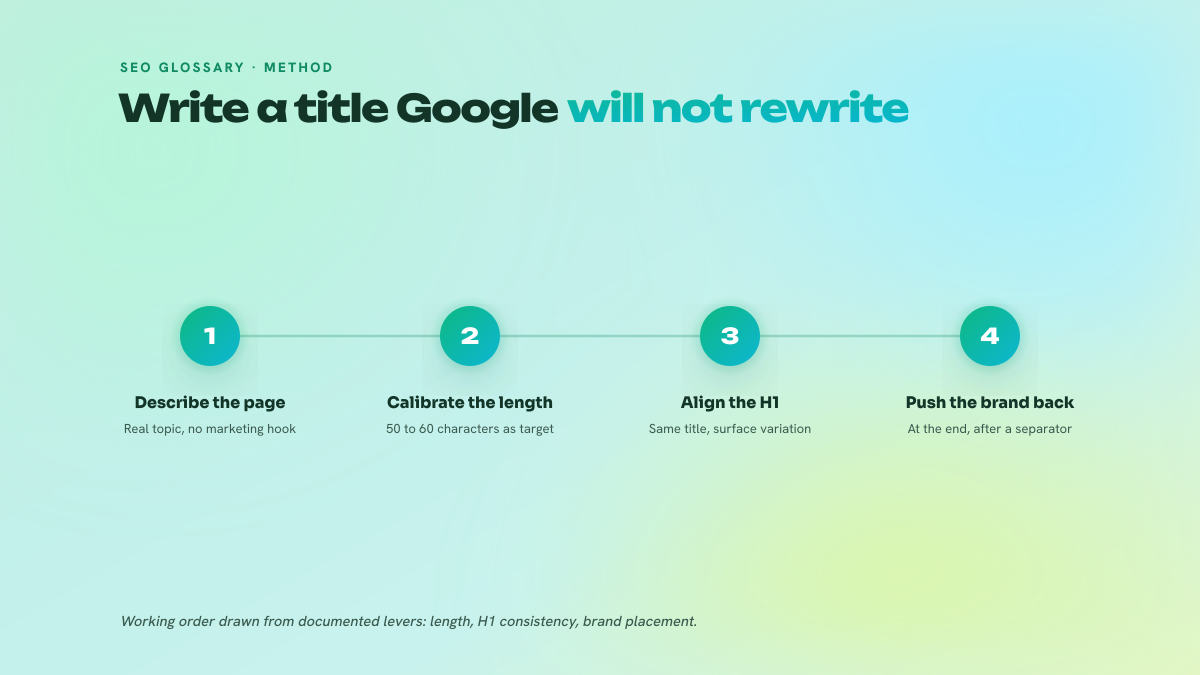
Character counts are a proxy. Pixel width is the constraint. Zyppy’s 2026 title length analysis, run on more than 81,000 titles, puts the reliable desktop display band at 50 to 60 characters or roughly 580 to 600 pixels. Mobile often shows 70 to 80 characters, which tempts people into longer titles, but longer titles absorb more rewrites and more truncation, so the wider mobile window is not the budget to design against.
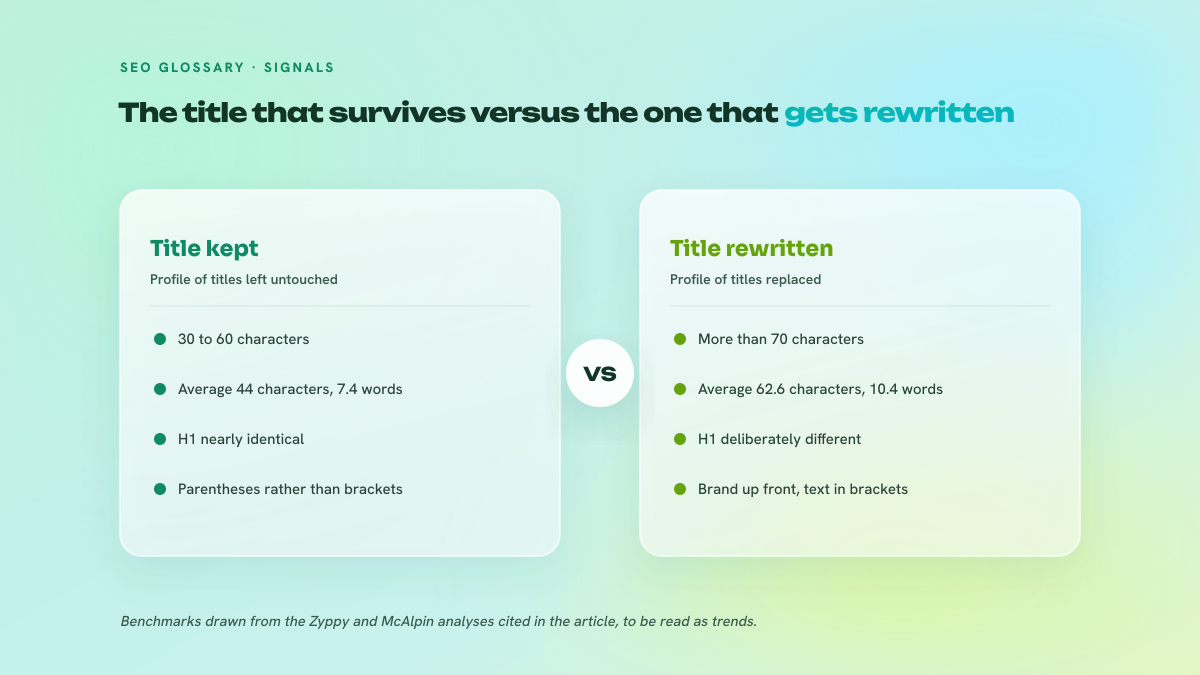
The rewrite curve is tight around that band. Titles of 51 to 60 characters show the lowest rewrite rate in Zyppy’s data, around 39 to 42%. Titles under 20 characters are almost universally rewritten, because they give Google too little context to trust. At the other end, Q1 2025 data shows titles above 70 characters rewritten nearly 100% of the time, while 84.87% of titles that survived untouched fell in the 30 to 60 character range. The averages tell the same story from another angle: unchanged titles averaged about 44 characters and 7.4 words, rewritten ones about 62.6 characters and 10.4 words.
Punctuation carries measurable risk too. Zyppy’s punctuation analysis of roughly 80,000 titles found square brackets associated with a rewrite rate near 77.6%, with Google stripping the bracketed text outright in about 32.9% of cases. Parentheses fare better at around 61.9%. If you use a modifier like « 2026 guide » or « updated », put it in parentheses, not brackets. It is a small edit with a documented delta.
The strongest lever in that dataset is alignment. When the H1 closely matches the title tag, Zyppy’s analysis shows rewrite rates falling sharply, in some cuts toward 20%. That is not a coincidence, it is the system finding two independent statements of the same topic and concluding it does not need to intervene. Practically: write the title first, then write an H1 that says the same thing in human phrasing, and let the small divergence between them be intentional rather than accidental.
Writing a title that survives the rewrite and still pulls the click comes down to a short list of moves, and this walkthrough covers the practical side well.
Where titles matter in a netlinking operation
Two places, and they are not the same job. On the money page you are building links to, the title is the line that decides whether the ranking you bought converts into a session. A page with the relevance but not the ranking is better served by acquiring placements straight from the publisher than by rewriting the headline a fourth time. That equation changed hard in the last eighteen months. BrightEdge data covering February 2025 to February 2026 shows AI Overviews now triggering on roughly 48% of tracked US queries, a 58% year on year increase, with education at 83%, B2B tech at 82% and healthcare at 88%. Seer Interactive measured organic click through rate falling 61% where AI Overviews appear, from 1.76% to 0.61%, in its September 2025 study. Their follow up shows partial recovery, a floor of 1.3% in December 2025 rebounding to 2.4% by February 2026, still under pre AI Overview levels.
The number nobody talks about enough sits in the same dataset: click through rate on queries without an AI Overview rose from 2.8% in early 2025 to 3.8% by February 2026. The value of a well written title has not fallen, it has concentrated. Segment your target queries by AI Overview presence before you invest a day in title rewriting, because the ceiling on an AIO heavy query set is structurally lower and your effort belongs on the clean SERPs where the organic slot still carries the click.
The second place is the publisher side. Every placed article carries a title, and titles are where networks leak. Across the owned French editorial media we run in-house, title patterns are treated as a footprint surface: no shared template, no recurring separator, no identical brand suffix construction across sites. If you are sourcing placements yourself, look at the title patterns of the pages already published on a domain before you commit, which is one of the checks worth running on any media catalogue you can browse without signing up. A site whose entire archive shares one title template is telling you something about how it is operated, and that context matters more than the metrics in the listing when you weigh it against what a placement actually costs.
What we see go wrong in audits
Missing or empty titles are still the most common finding on large sites, usually on templated routes nobody reviewed: filtered listings, tag archives, paginated series. Google falls back to whatever it can extract, typically the H1 or anchor text pointing at the page, and the result is often accurate but generic. It is not a penalty, it is a wasted slot.
Most title problems fall into a short list of repeat offenders, and this tutorial is a solid visual reference for the optimization side if you prefer to watch the fixes applied.
Duplication is the second. A single title reused across paginated pages or faceted variants gives the ranking system no basis for choosing which URL answers the query, and you end up with the wrong URL surfacing. The fix is boring and effective: make the differentiator explicit in the title rather than only in the URL.
Then there is the brand suffix reflex. Appending the site name to every title feels like brand building, and the data says Google deletes it in most rewrites. Keep it on the homepage and on pages where the brand is genuinely part of the query, drop it on long tail informational pages where those characters buy you nothing and push the descriptive part toward truncation.
The measurement mistakes are worse than the writing mistakes. Teams change titles across a section, then read Search Console seven days later and declare a winner. Title changes need reindexing time and symmetric before and after windows, ideally month over month on the same comparison period, filtered to the queries that actually triggered the affected pages. And when the click through rate does not move, check first whether Google is even displaying your title, because a rewrite silently invalidates the whole test.
Finally, multilingual. Teams translate a title and keep the same character budget, which does not survive contact with French or German, where the same idea runs longer. Titles need a per language rewrite against the local pixel budget, not a translation, and the hreflang cluster should carry genuinely distinct titles rather than the same English construction transposed word for word.
Nautilinks operates an owned network of editorial media. In-house written articles, transparency disclosures respected, anchor mix calibrated.
Frequently asked questions
What length should a title tag be in 2026, in pixels rather than characters?
Design against roughly 580 to 600 pixels on desktop, which Zyppy’s 2026 analysis of more than 81,000 titles maps to about 50 to 60 characters. Mobile displays 70 to 80 characters, but that extra room correlates with more rewrites and truncation, so it is not a budget to spend. The tightest rewrite rate in that dataset, around 39 to 42%, sits at 51 to 60 characters.
Should the title tag and the H1 be identical?
Close, not identical. Zyppy’s analysis shows rewrite rates dropping sharply, toward 20% in some cuts, when the H1 closely matches the title. The two elements serve different readers though: the title has a pixel budget and appears out of context in the results page, the H1 has room and sits above the content. Write the same claim twice, once compressed for the SERP, once in natural phrasing for the page.
Google rewrote my title. How do I get mine back?
Usually by removing the reason it intervened. Cut the length toward the 50 to 60 character band, swap square brackets for parentheses, drop the brand suffix, and align the H1 with the title. If it still gets rewritten, check the anchor text pointing at the page and any on-page text Google might prefer. With AI headline generation now live in Discover since January 2026 and under test in Search, some rewrites are simply not reversible.
Do title tags still move rankings, or only click through rate?
Both, with different confidence levels. The click through effect is directly observable in Search Console. The ranking effect is real but smaller than ranking factor tables suggest: FirstPageSage’s 2025 study puts « keyword in meta title tag » second at about 14% of algorithmic weight, which is a modelled estimate, not a disclosed weight. In audits, title fixes move rankings most on pages that were previously ambiguous about their own topic.
Is a title tag mandatory, and what happens without one?
Not mandatory in the sense of a validation error, and pages without one do rank. Google falls back to the H1, anchor text pointing at the page, or other on-page text to compose a title link. The output is usually serviceable and almost never as good as a deliberate one. On templated routes like faceted listings and tag archives, missing titles are the most common finding in large site audits.
Does it make sense to A/B test titles at scale?
Yes, on page groups rather than single URLs, and with discipline about windows. Change titles across a coherent set, wait for reindexing, then compare symmetric periods in Search Console filtered to the queries those pages actually served. The trap is drawing conclusions in seven days. The second trap is not verifying that Google displays your title at all: a rewrite invalidates the test silently.
Test your knowledge
Quiz: Title tag
1/3According to Zyppy’s data, which factor is most strongly associated with a lower title rewrite rate?