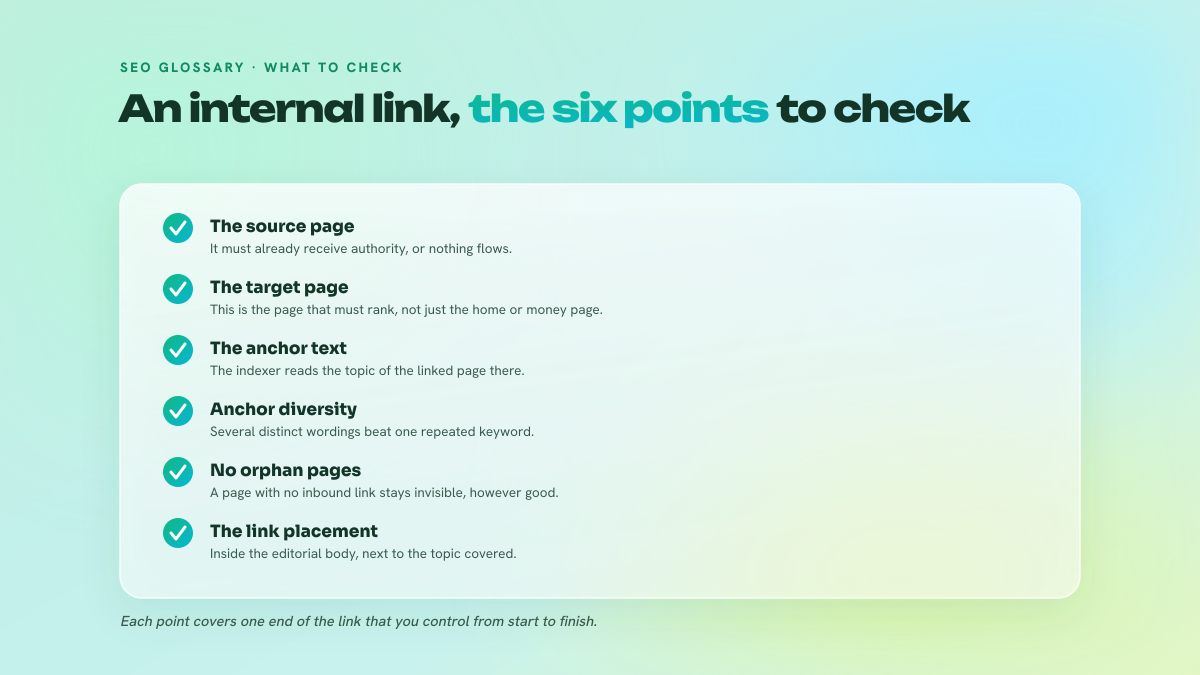
- →Internal links are the only ranking factor you control end to end: no editor, no budget, no third party. Treat them as owned inventory, not an afterthought.
- →The Zyppy 23M-link study (Feb 2026) puts the sweet spot near 45-50 internal links per page; past that, additional links correlate with less Google traffic, not more.
- →Anchor diversity is a real signal: RM Tech data (Sept 2024) shows pages with 11+ distinct internal anchors pulling roughly 13× the SEO visits of pages fed by a single anchor source.
- →Crawl depth is the silent killer: pages at depth 1-3 get about 9× more SEO traffic than depth 4+, per My Ranking Metrics. Flatten before you buy links.
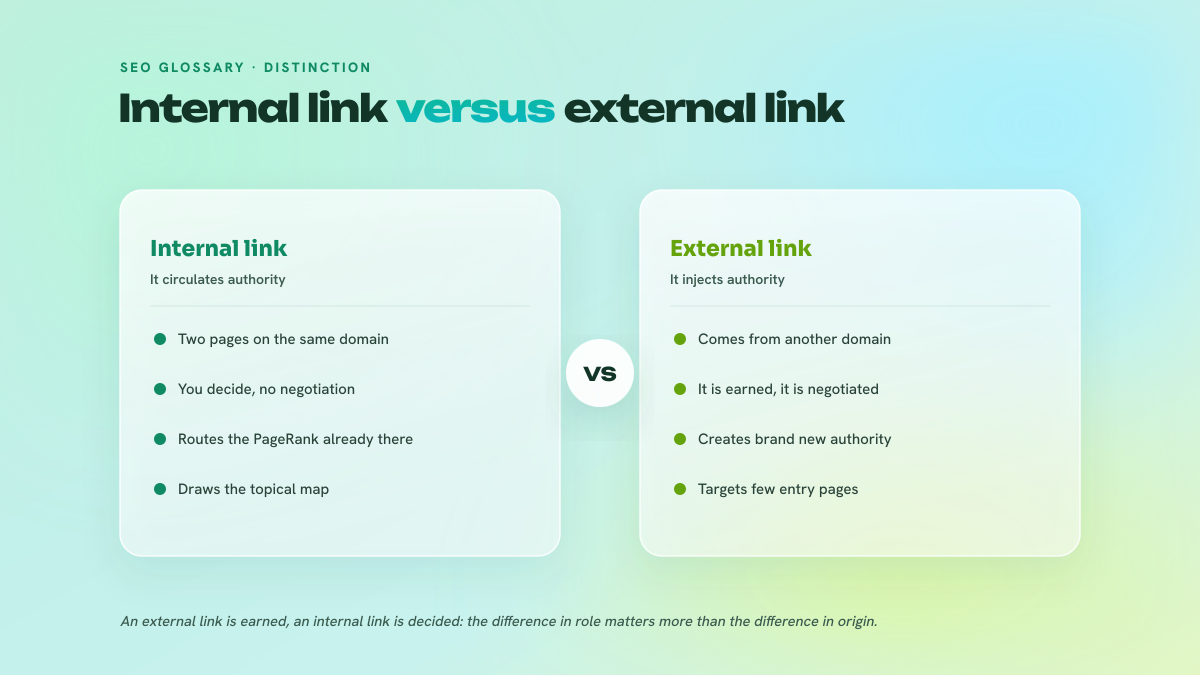
- →A backlink lands on one URL; internal links are how that authority reaches the rest of the cluster. Skip the plumbing and you pay for a link the site can't distribute.
- →Orphan pages are pure waste: JetOctopus audits routinely find ~25% of a large site's pages with zero internal links, and Googlebot simply doesn't crawl what nothing points to.
Beyond the href: what an internal link actually does
Ask a junior SEO what an internal link is and you get the plumbing answer: an anchor tag pointing from one page to another on the same domain. True, and useless as a working definition. The operational reality is that internal links are the only ranking lever you own outright. A backlink needs an editor to say yes, a budget, and a negotiation. An internal link needs a decision and a deploy. That asymmetry is why, in 2026, restructuring internal links is the single highest-ROI on-page task on most sites we audit.
The reason it matters more now than five years ago is topical authority. Google's December 2025 core update, which rolled out between 11 and 29 December, rewarded sites with clean hub-and-spoke and pillar-cluster structures. One documented case cited in post-update teardowns saw internal links added between 200+ existing articles lift organic traffic 34% in a single month, with no content changes at all. The pages were already indexed and already good. What changed was that Google could finally read the relationships between them.
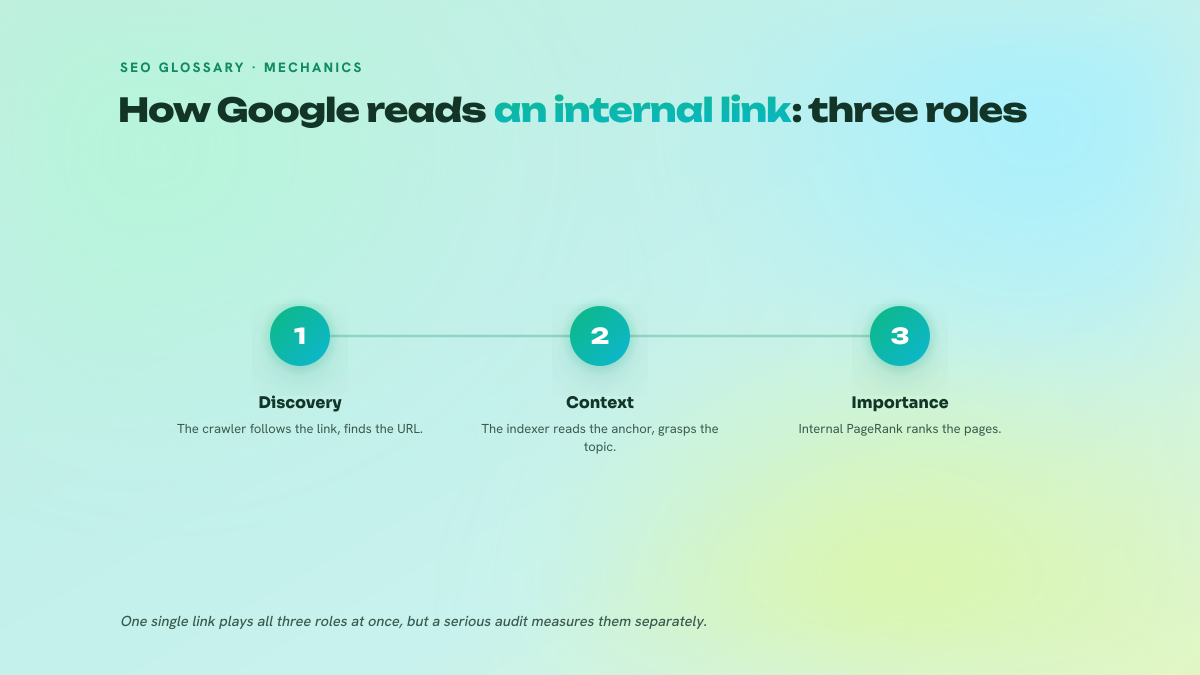
So the honest definition: an internal link is a directed edge in your site graph that tells Google how to crawl, what a page is about, and how important it is relative to its neighbours. Three jobs, one tag. Miss any of the three and you leave rankings on the table you already paid for.
The three jobs an internal link does in 2026
A June 2026 technical write-up of Google Search Central guidance frames it cleanly: internal links serve three distinct functions handled by three different systems. The crawler uses them for URL discovery. The indexer reads the anchor text for topical context. The ranking systems use them to compute internal PageRank, which Google still runs. Understanding which of the three you are optimising for changes what you do.
For discovery, the metric is crawl depth, the number of clicks from the homepage to reach a page. My Ranking Metrics data shows pages at depth 1-3 receiving roughly 9× more SEO traffic than pages at depth 4+. A 2025-2026 internal-linking guide puts numbers on the mechanism: pages four or more clicks deep see about 70% less crawl frequency than pages within two clicks. Crawl budget panic is mostly overblood for normal sites, Google's own guidance reserves genuine crawl-budget problems for sites above 1M URLs or 10k URLs changing daily, but discovery is not the same as budget. A page nothing links to deep enough does not get crawled often enough to rank, whatever its size.
For topical context, the lever is anchor text, and the data here is decisive. An RM Tech / My Ranking Metrics study on data from September 2024, across 24 million pages and 8,000+ sites, found that pages fed by 11 or more distinct internal anchor texts generated 13× more SEO visits than pages fed by a single internal anchor. Diversity beats repetition. The Zyppy dataset of 23 million internal links, summarised in May 2026, adds that pages carrying at least one exact-match internal anchor pulled roughly 5× the traffic of pages with none, a correlation worth exploiting without turning every anchor into the same keyword. Vary the phrasing the way you would when writing your heading structure across a page: natural, contextual, never robotic.
For importance scoring, the question is how many internal links a page receives, and here 2026 finally gave us a ceiling. The Zyppy SEO study published on 23 February 2026, covering 23 million internal links across roughly 1,800 sites, found traffic rising with incoming internal links up to about 45-50 per page, then declining beyond that. More is not better past the threshold. Dumping 200 sitewide footer links onto a page dilutes the equity each one carries and, on the data, correlates with lower Google traffic. Internal PageRank is a fixed pie you are slicing, not a faucet you can leave running.
Where it fits a netlinking operation
This is the part most link buyers get backwards. A backlink lands on exactly one URL. The authority it carries only reaches the rest of your site through internal links. Buy a strong link to a landing page that internally links to nothing, and you have bought a reservoir with no pipes. We see this constantly: a client spends real money on a placement, the target page ranks, and the three commercial pages it should have lifted stay flat because no internal path connects them.
So before we ever discuss placements, we check the receiving structure. When you calibrate a campaign over the long run, the internal graph decides how far each acquired link travels. A link to a well-connected pillar page distributes across the whole cluster; a link to an orphan dies where it lands. The order of operations is not negotiable: fix internal distribution first, then buy the external authority that flows through it.
The same logic applies when you pick which pages to point external links at. A page sitting at depth 5 with two internal anchors is a bad target no matter how good the external link is, because Google barely crawls it and can't read what it's about. Flatten it into the cluster first. Once the internal graph is clean, browsing the catalogue of owned media accessible without an account becomes a question of matching topical fit to an already-distributing target, not gambling that authority will somehow find its way. At Stringer we operate our own media in-house precisely so the internal graph of each is built the way we describe here, not left to a theme's default footer.
What we see go wrong in audits
The recurring failure is orphan pages. JetOctopus log-analysis work summarised in mid-2026 finds that large-site audits routinely surface around 25% of pages with zero internal links, and fewer than half receiving what the tools call sufficient links. Googlebot does not crawl what nothing points to. In one JetOctopus case, restructuring internal links pushed crawl coverage from 40% to 70% of site pages, a 30 percentage-point gain with no new content and no new backlinks. A 2026 best-practices piece estimates that roughly 40% of internal link value is wasted on sites with deep or orphaned pages. That is not a rounding error, that is nearly half your owned lever thrown away.
The second failure is treating depth as cosmetic. A case study documented in January 2025 and cited through 2026 reduced average crawl depth from 4.2 to 2.1 clicks, changing nothing else, and watched organic traffic climb from 12,000 to 31,000 monthly visits in 90 days, a 158% rise. No content, no links, just geometry. When a client tells us their content is fine but rankings won't move, the depth histogram is the first thing we pull.
The third is anchor laziness: the same exact-match phrase on every internal link to a page, or worse, generic anchors like « read more » and « click here » that hand the indexer no topical signal at all. Given that the RM Tech data ties 13× traffic to anchor diversity, uniform anchoring is leaving the single cheapest signal unclaimed. Anchors should read like the phrasing you'd choose for a page title: descriptive, varied, honest about what sits on the other end.
Tactics for a working SEO
Start with the depth histogram, not the link count. Pull every URL's click depth from the homepage in a crawler and flatten anything past depth 3 that you actually want to rank. Contextual body links do this better than nav bloat, because they carry topical relevance the indexer can use.
Then audit for orphans and cap the ceiling. Anything with zero incoming internal links gets connected from a relevant hub. Anything blowing past 50 incoming links gets pruned toward the 45-50 window the Zyppy data marks as the turning point. Both moves redistribute a fixed pool of internal PageRank toward the pages that earn revenue.
Finally, treat anchor text as an editorial decision, not a plugin default. Aim for a spread of distinct, natural anchors per target rather than one repeated exact match, and reserve exact-match phrasing for the handful of placements where it genuinely reads well. Internal linking is the rare lever where the honest, boring discipline, flat structure, no orphans, varied anchors, calibrated volume, is exactly what the 2026 data rewards. There is no growth hack here, only maintenance you either do or skip.
Nautilinks operates an owned network of editorial media. In-house written articles, transparency disclosures respected, anchor mix calibrated.
Frequently asked questions
Is there really a hard cap on internal links per page?
Not a hard cap, a correlation ceiling. The Zyppy study of 23 million internal links, published February 2026, found traffic rising with incoming internal links up to roughly 45-50 per page, then declining beyond that. It's a distribution effect: internal PageRank is a fixed pool, so past a point each new link dilutes the equity the others carry. Treat 45-50 as a design target for important pages, not a rule to enforce sitewide.
Do exact-match internal anchors still help, or is that risky like external anchors?
Internal anchors don't carry the over-optimisation risk external ones do, because they're your own signal to your own site. Zyppy's dataset, summarised May 2026, shows pages with at least one exact-match internal anchor pulling roughly 5× the traffic of pages with none. That said, RM Tech data ties 13× traffic to anchor diversity, so use exact match sparingly and vary the rest. One clean exact-match anchor plus ten natural variants beats eleven identical ones.
How do internal links interact with the backlinks I buy?
A backlink lands on one URL; internal links are how that authority reaches the rest of the site. If your paid link points to a page that internally links to nothing, the equity dies there. Build the internal distribution first, then acquire external authority that flows through it. We fix the internal graph before discussing any placement, because a well-connected target multiplies every link you buy and an orphaned one wastes it.
Does crawl budget actually matter for internal linking on a normal site?
Crawl budget as a genuine constraint is mostly a large-site concern: Google reserves it for sites above 1M URLs or 10k URLs changing daily. But discovery is separate from budget. Even on a 500-page site, a page four clicks deep gets crawled far less often, roughly 70% less frequently than a page within two clicks, per 2026 research. So internal linking matters for crawl at any size, just for discovery and depth rather than budget.
What's the fastest internal-linking win on a stagnant site?
Flatten crawl depth. A case study documented January 2025 cut average depth from 4.2 to 2.1 clicks with no new content or links and saw organic traffic go from 12,000 to 31,000 monthly visits in 90 days, up 158%. Pull the depth histogram, find revenue pages past depth 3, and connect them from relevant hubs with contextual body links. It's the cheapest move with the most documented upside.
Test your knowledge
Quiz: Internal links
1/3According to Zyppy's February 2026 study of 23 million internal links, what happens to a page's Google traffic once incoming internal links exceed roughly 50?