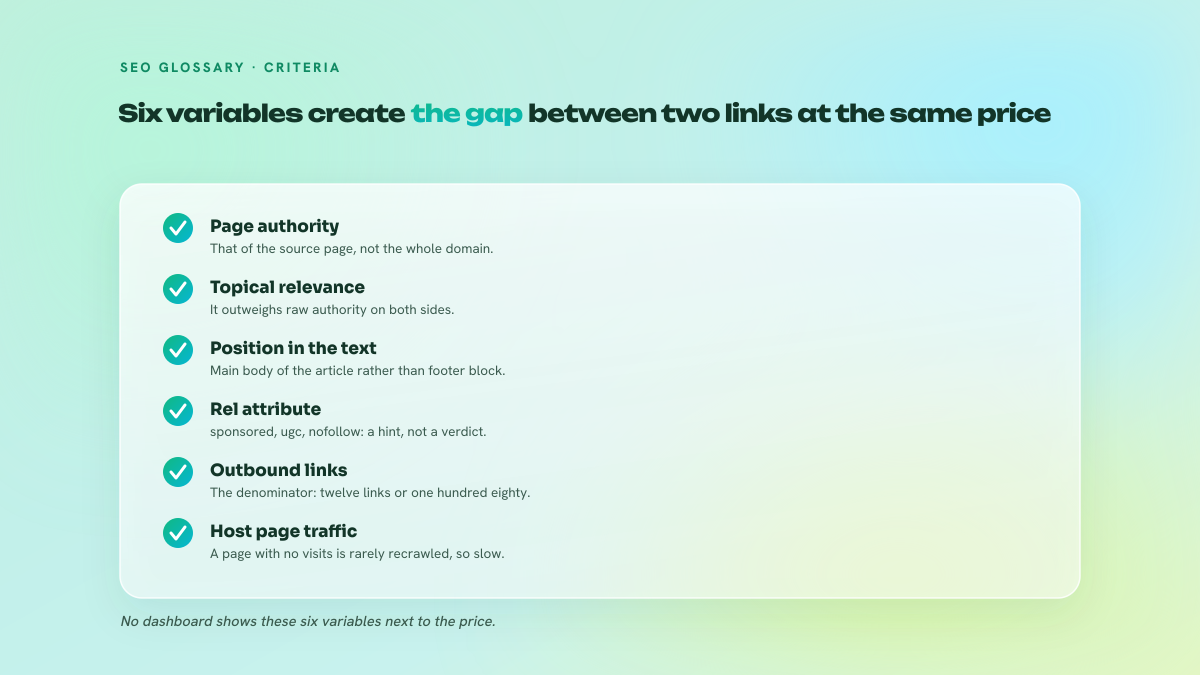
- →Equity is handed out by pages, not held by domains: a DR 72 article with no internal links and eighteen outbound links is worth less than a DR 45 category hub that links to you from its body copy.
- →Buy at URL level, never at domain level. The linking page's own inbound links and crawl frequency decide what actually reaches you.
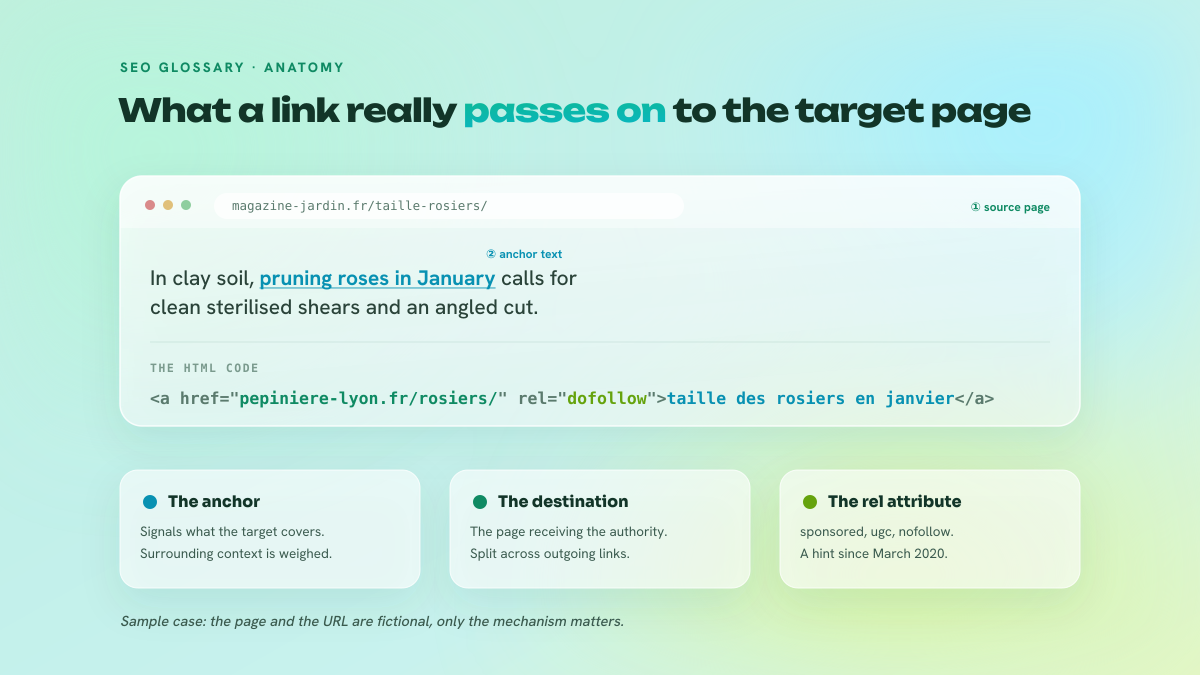
- →Since 2019 nofollow, ugc and sponsored are hints rather than directives, so the attribute is a probability, not an on/off switch.
- →Internal redistribution is free, reversible and effective at the next crawl. Most teams spend the entire budget on acquisition and never audit where it lands.
- →Recover before you buy: 404s that still hold inbound links, mapped one hop to the nearest topical equivalent, are the cheapest equity on the table.
- →Enforcement got faster. The March 2026 spam update completed in under twenty hours against roughly twenty-seven days for August 2025, so a clean link graph has to exist before the update, not after.
Link equity is a budget, not a property
The word comes from PageRank, and the original patent (US 6,285,999, «Method for node ranking in a linked database») still describes the mechanic better than most 2026 blog posts. A page holds a score, it distributes that score across its outbound links, and each hop applies a damping factor set at 0.85 in the 1998 paper, so roughly fifteen percent evaporates on every jump. A page with equity E and twenty outbound links passes about 0.85 × E / 20 to each target. Google stopped running that exact formula a long time ago, but the topology it describes survives every core update: authority is something a page hands out, not something a domain owns.
The budget framing changes what you audit. Your homepage is almost always the strongest node on the site, and every link you place in the global header or footer is a permanent slice of it. Add forty footer links to legal pages, author bios and tag archives, and you have quietly rerouted a large share of your strongest asset toward URLs that will never rank for anything commercial and will never convert. In an audit the first question is never how much authority we have, it is which URLs are eating equity without earning revenue.
«Link juice» is the same concept with a worse name. It works as shorthand between peers, but the liquid metaphor makes people think the tank refills on its own. It does not. You either acquire more from outside, or you redistribute what you already hold. Everything else here is a consequence of that sentence.
How equity actually flows in 2026
Not every link on a page carries the same share. Google's reasonable surfer patent (US 7,716,225) describes weighting each outbound link by the probability that a user clicks it, using signals such as position in the document, font size and anchor wording. The operational translation is blunt: a link sitting inside a paragraph of running text outweighs the same URL repeated in a sitewide footer, and links high in the main content area outweigh the ones buried under the comments. Nobody outside Google knows the coefficients, but the ordering has been stable for a decade and it holds on every property we operate.
The video below walks through the same flow visually, if you prefer watching the graph move:
Attributes complicate the picture more than most people admit. Since 2019 the dofollow default only means anything against rel=«nofollow», «ugc» and «sponsored», and Google reclassified all three as hints rather than directives, reserving the right to use them for crawling and ranking. Read that carefully: a nofollow link is not guaranteed to pass nothing, and a dofollow link is not guaranteed to pass anything. Treating the attribute as a switch is a 2015 mental model.
Redirects behave better than folklore suggests. Google has stated publicly since 2016 that 30x redirects do not lose PageRank, so a clean single-hop 301 preserves the value. Chains are where it goes wrong, not because each hop taxes the score, but because crawl budget, latency and eventual truncation mean the final target may simply never be reached.
The newer question is what happens on AI surfaces. Two 2026 industry surveys put the share of SEO professionals who believe backlinks still influence AI search visibility at 73.2 to 74 percent (linkbuild.agency and reporteroutreach, 2026). A survey measures opinion, not mechanics, and it is worth saying so out loud. The mechanical argument is stronger: GPTBot, PerplexityBot and their peers discover documents by following links exactly like Googlebot, so a page nobody links to internally is a page they will not read. Equity and crawl reachability are not the same thing, but they fail together.
Measuring something Google will never show you
Toolbar PageRank died in 2016 and nothing has replaced it from the source. Everything on the market is a third-party model built on a third-party crawl: Ahrefs Domain Rating and URL Rating, Semrush Authority Score, Majestic Trust Flow and Citation Flow. Semrush documents Authority Score as a 0 to 100 composite of backlink data, organic traffic and spam signals, explicitly built to separate genuine authority from artificially inflated profiles, and 2026 tool reviews credit the platform with an index above 43 trillion backlinks across roughly 390 million referring domains. Index size is a coverage argument, not an accuracy argument. Two tools scoring the same URL twelve points apart is ordinary.
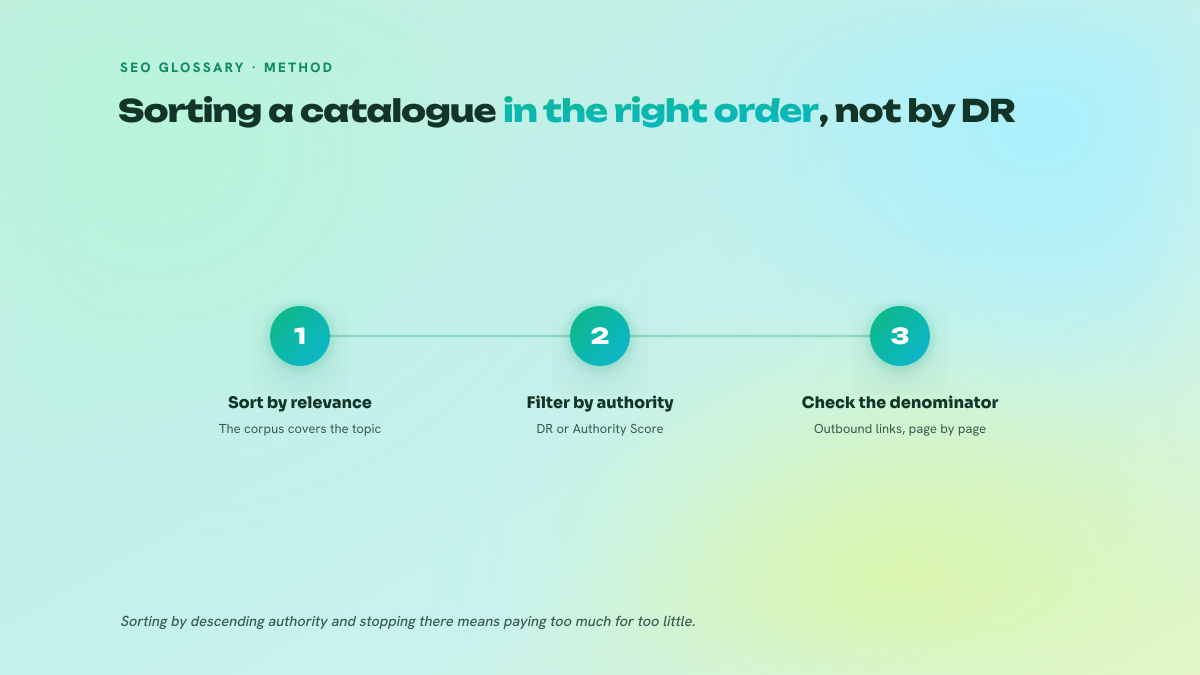
The mistake we see constantly is measuring at domain level and then buying at domain level. Equity arrives at a URL. A DR 72 domain whose article page has no internal links pointing at it, sits four clicks from the homepage and carries eighteen outbound links is worth less than a DR 45 domain linking from a well linked category hub. Page-level metrics and a manual look at the actual placement beat any domain average.
For the internal side, stop guessing and compute it. Screaming Frog's Link Score and Sitebulb's internal PageRank run the iterative calculation on your own crawl and hand you a distribution. Sort your URLs by internal score, sort them again by revenue, and read the gap. The pages in the top decile of equity and the bottom decile of value are the leak. One tooling caveat: AhrefsBot only began rendering JavaScript in its 2025 to 2026 update cycle, so any internal link graph you built before that from a JS-driven navigation was incomplete.
Where the real decisions get made
Two levers exist. Acquisition brings new equity into the graph, distribution decides where it lands. Most teams spend the whole budget on the first and never touch the second, which is strange given that internal redistribution is free, reversible and effective at the next crawl. If a category page sits three clicks deep and receives its only internal links from a paginated archive, no volume of external acquisition will fix its ranking economically.
On acquisition, the variable that decides the value of a placement is the linking page, not the seller's headline metric. Look at the article that will host your link: does it get internal links from the site's own hubs, is it in a section that gets crawled, does it already carry twelve outbound commercial links. That is why we publish the media catalogue you can browse without creating an account, metrics visible before you commit to anything. Our French editorial media are owned and run in-house, so the page that will carry your link exists before you order it and can be inspected.
Cost is where the conversation usually turns dishonest. Placement prices in France span an enormous range depending on the media's traffic, its thematic fit and how many intermediaries stand between you and the publisher, and any «average price of a backlink» you read without an attached methodology is marketing. The only honest answer is a published grid, which is why what each placement costs is listed media by media, with no hidden commission stacked on top. Judge the number against the equity you expect to land on a page that converts, not against a competitor's rate card.
Legality, since the question sits in every SERP on this topic: buying a link is not illegal in France, in the EU or in the US. It breaches Google's link spam policy, which is a contractual and algorithmic risk rather than a legal one, and the US FTC rules that do apply concern advertising disclosure, not SEO. Google's own guidance remains the most useful line written on this: if you have to ask whether a link scheme violates the guidelines, it probably does. What separates a durable programme from a penalty is editorial quality, thematic fit and rhythm, which is the argument for having someone calibrate the acquisition pace over several months instead of buying fifty links in a fortnight.
Where we watch equity leak
The failure patterns repeat across audits. Redirect chains built by three successive migrations, each layer added by someone who never checked the previous one. Sitewide sidebar links to a partners page nobody visits. Money pages orphaned from the main navigation and reachable only through a search results template. Canonical tags pointing a paginated series back to page one, quietly telling Google to ignore the signals of pages two through fifteen. Faceted navigation spawning parameter URLs that absorb internal links and return nothing.
The subtler one is «noindex, follow». It works while it works: the page keeps distributing what it receives. Once the URL drops out of the index, Google stops treating its outbound links normally and the configuration degrades toward noindex, nofollow. Anyone building a hub and spoke internal architecture on noindexed intermediary pages is building on a floor that dissolves after a few months.
Two myths deserve a direct answer. More links do not mean more equity at page level: adding outbound links divides what a page hands out, it does not create more. And a link does not expire on a timer, but the page hosting it decays. It loses its own inbound links, the site gets redesigned and the archive disappears, the article slides from page one to page four of a category and stops being crawled weekly. Since the March 2024 policies on Expired Domain Abuse and Site Reputation Abuse, a whole category of equity that used to be reliable, the recycled expired domain and the rented subfolder on a strong host, is explicitly discounted. Anyone still selling authority sourced that way is selling a depreciating asset.
Reclaiming equity you already paid for
Before buying anything, recover what already points at you and lands on a 404. Every site that has been through a migration, a CMS change or a category rename has inbound links hitting dead URLs. Ahrefs' Broken Link Checker and the best-by-links report filtered on 404 responses surface them in minutes, and Search Console crawl stats confirm which ones Google still requests. Each maps to a single 301 toward the closest live equivalent.
The tutorial below shows that reclamation workflow end to end:
Two rules separate recovering equity from pretending to. Redirect to the nearest topical match, never in bulk to the homepage: Google documents irrelevant mass redirects as soft 404s, which pass nothing and hide the problem behind a 200 response. And redirect in one hop, editing the old rules rather than stacking new ones above them. The same logic points outward: competitors' dead pages that still hold inbound links are recreatable targets, and unlinked brand mentions convert to links with one email.
Speed matters more than it used to. The March 2026 spam update finished in under twenty hours on Google's status dashboard, against roughly twenty-seven days for the August 2025 spam update (ppc.land and seo-kreativ, 2026). Enforcement cycles that once gave you a month of visible movement to react now close before your weekly reporting runs. The teams that hold their rankings through these are the ones whose equity graph was already clean, not the ones who cleaned it after the drop.
Nautilinks operates an owned network of editorial media. In-house written articles, transparency disclosures respected, anchor mix calibrated.
Frequently asked questions
Does link equity expire, or does the link just stop counting?
Neither Google nor any tool applies a decay timer to a link. What decays is the page hosting it. It loses its own inbound links, slides down the category archive, gets crawled monthly instead of weekly, or disappears in a redesign. A three-year-old link on a page that still receives internal links and traffic is worth more than a six-month-old link on an orphaned article. Audit the host page annually, not the link date.
Is buying links a legal problem or only a Google problem?
Only a Google problem. No jurisdiction in France, the EU or the US makes paid links illegal, and the FTC rules people cite concern advertising disclosure rather than SEO. The exposure is algorithmic and contractual: Google's link spam policy, enforced by SpamBrain and manual actions. That reframes the decision. You are not weighing legal risk, you are weighing whether a placement looks like editorial content or like a transaction.
How do you decide what a placement is worth before paying?
Price the linking page, not the domain. Check whether that specific URL receives internal links from the site's own hubs, how many outbound commercial links it already carries, whether the section gets crawled regularly, and how close the topic sits to your target page. A cheap placement on a well linked, on-topic article beats an expensive one on an orphaned page under a strong domain. Then compare the cost against the page you are feeding, not against a rate card.
Do nofollow links pass anything in 2026?
Possibly, and that is the honest answer. Google reclassified nofollow, ugc and sponsored as hints in 2019, keeping the option to use them for crawling and ranking without saying when. In practice we treat nofollow placements as discovery and referral value with an unknown equity component, never as the backbone of an acquisition plan. Refusing a strong, relevant, traffic-generating placement because of the attribute is a mistake we still see monthly.
Can a page gain equity without receiving a direct link?
Yes, through two routes. A single-hop 301 from a URL that holds inbound links transfers the value, which is why broken backlink reclamation is the cheapest acquisition channel available. And a well built internal hub concentrates equity from many entry points, then passes it down to children pages that never earned an external link themselves. That second route is free and usually more productive than the next thousand euros of acquisition.
Test your knowledge
Quiz: Link equity
1/3In the original PageRank model, what happens to a page's score when it links out to twenty pages?