- →Intent belongs to the query as Google models it, not to the keyword string: if the SERP returns product pages, shopping units and price panels, the query is transactional whatever your tool's intent column says.
- →Transactional queries are the least eroded lower-funnel bucket: a shopping-query analysis put AI Overview coverage at roughly 13-14 % for pure purchase queries against 83 % for « best [product] » research queries in November 2025.
- →Commercial investigation and transactional intent need different page types, different links and different KPIs. Serving one page for both is the single most expensive mistake we see in content plans.
- →Nobody links editorially to a checkout page: build authority on the informational and comparison layer, then route it internally with a clean cluster structure and non-exact anchors.
- →Rank alone is a weak proxy in 2026. Report SERP feature ownership, AI Overview citation, product feed visibility, branded versus non-branded demand and assisted revenue alongside position.
- →Product markup belongs in the initial HTML, not in a JavaScript afterthought, if you want transactional pages eligible for the commerce surfaces Google shipped through 2026.
A query state, not a keyword list
Transactional intent describes a searcher who has finished comparing and now wants to complete an action: buy, book, subscribe, request a quote, start a trial. The keyword is only the visible trace of that state. « order » , « buy », « price », « near me open now », a bare product reference with a size or a colour, all of these are surface markers, and treating the marker as the definition is where most keyword research goes sideways.
Every intent tool ships an intent column. Semrush labels keywords informational, navigational, commercial or transactional, and those labels are useful for slicing a 40 000-keyword export in ten seconds. They are model outputs over a SERP snapshot, not facts about the person typing. « nike air max 90 size 42 » is transactional for someone with a cart open and informational for someone checking whether the model runs small. The searcher's head is not observable. What is observable is what Google decided to serve.
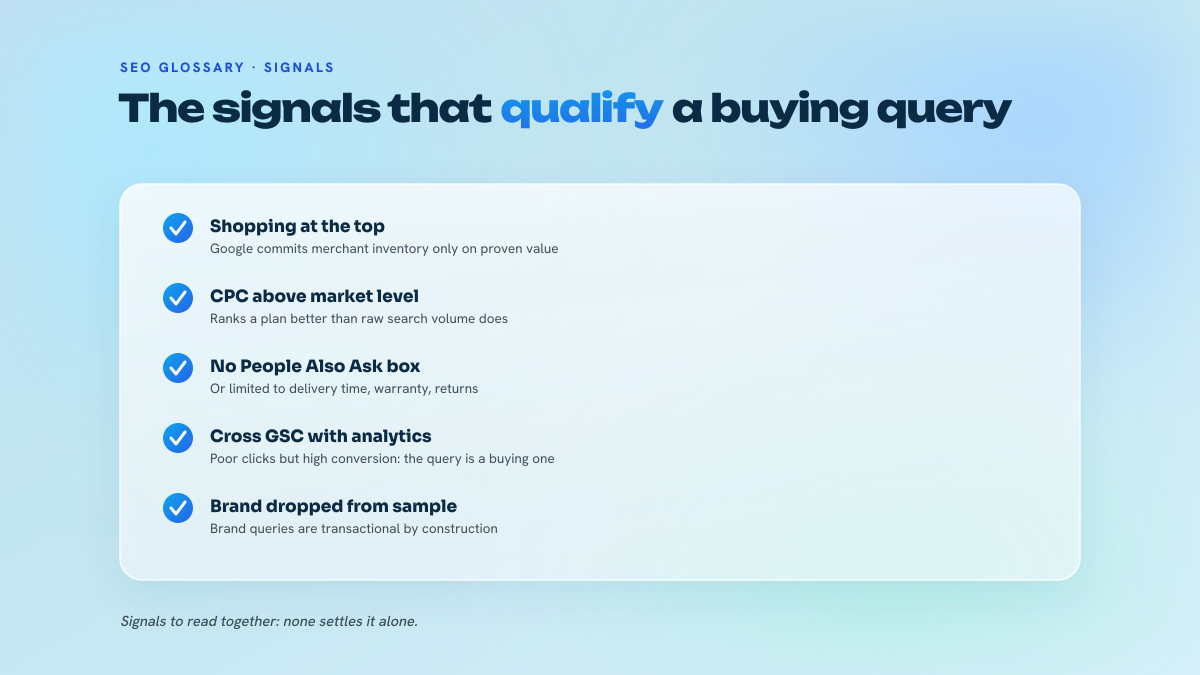
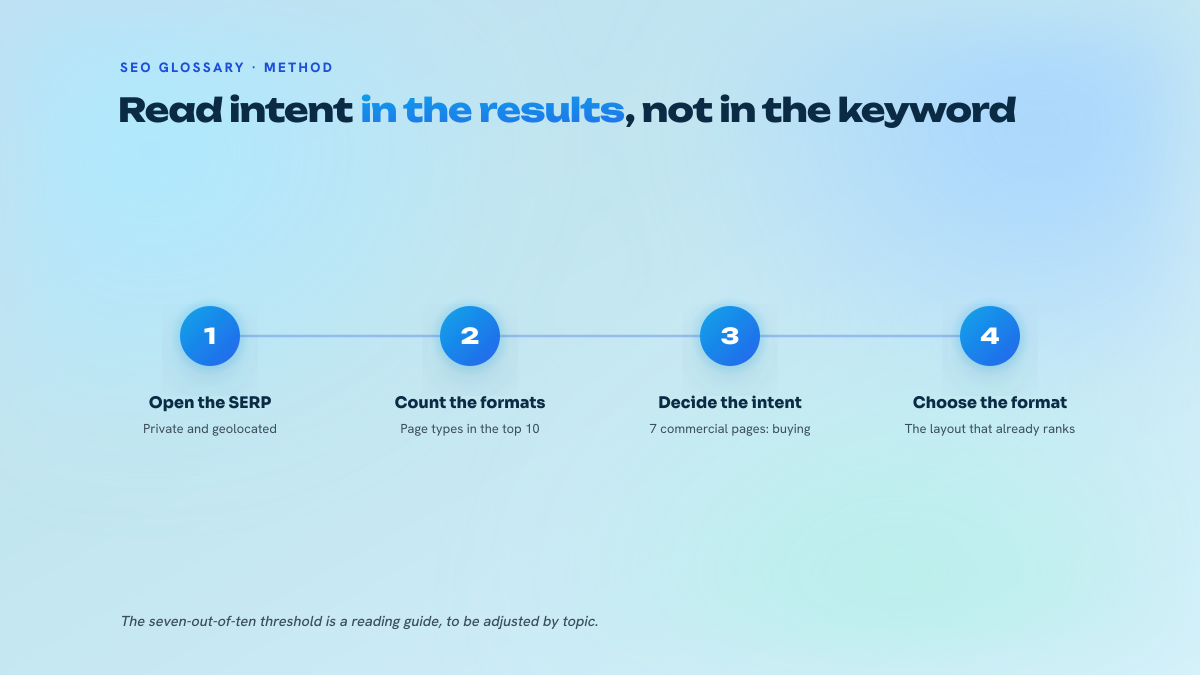
So the working definition we use in audits is mechanical: a query is transactional when the SERP is built for action. Product listings above the fold, price and availability in the result blocks, a local pack with booking affordances, few or no long-form articles in the top five. Run the query, look at what occupies the first screen, and you have the answer with more reliability than any intent column. If the SERP is full of guides and comparison articles, the query is not transactional yet, no matter how commercial the words look.
This matters because intent is what gates your page type. You cannot rank a 2 400-word buying guide on a query whose SERP is entirely product records, and you cannot rank a bare product page on a query whose SERP is entirely editorial. The keyword volume is irrelevant until that match is right. Ranking is downstream of format, and format is downstream of intent as Google models it, not as your spreadsheet labels it.
How Google actually handles transactional queries in 2026
The bigger shift of the last eighteen months is that Google stopped merely ranking pages for action-oriented queries and started facilitating the action itself. On 11 January 2026 Google launched the Universal Commerce Protocol, an open standard connecting AI agents, businesses and payment providers across discovery, purchase and post-purchase support. On 7 January 2026 it introduced an AI Mode shopping workflow where a user can track a price, set options and a budget, then ask Google to complete the purchase through Google Pay. On 19 May 2026 came Universal Cart, aggregating products across merchants, with UCP checkout extended to Canada and Australia and named participants including Nike, Sephora, Target, Walmart and Wayfair.
The operational consequence for anyone optimizing a transactional page: the landing surface is drifting from an HTML document toward a machine-readable record. Price, stock, variants, shipping and returns are becoming search marketing inputs on par with copy and links. Google Search Central's current documentation is explicit that Product markup should sit in the initial HTML and that servers need to handle the load when markup is generated with JavaScript. A transactional page whose price only materialises after hydration is a page that competes with one hand tied.
The second shift is generative coverage, and here the data argues against panic. Semrush's study of more than 10 million keywords found AI Overviews on 6.49 % of queries in January 2025, peaking at 24.61 % in July and settling at 15.69 % in November 2025, with the composition of triggering queries changing sharply: informational queries fell from 91.3 % in January 2025 to 57.1 % in October, while commercial queries reached 18.57 % and transactional queries 13.94 %. A separate analysis of shopping queries put AI Overview coverage at roughly 14 % by early 2026 against about 2.1 % for transactional queries in November 2024, a 5.6× increase, but with a revealing split: « best [product] » research queries were exposed at 83 % in November 2025 while pure purchase queries stayed near 13-14 %.
Read that split properly. Google has not treated the whole lower funnel the same way. Comparison and product research get summarised. Explicit purchase, price and product-name searches still send clicks, which is precisely why transactional pages keep their conversion value while comparison content bleeds. That does not make the click situation comfortable. Ahrefs, analysing 300 000 keywords with aggregated Search Console data, estimated AI Overviews were associated with a 58 % lower average CTR for the top-ranking page by December 2025, against a 34.5 % reduction in its April 2025 analysis. Seer Interactive's April 2026 update, covering 5.47 million queries and 2.43 billion organic impressions, found CTR on AI Overview queries bottomed at 1.3 % in December 2025 and recovered to 2.4 % by February 2026, while non-AIO query CTR rose from 2.8 % in early 2025 to 3.8 %. Seer also measured 0.70 % organic CTR when a brand was cited inside the overview against 0.52 % when it was not.
The commercial / transactional line most guides blur
Almost every page ranking for this topic lists four types of search intent, gives transactional one paragraph, and moves on. The expensive gap is the boundary with commercial investigation queries, because that boundary is where content budgets get burned.
Commercial investigation is « best CRM for a five-person agency », « hubspot vs pipedrive », « is X worth it ». The searcher is still building a shortlist. Transactional is « hubspot starter pricing », « pipedrive free trial », « buy X 500 ml ». The searcher has a candidate and wants terms. The two look adjacent on a keyword export and behave nothing alike: different SERP composition, different generative exposure as the 83 % versus 13-14 % figures above show, different conversion rate, different content length, different link acquisition potential.
Where it goes wrong in practice: a team targets « best project management software » with a product page, gets nowhere, then targets « project management software pricing » with a 3 000-word guide and gets nowhere again. Both failures have the same root cause, a page type that contradicts the SERP. The fix is not more words or more links, it is rebuilding the page to the format the query rewards, then linking to it.
The reverse mistake is subtler and more common: splitting one transactional query into three pages because three modifiers exist. « buy X », « X price » and « order X online » are typically the same intent, the same SERP and the same document in Google's eyes. Three pages means three weak candidates competing internally instead of one strong one. Consolidate, then vary the modifiers inside the H1, the title and the body where they read naturally.
Where transactional pages sit in a netlinking operation
Transactional pages carry the revenue and attract the fewest editorial links. Nobody links spontaneously to a pricing table or a category page. That asymmetry is the whole netlinking problem for lower-funnel SEO, and it has one honest answer: acquire authority where a publisher will genuinely link, then route it internally to the pages that convert.
Concretely, that means the linkable assets sit on the informational and comparison layer, original data, a method piece, a sector analysis, and the transactional page inherits through a clean cluster structure where every supporting article points to the money page with a descriptive anchor. When we place a piece on a media that actually covers the category, the target is almost never the checkout path. It is the pillar that feeds it.
Two operational disciplines follow. First, anchors: a transactional page pulling a majority of exact-match commercial anchors is the oldest detectable pattern in link building, and it is the profile Penguin was built to read. Descriptive anchors that name the brand or the category read like real editorial and pass the same equity. Second, topical fit: a link from a media that does not cover your vertical does nothing for a purchase query, whatever its Domain Rating. That is why our catalogue of owned French editorial media is public and filterable by theme and metric, with no account required to look. You should be able to check topical fit before spending, not after.
On budget, transactional pages justify a longer, steadier investment than comparison content because their value does not evaporate when a generative summary answers the question. If you would rather have that calibrated over several months than bought in one burst, a team can pace the campaign and pick the hosts for you. Either way, decide the split between funnel layers before you buy the first link, because retrofitting internal structure onto a badly linked site is more work than the links themselves.
What goes wrong, and what to measure instead of rank
The recurring failures we find in audits, in rough order of cost. Serving informational content against a transactional SERP, already covered and still the number one. Treating the tool's intent label as ground truth without opening the SERP, which produces content plans full of keywords that will never convert. Leaving product data incomplete or JavaScript-only, which quietly disqualifies the page from the commerce surfaces Google shipped through 2026. Over-optimizing the page into a wall of modifiers that converts worse than the version that ranked. And measuring the whole thing in organic sessions, which in a year of 58 % top-position CTR erosion tells you almost nothing about commercial performance.
A defensible measurement stack for transactional keywords in 2026 reports five things together: conventional rank plus which SERP features you own, AI Overview and AI Mode inclusion or citation for the query set, product and feed visibility where applicable, branded against non-branded demand over time, and assisted conversions with revenue rather than last-click sessions. The Seer citation gap, 0.70 % CTR when cited against 0.52 % when not, is small in absolute terms but it is the difference between existing and not existing on a summarised query, and it is trackable.
One threshold worth holding: if a transactional page has held a top-three position for a quarter and its assisted revenue is flat, the problem is the page, not the links. Buying more authority for a page that does not convert is the most efficient way to waste a netlinking budget, and it is the failure mode our published rates make easy to quantify: you know exactly what the experiment cost. Fix conversion first, then spend.
Algorithm volatility adds urgency. SE Ranking's comparison of 100 000 keywords found the March 2026 core update more turbulent than December 2025, with Top-3 movement at 79.5 % against 66.8 % and pages dropping out of the Top 100 after previously ranking Top 10 at 24.1 % against 14.7 %. Thin transactional pages built only to catch a purchase modifier are exactly the profile that moves in those windows. Depth, real product data and honest editorial links are what survives them.
Nautilinks operates an owned network of editorial media. In-house written articles, transparency disclosures respected, anchor mix calibrated.
Frequently asked questions
How do I decide whether a query is commercial investigation or transactional when the tool label is ambiguous?
Open the SERP and count formats in the top five. If comparison articles, listicles and review sites dominate, it is commercial investigation whatever the modifier suggests. If product pages, price panels, shopping units or booking affordances hold the first screen, it is transactional. The generative signal helps too: research-style queries are far more exposed to AI Overviews than pure purchase queries, so heavy summarisation usually means you are still in the comparison layer.
Should I build links directly to transactional pages or only to supporting content?
Mostly to supporting content, with a minority of direct links from genuinely relevant hosts. Editorial publishers rarely link to a pricing table or a category page, so a profile made mainly of direct commercial links looks manufactured. Build the linkable assets on the informational layer, pass equity internally through a clean cluster, and keep direct links to the money page occasional, topically matched and anchored in descriptive prose rather than exact-match commercial phrases.
Are transactional keywords still worth targeting given AI Overview click erosion?
Yes, and more than comparison keywords. A shopping-query analysis put AI Overview coverage near 13-14 % for pure purchase queries in late 2025 against 83 % for « best [product] » research queries. The summarisation pressure landed hardest on comparison content. Transactional pages keep a comparatively strong click and conversion opportunity, provided the commerce data is complete and machine-readable rather than rendered client-side.
Does the Universal Commerce Protocol change what I should ship on a product page?
It raises the cost of incomplete data. Since the January 2026 UCP launch and the Universal Cart announcement in May 2026, price, stock, variants, shipping and returns behave like ranking inputs, not merchandising details. Google Search Central recommends Product markup in the initial HTML and warns about server load when markup is generated with JavaScript. If your price appears only after hydration, assume you are invisible to the agentic surfaces.
How many pages should one transactional topic get?
Usually one. « buy X », « X price » and « order X online » normally return the same SERP and the same intent, so three pages create three weak candidates competing internally. Consolidate into a single strong document and vary the modifiers naturally in the title, the H1 and the body. Split only when the SERPs genuinely diverge, for instance when a local variant returns a local pack that the national query does not.
What KPI proves a transactional keyword set is working?
Assisted conversions and revenue attributed to the query set, read alongside branded versus non-branded demand. Position alone became a poor proxy once Ahrefs measured a 58 % lower average CTR for the top-ranking page on AI Overview queries by December 2025. Add SERP feature ownership and generative citation to the report: Seer measured 0.70 % organic CTR when a brand was cited in an overview against 0.52 % when it was not.
Test your knowledge
Quiz: Transactional intent
1/3According to the shopping-query analysis cited in this entry, how did AI Overview exposure differ between research and purchase queries in late 2025?