- →rel=sponsored declares the commercial nature of a placement, it says nothing about its quality: a paid link on a media with real readers and a paid link on a farm carry the identical attribute.
- →Per Google's outbound-link documentation, sponsored generally prevents following, but the destination can still be discovered and indexed through sitemaps or other links. It is not a noindex by proxy.
- →Ahrefs' 2026 SEO statistics dataset puts rel=sponsored at 0.01 % of referring domains to the top 110,000 sites, against 0.44 % for rel=ugc. Declaration is a rounding error in the live link graph.
- →The August 2025 Spam Update was announced by Google as a global, all-language spam update with no named tactics. Treating it as a paid-links crackdown is industry commentary, not a Google statement.
- →The commercial case for declared placements has moved to audience, brand mentions and AI-search citations: an Ahrefs 2025 study of 75,000 brands found branded mentions correlated with AI Overview visibility at 0.664, above backlinks or Domain Rating.
- →Audit rendered HTML per link, not the CMS field, and re-export quarterly: publishers retro-tag placements, and a slot resold as followed then quietly marked sponsored is a common pattern.
What rel=sponsored actually declares
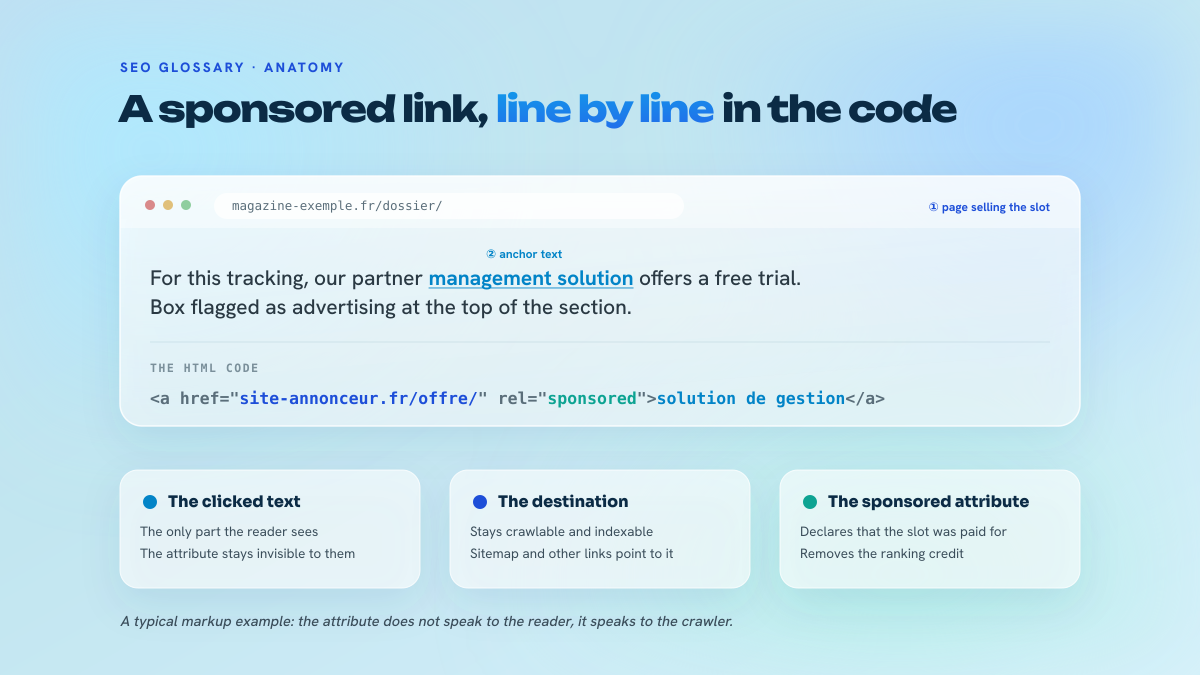
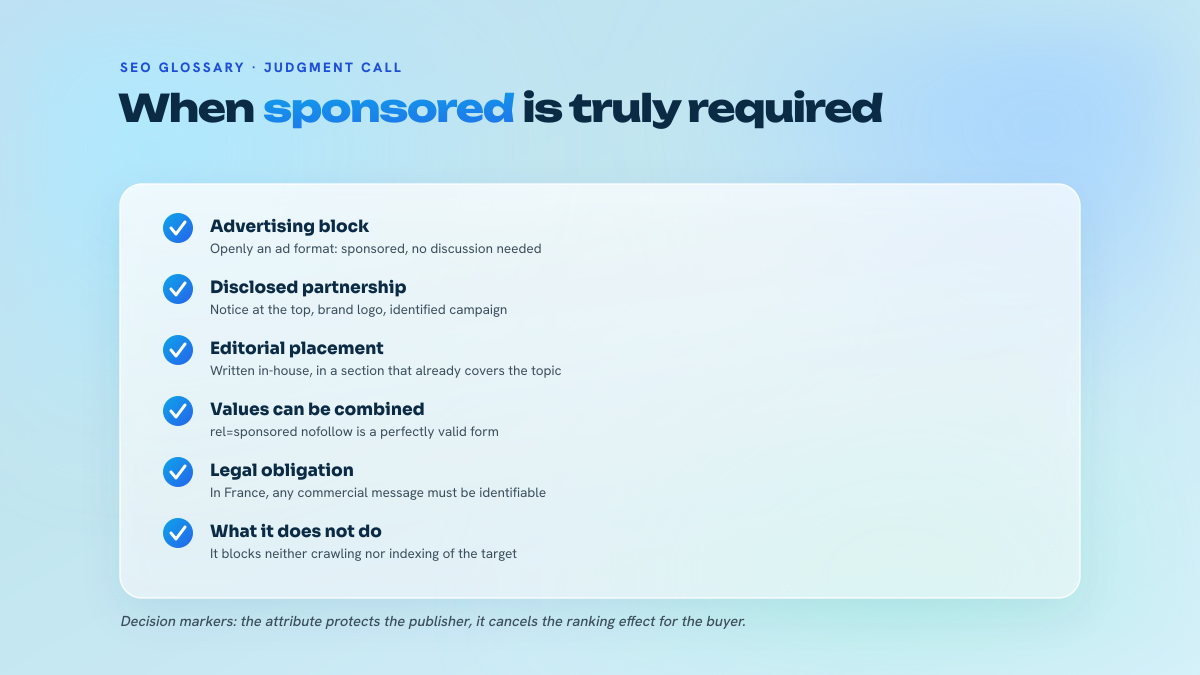
The attribute does exactly one job: it tells search engines that a link exists because money, a product or some other consideration changed hands. Google's outbound-link documentation is explicit that advertisements and paid placements, including what the industry simply calls paid links, should carry rel="sponsored", that values can be combined as in rel="sponsored nofollow", and that these attributes generally prevent following even though the destination may still be discovered through sitemaps or other links. Nothing in that guidance says the link becomes acceptable. It says the link becomes declared.
That distinction carries the whole term. Sponsored is a statement about the commercial relationship, not a verdict on editorial value. A paid article on a media with a real audience and a paid insertion on a content farm get the identical markup. Google uses the declaration to decide whether to pass ranking credit; everything else about the placement, the traffic it sends, the brand exposure it buys, the entity association it builds, sits outside the attribute entirely. Briefs that conflate the two produce the same bad decision every time: they price a placement as if the attribute were the product.
The attribute belongs to the same family as rel="ugc" and the older nofollow attribute, which Google treats as a hint for crawling and indexing rather than a hard directive. Two consequences still catch people out in 2026. A sponsored link can be crawled. And its target can still be indexed, because indexation depends on discovery paths Google has anyway. Sponsored has never been a way to keep a page out of the index, and using it that way is a category error.
So the pitch you occasionally still hear, « sponsored links that pass juice anyway », is a contradiction sold as a feature. Either the placement is declared and you buy it for reasons other than ranking equity, or it is undeclared and you are carrying the risk yourself with your eyes open. There is no third door. Most of the confusion we untangle in client link audits collapses once that binary is stated plainly.
How Google treats it in 2026, and how to measure it
Start with adoption, because it reframes the whole risk conversation. Ahrefs' 2026 SEO statistics dataset reports that only 0.01 % of referring domains to the top 110,000 sites use rel="sponsored", against 0.44 % using rel="ugc". The caveat matters and Ahrefs states it: the figure counts observed referring domains, not the total number of paid placements, and not the share of publishers complying with Google's guidance. Hold it against any honest estimate of how much of the commercial link graph is bought, though, and the reading is unambiguous. The market has collectively decided not to declare.
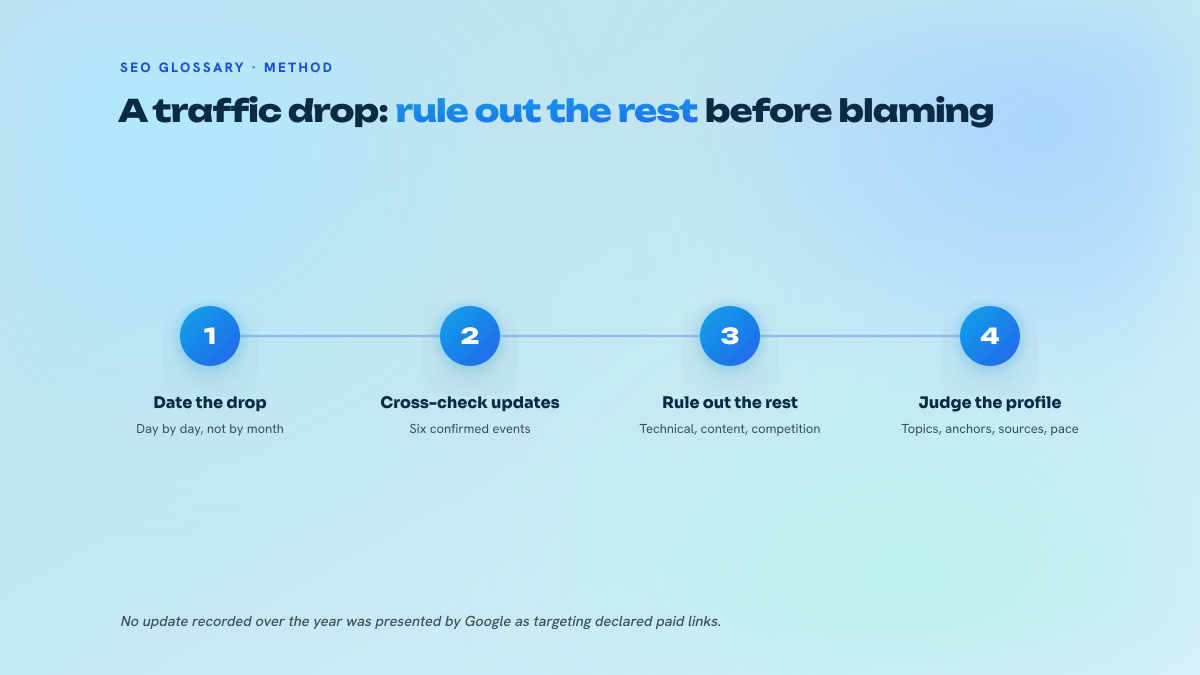
Which is precisely why Google's spam systems key on patterns rather than on the absence of an attribute. Between 26 August 2025 and 24 June 2026, Google's Search Status Dashboard records six confirmed ranking events: the August 2025 Spam Update (26 days, 15 hours), the December 2025 Core Update (18 days, 2 hours), the March 2026 Spam Update (19 hours 30), the March 2026 Core Update (12 days, 4 hours), the May 2026 Core Update (11 days, 21 hours) and the June 2026 Spam Update (2 days, 1 hour). Note what none of them was announced as: a link-spam update. Google presented the August 2025 event as a global, all-language spam update and did not specify individual tactics, a point Search Engine Roundtable also flagged at the time. If a strategy deck told you that update was a paid-links crackdown, that deck was reading commentary as doctrine.
Measurement is where seniority shows. Google Search Console will never surface rel attributes, so the audit runs on rendered HTML. Three checks catch nearly everything. The attribute has to sit on the <a> element itself, not on a wrapping container, which some page builders get wrong. The rendered source is the source of truth, not the CMS field, because plugins and consent layers rewrite outbound links after save. And redirect hops need following: a paid link routed through a 302 tracker launders nothing, it just hides where the credit was meant to land. Ahrefs and Majestic both expose per-link rel attributes in their exports, so the practical routine is a quarterly diff of your own backlink file against the previous export. Retro-tagging is common enough that the diff usually returns something.
Where it fits in a real netlinking operation
The decision is made at purchase, not at markup. In practice a campaign splits into two buckets that should never share a budget line. Placements bought for ranking equity are editorial, contextual, and priced on the authority they transfer. Placements bought for audience access, brand exposure or AI-search citation are priced on reach, and declaring them costs you nothing you were paying for. Once a team separates those two lines, the sponsored question answers itself per placement instead of becoming a doctrinal argument.
The industry has been moving that way for two years. A survey of 518 SEO professionals published by Editorial.link found 48.6 % rating digital PR as the most effective link-building tactic for 2026, against 16 % for guest posting and 12 % for linkable assets, and a separate 2026 survey of 500 professionals reported 58 % increasing link-building budgets while 14 % cut them. Money is not leaving the category, it is changing what it buys. And the AI layer accelerates that: an Ahrefs 2025 study of 75,000 brands found branded web mentions correlated with Google AI Overview visibility at 0.664, more strongly than backlinks or Domain Rating in that analysis. A declared sponsored placement on a media that genuinely gets read still produces a brand mention in a citable document. That is a real asset, it is simply not a PageRank asset.
Pricing is the part clients get wrong. BuzzStream's 2025/2026 benchmarks put the average direct guest-post placement around $364.76, with other summaries of the same analysis reporting typical guest posts near $220, higher-quality posts up to $609 and paid link insertions around $141, while the 518-professional survey reported an average acceptable price of $508.95 for a high-quality backlink and 80.9 % of respondents expecting costs to rise over the next two to three years. Those are directional benchmarks from different samples, not a market rate. They are still enough to run the test that matters: if a placement only makes financial sense when the link is followed, you are not buying media, you are buying a bet. We publish what each placement costs, openly and without a hidden commission for exactly that reason, and the same arithmetic should apply to whoever you buy from.
On our side the question is structural rather than philosophical. Nautilinks operates its own French editorial media, so we know with certainty which placements are commercial, because we own the inventory and the newsroom that writes it. That lets declaration be a per-placement decision taken openly with the client rather than a default hidden in a supplier's template. If you want the audience-and-mention side of the equation, a paid article published on a media that actually has readers is the honest instrument. If you want a mix calibrated across quarters instead of a one-off purchase, that is what handing the campaign brief to a team that operates its own media is for.
What we see go wrong
The most expensive failure is blanket application. A WordPress plugin set to add rel attributes to every external link will tag your genuine editorial citations as sponsored along with the two paid placements you actually meant to declare. On a site that has spent years earning outbound editorial credibility, that is a self-inflicted wound nobody notices for months because nothing visibly breaks. Check the template, not the intent.
The second is retro-tagging as damage control. Marking existing paid links sponsored after a manual action lands is a legitimate cleanup step, and reviewers do want to see it. It is not immunity, it does not restore anything on its own, and it certainly does not work as a preventive ritual applied to a profile that has other problems. Cleanup fixes the declaration, not the pattern that triggered the review.
Third, disclosure mismatch. Regulators read the visible text on the page, Google reads the markup. A French or European partnership disclosure with no rel attribute satisfies one and not the other; markup with no visible mention satisfies neither audience properly. They are two separate obligations and they cost nothing to satisfy together.
Fourth, the ugc confusion. Paid placements in forum signatures or comment sections are still paid: sponsored is the correct value, optionally combined with ugc. Marking them ugc alone describes where the link sits, not why it exists, and it is the kind of half-declaration that reads worse than no declaration at all if anyone looks closely.
Fifth, and this one shows up in supplier catalogues, packages advertised as compliant and priced like followed placements. Declaring a link removes the mechanism most buyers are paying for. A vendor charging followed-link rates for declared inventory is charging you for a product they have just told Google not to deliver.
The working rules
Decide the attribute at purchase, per placement, and write the decision into the order. A campaign where nobody can say afterwards which links were bought is a campaign nobody can audit, which is a far bigger operational problem than the markup itself.
Audit rendered HTML quarterly and diff against the previous export. You are looking for two things: your own site tagging links it should not, and publishers silently changing the attributes on placements you paid for.
Apply the price test before the compliance test. If the placement only pays for itself through transferred authority, declaring it destroys the purchase, which tells you something useful about what you were actually buying. If it pays for itself through referral traffic, audience and citation surface, declare it and stop worrying.
Keep the visible disclosure and the markup in sync, on the same page, every time. And treat rel="sponsored" for what it is: a piece of honest bookkeeping between you, the publisher and the search engine. It has never been a tactic, and no amount of 2026 commentary has made it one.
Nautilinks operates an owned network of editorial media. In-house written articles, transparency disclosures respected, anchor mix calibrated.
Frequently asked questions
If I retro-tag my paid links sponsored after a manual action, does that clear it?
It is a necessary step, not a sufficient one. Reviewers want to see that paid placements are now declared, but the action was triggered by a pattern across your profile, and marking attributes does not undo that pattern. Expect to combine retro-tagging with removals and a disavow file for what you cannot reach, plus a reconsideration request that states plainly what was bought and when. Applying the attribute preventively to a profile with other structural problems changes nothing.
Sponsored, nofollow or ugc for a paid guest post?
Sponsored, per Google's outbound-link documentation, which names advertisements and paid placements explicitly. You can combine values, <code>rel="sponsored nofollow"</code> is valid and some publishers default to it. Reserve ugc for content genuinely produced by users, and note that a paid placement inside user-generated space is still paid: sponsored applies, ugc is the optional second value describing where it sits. Marking a paid guest post ugc alone describes the container and hides the transaction.
Does rel=sponsored stop the target page from being indexed?
No, and the confusion is worth killing. Google's documentation states these attributes generally prevent following, then adds that the destination may still be discovered through sitemaps or other links. Indexation depends on discovery paths Google has independently of your link. If you need a page kept out of the index, that is a noindex directive or an authentication wall, never a rel attribute on somebody else's outbound link.
How do I audit rel attributes across a few thousand backlinks?
Export from Ahrefs or Majestic with the rel attribute column, then re-crawl the live URLs yourself to verify, because index data lags publisher changes. Three checks catch most issues: the attribute must sit on the anchor element rather than a wrapper, the rendered HTML is authoritative over the CMS field, and redirect hops need following since trackers hide the real target. Store each export and diff quarterly, retro-tagging shows up there.
If almost nobody declares, why should I?
Ahrefs' 2026 dataset does put sponsored at 0.01 % of referring domains to the top 110,000 sites, so non-declaration is the norm. The argument for declaring is not moral posturing, it is portfolio design: a placement bought for audience, referral traffic and brand mention loses nothing when declared, and an Ahrefs 2025 study of 75,000 brands found branded mentions correlated with AI Overview visibility at 0.664, above backlinks or Domain Rating. Declare what you bought for reach, and stop pretending the rest is something it is not.
Test your knowledge
Quiz: rel=sponsored
1/3According to Google's outbound-link documentation, what does rel=sponsored do to the destination page?