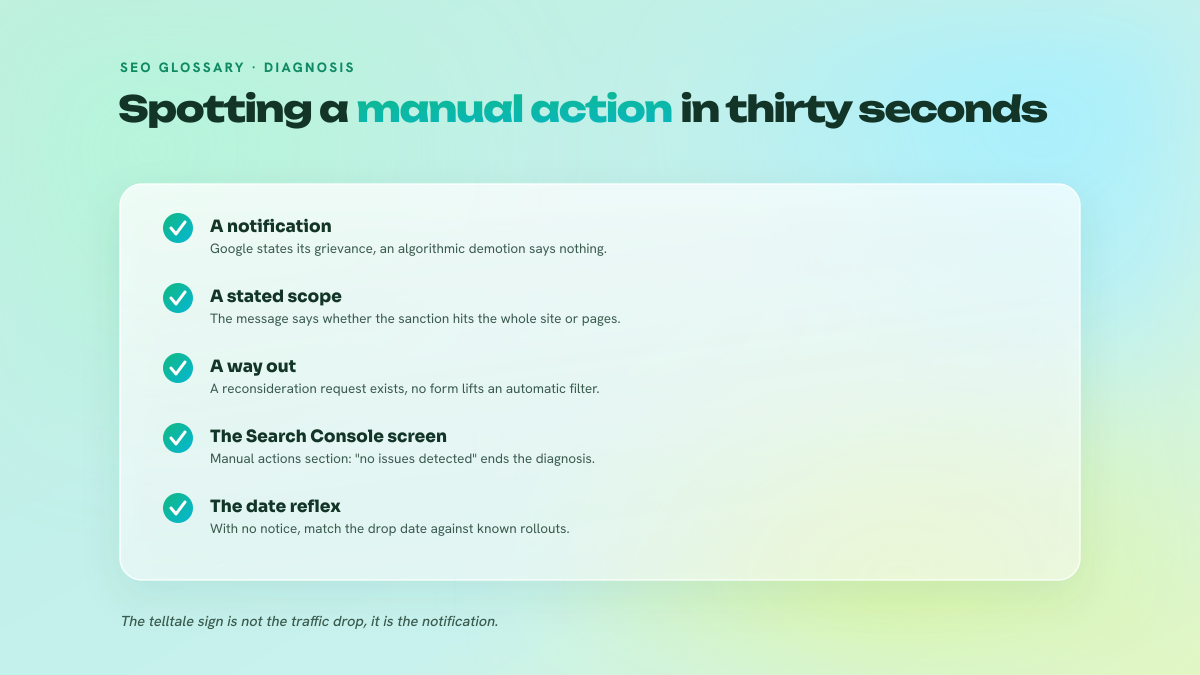
- →If Search Console shows nothing under Manual actions, you do not have a penalty. You have an algorithmic problem, and the reconsideration request you were about to write is wasted work.
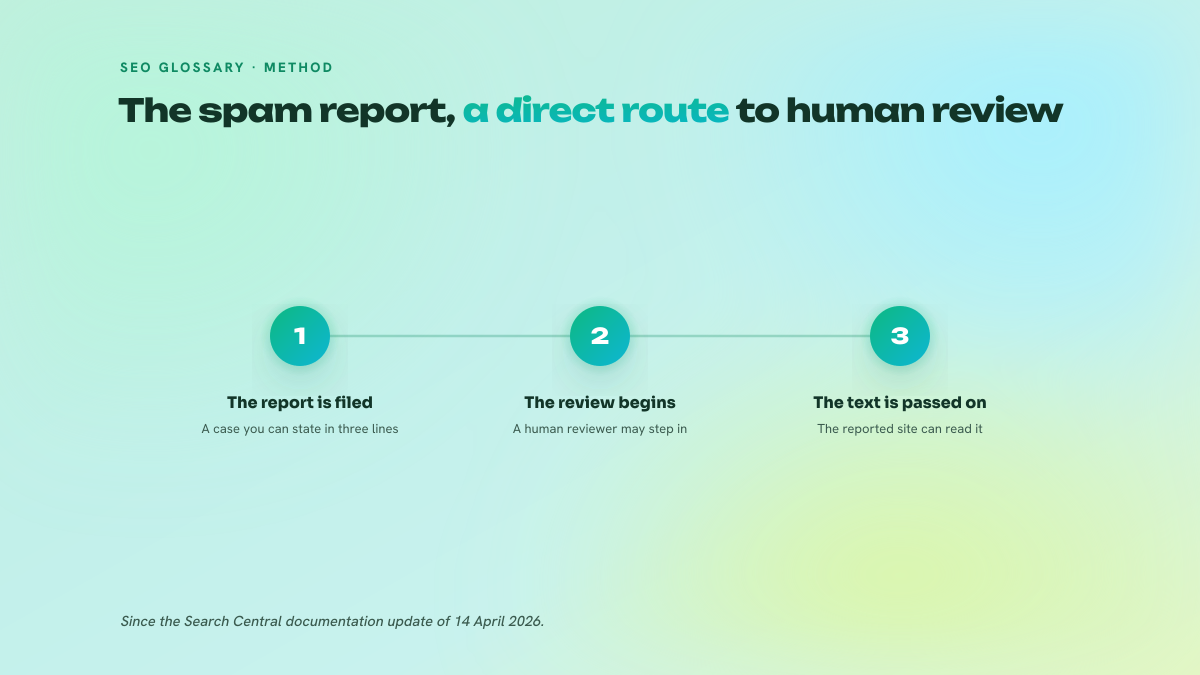
- →Google confirmed on 14 April 2026 that spam reports may be used to take manual action, which turns a competitor's report into a direct enforcement input rather than training data for SpamBrain.
- →Google's Webspam Report 2024 shows SpamBrain identifies around 200 times more spam pages than manual reviews: manual actions are a narrow, high-impact layer aimed mostly at link schemes and reputation abuse.
- →Partial link actions clear in roughly four to eight weeks with thorough cleanup, site-wide ones typically take three to six months according to 2026 recovery audits: budget the timeline before you promise a client a fix.
- →The GSC Links report is a capped sample, not Google's link graph, and it broke badly on 21 May 2026. Never run a forensic backlink audit on that export alone.
- →The only durable defence is a link profile where every placement survives being read by a human reviewer: real editorial context, no footprint, no paid-link pattern to spot.
A manual action is not an algorithmic drop
The single most expensive confusion in this field is treating every traffic loss as a penalty. A manual action is a specific administrative object: a human reviewer at Google applied a labelled sanction to a URL, a directory, or an entire domain, and that sanction appears in Search Console under Manual actions with the violation named. Nothing else counts. A core update that reshuffles your category, a spam update that recalibrates SpamBrain, a competitor overtaking you on a commercial query: none of these produce a notice, and none of these are lifted by a reconsideration request.
This matters operationally because the two situations demand opposite responses. An algorithmic demotion is corrected by changing the thing being scored, then waiting for the next recalculation. A manual action is corrected by remediating the specific violation, documenting that remediation, and asking a human to look again. Sending a reconsideration request when no action exists is not merely useless, it wastes the diagnostic window during which you should have been reading logs and comparing update timelines.
The reporting layer around this has its own failure modes. A June 2026 technical reference on Search Console notes that the Links report is explicitly a sample, capped at 100,000 exported rows, and does not reflect Google's full link graph. Worse, on 21 May 2026 the Links report suffered a significant outage in which many sites displayed near-zero backlinks or drops of 87 to 90 percent, with Google reverting to prior-week data after John Mueller acknowledged the bug. If your penalty diagnosis rests on what GSC shows for links, you are building on a surface that has demonstrably lied within the last twelve months. Search Console remains authoritative for the manual action itself. It is not authoritative for the link data you need to fix one.
How a manual action actually gets triggered in 2026
The old mental model was that Google's spam team crawled around looking for offenders. That was never quite true, and it is emphatically not true now. An analysis of Google's Webspam Report 2024 found that SpamBrain identifies roughly 200 times more spam pages than manual reviews, and keeps around 99 percent of search results free of spam. The automated layer does the volume. Human review is what happens when something is escalated: by a pattern the systems flag but cannot confidently resolve, by an internal investigation into a network, or, increasingly, by a report filed against you.
That last channel changed materially this year. On 14 April 2026 Google updated its Search Central spam reporting documentation to state that spam reports may be used to take manual action against reported sites, rather than only to improve its systems. Follow-up commentary on 23 April 2026 was blunt about the consequence: a spam report is now a direct input to enforcement, which raises the practical risk for anyone running visible link schemes. Google also clarified that the text of a report may be shared verbatim with the reported site owner, and that reporter anonymity holds only if no personal details are included in the report body.
Read that as a competitive-intelligence fact, not just a compliance one. In a French commercial vertical where four or five agencies fight over the same queries, your competitors know exactly which of your placements look bought, because they are buying too. Any footprint you leave that is legible to a peer is now one form submission away from a human reviewer's queue. That is a different threat model from 2019, and it argues for a much stricter standard than « will an algorithm catch this ».
Meanwhile the algorithmic layer keeps accelerating. The March 24 to 25, 2026 spam update rolled out globally across all languages and completed in about 19 hours and 20 minutes, against 27 days for the August 2025 spam update and 7 days for December 2024. Commentary noted it was a refinement of existing SpamBrain systems with no new spam policies announced. The narrowing gap between violation and consequence means the window in which a dubious tactic « works » keeps shrinking, and the residual work left to humans concentrates on exactly the categories that resist automation: paid link networks and reputation abuse.
What unnatural link actions look like in practice
Two labels do most of the damage in netlinking. The first is unnatural links to your site, applied when reviewers conclude you acquired links intended to manipulate PageRank. The second, newer and nastier, is site reputation abuse, introduced as a spam policy in March 2024, with the language tightened on 19 November 2024 and an editorial documentation update logged on 21 January 2025.
A May 2026 recovery guide focused on unnatural link actions catalogues the patterns that most often trigger them in current audits: paid links passing PageRank through unmarked sponsored posts, link insertions and paid guest posts; PBN links from networks of expired or repurposed domains; and large-scale link exchanges or satellite site networks. None of that is surprising to anyone who has run campaigns for a decade. What is worth noting is the ranking: the unmarked paid placement, the most ordinary transaction in this industry, sits at the top.
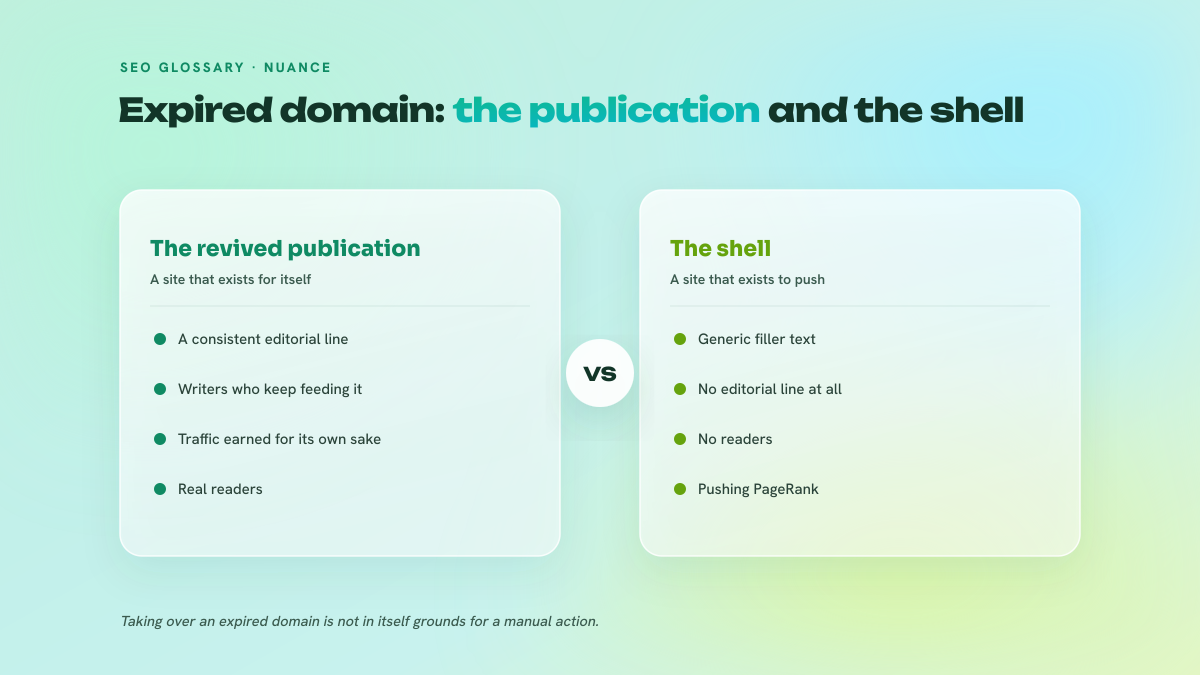
The site reputation abuse clarifications are the part most agencies still underestimate. Google stated that moving abusive content to a subdomain, applying noindex, or redirecting it does not automatically lift the action. It also stated that some editorial review or first-party involvement does not make third-party content compliant when its main intent is to exploit the host site's authority for unrelated or low-value content. That guts the standard defence for coupon subfolders, programmatic guest post programmes and rented sections on established media. If the content exists because the domain has authority rather than because the audience wants it, the structural workaround does not save you.
Recovery timelines follow the scope of the action. The same 2026 recovery resource reports that site-wide unnatural link actions typically take three to six months to fully recover, while partial or sectional actions can be resolved in roughly four to eight weeks when the cleanup is genuinely thorough. Those are the numbers to put in front of a client before you take the remediation brief, not after. If you are pricing a campaign, the honest calculation includes the possibility that the cheap tactic costs a quarter of organic revenue, which is why our published rates per media exist as a single visible number rather than a quote you negotiate.
What we see go wrong in recovery
The recurring failure is disavowing instead of removing. The disavow file tells Google to ignore links; it does not demonstrate that you stopped acquiring them. Reviewers assessing a reconsideration request want evidence of effort and evidence of changed behaviour. A 4,000-line disavow uploaded the same week the action landed reads as exactly what it is: a panic move by someone who never intended to change the acquisition process. Remove what you can actually remove, document the outreach, and disavow only the residue you could not reach.
The second failure is an incomplete inventory, and it usually traces back to the tooling problem described above. Auditing unnatural links from the Search Console export alone means auditing a capped sample of a graph that was demonstrably broken as recently as 21 May 2026. Pull from at least two independent crawlers alongside GSC, reconcile the sets, and treat any placement you cannot explain editorially as in scope regardless of which tool surfaced it.
The third is the reconsideration request written as a plea. Reviewers read a large volume of these. Ours are structured as a short factual account: what was acquired, over what period, through which channels, what has been removed with counts and dates, what remains disavowed and why, and what changed in the process so the pattern cannot recur. No apology paragraph, no promise of future good behaviour, no mention of employees whose jobs depend on the outcome. If the request cannot survive being read by a sceptical stranger in ninety seconds, rewrite it.
The fourth is partial remediation across a portfolio. When one client site takes an action for a link pattern, every other site in your care sharing that acquisition source carries the same exposure. The reviewer who examined one domain has, at that moment, a documented example of the pattern. Treat a manual action on any managed property as a portfolio-wide audit trigger, not a single-site incident.
Building a link profile that never earns one
The prevention standard worth adopting is simple and uncomfortable: assume a human reviewer will read every placement, with the referring site open in one tab and your client's site in the other. The question is not whether an algorithm can detect the transaction. It is whether a competent person, who does this daily, would conclude the article exists to pass authority.
That test kills most of what the market sells. It kills the guest post on a site whose entire recent output is guest posts. It kills the paragraph inserted into a three-year-old article about an unrelated topic. It kills the network where twelve properties share a footer template, a hosting range and a publication cadence. It survives only when the host medium has real editorial existence: its own topic, its own regular publication, an audience that is not your link.
This is the structural argument for owned media over aggregated inventory. A catalogue you can inspect before committing anything lets you apply the reviewer test yourself, medium by medium, instead of trusting a supplier's quality label. Stringer operates its French editorial media in-house for exactly that reason: when you control the editorial calendar and the topical scope, no placement needs to look like an exception in its host's output. Compare that with a catalogue aggregating third-party inventory, where the same medium may be selling to forty buyers with no coordination on anchor distribution or topical fit, and where you discover the footprint only after it is live.
The other half of prevention is pacing and anchor discipline. Sudden acquisition bursts after long silence, exact-match anchors clustered on money pages, and topical mismatch between host and target are the three signals that make a profile legible at a glance. None of them require sophisticated detection. All of them are visible to the competitor considering whether to file a report. If you are running sustained acquisition for a commercial site, the calibration work matters more than the volume, and it is worth handing the pacing to people who track it across quarters rather than fitting placements to a monthly budget cycle.
A February 2026 industry analysis argues manual actions are rising again, driven by the volume of AI-generated content and the cyclical crackdowns that follow. Whether or not the trend holds, the direction of the enforcement design is clear: automation absorbs the volume, humans handle the categories where intent must be judged, and reports from the field feed those humans directly. Link acquisition is squarely inside that residual category. Build accordingly.
Nautilinks operates an owned network of editorial media. In-house written articles, transparency disclosures respected, anchor mix calibrated.
Frequently asked questions
How do I tell a manual action apart from a core update hit when both landed the same week?
Search Console settles it: no notice under Manual actions means no manual action, full stop. If the report is empty, check whether the drop aligns with a confirmed update date and whether it is uniform across the site or concentrated on specific templates and query types. Manual actions applied at partial scope hit a defined section cleanly; core update movement is usually distributed across query intent and competitive context in a way that does not respect your directory structure.
Does disavowing links actually help lift an unnatural links action?
It helps as a component, never as the whole answer. Reviewers assess whether you made genuine effort to remove links and whether the acquisition behaviour changed. A large disavow uploaded with no removal outreach documented signals that nothing changed except the file. Remove what you can reach, log the attempts with dates and responses, disavow only the residue, and describe that sequence in the reconsideration request. Order and evidence matter more than file size.
Can a competitor's spam report get me penalised?
It can now put you in front of a human reviewer, which is the part that changed. Google updated its spam reporting documentation on 14 April 2026 to state that reports may be used to take manual action, not just to improve systems. The report does not itself impose a penalty; a reviewer still has to find a violation. But if your footprint is legible to a peer in your vertical, you no longer depend on an algorithm noticing it.
Will moving the offending content to a subdomain clear a site reputation abuse action?
No, and Google said so explicitly. The clarifications logged in January 2025 state that moving abusive content to subdomains, applying noindex, or redirecting it does not automatically lift the action. The same guidance holds that editorial review or first-party involvement does not make third-party content compliant when its main purpose is to exploit the host's authority. The structural workaround addresses the symptom, not the finding.
How long should I tell a client recovery will take?
Scope decides it. A 2026 recovery reference reports partial or sectional unnatural link actions resolving in roughly four to eight weeks with thorough cleanup, and site-wide actions typically taking three to six months for full recovery. Give the range up front, and separate two milestones in the plan: the action being lifted, which is binary and comes first, and rankings returning, which is gradual and never guaranteed to reach the previous level.
Is the Search Console Links report enough for a forensic backlink audit?
Not on its own. It is documented as a sample, exports cap at 100,000 rows, and it is not Google's full link graph. It also failed visibly on 21 May 2026, showing many sites near-zero backlinks or drops of 87 to 90 percent before Google reverted to prior-week data. Use it as one input, cross-reference at least two independent crawlers, and reconcile the sets before deciding what is in scope.
Test your knowledge
Quiz: Google manual actions
1/3According to the analysis of Google's Webspam Report 2024, how does automated detection compare with manual review in volume?