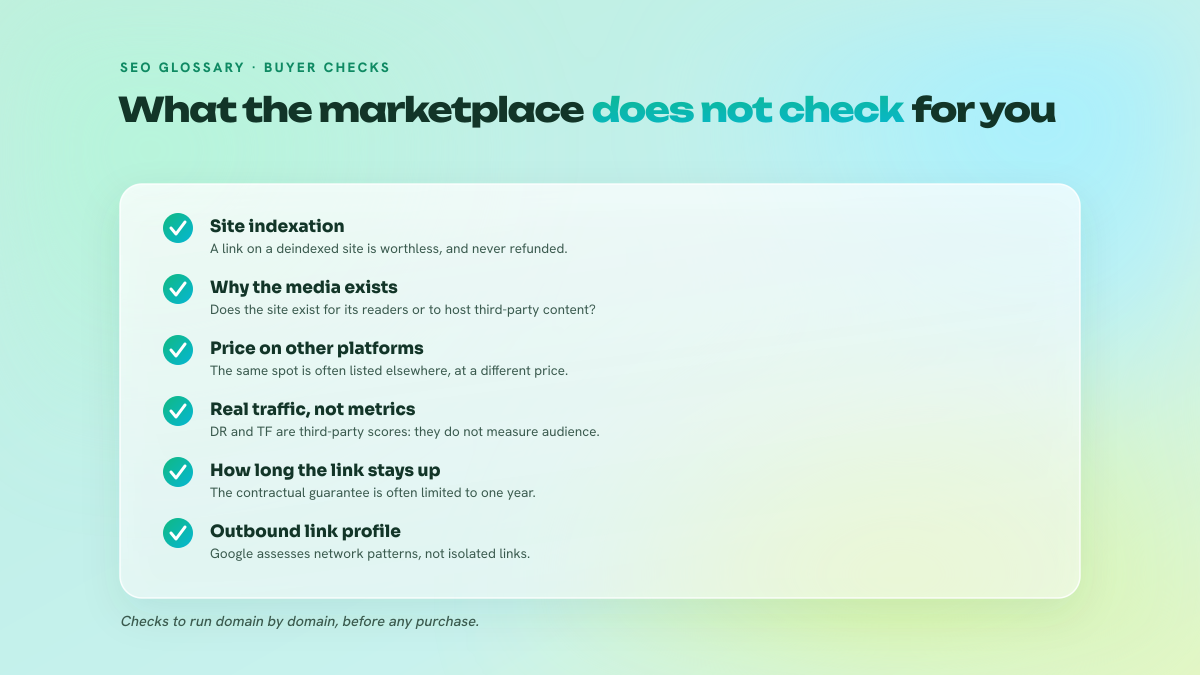
- →A marketplace sells procurement efficiency and inventory access, not link quality. Vetting is structurally your job: the platform's revenue is a commission spread, so its incentive is placement volume, not the longevity of the sites it lists.
- →Sort by organic traffic trend across the 2024-2025 update cycle, not by DR. Search Engine Land estimated the March 2024 rollout cut roughly 45% of unoriginal, low-value content from page-one results, and much of that inventory stayed listed at unchanged prices.
- →Price benchmark: $361.44 average per paid link, $1,003 for top-quartile placements (Authority Hacker survey of 755 SEOs). A dramatically lower price usually signals a different market segment, not a bargain.
- →Reserve marketplace inventory for supporting links whose individual failure is survivable. Load-bearing links to money pages need publishers you can audit continuously or control outright.
- →The single best qualification question: would this publisher exist without link revenue? Sites that exist to host paid content are the exact profile Google has been deindexing since the 2022 Helpful Content Update, per Ranking Atlas's 2026 analysis of 140,000 publisher listings.
Beyond the catalogue: what a link marketplace actually sells
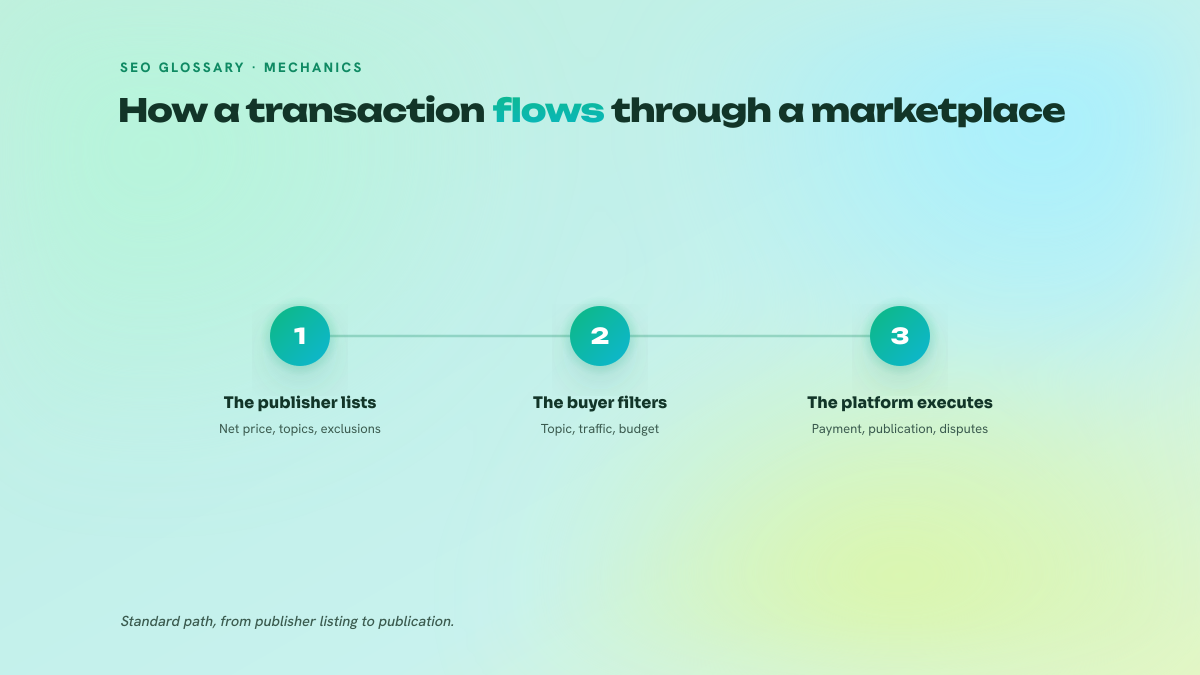
A link marketplace is a two-sided platform: publishers list domains willing to host paid placements, buyers filter that inventory by metrics, niche, language and price, then order guest posts or link insertions through a standardized checkout. The pitch is procurement efficiency, and that part is genuine. Link building through manual outreach means prospecting, negotiation, follow-ups and a reply rate that rarely flatters the hours invested. A marketplace collapses all of that into a search filter and a cart.
What the platform actually sells, though, is not links. It sells access to a pool of publishers who decided to monetize their authority, plus a thin layer of vetting and payment escrow. The marketplace earns a commission spread on every transaction, which means its structural incentive is placement volume, not the long-term health of the sites in its catalogue. Vetting standards diverge enormously between platforms for exactly this reason: strict vetting shrinks sellable inventory, and inventory is the product.
Underneath everything sits an adverse-selection problem. Publishers who list on open marketplaces self-select toward monetization-first operations, meaning sites whose editorial calendar exists to carry sponsored content. Ranking Atlas's 2026 analysis of 140,000 publisher listings across multiple platforms concluded that Google has been deindexing sites at scale since the 2022 Helpful Content Update, targeting precisely the profile of sites that exist primarily to host third-party SEO content, and noted that paid guest-post marketplaces «fit that profile exactly». When a listed domain drops out of the index, the report's phrasing is blunt: spend on those links goes to zero.
None of this makes marketplaces useless. It makes them raw inventory feeds that need your own qualification layer bolted on top. The distinction with a link broker who sells curation as the service itself matters here: a broker charges for negotiated access and judgment, a marketplace charges for self-service scale and quietly pushes the judgment work back onto you.
How pricing and inventory really work in 2026
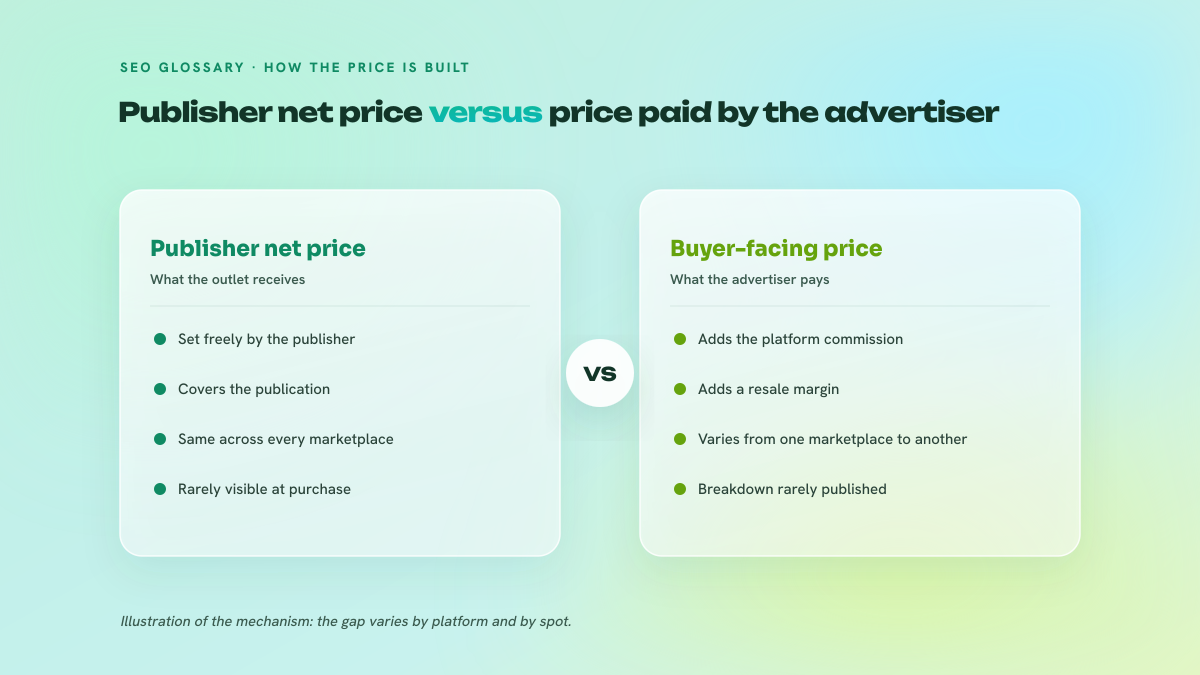
Pay-per-placement remains the dominant model, with subscription and credit systems layered on by platforms chasing recurring revenue. On price levels, the most cited reference is Authority Hacker's survey of 755 SEO professionals: an average cost of $361.44 per paid link, with top-quartile placements averaging $1,003. At the other end, a survey with a broader global sample reported an average of $83 per paid link (Digital Web Solutions, 2025). The gap tells you more about the market than about any « right » price: visually identical listings can differ by an order of magnitude depending on language, market maturity and the platform's positioning. Transaction-level data is finally replacing rate-card folklore: PressWhizz published a pricing report in July 2026 built on 23,000 real placements totaling $3.66M in spend, and that kind of dataset exposes how weakly listed prices correlate with anything measurable.
Filtering mechanics deserve the same skepticism. DR and Authority Score are the default sort keys on every platform, and they are also the most gamed inputs in the industry: third-party authority metrics are inflated by the very link schemes marketplaces host. The signal that resists manipulation is the organic traffic curve across Google's update cycle. The March 5, 2024 core and spam update codified site reputation abuse, expired domain abuse and scaled content abuse as named spam policies. Search Engine Land estimated that the March 2024 rollout cut roughly 45% of unoriginal, low-value content from page-one results, a purge that disproportionately hit marketplace-style publisher inventories according to Bluetree's 2026 risk analysis. Google followed with a spam-detection update on June 20, 2024 that explicitly called out guest-post and paid-link patterns, then another spam update on August 26, 2025 focused again on scaled content and site reputation abuse.
Each wave repriced the inventory, but the catalogues did not follow: sites that lost half their visibility kept their listing and their asking price long after the link value degraded. A marketplace price is a lagging indicator; the traffic graph is the leading one. This lag is also why we publish a flat, public rate for every media we operate, so a buyer can check what a placement actually costs before committing instead of decoding a spread.
Where a marketplace fits in a netlinking operation
Demand is not going anywhere. Editorial.Link's 2026 survey of 518 SEO professionals, with fieldwork run between March and May 2025, found that 91.89% believe their competitors buy links, statistically unchanged from the 92% measured in the 2025 edition. Search Engine Journal survey data cited by Bluetree has 41% of SEO professionals calling link building the most challenging part of SEO. Marketplaces exist at the intersection of those two facts: nearly everyone buys, and sourcing is the bottleneck.
Where marketplaces earn their place: the long tail of a campaign. Supporting links to category and cluster pages, volume tiers where individual placement failure is survivable, quick tests of a new niche, and foreign markets where you have no outreach capability and no reading ability. In those contexts, self-service speed beats artisanal sourcing, and the occasional dud is an accepted line item.
Where they do not belong: the load-bearing links pointing at your money pages. Those placements need publishers whose future behaviour you can predict, because the economics of selling links push most third-party publishers toward higher sponsored density over time, and every additional paid post on the domain dilutes and endangers yours. The operational rule we apply is simple: marketplace inventory for the layer of links whose individual failure you can absorb, controlled or continuously audited publishers for everything the campaign actually rests on.
The failure modes we see in audits
The same mistakes surface in nearly every backlink audit we run on marketplace-heavy profiles. The first is sorting by DR and ignoring trajectory: a DR 55 site that lost most of its organic traffic across the 2024-2025 updates is a fundamentally different asset from a DR 40 site that sailed through them, yet the catalogue ranks the first one higher and prices it accordingly.
The second is ignoring sponsored density. Open the last thirty published articles: if the overwhelming majority carry outbound commercial links to unrelated verticals, you are looking at a paid-link directory wearing a magazine skin, whatever the metrics say. The third is the absence of post-purchase monitoring. Buyers verify the link went live, then never check whether the page, the category or the whole domain is still indexed six months later. Given the deindexing dynamics documented by Ranking Atlas, a marketplace-sourced profile without quarterly indexation checks is a portfolio with unbooked losses.
The fourth is anchor discipline, or the lack of it. A marketplace makes it operationally trivial to order dozens of placements in a week, and buyers replicate the same optimized anchor across all of them. Bluetree's 2026 deep-dive on Google's backlink policy notes that SpamBrain evaluates patterns at network level, including anchor-text distributions and relations between linking and linked domains, and references a leaked internal «BadBackLinks» signal that turns a contaminated profile into a negative factor. Scale without variance is exactly what network-level detection is built to catch.
The last one is psychological: treating refund policies as risk management. Platforms refund removed links. Nobody refunds a devalued one, and devaluation is the common case.
Marketplace, broker or owned network: the actual trade-off
Three procurement models coexist in 2026. The marketplace sells self-service scale over aggregated third parties. The broker sells curated access and negotiation. The owned network sells control. The variable that decides whether a placement survives the next spam update is not the DR at the moment of purchase; it is who controls the publisher's future choices: the editorial calendar, the ratio of sponsored to organic content, the writing quality, and ultimately whether the site would exist without link revenue. On a marketplace, you rent someone else's risk profile and you learn about changes after the fact.
That control question is why Nautilinks is built as the structural opposite of a marketplace: a network of French editorial media we own and operate in-house, with internal writing and a single seller who carries the deindexing risk on his own assets. The full list of media we run is public, and orders go through a platform built on that owned inventory rather than on aggregated third-party listings. The point is not that owned is virtuous and marketplace is not; the point is that the survival variables sit on the seller's side of the table, so you should know exactly who is sitting there.
Marketplaces will remain the commodity layer of the link economy, and used with a qualification layer they are a legitimate tool for the survivable tier of a campaign. The senior filter fits in one question, and it is the one no catalogue metric answers: would this publisher still exist if the link revenue stopped tomorrow? If the honest answer is no, you are not buying authority. You are buying a countdown to the next spam update.
Nautilinks operates an owned network of editorial media. In-house written articles, transparency disclosures respected, anchor mix calibrated.
Frequently asked questions
How do I qualify a marketplace listing beyond the platform's own metrics?
Pull the organic traffic curve over 24 months and read behaviour across the March 2024, June 2024 and August 2025 Google updates: a site that dropped and never recovered is repriced inventory whatever its DR says. Then open the last thirty published articles and count sponsored posts, check that the category hosting your placement is actually indexed, and scan outbound anchors for unrelated verticals. Ten minutes per domain kills most bad buys before checkout.
Does listing on a marketplace itself create a detectable footprint?
The listing itself, no: catalogues are gated and Google does not need them. The behavioural footprint is the real exposure: publication cadence, outbound anchor distributions, and shared buyer graphs across a publisher's sponsored posts. Bluetree's 2026 analysis of Google's backlink policy notes that SpamBrain evaluates relations between linking and linked domains at network level, so the risk you inherit is the publisher's aggregate behaviour, not your single order.
Is an $83 average price per link a bargain or a trap?
Neither: it is a different market. The $83 figure comes from a mixed global sample (Digital Web Solutions, 2025), while Authority Hacker's survey of 755 professionals, weighted toward Western markets, lands at $361.44 average and $1,003 for the top quartile. Price maps to publisher economics: a French editorial site with real traffic and internal writing cannot produce a placement at $83 without cutting something you would eventually notice in the link's survival.
When does a link broker beat a marketplace?
When your qualification cost exceeds the broker's margin. Brokers make sense for markets you cannot read, one-off high-stakes placements, and inventory that never reaches public catalogues. For high-volume supporting tiers in a language you master, the broker's spread buys you little that a disciplined internal vetting checklist does not. The honest comparison is your hourly cost of qualification versus the markup, not the sticker prices.
What happens to my links if a listed site gets deindexed?
They pass nothing, and you will rarely be notified. Marketplace guarantees cover removed links, not devalued or deindexed ones, which is the far more common failure. Ranking Atlas's 2026 analysis of 140,000 publisher listings describes spend on deindexed domains as going to zero, and documents deindexing at scale since the 2022 Helpful Content Update. The only defence is quarterly indexation monitoring of every domain you have bought from.
Test your knowledge
Quiz: Link marketplace
1/3According to the Authority Hacker survey of 755 SEO professionals, what is the average cost of a paid link?