- →Selling a followed link for money is link spam under Google's spam policies (updated 15 May 2026); qualifying it with rel=sponsored or rel=nofollow makes the placement compliant and simultaneously removes the ranking value the buyer paid for. Everyone in this market operates in that contradiction.
- →Publisher-side risk is real but structurally different from buyer-side risk: a site that sells followed links to anyone loses its own rankings before its clients do, because the outbound pattern is what gets classified.
- →BuzzStream's 2025/2026 analysis of over 26,000 sites puts the average direct guest-post price near $295 and vendor price near $461, with only 1.37 % of guest-post opportunities meeting its higher quality bar. Price is a poor proxy for quality in either direction.
- →The economically honest version of link selling is renting audience and editorial credibility, not renting a DR number. Sites built purely to sell placements have no second revenue line and no reason for a reader to exist, which is exactly the signal classifiers look for.
- →Ahrefs' 2025 study of 75,000 brands found branded web mentions correlated with AI Overview presence at 0.664, above backlinks and domain rating in that dataset. Sellers whose inventory produces mentions and traffic, not just anchors, are the ones with a 2027 business.
Two businesses share the name, only one is ours
Search for link selling and half the results are about retail. They explain cross-selling, the practice of recommending an additional product to a customer who is already purchasing (the case with the phone, the insurance with the flight), and upselling, which offers a more expensive version of the same product rather than a complementary one. Those pages rank on this query because the phrase reads like commerce vocabulary. The overlap is a homonym, nothing more. If you landed here from an e-commerce angle, cross-selling and upselling are basket-size tactics measured in average order value, and this article will not help you.
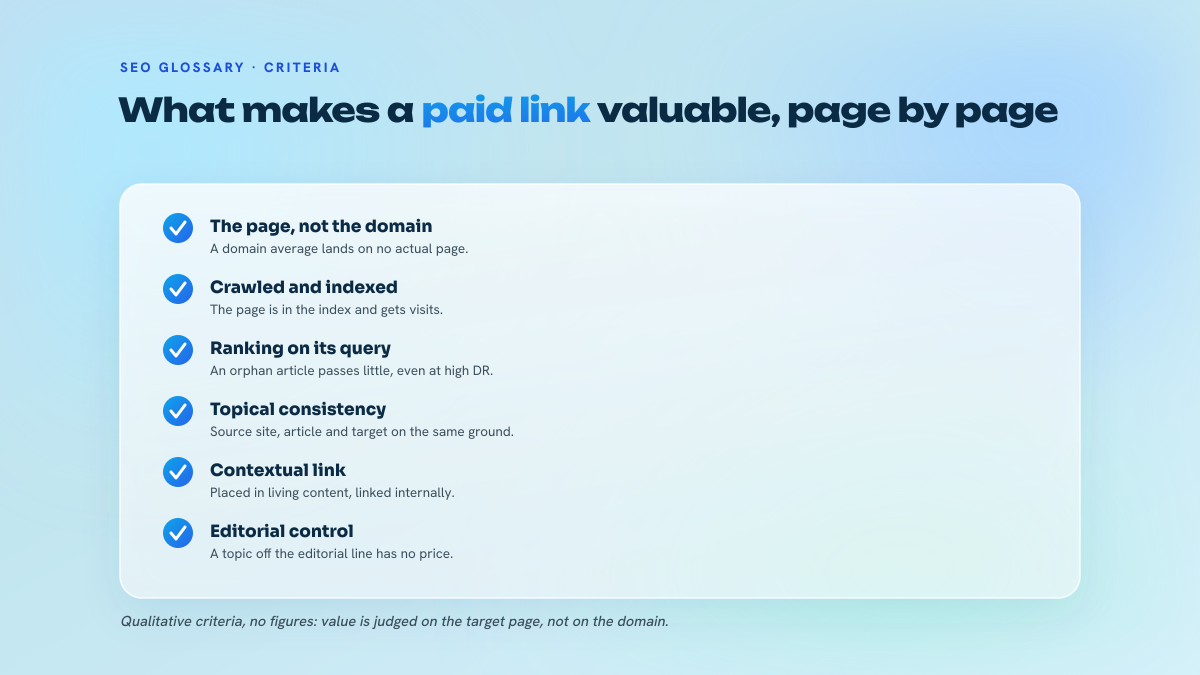
In SEO, link selling is the supply side of paid netlinking: a publisher who owns a website with real traffic sells an editorial placement, and a link inside that article points to a client's page. The buyer is paying for one thing, the transfer of ranking signal from a page Google trusts to a page it does not yet trust enough. Everything else in the transaction, the article, the anchor, the invoice, the marketplace interface, is packaging around that transfer.
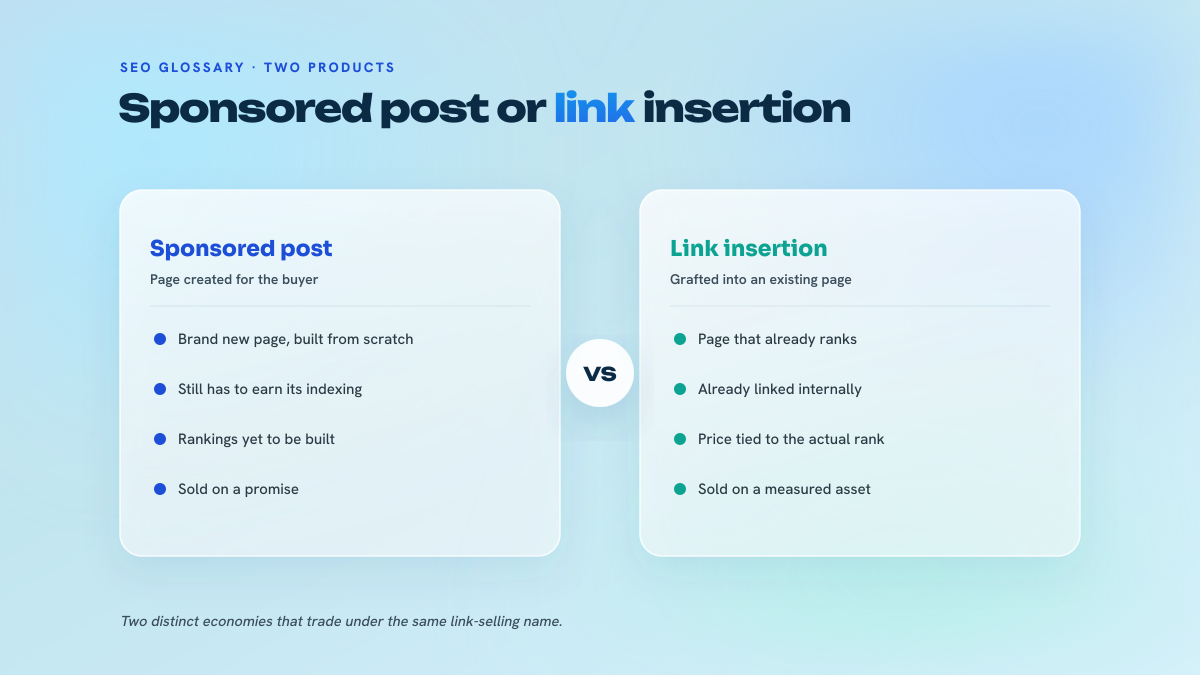
The distinction that matters operationally is between selling a link and selling attention. A publisher who sells a sponsored article that genuinely gets read is running an advertising business with a link attached. A publisher who sells a niche edit dropped into a three-year-old post nobody visits is selling a database row. Both are called link selling, both appear on the same marketplaces at similar prices, and they carry completely different risk profiles. Any serious discussion of this term has to start by refusing to treat them as the same product.
What Google actually says, and what it enforces
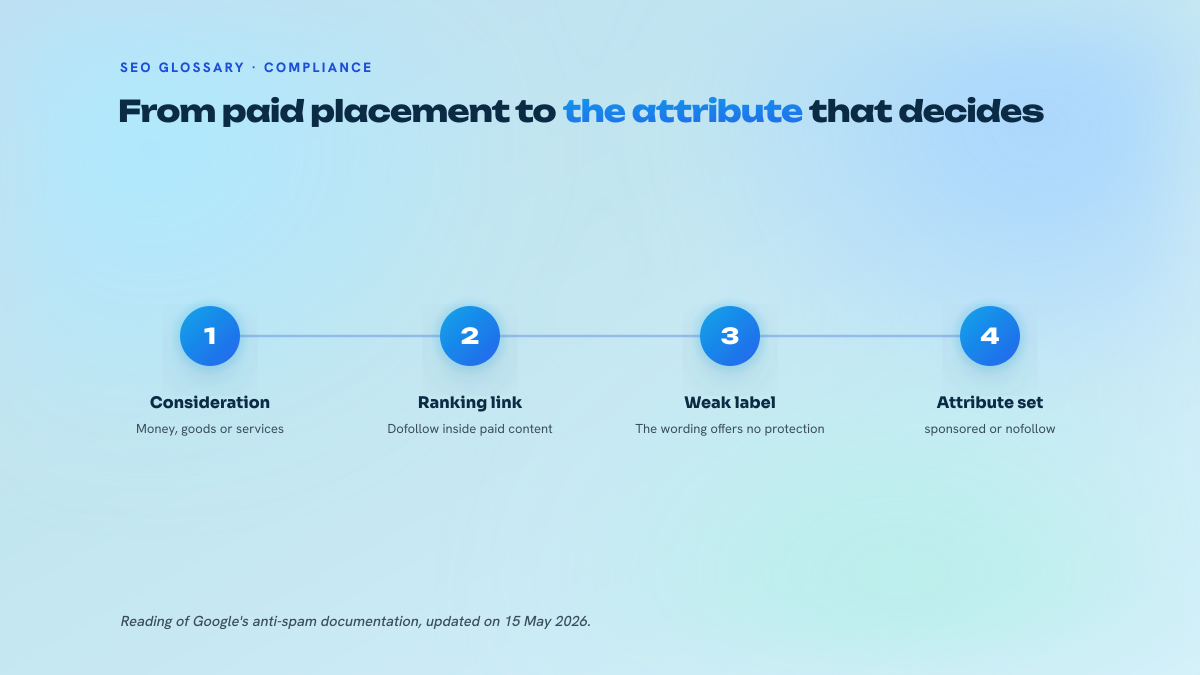
Google's spam policy documentation, updated 15 May 2026, is unambiguous on the principle: exchanging money, goods or services for links that pass ranking credit is link spam. The policy names paid advertorials and guest posts with ranking-passing links, optimized-anchor links in paid articles, automated link services, excessive exchanges, and low-quality directory or widget links. It also states the escape hatch plainly. Paid links are permitted when qualified with rel=sponsored or rel=nofollow, because those attributes stop the placement from passing ranking credit.
Read that carefully and the market's central contradiction becomes visible. The compliant version of a paid link is the version with no SEO value for the buyer. Calling something a sponsored post does not launder it; the label describes the commercial relationship, the rel=sponsored attribute is what actually implements the policy. Anyone selling followed links while pointing at a disclosure banner as their compliance story is not compliant, they are disclosed.
The second thing to understand is who carries the risk. Google's policy explicitly covers links from a site, not only links to one. A publisher selling followed placements is exposed on their own rankings, and that exposure arrives before their clients feel anything. The enforcement record over the last twelve months is worth stating precisely, because the industry routinely overstates it: the confirmed events are broad rollouts, not a named link-spam update. The August 2025 spam update ran 26 August to 22 September 2025 and Google described it as a general spam update across languages. A further spam rollout ran 24 to 26 June 2026 per Google's status dashboard. Core updates in June 2025, December 2025 and May 2026 named no link-specific target. Articles claiming any of these updates specifically hit sponsored-link structures are practitioner interpretation, not documented fact. Treat them as such when a client forwards one in a panic.
What links actually sell for in 2026
Pricing is where the market gets honest, because money is harder to spin than methodology. BuzzStream's 2025/2026 pricing analysis of more than 26,000 sites reported an average direct guest-post price around $295 and an average vendor price around $461, with link insertions near $179. The same research puts digital PR placements at roughly $1,250 to $1,500 and top-tier guest posts between $3,130 and $6,018. Other summaries of that dataset report a direct benchmark of $364.76 and insertions at $141, which tells you how much dataset vintage and quality thresholds move a headline number. The figure that should stop you: only 1.37 % of guest-post opportunities in that analysis met its higher quality standards.
Demand-side numbers come from a 2025 Editorial.link survey of 518 SEO professionals conducted March to May 2025, which reported an average acceptable price of $508.95 for one high-quality backlink and an average competitive-niche budget of $8,406 per month. That survey comes from a company selling link-building services, so read it as vendor research rather than a market census. The Authority Hacker survey of 755 link builders in 2025 is the more useful behavioural read: 74.3 % pay for links, 51.6 % use exchanges, 64.9 % use guest posting, and 93.8 % claim to prioritize quality over quantity. The last figure is aspirational, since the same population is buying at marketplace prices.
The spread between $141 and $6,018 is not a quality gradient, it is two different products sold under one label. Commodity inventory has collapsed toward the low end because supply is infinite: anyone can spin up a site, write forty articles and list it. Placements with genuine traffic, editorial review and an audience that overlaps the client's are priced like media buys because that is what they are. When a client asks us what a placement should cost, the useful answer is never an average, it is a per-site number tied to that site's traffic and topic fit.
Link selling inside a working netlinking operation
Three structures dominate the supply side, and they behave differently under pressure. Marketplaces aggregate third-party inventory and take a cut; the operator controls neither the editorial nor the outbound link policy of the sites listed. Brokers curate on behalf of a buyer and price their judgement, which is worth paying for when the judgement is good. Owned networks publish and sell from media they operate themselves, which is what we do at nautilinks across our own French editorial media: the outbound link policy, the publication rhythm and the editorial standard are decisions we make rather than inherit. The trade-off is honest in both directions, an owned network has a finite catalogue while a link marketplace has breadth it cannot vouch for.
For a buyer, the practical question is not which model is philosophically superior, it is which one lets you verify what you are buying before you pay. That means seeing the site, its traffic curve, its existing outbound link pattern and its editorial calendar. Anything sold as an anonymized listing with a DR score and a topic tag is a lottery ticket. This is why we publish the full list of media we run in-house rather than hiding it behind a login: a catalogue you cannot inspect is a catalogue that has something to hide.
For a publisher considering selling, the discipline is quantitative. Cap paid outbound links as a fraction of total outbound links, keep the article genuinely useful to a reader who arrived from search, vary anchors so the paid subset does not look like a separate population from the editorial subset, and refuse categories that will drag your own site's classification down regardless of price. A site that accepts every order at the asking price converges on being a private blog network with an invoice trail, which is the worst of both worlds. Buyers who want the calibration handled for them can order placements directly from the publisher without a middleman taking a cut, which removes the layer where most of the opacity lives.
What we see go wrong on both sides
The most common buyer mistake is treating a purchased link as an event rather than a position in a portfolio. Twenty placements bought in one month on a domain that acquired nothing for a year produces a link velocity curve that looks manufactured before anyone evaluates the sources. Spend the same budget across a quarter and the same links look like the natural consequence of a growing site.
The second is buying metrics instead of traffic. Domain-level scores are vendor estimates, and estimates that can be raised cheaply will be raised cheaply by anyone whose business depends on them. From what we see in audits, the single most predictive input is whether the linking page itself receives organic visits, which is also the hardest number for a seller to fake.
On the publisher side, the failure is almost always concentration. A site whose only revenue line is link sales has no editorial reason to exist, and that shows up in the content, the publication rhythm and the outbound profile simultaneously. It is also strategically fragile: the market is drifting away from raw link volume. The Editorial.link survey put digital PR first at 48.6 % as the most effective acquisition tactic, ahead of guest posting at 16 %, and Ahrefs' 2025 analysis of 75,000 brands found branded web mentions correlated with AI Overview presence at 0.664, more strongly than backlinks or domain rating in that dataset. A publisher whose placements generate real mentions and real readers is selling something that survives the next reclassification. One selling anchor text in dead archives is selling an asset with a depreciation schedule.
Nautilinks operates an owned network of editorial media. In-house written articles, transparency disclosures respected, anchor mix calibrated.
Frequently asked questions
Is selling links from my own site more dangerous than buying them?
Structurally, yes. Google's spam policies cover links from a site as well as links to one, and outbound patterns are easier to classify at scale than inbound ones: a site whose external link profile is dominated by unrelated commercial targets with optimized anchors is a legible signal. A buyer with one bad placement among fifty loses a fraction of value. A seller with a systematic pattern loses the asset itself, which is also the collateral behind every future sale.
Does rel=sponsored actually solve the compliance problem?
It solves Google's problem, not the buyer's. Per Google's spam policy documentation updated 15 May 2026, qualifying a paid link with rel=sponsored or rel=nofollow prevents it from passing ranking credit, which makes the placement compliant. The same mechanism removes the ranking transfer the buyer was paying for. That is not a loophole to be engineered around, it is the actual design intent. Sponsored placements still carry value through referral traffic, brand exposure and citations, which is a different business case.
What is a fair price to charge for a placement on my site?
Anchor it to traffic and topical fit, not to a domain score. BuzzStream's 2025/2026 analysis of over 26,000 sites reports averages near $295 for direct guest posts and $179 for link insertions, with top-tier placements between $3,130 and $6,018. If your page receives no organic visits, you are at the commodity end regardless of your DR. If it ranks for queries a buyer's customers actually search, you are closer to a media rate and should price accordingly.
Have recent Google updates specifically targeted link sellers?
Not according to Google. The confirmed events over the last twelve months are broad rollouts: the August 2025 spam update, described by Google as a general spam update, ran 26 August to 22 September 2025, and a further spam rollout ran 24 to 26 June 2026. Core updates in December 2025 and May 2026 named no link-specific target. Industry claims that a given update hit sponsored-link structures are practitioner interpretation. Attribute a ranking drop to link selling only after ruling out content and intent shifts.
How does link selling relate to cross-selling and upselling?
Only by accident of vocabulary. Cross-selling recommends a complementary product to a customer already purchasing, upselling pushes a higher-priced version of the same product, and both are e-commerce revenue tactics measured in average order value. Link selling in SEO is the sale of an editorial link placement. The terms collide in search results because the phrasing looks like retail language, which is why the query returns two unrelated bodies of content.
If the market is shifting to brand mentions, is buying links finished?
No, the weighting is moving. Ahrefs' 2025 study of 75,000 brands found branded web mentions correlated with AI Overview presence at 0.664, above backlinks and domain rating in that dataset, and the 2025 Editorial.link survey of 518 professionals ranked digital PR first at 48.6 %. The practical read: placements that produce a real mention on a page real people visit keep their value under both classical ranking and generative retrieval. Anchor-only inventory in dead archives is the part with a shrinking future.
Test your knowledge
Quiz: Link selling
1/3Under Google's spam policies as updated on 15 May 2026, what makes a paid placement compliant?