- →A link broker is an intermediary who resells placements they do not control. Their margin is invisible by design: you see the retail price, never the wholesale one, and the difference is often larger than the publisher's cut.
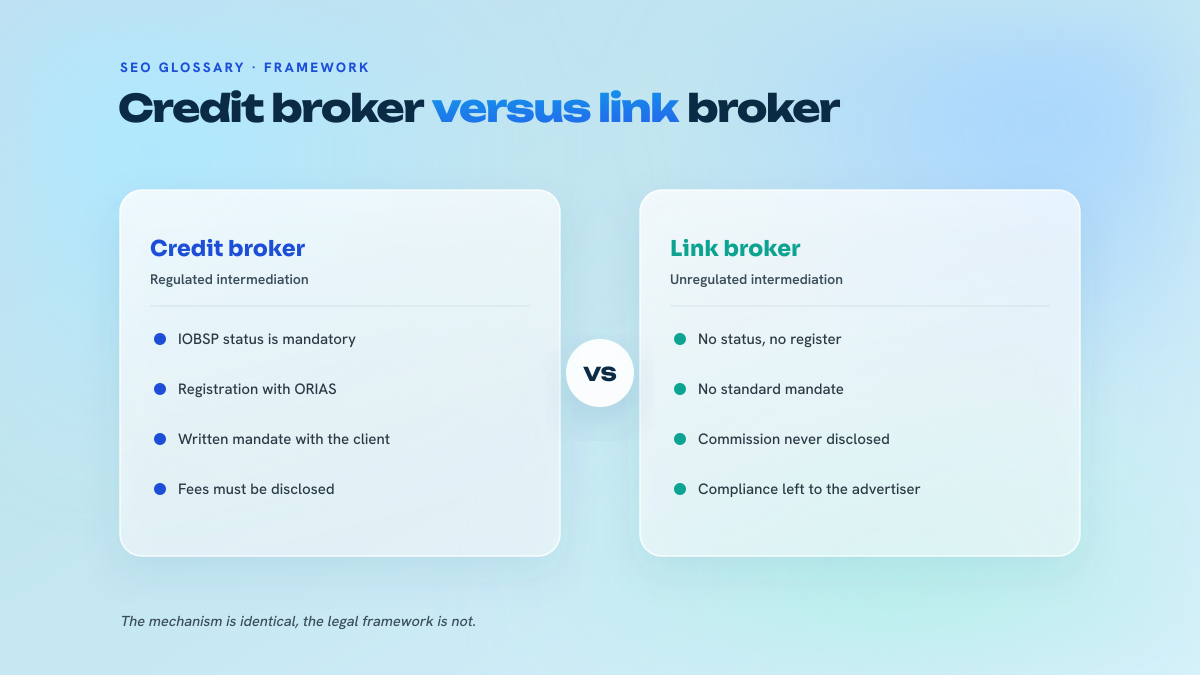
- →The word broker is borrowed from insurance and reinsurance broking, where a broker is regulated, compensated by a disclosed commission, and legally accountable to the client. None of those three properties transfer to link brokerage. The metaphor flatters the business more than it describes it.
- →BuzzStream's 2026 study found roughly 98 % of websites on guest-post marketplaces are low quality, defined as under 10k monthly traffic and DR below 40. Broker inventory is drawn from the same pool, so assume that base rate until a broker proves otherwise with traffic screenshots.
- →Shared inventory is the real footprint risk. A broker who sells the same domain to 200 buyers builds an outbound link profile on that site that looks exactly like what SpamBrain was trained to find.
- →Price is a weak quality signal in both directions. Authority Hacker's 2023 survey of 750 link builders put the average paid backlink at 83 $, while editorial.link's 2026 survey of 518 experts found respondents consider 508,95 $ an acceptable price for a high-quality one. The gap is market segmentation, not a quality curve.
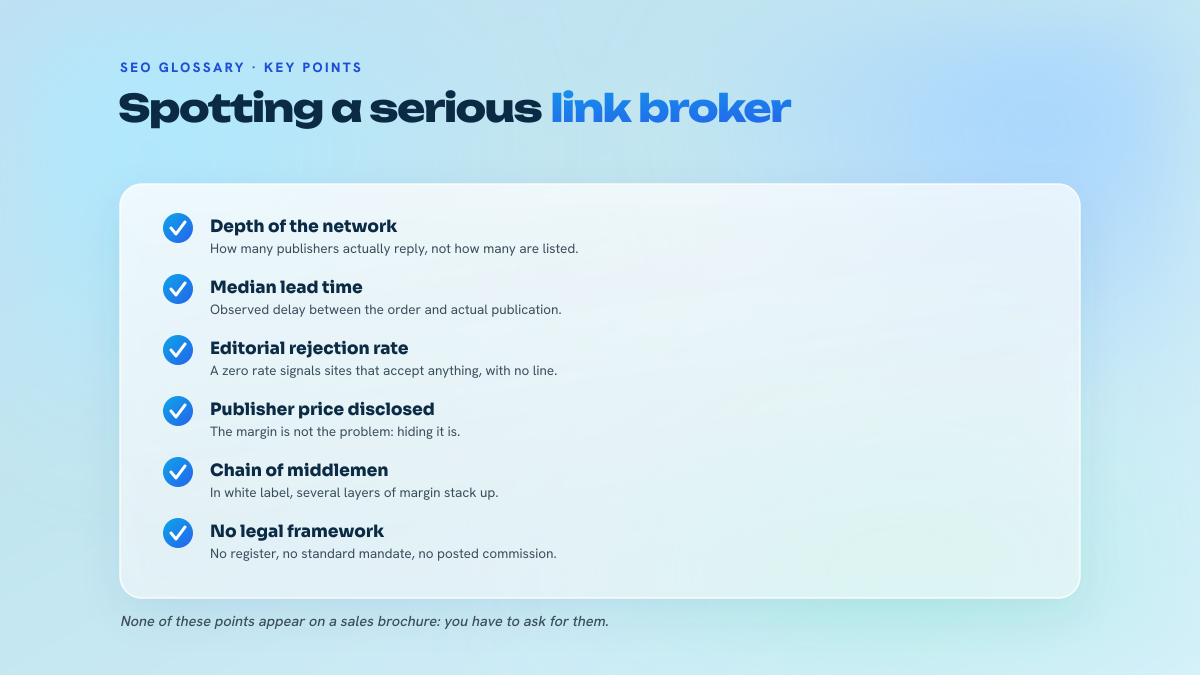
- →The only broker questions that matter: who owns the site, how many other clients are on it, what is the publisher actually paid, and can you see the traffic curve before you commit.
What a link broker actually sells
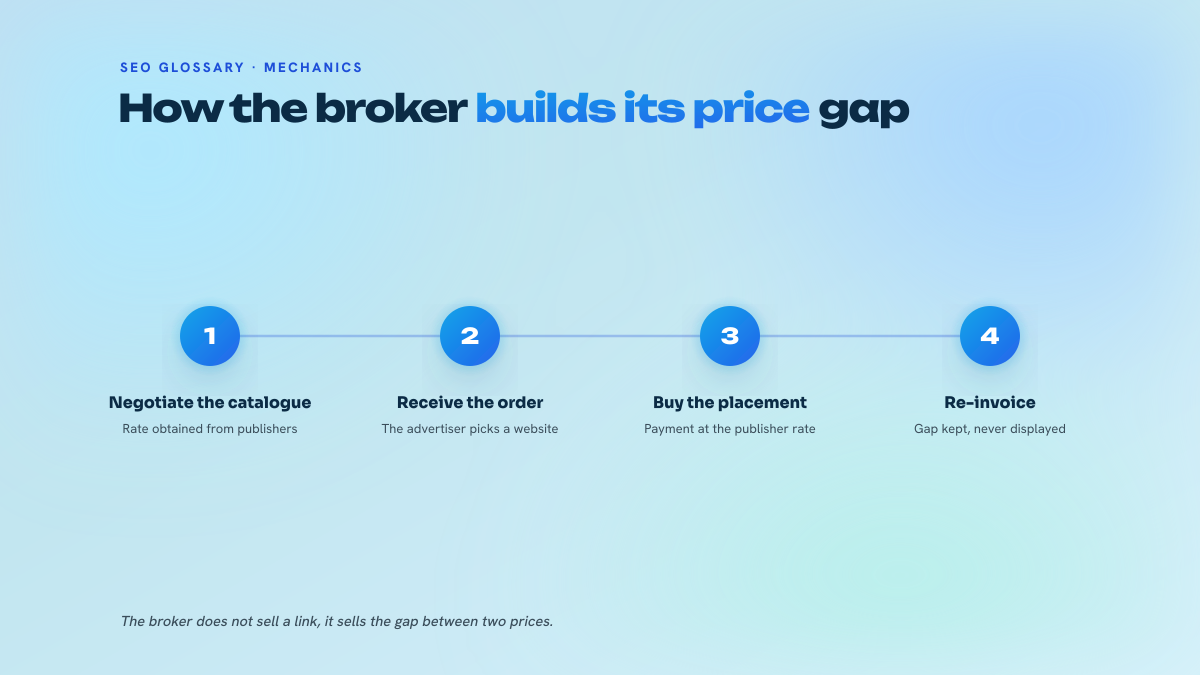
Strip the vocabulary away and a link broker is a reseller with a spreadsheet. They maintain a list of publishers who accept paid placements, they negotiate a wholesale rate with each one, and they quote you a retail rate. You pay the retail rate. The publisher receives the wholesale rate. Nobody tells you the two numbers, and the entire commercial proposition rests on you not asking.
That is not a moral judgment, it is a structural description, and it has consequences. A broker does not own the media. They cannot guarantee the article stays live, cannot guarantee the site will not be sold next quarter, cannot guarantee the publisher is not simultaneously selling the same slot to eleven other agencies. What they sell is access plus convenience: one invoice instead of forty, one point of contact instead of a mailbox full of unanswered outreach.
Convenience is a legitimate product. Plenty of in-house teams have no appetite for negotiating individually with French regional publishers, and paying someone to hold that relationship is a rational purchase. The problem is that the industry adopted the word broker from a field where it means something considerably stronger.
How the spread works, and why it hides quality
In insurance broking, a broker is an intermediary between a company seeking cover and the carriers who underwrite risk. That broker is registered, their commission is disclosed, and in most jurisdictions they carry a duty of care to the client rather than to the carrier. A firm doing reinsurance broking for a construction or marine portfolio operates under regulatory filing obligations, publishes annual accounts, and can be held liable when placement advice turns out to be negligent. The whole apparatus exists because the client cannot personally evaluate the risk they are buying protection against.
Link brokerage borrowed the label and none of the apparatus. There is no register, no disclosed commission, no duty of care, no filing requirement. If the placement gets devalued six months later, the recourse is a polite email. Anyone comparing a link broker to a London insurance broker is doing branding, not analogy.
The practical effect of an undisclosed spread is that it decouples what you pay from what the publisher is worth. A broker charging 300 € for a placement they source at 60 € has a strong incentive to keep selling that particular site, because the margin is excellent, regardless of whether the site has lost half its traffic since they added it to the catalogue. Refreshing inventory costs money. Reselling stale inventory does not. Left alone, the economics push toward catalogue rot, and that is precisely what audits keep surfacing: domains still quoted at last year's price with this year's flat traffic curve.
This is why we built a catalogue where every media is listed with its real metrics and a public price rather than a quote-on-request model. When the price is public and the media is owned, there is no spread to defend and no reason to keep a declining site in the list.
Broker, marketplace, owned network: three different risk profiles
These three get used interchangeably in sales conversations and they are not the same thing at all.
A broker is a human intermediary with a private list and a negotiated price. High touch, opaque pricing, variable quality, and the relationship is the product. A link marketplace works as a self-serve platform where publishers list themselves and buyers filter by metric. Lower touch, visible price, and the platform takes a cut on each transaction. An owned network means the operator writes and publishes on media they run in-house, so there is no publisher to negotiate with because the operator is the publisher.
The risk profiles diverge on one axis: who controls the outbound link profile of the host site. On a broker or marketplace domain, nobody does. The publisher accepts orders from every intermediary who sends them, and the site accumulates outbound links to unrelated commercial pages at whatever rate demand dictates. That is shared inventory, and the study by TheWebsiteFlip covering 93 812 backlinks across six marketplaces in 2026 flagged exactly this: most platforms sell links on domains shared across many buyers, which raises footprint risk.
Stringer runs its own French editorial media, which means we decide the outbound rate on each one and we know every advertiser who has ever appeared on them. That is the only structural answer to shared inventory. It is not a claim about link quality, it is a claim about control, and the two are frequently confused.
What Google does with broker inventory in 2026
Google's spam policies prohibit link acquisition through payment, excessive reciprocation, large-scale coordinated schemes, and manipulative infrastructure including private blog networks, link farms, guest post networks, and expired domain abuse. That list is worth reading carefully, because guest post networks landed on it explicitly and broker catalogues are, functionally, guest post networks with an account manager attached.
Two enforcement waves matter for anyone buying through intermediaries. The December 2024 spam update targeted long-running link networks, and the notable mechanic was that SpamBrain could devalue the manipulated portion of a link profile without issuing a sitewide penalty. No manual action, no notification in Search Console, just links that quietly stop counting. The October 2025 spam update went further and treated AI-generated guest-post farms and large-scale paid-link content operations as a distinct violation category.
The silent devaluation is the part most buyers underestimate. A published case study describes a mid-size Polish ecommerce site buying around 200 links per month at roughly 30 € each, so 6 000 € monthly through a link marketplace, whose rankings dropped when link-spam systems updated despite no public manual action. The invoices kept arriving, the reporting dashboard kept showing links acquired, and none of it was doing anything.
There is also the question of active harm. Analysis of leaked internal Google documentation surfaced a signal named BadBackLinks, which is cited in 2026 policy summaries as evidence that spammy backlinks can hurt rather than simply be ignored. Treat that as a directional signal rather than a settled mechanic, but it should end the lazy argument that a bad link is at worst neutral.
How to evaluate a broker without taking their word for it
Start from the base rate. BuzzStream's 2026 study of guest-post sites found roughly 98 % of websites on guest-post marketplaces qualify as low quality, meaning under 10k monthly traffic and DR under 40. Any broker claiming their inventory is different is claiming to be in the remaining sliver, and that claim needs evidence, not assertion.
Four questions do most of the work. Who owns the site, and can you see anything beyond a domain name before paying. How many other clients have placements on that domain in the last twelve months. What does the publisher actually receive, and if that number is confidential, why. Can you see a real traffic curve, ideally a Search Console or analytics screenshot rather than an Ahrefs estimate, because DR is trivially inflatable and organic traffic is not.
Price is a poor proxy. Authority Hacker's 2023 survey of 750 link builders found an average paid backlink cost of 83 $ and an average guest post of 77,80 $, while editorial.link's 2026 survey of 518 SEO experts reports respondents consider 508,95 $ an acceptable price for a high-quality backlink. Those numbers describe different market segments, not a quality gradient, and a 400 $ link from a broker with shared inventory is worse than a 120 $ placement on a site whose traffic you have verified. What you should compare is what a placement costs against the traffic and topical fit you can actually verify, not against a market average.
One more filter that catches a lot: ask whether the article is written in-house or by a freelancer paid per word from a pool. A broker who cannot tell you who writes the content is selling you a placement inside an article they have never read.
What to do with this on Monday morning
Audit your existing broker spend against outcomes rather than deliverables. Most reporting counts links acquired, which is the one metric that is guaranteed to look good. Pull the referring domains from the last two quarters, check which ones still have the article live at the same URL, check which ones have grown or lost organic traffic since placement, and check how many outbound commercial links each has accumulated. The domains failing all three are the ones your broker is farming.
Concentrate budget on fewer, verifiable placements. The market has bifurcated, and the middle is where the waste sits: too expensive to be a volume play, too anonymous to be a real editorial mention. Buying directly from operators who publish their own media removes the spread and, more importantly, removes the ambiguity about who else is on the page. That is the logic behind going straight to the publisher for French placements instead of through a chain of intermediaries.
And keep the vocabulary honest internally. If a supplier calls themselves a broker, ask what they broker and to whom they answer. The answer tells you whether you are dealing with an operator or a reseller, and the difference shows up in your link profile eighteen months later.
Nautilinks operates an owned network of editorial media. In-house written articles, transparency disclosures respected, anchor mix calibrated.
Frequently asked questions
Is buying through a link broker riskier than buying directly from a publisher?
Yes, for one specific reason: you lose visibility on who else is placing links on the same domain. A publisher selling directly usually has a handful of advertisers. A publisher listed with five brokers is fielding orders from all of them and has no reason to cap the volume. The link itself is not intrinsically worse, but the host site's outbound profile degrades faster and you have no way to see it happening.
How do link brokers actually get paid?
On the spread between what you pay and what they pay the publisher, almost never on a disclosed commission. Some larger operations run a hybrid, taking a platform fee on top. The distinction matters because a disclosed-commission model aligns the intermediary with you, while a spread model rewards them for sourcing cheaply and reselling at whatever the market bears. Ask for the publisher's cut. The reaction to the question is informative even when the answer is not.
Can a broker guarantee a link stays live?
They can contract for it, typically twelve or twenty-four months, and they can chase the publisher when it disappears. They cannot guarantee it, because they do not control the site. When a domain changes hands or the publisher does a content cleanup, the link goes and your recourse is a credit note. Build an automated live-check on every acquired link rather than relying on the guarantee clause.
Does using a broker create a detectable footprint on its own?
Not directly, but shared inventory does. The pattern SpamBrain looks for is a cluster of unrelated commercial sites receiving links from the same small pool of hosts with similar anchor and temporal profiles. When a broker sells the same fifty domains to hundreds of buyers, that cluster forms whether or not anyone intended it. Overlap analysis is worth running: pull the referring domains of three competitors in your niche and see how many you share.
Are link brokers regulated in any meaningful sense?
No. The word is borrowed from insurance and financial broking, where registration, disclosed commission, and a duty of care to the client are legal requirements. None of that applies here. There is no register to check, no licence to revoke, and no regulator to complain to. The only accountability is commercial reputation, which is why references from buyers who left are more useful than references the broker supplies.
Is there any case where a broker is the right choice over an owned network?
When you need topical reach outside what any single operator covers. No owned network spans every vertical, and a broker with genuine publisher relationships in a niche you cannot otherwise access is providing real value. The test is whether they can name the sites before you pay and show verified traffic. A broker who insists on anonymised inventory is selling opacity, not access.