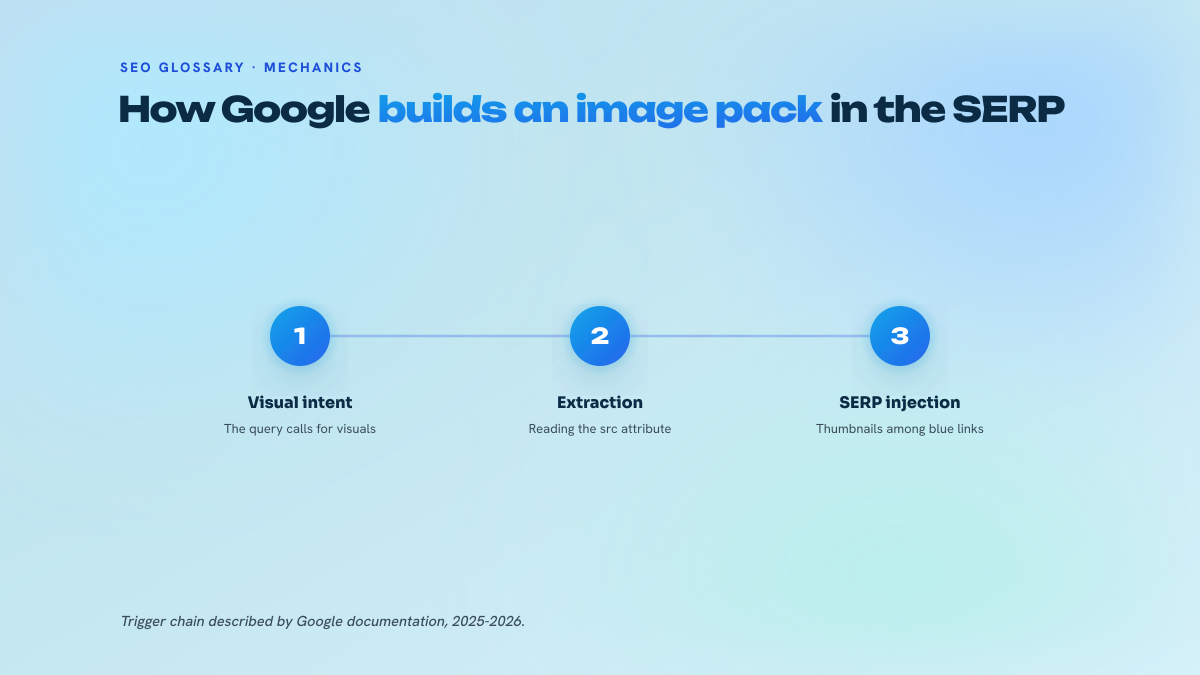
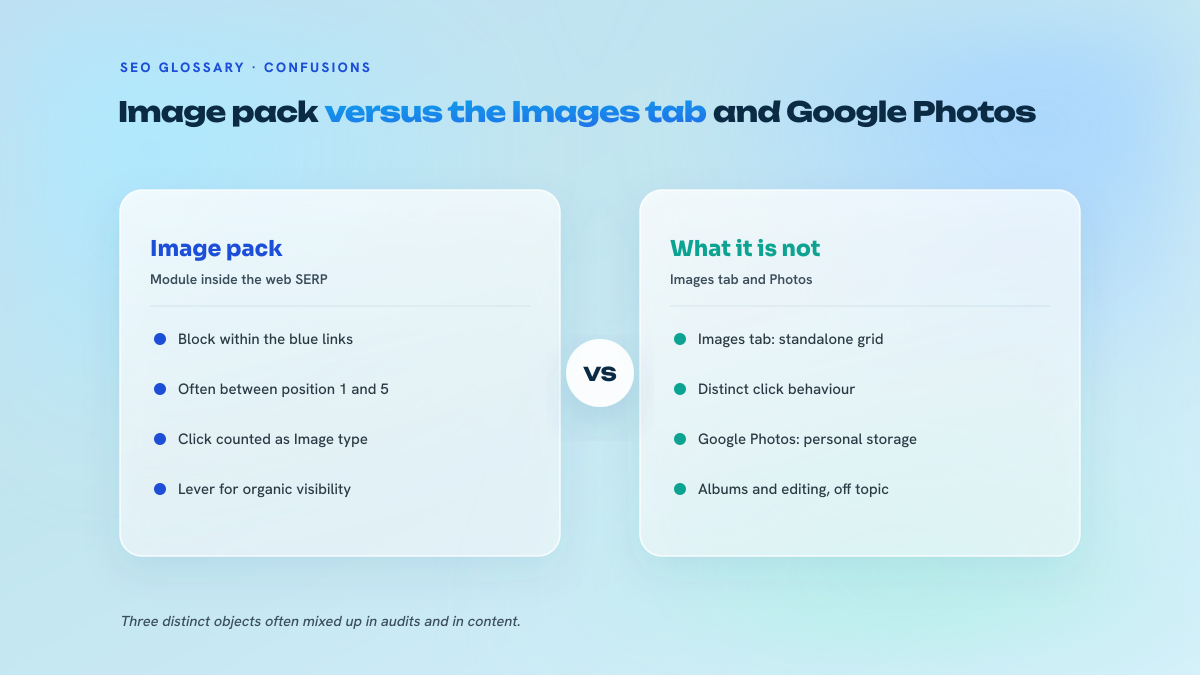
- →Image pack thumbnails link to the hosting page, not to the image file, which makes the module an organic entry point rather than an Images-tab shortcut.
- →seoClarity's Research Grid comparison between January 2024 and December 2025 found image pack appearances within the top 10 organic positions up 48.5 % while the number of queries triggering a pack at any position fell 8 %: fewer opportunities, concentrated on pages that already rank.
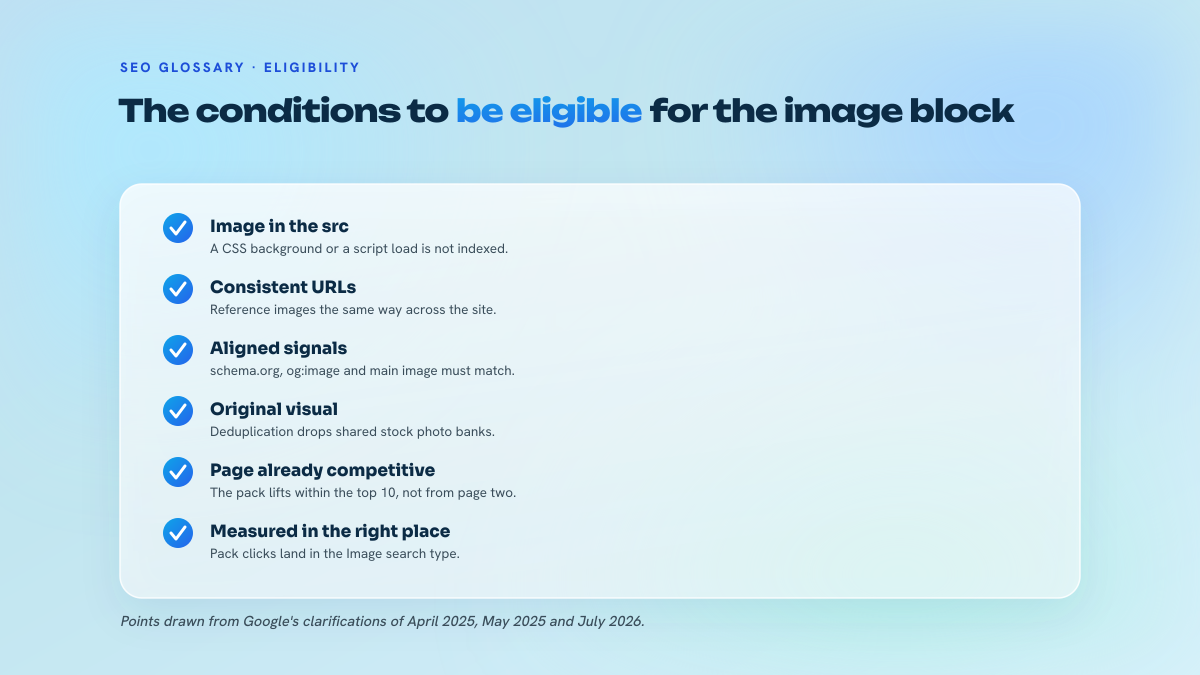
- →Google Search Central confirmed on 1 July 2026 that both schema.org markup and the og:image tag feed thumbnail selection, and on 16 April 2025 that extraction happens from the src attribute of an img tag: CSS background images and src-less lazy loading are invisible.
- →Search Console impressions, CTR and average position were mislogged from 13 May 2025 to 27 April 2026 and never backfilled, so any year-over-year image visibility chart crossing that window is unusable. Clicks were not affected.
- →The pack rewards a distinctive original asset on a page with real topical context. Reused stock imagery loses to a mediocre in-house photograph almost every time on long-tail queries.
- →Hash-based filenames that rotate on every deploy quietly destroy accumulated image history: URL stability is a ranking asset nobody budgets for.
An image pack is a ranking slot, not a gallery
The module sitting between two blue links, four to eight thumbnails on a row or a small grid, is not a shortcut into the Images tab. Every thumbnail in it points to the web page hosting the picture, not to the file. That mechanical detail is the entire reason the image pack belongs in a ranking conversation rather than a design one: it is a second entry point into a results page where you may already hold position 6, and it occupies more vertical space than any title tag will ever buy you.
Two consequences follow, and both are operational. An image pack owned by a competitor pushes every organic result underneath it further down the page, so a pack you are absent from costs you visibility even when your ranking has not moved a single position. And the click arriving from a thumbnail behaves differently from a click on a text result: the user has already seen what they are getting, which lifts engagement when the picture is honest about the page and destroys it when the picture oversells.
One naming confusion is worth clearing straight away, because it shows up in half the briefs we read. The image pack is a module inside a standard web results page, triggered by visual intent in the query. The local pack is the three-business map block triggered by geographic intent. They share the word « pack » and nothing else: different trigger, different ranking inputs, different owners inside a client organisation.
How eligibility actually works in 2026
The interesting number here comes from seoClarity's Research Grid, comparing January 2024 with December 2025: image pack appearances within the top 10 organic positions rose 48.5 %, while the number of queries triggering an image pack across all ranking positions fell 8 %. The same dataset found packs appearing nearly 13 % more often on mobile than on desktop. Read together, that is a consolidation story. Google shows the module on fewer queries than it used to, but when it does show it, it plants it high, inside the zone where the competition is already fierce.
Which reframes the work. Optimising images on a page ranked 40th for a visual query is close to wasted effort. Optimising them on a page ranked 8th is one of the cheapest visibility gains available, because the eligibility signals are mechanical and the competition for them is thin.
Those signals have been documented more precisely over the last eighteen months than in the previous five years. Google Search Central's changelog on 16 April 2025 clarified that image extraction happens from the src attribute of an img tag, which quietly disqualifies every hero rendered as a CSS background and every lazy-loading implementation that leaves src empty until a script fires. On 12 May 2025 the same changelog asked that image URLs be referenced consistently across a site, framed as a crawl efficiency point for large properties, and read in practice as a warning against URL churn. On 1 July 2026 Google added preferred-image guidance confirming that it uses both schema.org markup and the og:image meta tag when determining thumbnails in Search and in Discover.
That last one settles a long-running argument. The thumbnail Google picks is not always the largest image on the page, and it is not always the first: it is the one your markup nominates. If your structured data, your og:image and your visible hero disagree, you have handed the choice back to an algorithm that will resolve it in whatever way suits its index, not your conversion rate.
Around the module itself, the surface is widening fast. On 15 July 2026 Google announced a browseable Google Images home, a dynamic gallery updated in real time and personalised to user interests with saved collections shown as tabs, rolling out first to desktop users in the United States in English, alongside a personalised Images feed in the Google app for Android and iOS in the U.S. The same anniversary post documents « visual image fan-out », which breaks an image search into dozens of subqueries, a close cousin of the text fan-out behaviour behind AI Mode. Image SEO in 2026 is no longer a single thumbnail slot to win. It is a set of surfaces fed by the same crawlable asset.
Measuring it after fifty weeks of broken reporting
Any 2026 conversation about image performance has to start with a caveat most agencies are still ignoring. Google's Search Console logging issue affected impressions from 13 May 2025 through 27 April 2026, roughly fifty weeks, as documented by Search Engine Land. Google stated that impressions, CTR and average position were affected while clicks were not, applied the fix going forward only, and did not correct the historical data. Image search impressions were among the anomalies observed during that window.
The practical rule is blunt: if your year-over-year image visibility chart crosses that period, throw it away. It is not evidence of anything. Clicks filtered on search type Image remain trustworthy, as do analytics landing-page sessions, rank-tracker SERP captures, and any Search Console data after 27 April 2026. We have already seen client reports this year attributing an « image collapse » to a redesign when the only thing that collapsed was Google's logging.
For live tracking, the four questions worth answering are the ones seoClarity set out in its January 2026 guidance: does the keyword trigger an image pack at all, where does your domain sit inside that pack, what share of total pack results you own, and how those move over time. Notice that share matters more than presence, because a pack holding eight thumbnails from three domains behaves nothing like one holding eight thumbnails from eight.
Tool-side, SERP-feature tracking has drifted upmarket. Ahrefs' current pricing page lists Lite at 129 $/month, Standard at 249 $/month and Advanced at 449 $/month, with Brand Radar AI from 199 $/month, a sign that measurement budgets are being pulled toward AI and prompt visibility rather than toward classic SERP features. If image packs are a genuine channel for your client, that line item competes directly with content and link spend, which is a trade-off worth pricing honestly: our own published rates for a placement exist precisely so that arbitrage can be done with real numbers on both sides.
Where it fits in an SEO and netlinking operation
The 48.5 % concentration inside the top 10 is the whole strategic point. The image pack is a multiplier on positions you already hold, not a side door into positions you do not. No amount of alt text discipline lifts a page from position 34 into a pack, because the module draws overwhelmingly from pages the algorithm already considers relevant enough to rank. That makes image work a second-order lever, sequenced after topical depth and after the authority that gets a page into striking distance in the first place.
Broad updates reinforce the ordering. Google's March 2026 core update ran from 27 March to 8 April 2026, twelve days and four hours according to Search Engine Land, described as a regular update aimed at surfacing more relevant and satisfying content, with no image-specific ranking guidance issued. Pages that lost relevance in that window lost their pack slots with everything else. An image asset sitting on a thin gallery page has no protection: it inherits the fate of its host document, which is why we treat pack eligibility as a property of the page rather than of the file.
This is where the link side connects. If the visual query you want is genuinely commercial, the honest sequence is to earn the organic position first, through topical coverage and through links placed inside relevant editorial context, then harvest the pack slot as a near-free extension of that position. Across the French editorial media we run in-house, the pattern is consistent: original photography produced for the article wins thumbnail slots on long-tail queries that the same page with stock imagery never touches, and it wins them without any additional link investment. Publishers who want to see which media carry that kind of original visual production can check the catalogue we keep open without an account rather than take our word for it.
What we see go wrong in audits
The most expensive failure is silent and infrastructural: hash-based filenames that rotate on every deploy. Every build ships a new image URL, Google re-crawls a fresh file with zero history, and whatever ranking equity the previous asset had accumulated evaporates. Google's own 12 May 2025 guidance on consistent image URLs points straight at this, and modern asset pipelines violate it by default. Pin the filenames of assets you actually care about, or accept that they restart from zero every fortnight.
Close behind: modern rendering patterns that make the image invisible to extraction. CSS background images on the hero, srcset without a valid src fallback, image components that only populate src after hydration. All of them look fine to a human and produce nothing extractable, which is exactly why they survive so long in production. Fetch the rendered HTML and confirm a real src attribute exists before debating file formats.
Then the markup mismatches. An og:image built for social sharing, with an overlaid logo and a text banner, competing with the article's real photograph for thumbnail selection. Since Google confirmed on 1 July 2026 that both schema.org markup and og:image feed that decision, a divergence between the two is a coin flip you chose to enter.
On the content side, keyword-stuffed alternative text remains the most common wasted effort in the category. Alt text is a description, and a description that reads like a query string is a weaker relevance signal than a plain sentence, on top of being an accessibility failure. The surrounding paragraph, the caption and the heading above the image carry more weight than the attribute itself, and almost nobody optimises those.
Finally, a targeting error worth naming. Teams chase pack slots on transactional queries where Google increasingly shows product-shaped modules fed by merchant data rather than a classic web image pack. The visual real estate looks similar in a screenshot and is structurally unreachable through page optimisation. Sort your target keywords by intent before building the programme: informational and how-to visual queries are where the image pack still behaves like an organic slot you can win, and they are also where a text answer block and an image pack frequently sit on the same page, doubling the surface a single well-built article can occupy.
Nautilinks operates an owned network of editorial media. In-house written articles, transparency disclosures respected, anchor mix calibrated.
Frequently asked questions
Is the image pack the same thing as the local pack or the map block?
No, and the shared word causes real briefing errors. The image pack is a thumbnail module inside a standard web results page, triggered by visual intent, where each thumbnail links to the page hosting the picture. The local pack is the three-business map block triggered by geographic intent and fed by Google Business Profile data. Different triggers, different ranking inputs, and usually different owners inside a client team. Optimising one does nothing for the other.
Can a page appear in an image pack without ranking in the top 10 for that query?
It happens, but treat it as an exception rather than a plan. seoClarity's comparison of January 2024 with December 2025 found pack appearances inside the top 10 organic positions up 48.5 %, meaning the module draws increasingly from pages already judged relevant. If your page sits at position 30, the realistic route to a thumbnail slot is to improve the page's organic standing first. Image optimisation on a page with no organic traction is effort spent on the wrong bottleneck.
Why did my image impressions crater in Search Console during 2025?
Probably nothing you did. Google's Search Console logging issue affected impressions from 13 May 2025 through 27 April 2026, roughly fifty weeks, with impressions, CTR and average position all affected while clicks were not, per Search Engine Land. The fix applied going forward only and historical data was never corrected. Any year-over-year image visibility comparison spanning that window is unusable. Rebuild the analysis on clicks, analytics sessions and rank-tracker captures instead.
Which image does Google actually pick as the thumbnail?
The one your markup nominates. Google Search Central's 1 July 2026 preferred-image guidance confirmed that both schema.org markup and the og:image meta tag are used to determine thumbnails in Search and Discover, and its 16 April 2025 note confirmed extraction from the src attribute of an img tag. So the practical answer is to align three things: the visible hero rendered with a real src, the structured data reference, and og:image. When they disagree, the choice is made for you.
Does file format matter for eligibility, WebP versus AVIF versus JPEG?
Far less than URL stability and page relevance. Google renders all three, and no documented eligibility rule favours one. Where format actually bites is the migration: converting a library to WebP usually changes every URL, which resets the accumulated history of assets that were performing. If you convert, keep the paths identical or ship proper redirects. Format choice is a performance decision, not a ranking one, and teams routinely invert that priority.
Is it worth optimising for image packs now that Google is pushing personalised image feeds?
Yes, and more so than before, because the same crawlable asset feeds several surfaces. Google's 15 July 2026 announcement described a browseable Images home personalised to user interests, an Images feed in the Google app, and visual image fan-out breaking a search into dozens of subqueries. A distinctive original image on a strongly contextualised page is now the input to all of that. A stock photo reused across forty pages is the input to none of it.
Test your knowledge
Quiz: Google image pack
1/3In a Google image pack shown inside a standard web results page, where does a thumbnail send the user?