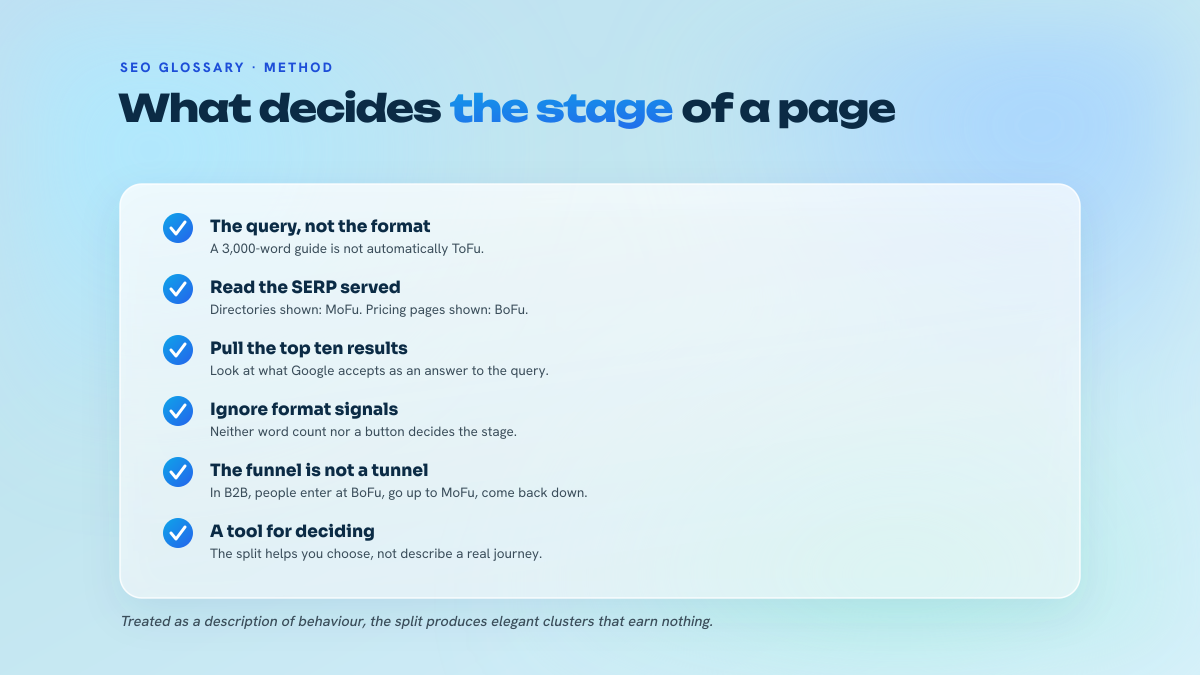
- →Classify a page by the SERP it competes in, not by the shape of the keyword: if Google fills the results with media listicles, your product page is in a MoFu fight it cannot win with a commercial template.
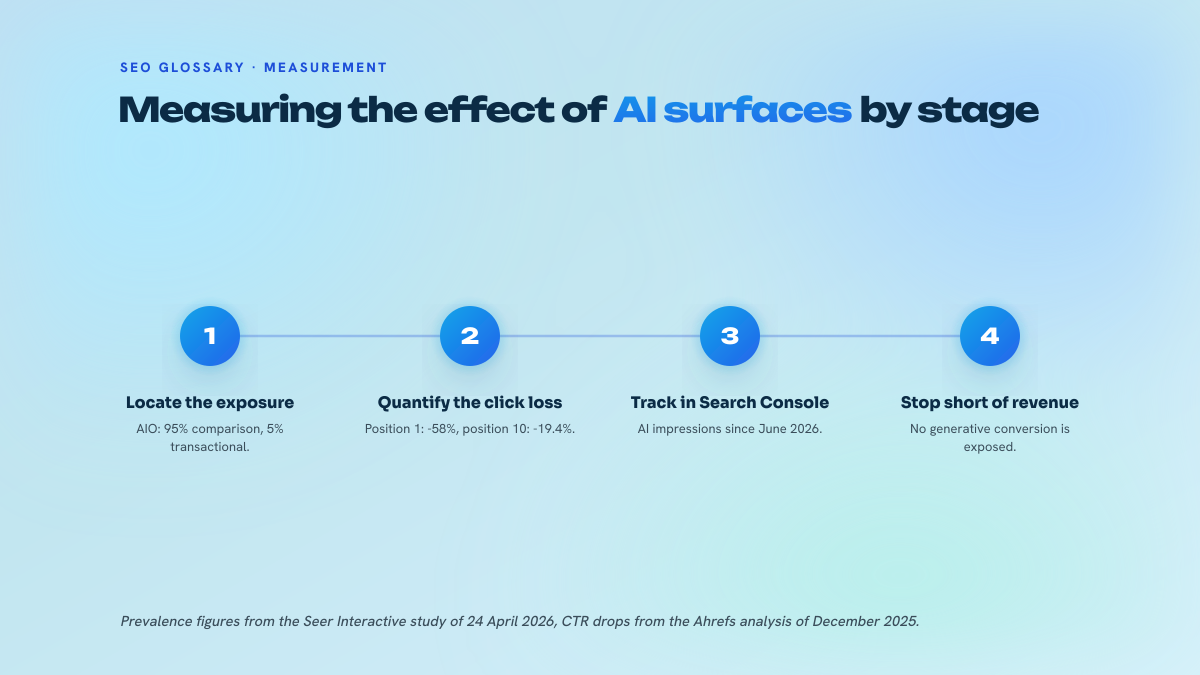
- →MoFu is the exposed tier, not ToFu: the Seer dataset published by Search Engine Land on 24 April 2026 found AI Overviews on roughly 95 % of comparison queries and 86 % of question queries, against about 5 % of transactional ones.
- →Being cited inside an AI Overview roughly doubles what is left of the click: Seer measured about 2.1 % CTR when cited versus about 0.9 % when not, against about 3.3 % with no AI Overview at all, in February 2026.
- →BoFu SERPs stayed close to ten blue links plus ads, which is why an external contextual link pointed at a transactional page still converts into revenue faster than one pointed at a pillar page.
- →Search Console has exposed AI Overviews and AI Mode impressions since 3 June 2026, so per-tier reporting is now measurable instead of inferred, but no generative conversion metric shipped with it.
- →Traffic drops should be segmented against the dated rollouts on Google's Search Status Dashboard before anyone blames « the AI », since five core and spam updates landed between December 2025 and June 2026.
What the three tiers actually encode
The labels arrived from demand generation, where they described a buyer walking down a funnel over weeks. Transferred to search, that story is fiction. Nobody reads a definition page on Tuesday and requests a quote on Friday in a line you can trace, and any attribution model that pretends otherwise is selling you a narrative. What survives the transfer is something narrower and more useful: a way of sorting pages by the kind of result page they have to fight in.
Top of funnel is the informational family: what, why, how, definitions, mechanics, the pages that exist because someone is trying to understand a problem they cannot yet name. Middle of funnel is evaluation: best X, X versus Y, alternatives to X, reviews, buying guides, the queries where a decision is being narrowed but not made. Bottom of funnel is transactional: pricing, quotes, demos, service plus city, the queries a prospect types when the decision is already taken and only the vendor is open.
The reason to keep the labels in 2026 has nothing to do with the journey. It is that Google renders these three families with structurally different layouts, and the layout, far more than the position, decides what a ranking is worth. A number one on an informational query and a number one on a transactional query are not the same asset, have not been for two years, and pretending they are is how agencies end up reporting record impressions during a revenue decline. Tier your pages by the SERP they compete in and your reporting stops lying to you.
One clarification worth making early, because it costs people months: the tier is a property of the query, not of the page you happened to write. If you built a commercial landing page for a keyword whose results are wall to wall editorial roundups, you did not build a BoFu page. You built a MoFu page that is going to lose.
How each tier behaves in 2026 SERPs
The single most useful dataset on this question is the longitudinal study Seer Interactive published through Search Engine Land on 24 April 2026, covering 53 brands, 5.47 million queries and 2.43 billion impressions between January 2025 and February 2026. Its incidence figures cut cleanly along funnel lines: AI Overviews appeared on roughly 95 % of comparison queries, 86 % of question queries, 36 % of informational queries and about 5 % of transactional ones.
Read that ordering again, because it contradicts the reflex. The industry has spent two years announcing the death of top of funnel, and the tier actually saturated is the middle. Comparison content, the best-of pages and the versus pages, the exact format every content team was told to scale in 2023, sits under an AI-generated summary almost every time it ranks. Broad informational queries, at roughly a third incidence in that sample, are less exposed than the pages built to convert them.
The magnitude of the click loss is documented separately. Ahrefs re-ran its analysis in December 2025 across 300 000 keywords, half triggering AI Overviews and half not, comparing aggregated desktop Search Console CTR between December 2023 and December 2025. It estimated a 58 % CTR reduction at position one when an AI Overview was present, tapering to 19.4 % at position ten. The pattern is worth internalising: the AI Overview does not flatten the SERP evenly, it eats the top disproportionately, which means the premium on ranking first shrank while the cost of earning it did not.
Seer's own February 2026 benchmarks put numbers on what is left. Around 3.3 % CTR with no AI Overview, around 2.1 % when an AI Overview appears and your page is cited inside it, around 0.9 % when one appears and you are not. Citation is therefore worth roughly double the residual click, and it is the only lever available on a query you cannot remove the AI Overview from. The same study noted AI Overview CTR falling to 1.3 % in December 2025 then recovering to 2.4 % by February 2026, so anyone modelling a straight-line collapse is extrapolating from a trough.
Two cautions before you quote any of this in a client deck. Prevalence figures are not interchangeable between studies: Semrush-derived tracking reported by SeoProfy showed roughly 6.49 % of queries carrying an AI Overview in January 2025, a peak near 24.61 % in July 2025 and 15.69 % by November 2025, on a completely different keyword universe. Always state the dataset, the intent mix, the geography and the measurement date. And the paid side moved in the opposite direction to the organic one in Seer's sample, with paid CTR rising from 14.6 % to 16.2 % when an AI Overview was present while falling from 26 % to 21.8 % when it was not, which is not a detail if your BoFu strategy quietly depends on ads picking up the slack.
Measurement finally caught up on 3 June 2026, when Google started rolling out Search Generative AI performance reports in Search Console to a subset of sites, exposing impressions in AI Overviews and AI Mode, the URLs shown, countries, devices and hourly through monthly granularity. No separate generative conversion metric shipped with it. Since your URLs are already tiered, that report turns per-tier AI exposure from an inference into a number you can pull.
Where the funnel decides your link budget
The inherited doctrine says point external links at your top of funnel pillar pages, then distribute the equity downward through internal links. That doctrine was written when informational pages still received clicks worth converting. The arbitrage has moved, and the honest version in 2026 is messier.
Top of funnel content remains the only thing anyone links to editorially, so it stays the natural landing zone for editorial placements written in-house on owned media. But the selection criterion should stop being search volume and start being internal link topology: the ToFu page worth reinforcing is the one that actually feeds a transactional page two clicks down, not the one with the biggest impression count. A pillar with no path to revenue is a very expensive brochure, and grouping content into a coherent cluster with a working internal architecture is what turns that link into something other than a vanity metric.
Middle of funnel is where most budgets are currently misallocated. Ranking third on a comparison query whose SERP carries an AI Overview 95 % of the time is a citation lottery, and you should price it as one. It is still worth contesting, but the winning condition changed: the page has to be quotable, which means first-party data, a real testing protocol, prices you actually verified, numbers nobody else has. A rewritten roundup assembled from the current top ten cannot be cited for anything the model did not already have.
Bottom of funnel is the tier nobody wants to link to and the tier where a link still pays fastest, precisely because roughly 5 % AI Overview incidence means the transactional result page is still close to ten blue links plus ads. Across the owned French editorial media we operate, the target URLs clients ask us to point at skew heavily transactional, and the ones still holding position six months later are consistently those that also received internal links from a tier above. An external link into an orphaned commercial page is a one-shot injection with nothing to hold it. Getting that split right over several months is the actual work of calibrating a campaign tier by tier rather than buying in bulk, and it is why what a placement costs by media tier should be a planning input rather than an afterthought.
What goes wrong in real accounts
The most common failure is assigning the tier from the keyword string instead of the result page. Best CRM software reads transactional to a spreadsheet and is, in practice, a media listicle SERP that a vendor page will not enter. Open the SERP, look at what is ranking, classify from that. Five minutes per priority query prevents a quarter of wasted production.
The second is the page that tries to serve all three tiers at once, usually a long explainer with a pricing table bolted onto the bottom and a comparison section wedged into the middle. It satisfies no single dominant intent in the SERP it targets and ranks for nothing durable. Split it.
The third is treating impressions as a proxy for sessions on informational pages. With the Ahrefs figure at 58 % click reduction at position one, an impression graph can climb while the business starves. Segment Search Console by tier, then track clicks per impression within each tier over time. Sitewide CTR is now a blended number with no meaning.
The fourth is attributing every drop to AI. Google's Search Status Dashboard records discrete, dated events across the period: the December 2025 core update starting 11 December and running 18 days, the March 2026 core update from 27 March over 12 days, the May 2026 core update from 21 May over roughly 12 days, and a two-day spam update from 24 June 2026. Line your traffic curve up against those dates before you write the post-mortem, because a core update hitting MoFu content quality and an AI Overview eating MoFu clicks call for opposite responses.
The fifth is a link profile that piles exact-match commercial anchors onto transactional pages because those are the pages the client cares about. It reads as a bought profile, and it wastes the one tier where editorial links are naturally earnable.
Calibration rules for a working SEO
Tag every URL in your inventory with a tier, derived from the SERP, and carry that tag into your Search Console exports, your rank tracker and your link plan. Everything below depends on that one piece of hygiene.
Set different success metrics per tier. Informational pages are judged on citation eligibility and on how much internal equity they pass down, not on sessions. Evaluation pages are judged on whether the AI Overview quotes you, which the new generative performance report now makes visible. Transactional pages are judged on position and on assisted revenue, because their SERP is still one where position converts.
Put your first-party data where it can be cited. Comparison pages built on original testing, disclosed methodology and structured tables are the only MoFu format with a defensible position, and the effort is better spent there than on producing three more generic roundups.
Do not fix a budget split by percentage. Link investment should follow where the SERP still returns clicks, which currently means a heavier bottom of funnel weighting than the 2020 playbook recommends, with top of funnel links selected for the internal paths they feed.
One last observation on the industry's own posture. BuzzStream's 2025 compilation found 48.6 % of respondents naming digital PR their most effective link-building tactic and 73.2 % believing backlinks influence AI-search visibility, while only 11 % reported a repeatable process for earning AI citations. The belief is running years ahead of the method. Anyone selling you a guaranteed citation product is selling ahead of what the field can actually reproduce.
Nautilinks operates an owned network of editorial media. In-house written articles, transparency disclosures respected, anchor mix calibrated.
Frequently asked questions
If AI Overviews saturate comparison queries, is MoFu content still worth producing?
Yes, but the deliverable changed. On a query where an AI Overview appears roughly 95 % of the time, per the Seer dataset published by Search Engine Land in April 2026, the goal is being the cited source rather than harvesting the click. That requires something the model cannot synthesise from the existing top ten: your own testing, disclosed methodology, verified pricing, structured comparison tables. Rewritten roundups fail this test and should be cut rather than refreshed.
How do I tier a page whose target query sits between evaluation and purchase?
Let the SERP arbitrate. Pull the top ten and count page types: if editorial listicles dominate, it is an evaluation SERP and a vendor page will not enter without a format change. If vendor pages, pricing and local results dominate, it is transactional. Ambiguous SERPs with a visible mix usually mean Google is hedging, and the practical response is two pages rather than one hybrid that satisfies neither reading.
Should top of funnel pages still receive external links now that they convert less?
They should, because they remain the only pages anyone links to editorially, but the selection criterion has to change. Pick the informational pages with a working internal path to a transactional page two clicks away, not the ones with the highest search volume. An informational page with no downstream path absorbs equity and returns nothing. The link is an investment in the cluster, not in that URL's own click yield.
Can I measure funnel-tier exposure to AI features directly?
Since 3 June 2026, partially. Google rolled out Search Generative AI performance reports in Search Console to a subset of sites, exposing impressions in AI Overviews and AI Mode, the URLs shown, countries, devices and granularity from hourly to monthly. If your URLs already carry a tier tag, you can aggregate that report per tier. No generative conversion metric shipped alongside it, so revenue attribution still has to be modelled on your side.
Why do prevalence figures for AI Overviews differ so much between studies?
Because the keyword universe drives the result. Seer's sample was brand-anchored across 5.47 million queries with a specific intent mix, while Semrush-derived tracking reported by SeoProfy showed roughly 6.49 % of queries in January 2025, a peak near 24.61 % in July 2025 and 15.69 % by November 2025 on a different basket. Neither is wrong. Any figure quoted without its dataset, intent mix, geography and date is unusable in a decision.
Does the funnel model still justify separate anchor strategies per tier?
It justifies separate anchor budgets. Informational and evaluation pages earn brand, naked and descriptive anchors naturally, which is where profile diversity is built at low risk. Transactional pages attract the commercial anchors people want, and that is exactly where over-concentration reads as purchased. In practice, load the softer anchor types onto the tiers that earn links editorially, and keep the commercial anchors on transactional targets rare and surrounded by relevant context.
Test your knowledge
Quiz: ToFu / MoFu / BoFu
1/3In the Seer dataset published by Search Engine Land in April 2026, which query family showed the highest AI Overview incidence?