- →GSC stops at the click, GA4 starts at the session: any metric that requires both sides of that boundary (true organic conversion rate per query) is a modelled estimate, not a measurement.
- →Every GSC impression, CTR or impression-trend comparison touching 13 May 2025 to 27 April 2026 carries a permanent inflation caveat; Google fixed the logging forward but never rebuilt the history. Clicks were unaffected, so pivot those reports to clicks.
- →Rank-one no longer implies traffic: Ahrefs' December 2025 analysis put the CTR reduction on AI-Overview keywords at 58%, and Seer Interactive measured 0.61% organic CTR on Overview queries against 1.62% without.
- →GA4 is the only side that sees ChatGPT, Perplexity and Claude referrals. GSC will never report them, so an AI-visibility programme that reports only in GSC is reporting on the wrong channel.
- →Data-driven attribution became the default for new GA4 conversion events after 14 October 2025, which mechanically lowers the conversion credit organic receives in mixed funnels. Record the attribution model on every dashboard.
- →For link acquisition, GSC is the leading indicator (impressions and query breadth move first) and GA4 the lagging one (assisted conversions). Judging a campaign on GA4 alone at four weeks reads as failure almost every time.
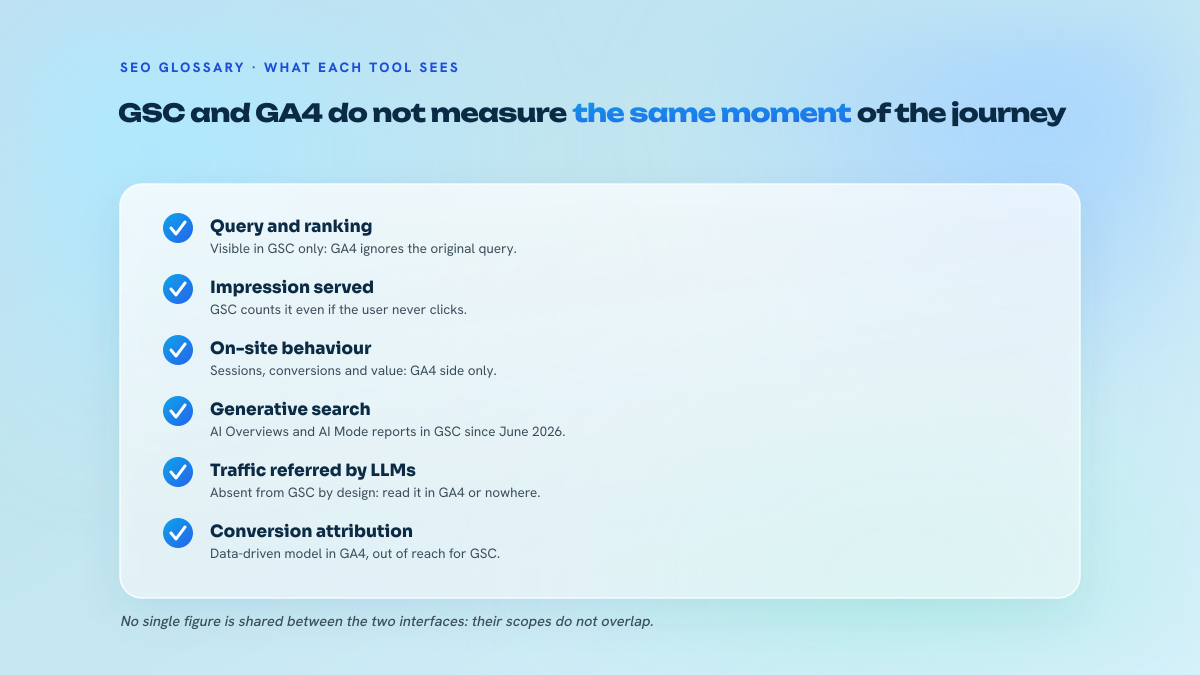
What each system can physically see
The distinction that matters is not feature lists, it is the observation point. Search Console sits inside Google's serving infrastructure and logs what Google itself did: it recorded an impression for a URL on a query, a position, and whether a click left the SERP. It sees every exposure, including the ones that produced nothing. It never sees the visit.
GA4 sits in your page, in your tag. It fires when a browser executed your JavaScript on your property. It sees the session, the landing page, scroll depth, the second page, the form, the purchase, and it can attribute that chain across channels. It has no idea how many times Google showed you and got ignored, and no idea what query produced the visit, because Google stopped passing the keyword in the referrer well over a decade ago.
Everything else follows from that boundary. Impressions, average position, query-level data, coverage and indexation status exist only in GSC. Engagement rate, conversion, revenue, path analysis and channel attribution exist only in GA4. Any metric you want that spans both sides, organic conversion rate per query being the classic ask, is a join you build yourself by matching landing pages, and it is an estimate with a known error bar, not a measurement. Senior practitioners state that error bar out loud in the report. Juniors present the join as fact.
One asymmetry has grown sharply. On 3 June 2026 Google launched dedicated Search Console reports for impressions in generative features, covering AI Overviews and AI Mode, data that remains folded into the overall Performance report but is now visible as its own layer. GA4 structurally cannot reproduce that view: a user who read an Overview and never clicked never reached your property, so no tag fired. Conversely, GA4 is the only system that sees referrals from ChatGPT, Perplexity or Claude, because those are ordinary referring sessions and Search Console only ever reports Google Search.
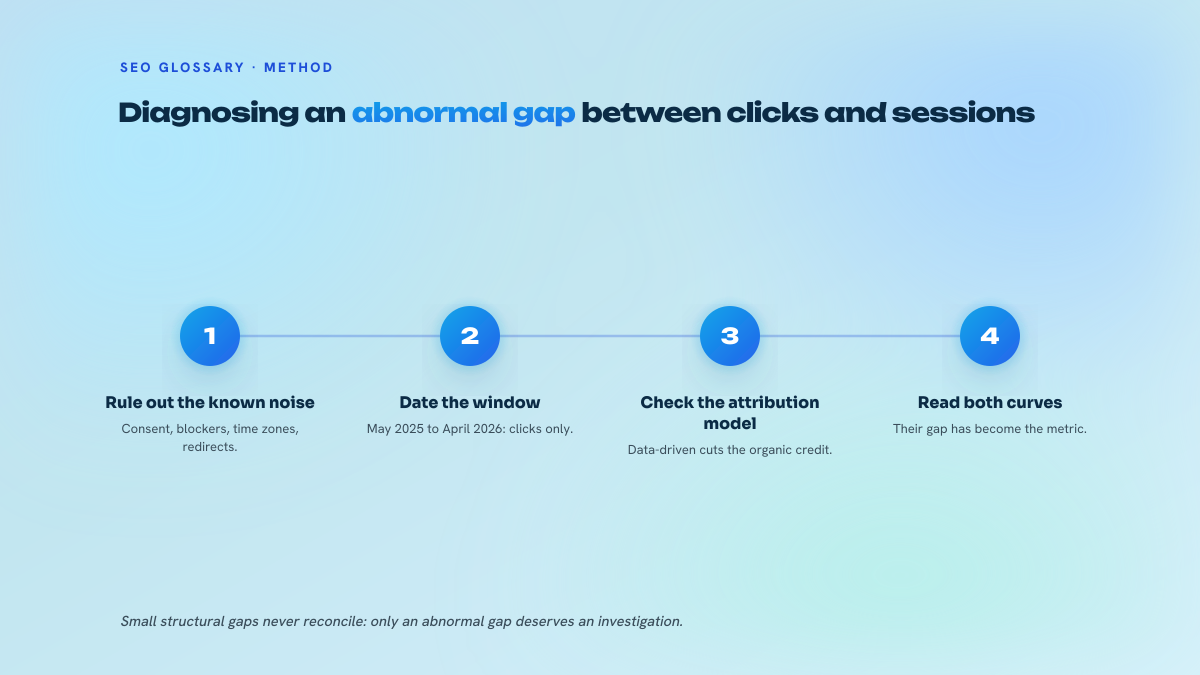
The 2026 data defects you have to carry
Anyone doing year-over-year analysis in 2026 has to know one thing: Google acknowledged that a logging error overstated Search Console impressions from 13 May 2025 through 27 April 2026, roughly fifty weeks. The forward-looking issue was fixed, the historical data was not reconstructed, and click data was not affected. The defect ran for nearly a year before anyone caught it.
The operational consequence is blunt. Every impression total, every CTR, and every impression-derived trend that touches that window is inflated by an unknown, non-uniform factor. A CTR that appears to collapse across that period may be an artefact of the denominator. The correct move is not to abandon the data, it is to pivot the affected reports to clicks, keep impressions as a directional signal only, and write the caveat into the dashboard rather than into a footnote nobody reads. GA4 organic sessions and conversions are untouched by this particular defect, which for once makes GA4 the more reliable side of a comparison.
Two other 2026 realities belong in the same paragraph of your methodology note. Since 10 December 2025, Search Console offers weekly and monthly aggregation in the Performance report, which finally makes it possible to separate genuine movement from weekday noise and to compare update periods without hand-rolling the rollup. And on the GA4 side, industry reporting indicates that data-driven attribution became the default for newly created conversion events after 14 October 2025, replacing last-click. That change silently reduces the conversion credit organic receives whenever paid, video or display touched the path first. If your organic conversions appear to have softened in late 2025 with no matching drop in sessions, check the attribution model before you check your links.
Why the two never reconcile
GSC clicks and GA4 organic sessions will not match, and chasing parity is wasted time. The structural reasons are known: GSC counts a click on the SERP whether or not the page finished loading, GA4 counts a session only if the tag executed, so consent refusals, ad blockers, bounced loads and slow mobile connections shave the GA4 side. GSC deduplicates clicks per query per session in ways it does not fully document. GA4 will start a new session after thirty minutes of inactivity or on a campaign change, splitting one visit into two. Time zones differ unless you have aligned them explicitly.
A gap in the range of ten to twenty percent is normal and not worth a meeting. What is worth a meeting is a gap that changes shape: a stable ratio that suddenly diverges usually means a tagging regression, a consent banner change, or a redirect that lost the tag, not an SEO event. Treat the GSC-to-GA4 ratio itself as a monitored metric and you get a free integrity check on your analytics stack.
The larger 2026 divergence is not technical, it is behavioural. A Pew Research study published in July 2025, based on 68,879 real Google searches from a panel of 900 U.S. adults, found users clicked a traditional result on 8% of visits when an AI summary appeared, against 15% without one, a 47% relative decline. Ahrefs' analysis of aggregated Search Console data across 300,000 keywords reported a 34.5% lower CTR for the top-ranking page when an AI Overview appeared, and its later December 2025 analysis put the reduction at 58%. Seer Interactive's longitudinal work covering 53 brands, 5.47 million queries and 2.43 billion impressions measured organic CTR of 0.61% on AI-Overview queries against 1.62% without.
These are observational correlations, not controlled causal estimates, and I would not present them as a law. But the direction is unambiguous and it changes what GSC means. Impressions and average position are now upstream indicators of exposure, not proxies for traffic. Anyone still reporting « we hold position 3 » as an outcome is reporting a stable input while the output erodes underneath.
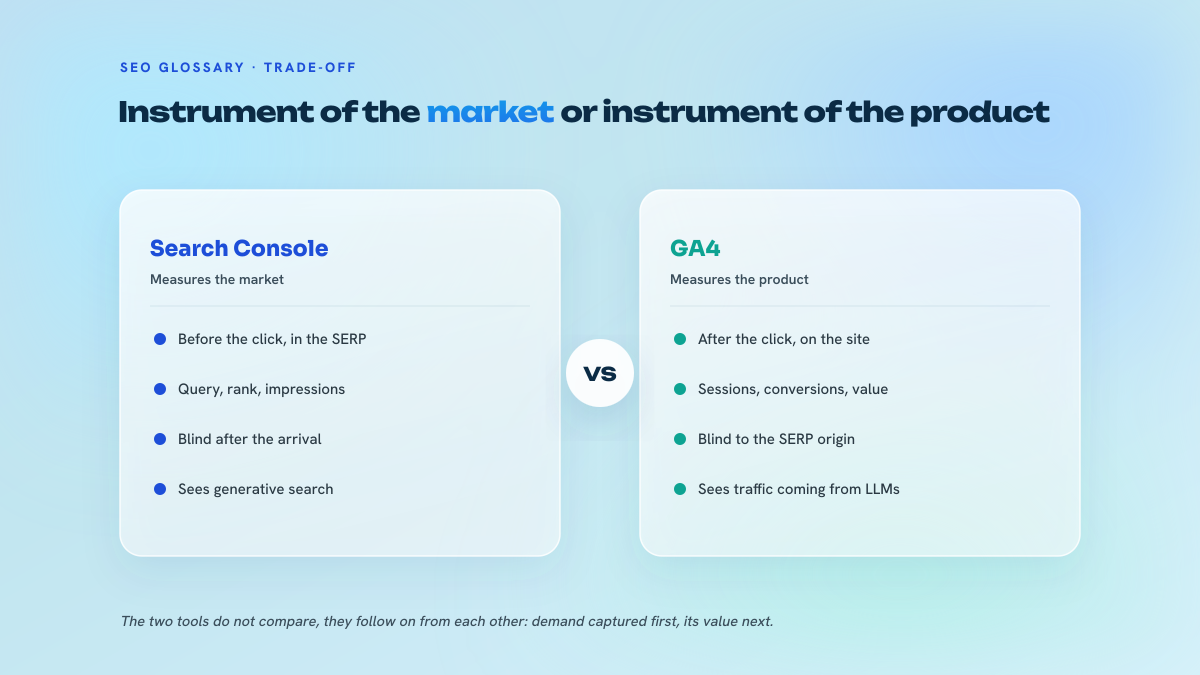
How to read both on a netlinking campaign
On a link campaign the two systems have different latencies, and confusing them causes most premature verdicts. Search Console moves first. Two to six weeks after links land, what you should see is not a rank jump on the head term but query breadth: more distinct queries firing on the target page, impressions appearing on variants and long-tail formulations the page never surfaced on, and average position tightening on queries that were previously sitting past page two. That is the earliest honest signal that authority reached the page. Filter the Performance report to the target URL, compare the count of unique queries, and use clicks rather than impressions given the logging defect above.
GA4 is the lagging read, and it is the one that decides whether the campaign was worth its cost. Set the landing pages of the campaign as an exploration segment and look at assisted conversions, not last-click conversions, because a page that earns links is usually mid-funnel. When we plan link placements across the French editorial media we run in-house, the media selection is made on topical fit and on referring domain profile, but the retrospective judgement is made in GA4 on assisted conversions per placement, which is the only number that survives a CFO reading it. Publishers whose real traffic and thematic scope you can inspect before buying are the ones that make that retrospective possible, which is why picking your placements from an open catalogue rather than a broker's shortlist matters more than any metric threshold.
The two systems also split the AI question cleanly. The 2025 Previsible AI Traffic Report tracked 19 GA4 properties and found LLM referral sessions rose from roughly 17,000 to 107,000 comparing January to May 2024 against January to May 2025, around 527% growth. That channel exists only in GA4, as referral traffic from chat hosts. If part of your acquisition thesis is being cited by assistants, your reporting has to live in GA4 with a custom channel group, and your GSC generative reports cover only the Google side of it.
Third-party link tools sit outside both. Ahrefs and its index of referring domains tell you what was acquired, GSC tells you what Google did with it, GA4 tells you what it produced. Three tools, three questions, and the link-index metrics are the least authoritative of the three because they are vendor estimates rather than observations of Google. When you are sizing what a campaign should cost against what it can plausibly return, work backwards from the GA4 number, then check it against what placements actually cost before committing a budget.
What goes wrong in practice
The recurring failure in audits is treating GSC average position as a KPI. It is an average over impressions, so a page that starts surfacing on a hundred new weak queries will show a worsening average position while genuinely gaining. Segment by query before you draw any conclusion from that number, or drop it entirely and track clicks plus unique query count.
The second is reading a GA4 drop as an SEO event without checking the annotations. Google's confirmed 2025 core updates ran 13 to 27 March, 30 June to 17 July, and 11 to 29 December; in 2026 the March core update ran 27 March to 8 April and the May core update 21 May to 2 June, while the August 2025 spam update rolled from 26 August to 22 September 2025. Those dates belong as annotations in both systems. A traffic movement that starts mid-rollout is an algorithmic story, one that starts on a Tuesday with no rollout in flight is usually a deployment, a consent change, or a redirect.
The third is asymmetric comparison windows. Comparing a 28-day period against the previous 28 days when one contains a holiday week, or comparing GSC's Pacific-time days against GA4's local-time days, produces differences that have nothing to do with your work. Fix the time zone once, use the new weekly or monthly aggregation, and compare like for like.
The fourth is expecting Search Console to validate a link. It will not. GSC has never reported inbound links in a way that is complete or timely, the Links report is a lagging sample, and its absence proves nothing about whether a link was crawled or counted. Verify placement live on the page, check indexation of the hosting URL, then read the effect downstream in query breadth. A campaign judged on whether links appeared in the GSC Links report is a campaign judged on the wrong instrument, which is also true of the media selection itself: inspect what a host actually publishes rather than what its category labels claim.
Nautilinks operates an owned network of editorial media. In-house written articles, transparency disclosures respected, anchor mix calibrated.
Frequently asked questions
Can I rebuild an accurate CTR history across the impression logging defect?
No. Google fixed the logging going forward from 27 April 2026 but never reconstructed the historical data, so impressions between 13 May 2025 and that date remain overstated by an unknown, non-uniform factor. There is no correction coefficient you can apply honestly. The workable approach is to rebase those reports on clicks, which were unaffected, and to mark the window explicitly on any chart that crosses it rather than silently presenting a CTR trend that is partly an artefact of its denominator.
Why do GSC clicks exceed GA4 organic sessions on nearly every property?
Because they are counted at different points. GSC registers the click on the SERP whether or not your page rendered; GA4 registers a session only if the tag executed, which excludes consent refusals, blockers, abandoned loads and slow mobile connections. Session timeout rules and time-zone misalignment add more. Ten to twenty percent is unremarkable. What matters is stability: a ratio that suddenly shifts points to a tagging or consent regression, not to an SEO event, and monitoring the ratio gives you a free integrity check.
Which system should judge a netlinking campaign, and at what horizon?
Both, at different horizons. GSC is the leading read at two to six weeks: look for query breadth on the target URL, meaning more distinct queries and impressions on variants, rather than a head-term rank jump. GA4 is the lagging read at three to six months, on assisted conversions for the campaign landing pages, since link-earning pages are usually mid-funnel. Judging on GA4 last-click conversions at four weeks will read as failure on almost any campaign, including the ones that worked.
Does GSC show AI visibility now that generative reports exist?
Partly, and only for Google. Since 3 June 2026 Search Console exposes impressions in generative features including AI Overviews and AI Mode as a separate view, still counted inside the overall Performance report. That covers Google surfaces only. Sessions referred by ChatGPT, Perplexity or Claude never appear in Search Console because they are not Google Search; they arrive as referral traffic and are visible only in GA4, where you should isolate them with a custom channel group.
Did the GA4 attribution default change affect how organic looks?
Yes, and it is easy to misread. Industry reporting indicates data-driven attribution became the default for conversion events created after 14 October 2025, replacing last-click. In funnels where paid, display or video touched the path before the final organic visit, organic now receives fractional rather than full credit, so conversions can soften with no change in sessions or rankings. Record the attribution model and conversion configuration in force on every historical dashboard, otherwise the model change looks like a performance drop.
Is average position still worth tracking in 2026?
Only segmented, and never as a headline KPI. It is an impression-weighted average, so a page that begins surfacing on a hundred weak new queries shows a worse average position while genuinely gaining reach. Combined with the AI Overview effect measured by Seer Interactive, 0.61% organic CTR on Overview queries against 1.62% without, a stable position also stopped implying stable traffic. Track clicks and unique query count instead, and keep position as a diagnostic for a specific query set.
Test your knowledge
Quiz: GSC vs GA4
1/3Which Search Console data was affected by the logging defect Google acknowledged for 13 May 2025 to 27 April 2026?