- →RankBrain is a query interpretation system, not a ranking factor: no page-level or link-level optimisation targets it directly, and any audit line item called « RankBrain optimisation » is a repackaging of semantic coverage work.
- →Google has announced no RankBrain-specific change between August 2025 and August 2026. Treat it as settled infrastructure and put your monitoring effort on core updates and generative surfaces instead.
- →The March 2026 core update moved 79.5 % of top-three URLs and pushed 24.1 % of former top-10 pages out of the top 100 (SE Ranking data reported by Search Engine Land), and Sistrix analysis in the same report shows visibility shifting toward primary sources rather than aggregators.
- →Ahrefs measured a 58 % CTR drop at position one on AI Overview queries in its 4 February 2026 study of 300 000 keywords, which means ranking reports alone now understate what a page is losing.
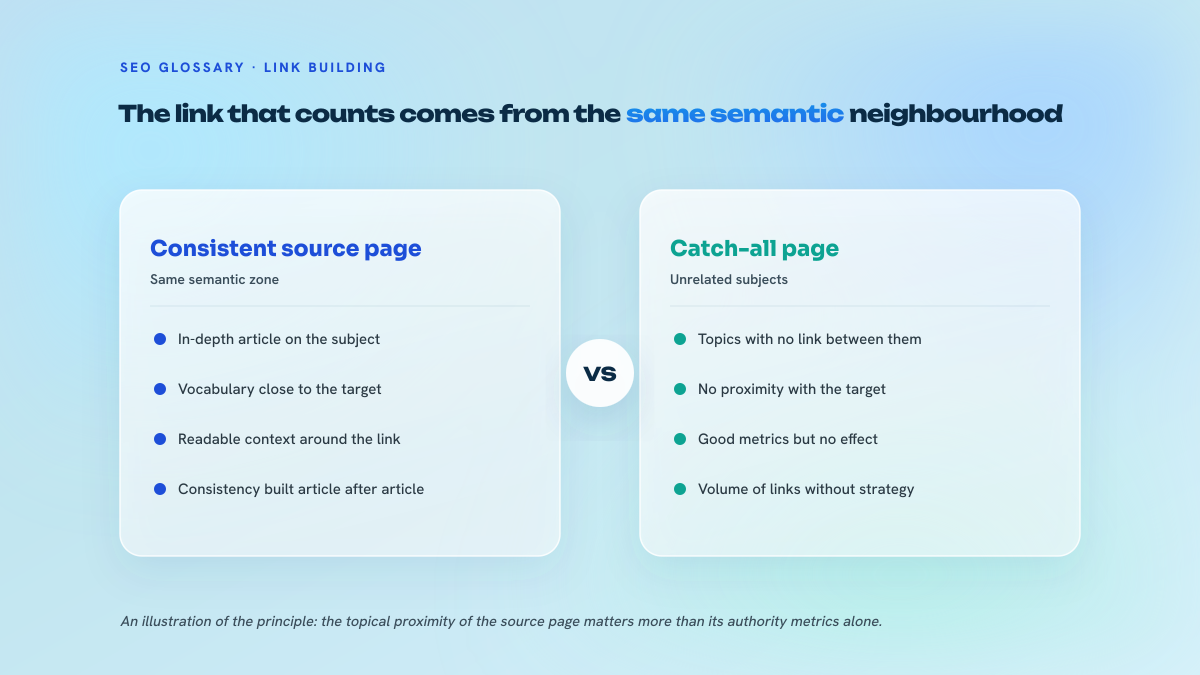
- →For link acquisition, the operational consequence of a concept-based interpretation layer is topical proximity of the linking page, not anchor string engineering.
- →Dwell time and pogo-sticking are not documented RankBrain inputs. Building a strategy on them is building on a rumour.
What RankBrain actually is, past the 2015 press cycle
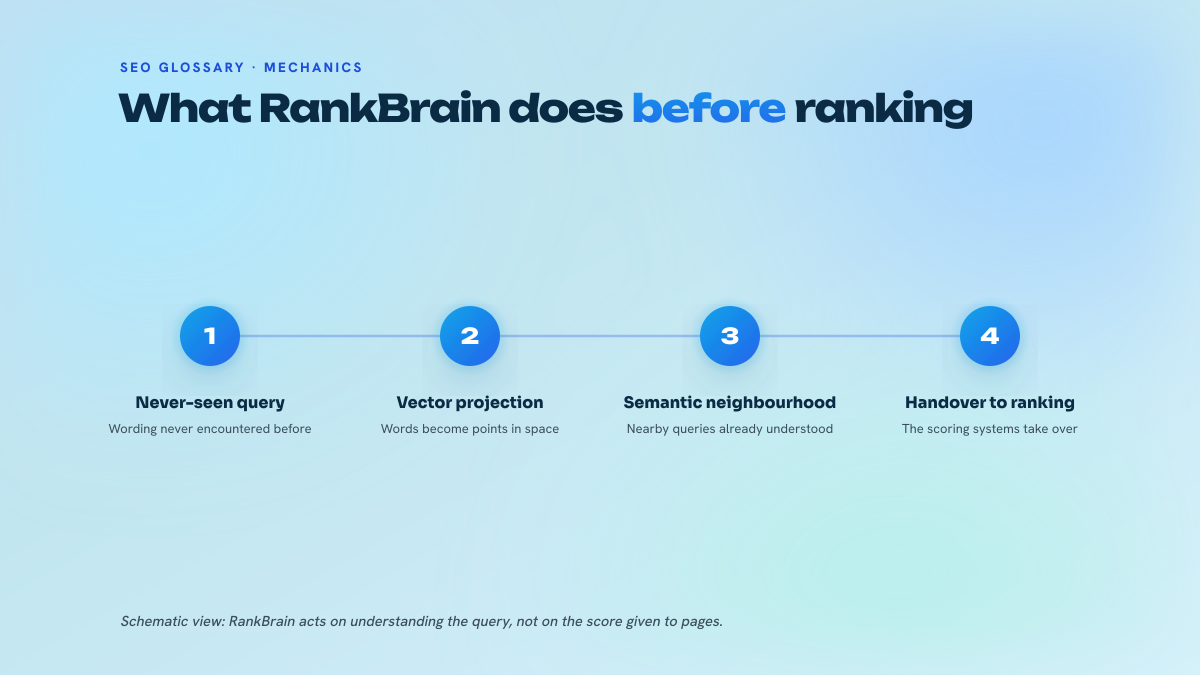
Google confirmed RankBrain in an October 2015 Bloomberg interview with Greg Corrado, and the industry has been over-reading that one interview ever since. RankBrain is a machine learning component that helps Google interpret queries, particularly ones it has never seen before, by projecting words and phrases into a vector space where semantically close things sit close together. It was never something you optimise a page for. It sits between the query a user types and the documents the ranking systems then score.
That distinction carries real operational weight. A ranking factor is something measurable on your page or in your backlink profile: a title tag, a referring domain, a Core Web Vitals score. RankBrain measures nothing about your site. It decides what the search is about, then hands a better-formed problem to everything downstream. When the industry heard RankBrain described as a « signal », half of it read that as « factor » and started selling checklists. Ten years later those checklists are still circulating.
Google itself settled the vocabulary question when it published its guide to ranking systems: RankBrain is listed as a system, meaning a permanent part of how Search works, not an update, meaning a dated event with a rollout window and a recovery story. Anyone attributing a traffic drop to RankBrain is describing something that has no announcement, no timestamp, and no diagnostic signature. It is the SEO equivalent of blaming the weather.
The mechanics: vectors, unseen queries, and where it sits in the stack
The mechanism is embeddings. Words, phrases and whole queries get converted into numerical vectors, and proximity in that space approximates proximity in meaning. That is what lets Google handle a query nobody has ever typed before: it cannot look up historical click data for a string it has never seen, but it can find the region of the vector space that string lands in and reuse what it knows about neighbouring queries. Never-before-seen queries are precisely the gap RankBrain was built to close.
This short explainer covers the intuition before we get into where the system sits today.
The practical consequence for a working SEO is that Google stopped matching strings a long time ago and started matching concepts. A page about mortgage refinancing that never uses the exact phrase a user typed can still be the best answer, because the query and the document occupy the same neighbourhood. This is the entire basis of working on semantic coverage rather than keyword density: you cover a concept and its adjacent entities, and the interpretation layer does the rest.
Where people get confused is the stack. RankBrain interprets. BERT, introduced in 2019, parses the syntax and the relationship between words in a sentence, which is why it changed how prepositions and word order are handled. MUM, which Google announced in 2021, works across languages and formats on more complex informational problems. In 2026 you also have the generative layer, where a single query is decomposed into multiple sub-queries before answers are assembled, a behaviour the industry now calls query fan-out. These are not competitors. They are successive layers of the same pipeline, each handling a different failure mode of literal matching, and none of them replaced its predecessor.
Is RankBrain still running in 2026
Yes, and the more useful answer is that it stopped being an interesting question. Between 6 August 2025 and 6 August 2026 Google announced no RankBrain-specific update, deprecation, or change of role. Its public communication over that period has been about broader ranking systems and generative features. RankBrain is settled infrastructure: it runs, it is integrated with everything built on top of it, and there is nothing about it to track week to week.
This video is a decent summary of why the system remains structurally important even without headlines.
What has changed in the last twelve months is everything around it. On 15 May 2026 Google Search Central published a dedicated resource on optimising for generative AI in Search, and its central message was that visibility in AI Overviews and AI Mode rests on the same quality and SEO foundations as classic Search, with explicit mythbusting around AEO and GEO tactics. That is the clearest institutional statement yet that treating « RankBrain SEO » as a separate discipline was always a marketing construct.
On 3 June 2026 Google started rolling out generative AI performance reports in Search Console to a subset of sites, covering impressions in AI Overviews, AI Mode and generative Discover features, with country, device and hourly to monthly granularity. That is the measurement shift that actually matters this year. Until now you inferred generative visibility from click anomalies; now a slice of it is reportable. And it matters because Ahrefs, in a study published on 4 February 2026 across 300 000 keywords, estimated a 58 % lower CTR at position one when an AI Overview is present, with the measured position-one CTR on those queries falling from 0.073 in December 2023 to 0.016 in December 2025. Their earlier April 2025 estimate was 34.5 %. A page can hold its ranking and lose most of its traffic, which makes rank tracking alone a misleading dashboard.
What it changes for a netlinking operation
There is no RankBrain link building tactic, and anyone selling one is selling nothing. But an interpretation layer that works on concepts rather than strings does change how you choose linking pages. If Google represents both the linking document and the target document in a semantic space, the value of a link correlates with how close those two representations are. A link from a page that genuinely covers the adjacent subject beats a link from a general page with a well-crafted anchor. That is why reasoning in entities rather than keywords has quietly become the selection criterion on our side: at nautilinks we place links inside the editorial context of the French media we operate in-house, and the article the link sits in is chosen for topical proximity first, anchor second.
The March 2026 core update is the best recent evidence for where the value sits. SE Ranking data reported by Search Engine Land found 79.5 % of top-three URLs changed position against 66.8 % after the December 2025 update, 90.7 % of top-10 URLs moved, only 20.5 % of top-three URLs held their exact position, and 24.1 % of previously top-10 pages fell outside the top 100. Independent Sistrix analysis cited in the same report showed visibility moving away from aggregators, directories and comparison sites, and toward official sources, specialist sites, established brands and primary destinations. Links did not stop working. Links as a substitute for being the actual source stopped working.
Operationally that means an acquisition plan built on volume is the wrong plan. It is worth looking at the media catalogue before you commit anything and picking a handful of genuinely on-topic hosts rather than thirty loosely related ones. On budget, Editorial.link's 2025 survey of 518 SEO professionals, still used as a 2026 benchmark, put the average acceptable price for a high quality backlink at 508.95 dollars and had 48.6 % naming digital PR as the most effective tactic. Against that market, knowing what a placement costs before you order it is the difference between a calibrated campaign and an open-ended invoice.
The RankBrain myths still being sold
The dwell time myth refuses to die. A large part of the RankBrain content published since 2016 asserts that the system feeds on dwell time, pogo-sticking and organic CTR as direct ranking inputs. Google has never documented that, and Search Console click data has been shown repeatedly to be a reporting surface, not a scoring input. Building a strategy on it produces the worst kind of work: clickbait titles that inflate CTR, harm conversion, and change nothing in the rankings.
The second mistake is treating BERT or MUM as replacements. They are additions. Asking whether you should optimise for RankBrain or for BERT is like asking whether to optimise for the database or the query parser. You write for the reader, cover the concept properly, and the layers sort themselves out.
The third is the checklist. Any audit deliverable containing a « RankBrain optimisation » section is repackaging ordinary semantic work: intent coverage, internal linking, entity completeness. There is nothing wrong with the underlying work, there is something wrong with pricing it as a specialist intervention against a system Google has not touched publicly in years.
The fourth, and the expensive one in 2026, is still reporting on rankings alone. With a measured 58 % CTR drop at position one on AI Overview queries in Ahrefs' February 2026 data, and Search Console now exposing generative impressions on part of the fleet, a report that shows only positions and organic clicks hides the actual trend. Put AI surface impressions, brand queries and assisted conversions next to the ranking table, or you will be explaining a flat position curve and a falling revenue curve with nothing to connect them.
Nautilinks operates an owned network of editorial media. In-house written articles, transparency disclosures respected, anchor mix calibrated.
Frequently asked questions
Can RankBrain penalise a site?
No. RankBrain interprets queries, it does not evaluate sites, and it issues nothing resembling a sanction. Demotions come from core updates, spam systems, or manual actions, all of which have documented signatures and, in the case of manual actions, a Search Console notification. If you are looking for a cause behind a drop, check core update dates and the manual actions report before inventing an algorithmic culprit that has no announcement history.
What is the practical difference between RankBrain and BERT?
RankBrain works on query meaning at the vector level, which is what lets Google handle strings it has never seen before by placing them near known ones. BERT, deployed from 2019, parses the syntax of a sentence and the relationship between its words, which is why it changed the handling of prepositions and word order. One resolves ambiguity by proximity, the other by grammar. They run together, and neither superseded the other.
Does any tool let me monitor RankBrain's effect?
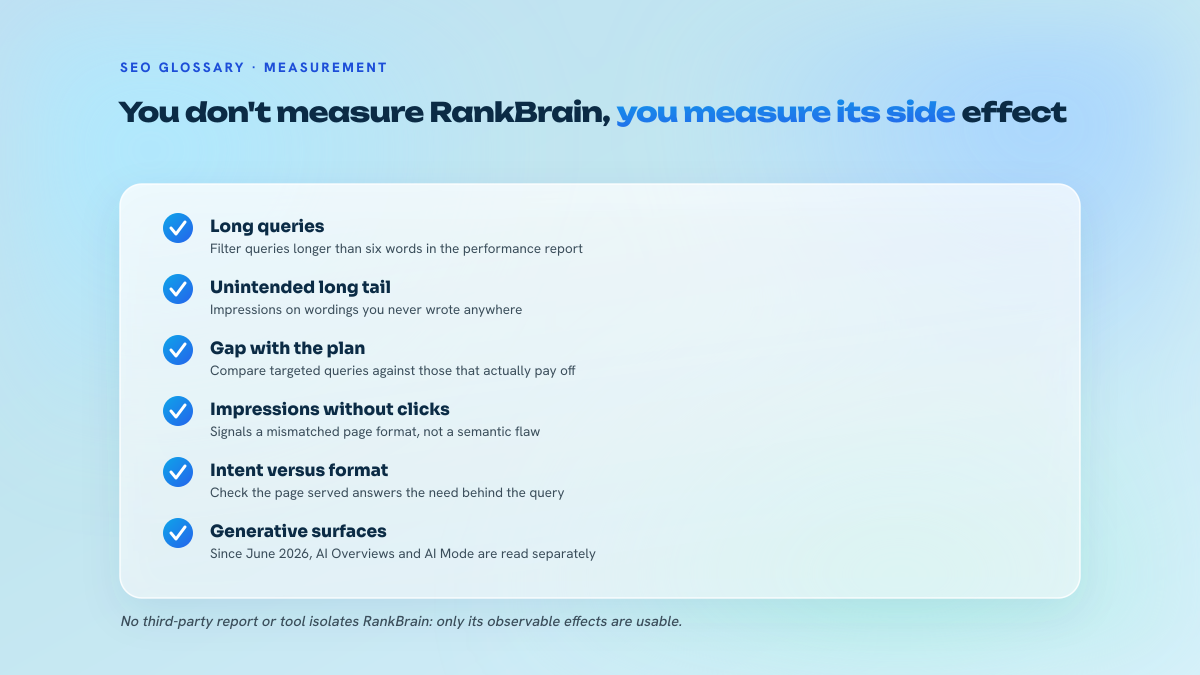
None, and any tool claiming to is measuring something else. What you can monitor is the outcome of concept-based interpretation: which queries a page actually gets impressions on in Search Console versus which one you targeted. A wide, coherent spread of related queries on a single URL means the interpretation layer has correctly placed your document. A narrow spread on exact-match variants usually means thin topical coverage.
Do backlinks matter less now that Google interprets meaning?
They matter differently. The March 2026 core update, per SE Ranking data reported by Search Engine Land, moved 79.5 % of top-three URLs, and Sistrix analysis in that report showed visibility shifting toward primary sources and specialist sites. Links from topically close, genuinely editorial pages held up. Volume acquired across loosely related hosts did not. Selection quality replaced quantity as the variable that moves the needle.
Should I optimise separately for AI Overviews and for classic ranking?
Google's 15 May 2026 Search Central resource says no: generative visibility rests on the same quality and SEO foundations, and the post explicitly addresses AEO and GEO myths. What does change is measurement. Since 3 June 2026 a subset of sites receive generative AI performance reports in Search Console, so you can start separating classic Search performance from generative surface impressions instead of inferring it from click anomalies.
Test your knowledge
Quiz: RankBrain
1/3What role does RankBrain play in Google Search?