- →Semantic SEO optimises a page for a topic and its entity relationships, not a keyword string. The unit of ranking is the cluster, not the URL.
- →In 2026 the payoff shifted from the ten blue links to being cited as a source inside AI Overviews. A Semrush study (Feb 2026) found cited pages carried 47% more topical breadth than pages that ranked but were not cited.
- →Entity disambiguation is now table stakes: after Google deleted roughly 3 billion Knowledge Graph entities in June 2025 (per Outpace SEO), each page needs one unambiguous primary entity.
- →Topical authority is built with internal architecture, pillar and cluster pages, consistent schema, not with more exact-match anchors.
- →Depth is a link magnet. In netlinking terms, a well-structured cluster earns editorial links a thin keyword page never will, which is why we place links into cluster hubs, not orphan posts.
- →Schema and structured data help machines resolve the entity, but they never rescue thin content. Semantic depth first, markup second.
What semantic SEO actually is
Strip away the marketing and semantic SEO is the practice of optimising a page so a search engine understands its meaning and its place in a web of related concepts, rather than matching a query to a literal string of characters. The classic illustration is the word « Apple »: the same five letters point to a fruit or a technology company, and a modern engine resolves which one you mean from context, related entities and intent, not from keyword density. That resolution step is the whole game.
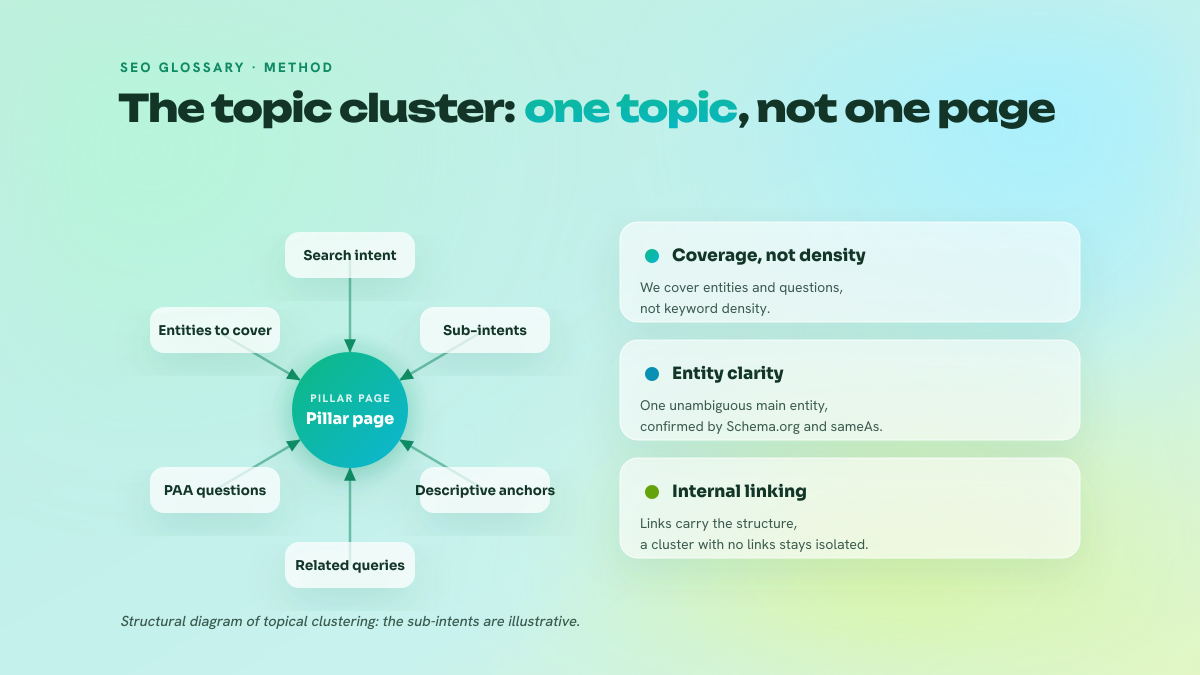
The dictionary line, « optimising content for topics and entities instead of keywords », is true but useless on its own. What matters operationally is the shift in the unit of work. In keyword SEO the unit is a page targeting a query. In semantic SEO the unit is a topic covered exhaustively across a hub and its supporting articles, wired together so the engine reads the whole set as one authoritative body on a subject. You stop asking « what keyword does this page rank for » and start asking « does this site demonstrably own this topic ».
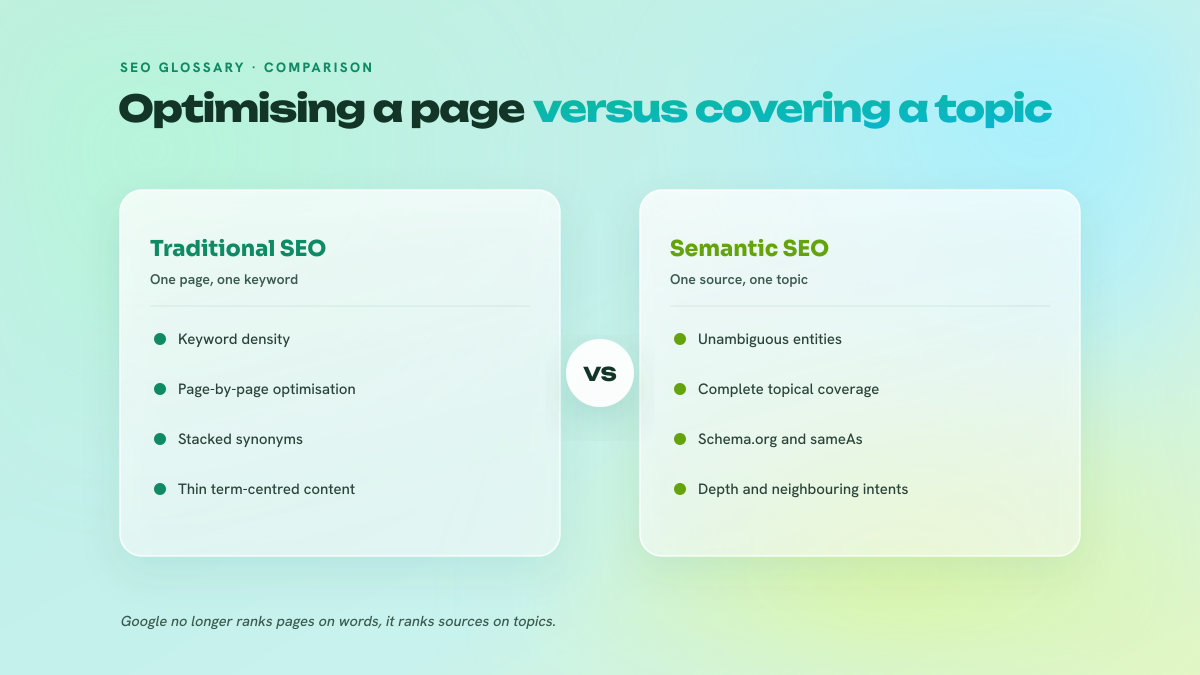
The difference from traditional SEO is not cosmetic. Traditional SEO structures a site flat, one page per keyword, and leans on backlinks and exact-match anchors. Semantic SEO structures a site as clusters, maps user intent to content, and treats entities and their relationships as the ranking substrate. The two are not enemies, but a 2026 workflow that still treats keywords as the atomic unit is optimising for an engine that stopped existing several core updates ago.
How it works in 2026
Google reads a query, expands it into related entities and probable intent, then retrieves and ranks documents on semantic relevance before classic signals refine the order. This is why two pages with identical keyword usage can rank worlds apart: one demonstrates topical coverage the model recognises, the other repeats a phrase. The mechanics run through natural-language understanding, the Knowledge Graph, and increasingly a generative layer that summarises answers directly.
That generative layer is the 2026 inflection point. Google rebranded its Search Generative Experience to AI Overviews on 14 May 2024 and, by late 2024, had pushed it to more than 100 countries. The consequence for content strategy is blunt: on informational queries, the win condition is no longer position 3 in the blue links, it is being selected as a cited source inside the Overview. A Semrush study from February 2026, referenced in current semantic-SEO literature, found that pages cited in AI Overviews carried 47% more topical breadth than pages that ranked on the same query but were not cited. Breadth of coverage, not keyword repetition, is what earns the citation. Much of that breadth comes from query fan-out, the technique Google presented at I/O 2025, where one question is decomposed into dozens of synthetic sub-queries run in parallel, each retrieving its own passage before the answer is assembled: a page that only resolves the head query stays invisible to most of that fan-out, which is the structural problem we unpack in our work on how AI engines decompose one question into dozens of sub-intents.
How do you measure any of this in practice? You track topic coverage against the entities that co-occur in the top results, you watch which of your URLs get pulled into AI Overviews in Search Console, and you audit whether your cluster actually answers the sub-questions a topic implies rather than restating the head term. A Backlinko analysis of 11.8 million SERPs, published in 2025, reported that pages with structured semantic depth ranked on average 4.2 positions higher than pages without it. The threshold that matters is not a word count, it is whether the page resolves the full intent behind the query without the reader needing a second tab.
Entities and the knowledge graph
An entity is a distinct thing Google can identify and reason about: a person, a company, a product, a place. Semantic SEO lives or dies on entity clarity, and 2026 made that unforgiving. According to an entity-SEO analysis published by Outpace SEO, Google executed the largest contraction of its Knowledge Graph in a decade in June 2025, deleting over 3 billion entities in a single week, roughly a 6.26% reduction of the whole graph, to strip out ambiguous and low-confidence entries. The same analysis reports Google now expects each page to carry one unambiguous primary entity type.
The operational reading is straightforward. If your page tries to be about three things at once, the engine cannot cleanly attach it to a node, and a page it cannot resolve is a page it cannot cite. You fix this with consistent naming, structured data that declares the entity, and sameAs links to authoritative profiles so the engine can reconcile your entity with the one it already knows. Schema markup is the enabling layer here, not a ranking trick: it tells the machine which Apple you mean. Used well it earns rich results and cleaner disambiguation; used as a substitute for depth it does nothing, because structured data on thin content is still thin content.
This is also where topical authority and entity SEO converge. Covering a subject with a connected set of articles that each reinforce the same primary entities is how you signal, at scale, that your site is a credible source on the topic. One deep page rarely builds authority. A coherent cluster that consistently references the same entities does.
Where it fits in a netlinking operation
Semantic SEO and link building are usually taught as separate disciplines. In a real operation they are the same lever pulled from two ends. Depth attracts links: a 2025 semantic-SEO analysis reported that longer, topically deep pages received roughly three times more traffic and three and a half times more backlinks than shallow posts on the same subject. A well-built cluster is a link magnet in a way an isolated keyword page never is, because editors cite the resource that answers the question completely.
That changes where link equity should land. When you plan a campaign across a whole topic cluster rather than one money page, you push authority into the hub and let the internal architecture distribute it to the supporting articles the way the engine already reads the set. Pointing every link at a single URL while ignoring the cluster wastes the semantic structure you built. On the acquisition side, the anchor and the surrounding paragraph on the linking page are themselves semantic signals: a link embedded in genuinely relevant editorial context, from a French media title on the same topic, carries entity relevance that a footer link never will. That is precisely why we operate a network of French editorial media we own, so a link sits inside content that shares the target page's entities rather than being bolted onto an unrelated domain. This only compounds when placements land on that rhythm rather than in one burst, which is the logic behind calibrating a link acquisition campaign over several months.
If you are sourcing links rather than earning them, the same principle holds. A link inside an editorial article written around the topic transmits contextual relevance a directory listing cannot, and you can inspect that context before you buy when the placements are visible in a catalogue you can browse without signing up. Semantic relevance of the source, not just its raw authority score, is the metric that survives the next core update.
Common mistakes we see
From what we see in audits, the first mistake is chasing entities without content depth: stuffing a page with named entities and schema in the hope that markup substitutes for actually answering the topic. It does not. The engine reads the body first and the markup second, and a page thin on substance stays invisible no matter how clean its JSON-LD is.
The second is ignoring intent. Teams map keywords to pages and forget that a query carries a job to be done. A comparison query and a definition query on the same term want different pages, and a cluster that answers only one leaves the other on the table for a competitor. The third recurring failure is treating the topic cluster as a content-calendar formality: publishing twenty loosely related posts with no internal wiring, no clear pillar, and no shared entities, then wondering why authority never consolidates. A cluster without deliberate internal links is just a folder.
The last one is over-indexing on volume. A page can be long and shallow. Depth is measured by the sub-questions and entities it resolves, not by word count, and the 2025 core updates, documented across March, June and December, consistently rewarded topical clarity while penalising thin, keyword-first pages. If your content strategy still starts from a keyword volume spreadsheet rather than a topic and its entities, you are optimising the wrong object.
A working optimisation process
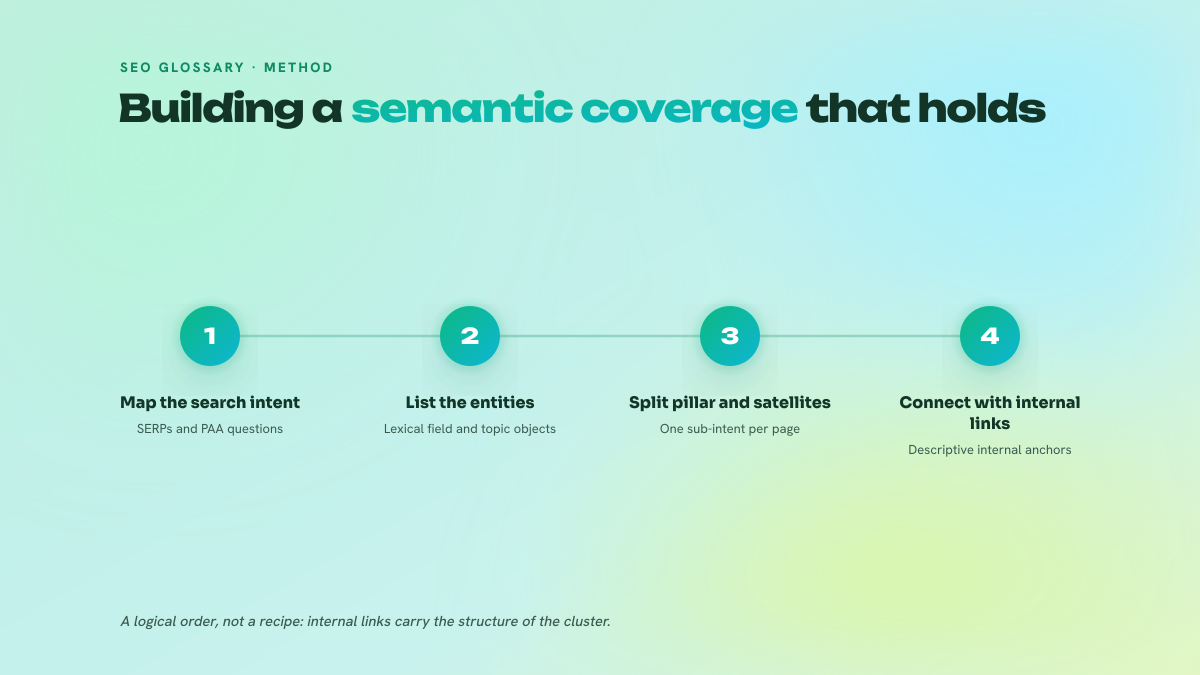
A workable process is less a checklist than a sequence you internalise. Start from the topic, not the keyword: identify the primary entity a page should own and the related entities that define its neighbourhood. Cluster your research around that neighbourhood so you know which sub-topics belong to the hub and which deserve their own supporting article.
Next, structure the content as a hub and spokes, with the pillar covering the topic broadly and each cluster page resolving one intent in depth, all interlinked with natural, descriptive anchors that name the concept rather than repeat an exact-match phrase. Then declare your entities with structured data and consistent naming so the machine resolves them cleanly. Finally, write metadata for meaning: a title and description that frame the entity and intent, not a keyword you hope to trigger. The June 2025 core update, which ran from 30 June to 17 July 2025, sharpened the weight on E-E-A-T and content quality, which in practice rewards exactly this order of operations, substance and structure first, signals second. Tools like Ahrefs, Semrush or SE Ranking help you find the semantic neighbours and cluster them, but the judgement about what a topic actually owes the reader stays human.
Nautilinks operates an owned network of editorial media. In-house written articles, transparency disclosures respected, anchor mix calibrated.
Frequently asked questions
How is semantic SEO different from traditional SEO in practice?
Traditional SEO builds one page per keyword on a flat structure and leans on exact-match anchors. Semantic SEO builds topic clusters, optimises for entities and intent, and treats the whole set as the unit of ranking. In practice you stop asking which keyword a page targets and start asking whether your site demonstrably owns a topic. The two coexist, but keyword-first workflows underperform against engines that read meaning before matching strings.
Does semantic SEO actually help you rank in AI Overviews?
That is now its main payoff. On informational queries the target is being cited as a source inside the Overview, not just ranking below it. A Semrush study from February 2026 found pages cited in AI Overviews carried 47% more topical breadth than pages that ranked but were not cited. Breadth and depth of coverage, resolving the full intent behind a query, are what earn the citation, not keyword repetition.
Is schema markup enough to do semantic SEO?
No. Schema helps a machine resolve which entity a page is about and can earn rich results, but it never substitutes for depth. Google reads the body first and the markup second. After the June 2025 Knowledge Graph contraction reported by Outpace SEO, disambiguation matters more than ever, but structured data on thin content stays thin. Treat schema as the enabling layer on top of genuinely complete content, not as the strategy itself.
How do I measure whether my content has enough topical depth?
Do not measure by word count. Check whether the page resolves the sub-questions and related entities that co-occur in the top results, and whether readers need a second tab to finish the job. Track which of your URLs get pulled into AI Overviews in Search Console. A Backlinko analysis of 11.8 million SERPs in 2025 found pages with structured semantic depth ranked on average 4.2 positions higher, so depth is measurable in outcomes, not length.
What does semantic SEO change for a netlinking campaign?
It moves the target from a single money page to the cluster. Depth attracts links, a 2025 analysis found deep pages earned around 3.5 times more backlinks than shallow ones, so you point equity at the hub and let internal architecture distribute it. It also raises the bar on source relevance: a link inside editorial content sharing your target page's entities transmits far more than a high-authority but off-topic placement.
Are topic clusters just a content-calendar trend?
No, but they fail when treated as one. Publishing loosely related posts with no clear pillar, no shared entities and no internal wiring is a folder, not a cluster. The value comes from the deliberate structure: a hub that covers the topic, spokes that each resolve one intent, and interlinking that lets the engine read the set as one authoritative body. The 2025 core updates consistently rewarded that clarity and penalised thin, disconnected content.
Test your knowledge
Quiz: Semantic SEO
1/3According to the Semrush study cited (Feb 2026), what distinguished pages cited inside AI Overviews from pages that merely ranked?