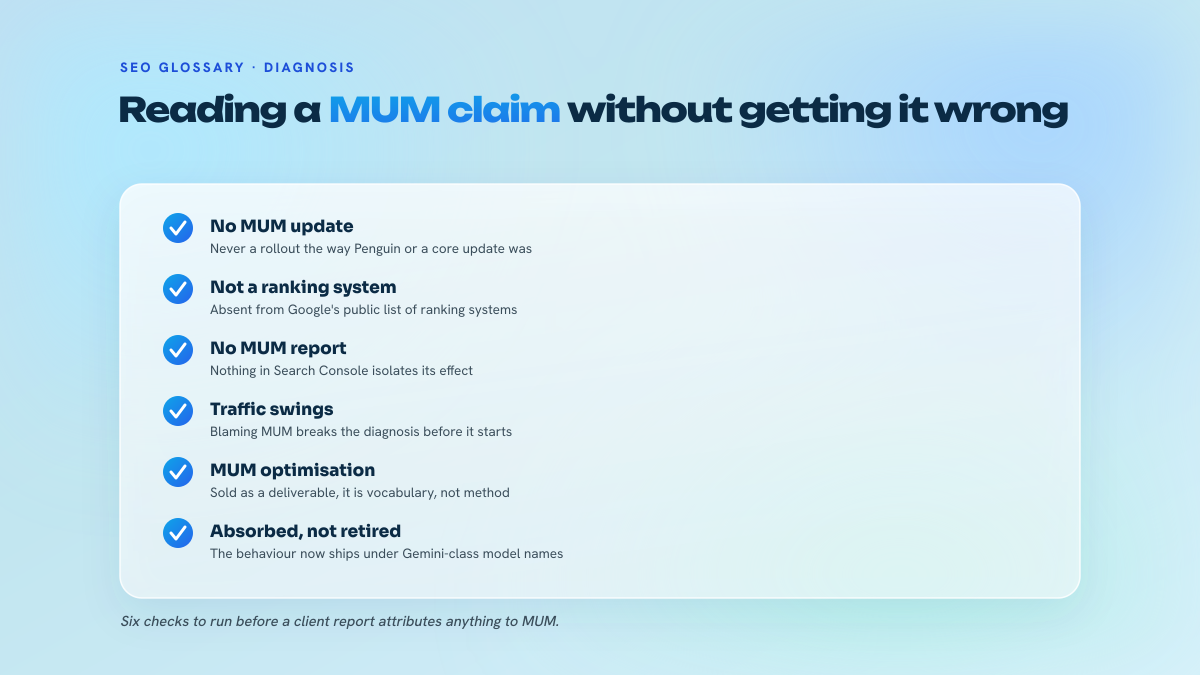
- →MUM has never been a ranking system: it does not appear in Google's public list of ranking systems, and no MUM rollout was ever announced. A drop attributed to MUM is a misdiagnosis.
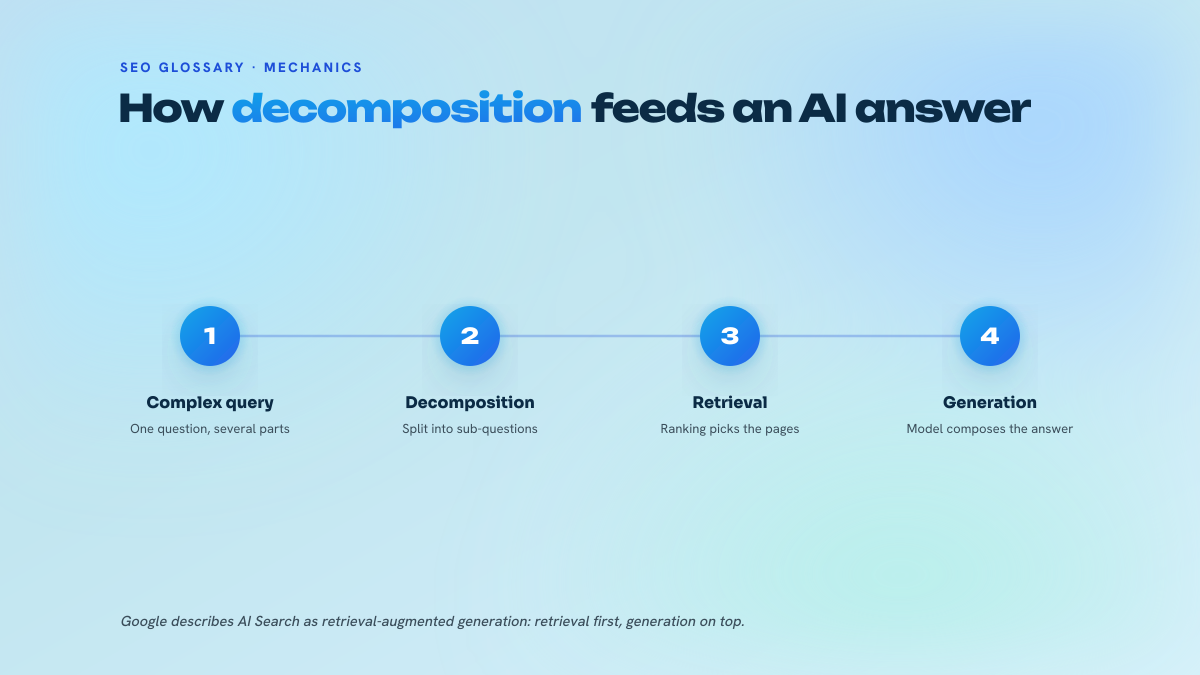
- →Its real signature is query decomposition and cross-lingual transfer, the direct ancestor of how AI Mode splits a question into parallel sub-queries today.
- →Google's 10 July 2026 generative search guidance describes AI Search as retrieval-augmented generation: classic ranking retrieves, the model composes. Links still decide eligibility.
- →AI Overview presence is volatile, not a linear takeover: 6.49 % of tracked queries in January 2025, 24.61 % in July, 15.69 % in November (Semrush, 15 December 2025, 10 million-plus keywords).
- →Since 15 May 2026, Google's spam policies explicitly cover attempts to manipulate generative responses, so tactics built to game an AI answer sit in the same bucket as link schemes.
- →Track the surfaces, not the model: Search Console has carried dedicated generative-AI performance reports since 3 June 2026.
What MUM really is, and what it never was
MUM stands for Multitask Unified Model, introduced in 2021 as the next step after BERT in the query understanding stack: a model able to work across languages and formats rather than text alone. Google's own communication described it as 1,000 times more powerful than BERT (blog.google). That single sentence caused more confusion in SEO discourse than anything else Google published that year, because the industry read a capability claim as a ranking announcement.
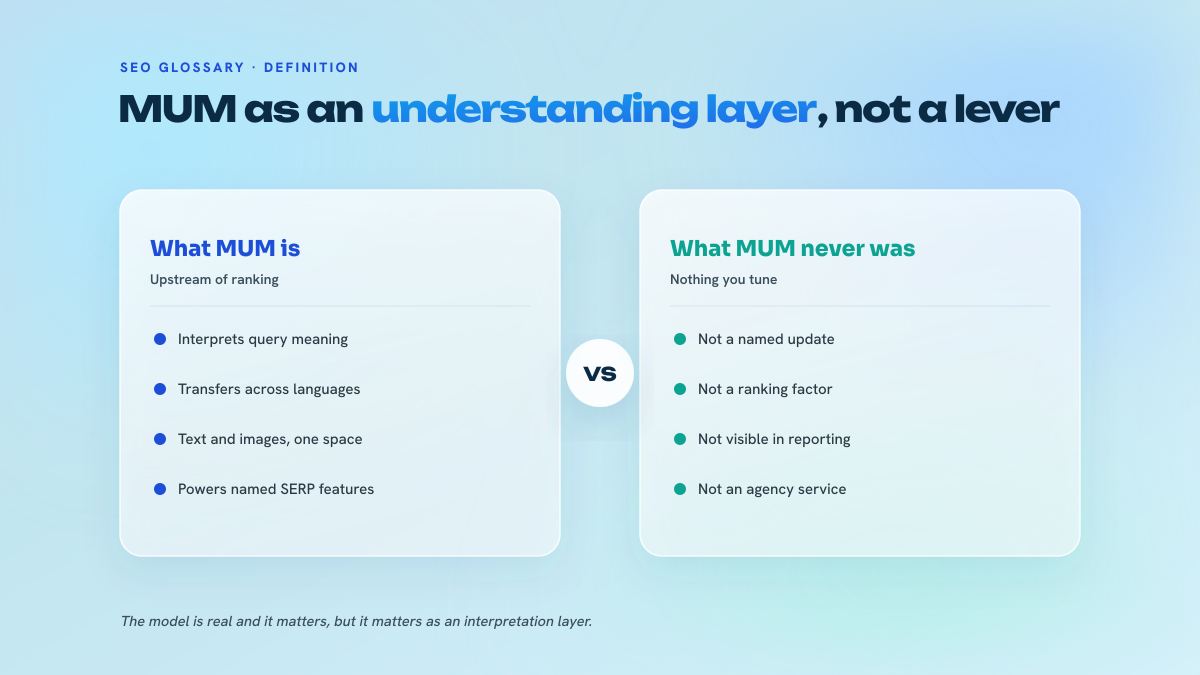
There was never a MUM update in the sense that there was a Penguin rollout or a December 2025 core update. MUM has never appeared in Google's public documentation of ranking systems next to the helpful content system or the reviews system. It sits upstream of ranking: a model used to interpret what a query means, to connect concepts across languages and modalities, and to power a handful of named SERP features. No site has ever gained or lost positions « because of MUM » the way it moves after a broad core update.
The practical consequence for anyone running an SEO operation in 2026: if a client or a report attributes a traffic swing to MUM, the diagnosis is wrong before the analysis starts. And any agency deliverable sold as MUM optimisation is vocabulary, not method. The model is real and it matters, but it matters as an understanding layer whose descendants now sit under AI Mode, not as a lever you tune.
Multitask, multimodal, multilingual: the actual mechanics
The three prefixes are not marketing. Multitask means one model handles jobs that used to need separate systems: classification, summarisation, question decomposition, cross-format association. Multilingual means knowledge acquired in one language transfers to a query asked in another, which is the part that matters most for anyone operating in French or German markets. Multimodal means text and images are represented in the same space, which is what makes visual query handling possible at all.
Google's clearest published deployments stayed unglamorous: normalising the way a single entity is named across languages, so that Search could return the same authoritative results whatever local wording or transliteration someone typed. Not a ranking change. A normalisation of the entity space, with a handful of named SERP features built on top of it afterwards.
The mechanic worth remembering is decomposition. MUM was built to take one complex, multi-part question and break it into sub-questions answerable from different sources. That is the direct ancestor of the way modern AI surfaces split a single question into parallel sub-queries. If you want a mental model for how AI Mode selects sources today, decomposition is the right one, and keyword matching is not.
On measurement, be blunt with clients: there is no MUM report, no MUM score, nothing in Search Console that isolates it. Anyone claiming to measure MUM impact is measuring something else and mislabelling it.
From MUM to Gemini: where the 2021 model actually went
MUM was a research milestone that got absorbed. Google's Search-facing communication in 2025 and 2026 no longer names it: in November 2025 Google introduced Gemini 3 in Search, first through AI Mode, with automatic model selection planned for harder questions in AI Mode and AI Overviews (blog.google, November 2025). The multimodal, multilingual, decomposing behaviour MUM demonstrated is now delivered by Gemini-class models under different product names.
The most useful document for a working SEO is Google's generative search guidance published on 10 July 2026, which describes AI Search as retrieval-augmented generation: the ranking systems retrieve relevant and current pages, and the model composes an answer from them. Read that twice. Retrieval still runs on the stack you already work on. Generation sits on top. The corollary is that authority, topical relevance and links keep deciding what enters the candidate set in the first place.
The volatility of the surface is documented. A Semrush study published on 15 December 2025, covering more than 10 million keywords from January to November 2025, found AI Overviews on 6.49 % of tracked queries in January, a peak at 24.61 % in July, and a fall back to 15.69 % in November. That is a product still being tuned, not a linear takeover. On the click side, an Ahrefs 2025 analysis reported a 34.5 % lower CTR for the top-ranking page when an AI Overview is present, and a 2025 Seer Interactive dataset reported organic CTR falling from 1.76 % to 0.61 % on those queries, while brands cited inside the overview took 35 % more organic clicks than non-cited brands at the same position. Different datasets, not a combinable benchmark, but the direction is consistent: position alone stopped being the whole story, and being cited became a visibility unit of its own.
What the MUM lineage changes for a netlinking operation
Cross-lingual transfer is the piece with real operational weight. When a model understands a concept from English sources and applies that understanding to a French query, your French page competes against knowledge built elsewhere. The defence is entity coherence rather than translation volume: consistent naming, consistent attributes, consistent associations across your pages, which is the ordinary discipline of treating your subject as an entity instead of a keyword. Translated duplicates with mismatched entity naming lose on both sides of the border.
Second, because retrieval feeds generation, the link graph keeps deciding which documents are even eligible to be quoted. Practitioners agree on this, though practitioners are not Google: a 2025 Editorial.link survey of 518 SEO professionals found 73.2 % believe backlinks influence inclusion in AI-search results and 80.9 % believe unlinked brand mentions influence organic rankings. Those are opinions, not confirmed ranking factors, and should be reported as such. The same survey put the acceptable average price of a high-quality backlink at $508.95, a useful reference point when you compare it against what a placement actually costs tier by tier.
Third, thematic proximity beats raw volume in a decomposed-query world. A link from a media outlet that already covers your sub-topics helps the retrieval layer associate you with them, and a link from a generalist site with no semantic overlap contributes far less than its metrics suggest. That is why we run our own French editorial media in-house rather than reselling whatever inventory happens to be available: topical fit and editorial calibration can only be guaranteed on media you actually operate, and the catalogue stays public so the fit can be checked before anything is ordered.
What we see go wrong around MUM
The recurring error in audits is calendar blindness. A drop gets labelled MUM when the dates line up exactly with a documented rollout: the December 2025 core update ran from 11 to 29 December, the March 2026 core update from 27 March to 8 April, the May 2026 core update from 21 May to 2 June, and the August 2025 spam update from 26 August to 22 September. Put the traffic curve against those windows before writing a single hypothesis. Most MUM diagnoses dissolve right there.
The second error is writing for the model. Pages padded with question-shaped headings and paraphrased sub-answers, produced in the hope of being decomposition-friendly, read as thin to human evaluators and perform worse rather than better. Depth on one angle beats shallow coverage of twelve sub-questions, and that has been true through every update since 2023.
Third, assuming multimodal means adding images. Multimodal understanding means visuals carry semantic weight when they are genuinely informative, not that a stock photo per section improves anything. Google's July 2026 guidance does note that images and video create additional visibility opportunities in AI Search, which is an argument for producing original visual assets, not decorative filler.
Fourth, and this one now has teeth: on 15 May 2026 Google amended its spam policy language to explicitly cover attempts to manipulate generative AI responses, including AI Overviews and AI Mode (Search Engine Roundtable, May 2026). Tactics engineered to game an AI answer sit under the same policy as manipulative link schemes, and a spam update can act on them.
Working takeaways
Treat MUM as history that explains present behaviour, and instrument the surfaces instead of the model. Search Console has carried dedicated generative-AI performance reports since 3 June 2026, covering visibility in AI Overviews, AI Mode and generative features in Discover, with the data still included in overall performance reporting. That is the instrument panel, and it retires every proxy metric someone tried to sell as MUM tracking.
Then keep the fundamentals honest. Retrieval decides eligibility, so the link profile and the topical coherence of the site still do the heavy lifting. Cross-lingual understanding rewards entity consistency across markets more than it rewards translated word count. Citation, not position alone, is what you report on. And when a client asks what to do about MUM, the honest answer is that there is nothing to do about MUM specifically, which is itself a useful piece of consulting.
Nautilinks operates an owned network of editorial media. In-house written articles, transparency disclosures respected, anchor mix calibrated.
Frequently asked questions
Was there ever a MUM rollout a site could have been hit by?
No. Google announced MUM as a model in 2021 and later described specific features built on it, but it never published a MUM rollout with start and end dates the way it does for core and spam updates. MUM has never been listed among Google's ranking systems either. If a traffic curve moves, check it against the documented core update windows first, then against your own deploys and index coverage.
Did MUM replace BERT in the ranking stack?
It did not replace it so much as extend the family. Google described MUM as 1,000 times more powerful than BERT (blog.google), which is a capability comparison, not a swap announcement. BERT-class understanding continued to run on queries while MUM powered specific multimodal and cross-lingual features. By 2026 the question is largely archaeological: Google introduced Gemini 3 in Search in November 2025, first via AI Mode, and its Search communication now names Gemini rather than either predecessor.
Does MUM's cross-lingual transfer mean I can skip local content and rely on my English pages?
No, and this is the most expensive misreading of the model. Cross-lingual transfer helps Google understand a concept, not rank your foreign-language URL for a local query. What it does change is the standard: your French or German page competes against understanding built from the best sources worldwide, so a thin translation loses. Keep local pages, keep entity naming consistent across markets, and keep hreflang correct so the right URL is served.
If AI Overviews cut clicks, is ranking still worth the link budget?
Yes, because retrieval feeds generation. Google's 10 July 2026 guidance describes AI Search as retrieval-augmented generation: ranking systems retrieve the pages the model then quotes. The 2025 Seer Interactive dataset is the argument in numbers, organic CTR falling from 1.76 % to 0.61 % on AI Overview queries, but brands cited inside the overview taking 35 % more organic clicks than non-cited brands at the same position. You need the position to get the citation.
How do I report on MUM-era visibility to a client?
Stop reporting on the model and report on the surfaces. Since 3 June 2026 Search Console carries dedicated generative-AI performance reports covering AI Overviews, AI Mode and generative features in Discover, with that data also folded into overall performance. Pair it with citation tracking from a platform that monitors mentions in AI answers, and keep classic position and referring domain reporting alongside. Anything labelled MUM score in a dashboard is invented.
Test your knowledge
Quiz: MUM
1/3Which statement about MUM's status in Google Search is accurate?