- →Evergreen is a demand curve plus an editorial commitment, not a genre. If nobody owns the yearly review, the page is dated content with a longer fuse.
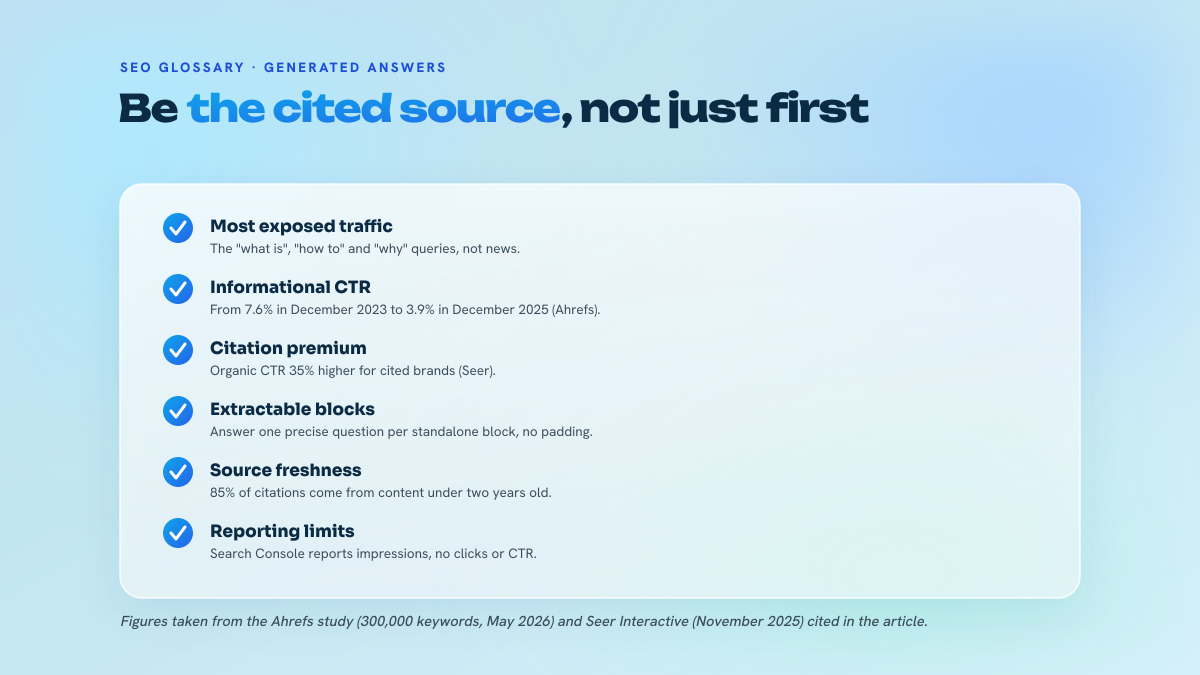
- →Informational evergreen queries are the class most exposed to answer summaries: Ahrefs measured position-one CTR on informational keywords falling from 7.6 % in December 2023 to 3.9 % in December 2025.
- →Ahrefs found in May 2026 that 85 % of AI Overview citations came from content published within the previous two years, which makes substantive refreshes a visibility lever, not housekeeping.
- →Point your acquired links at evergreen URLs. Equity aimed at a news post decays with the post; equity aimed at a durable guide keeps compounding for years.
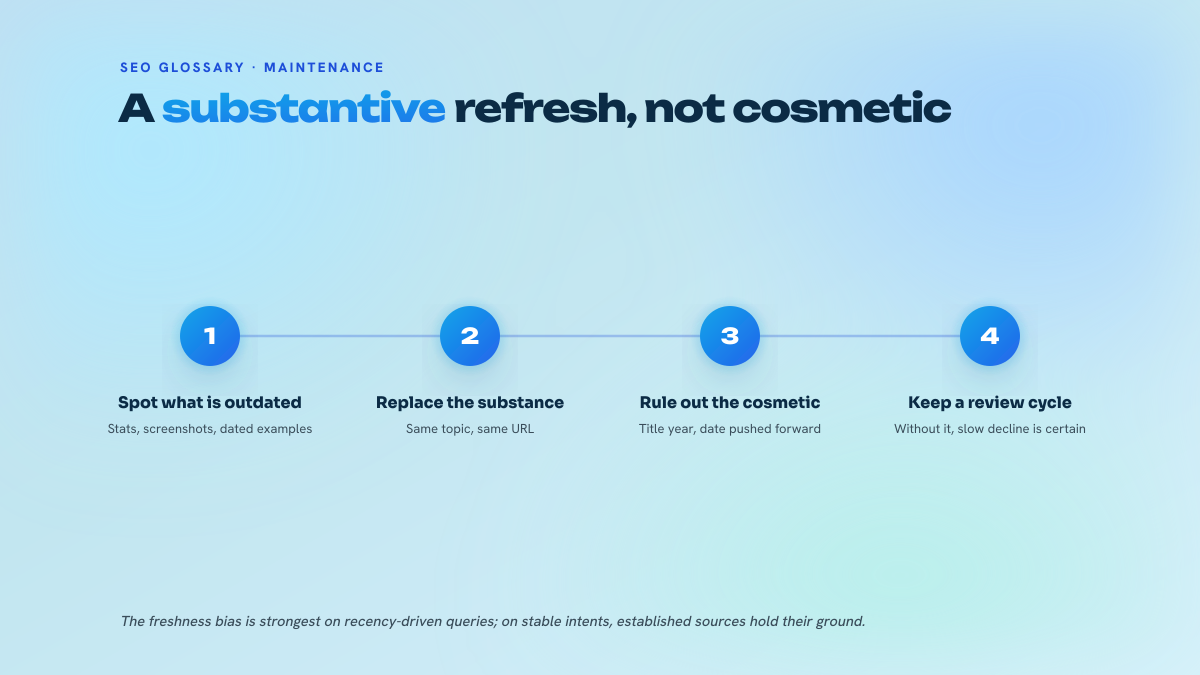
- →A real refresh replaces outdated statistics, screenshots and product claims. Changing the year in the title tag is cosmetic and everyone can see it.
- →Since FAQ rich results ended on 7 May 2026, evergreen FAQ blocks buy no SERP real estate. Keep them for answer extraction, drop them if they only existed for the markup.
What evergreen content really is
Take two pages published the same week in 2019: one on the Penguin rollout of that quarter, one on how anchor text distribution works. Seven years later the first one gets nothing, the second still pulls a few hundred sessions a month if somebody kept it honest. The difference is not that the second topic was « timeless ». It is that the underlying question survived, and that someone came back to it. Evergreen content is the intersection of a flat demand curve and an editorial commitment to maintain the page. Drop either half and you do not have an evergreen asset, you have dated content with a longer fuse.
Here is a short primer that covers the same ground visually if you want the two-minute version before the operational part.
The usual three-way split still holds up. Trending content buys impressions inside a window measured in days and then flatlines. Seasonal content returns on a predictable cycle and needs a pre-season refresh to catch the wave. Evergreen content accumulates: every month of indexation, every internal link, every earned citation adds to a base that does not reset. That accumulation is the whole business case, and it is also why the format attracts so much lazy production. Writing a definitional guide is easy. Owning it for six years is not.
In practice, four shapes carry most evergreen traffic: how-to guides, what-is definitions, comparison and review pages, and structured list posts. What they share is that the reader arrives without a date in mind. Nobody searches for a 2026 definition of a canonical tag, they search for the definition. That is the tell we use when qualifying a topic: if the query only makes sense with an implicit « right now », it is not evergreen, whatever the keyword tool says about volume.
The 2026 click math on evergreen queries
The economics changed and pretending otherwise is dishonest. An Ahrefs analysis updated on 28 May 2026, covering 300 000 keywords, found AI Overviews associated with a 58 % reduction in click-through rate for the top organic result by December 2025, with position-one CTR on informational keywords falling from 7.6 % in December 2023 to 3.9 % in December 2025. Informational is precisely the query class where evergreen content lives. Seer Interactive, working from 3 119 queries and 25.1 million organic impressions in November 2025, measured organic CTR of 0.61 % on queries showing an Overview versus 1.62 % on comparable queries without one.
Two caveats keep this from being a reason to stop. First, the same Seer dataset found that brands cited inside the Overview recorded 35 % higher organic CTR than non-cited brands, so the question is no longer only « do I rank » but « am I the source being paraphrased ». Second, Seer's 2026 follow-up reported a partial rebound, organic CTR on Overview-present queries rising from 1.3 % in December 2025 to 2.4 % in February 2026. The floor moved, it did not disappear. And the exposure is uneven: a separate Ahrefs study of 146 million SERPs put the overall AI Overview rate at 20.5 % in September 2025, with news-heavy queries less likely to trigger one, which is another way of saying stable informational topics absorb most of the impact.
The operational consequence is a reporting change, not a strategy change. Since 3 June 2026, Search Console ships dedicated Search Generative AI performance reports covering AI Overviews, AI Mode and generative features in Discover, broken down by page, country and device. They report impressions, not clicks or CTR, so any evergreen dashboard now needs a visibility layer sitting next to sessions. Google also published its first dedicated resource on optimizing for generative features on 15 May 2026, which settles the debate about whether this is a parallel discipline: it is treated as part of normal Search. One casualty worth noting is the FAQPage markup everyone bolted onto their guides, since FAQ rich results ended in Google Search on 7 May 2026. If your evergreen FAQ block existed only to win an expandable SERP treatment, delete it. If it answers real questions readers ask, keep it, it still feeds extraction.
Where evergreen content earns its keep in netlinking
This is the part most content guides skip, and it is where the money is. A link is a durable asset pointed at a target. If the target is a news post, the equity decays at the same rate as the post's relevance and you paid full price for a depreciating placement. If the target is an evergreen guide, the same link keeps feeding a URL that is still winning queries in three years. That single decision, choosing what you point at, does more for campaign ROI than any amount of metric shopping on the source side.
The numbers make the argument concrete. A 2025 survey of 518 SEO professionals reported an average acceptable price of $508.95 for a high-quality backlink, and a BuzzStream analysis of more than 26 000 guest-post sites estimated average direct placement cost at $364.76. At those levels, spending on a page that will be irrelevant in four months is not a tactic, it is waste. When we build an acquisition plan, target selection starts from the evergreen inventory and works backwards, which also makes budgeting legible: you can see what a placement actually costs against the lifespan of the page it feeds instead of averaging everything into a monthly retainer.
Evergreen content also changes what an editor will accept. Pitching a durable resource to a host publication is a different conversation from pitching a time-stamped announcement, because the host is also acquiring an asset that keeps working for their archive. That alignment is why placing a long-form piece with a real editorial angle converts better than a link insertion request on a random paragraph. Across the French editorial media we run in-house, the pages that accumulate the most inbound references are, without exception, the guides nobody has had to rewrite from scratch.
The other half of the equation is internal. Evergreen guides are the natural hubs of a topical structure, the pages that collect equity from satellite articles and redistribute it. Building recognised expertise on a subject area means having a stable centre for each theme, and a centre that gets rewritten every eighteen months is not stable. When we plan an acquisition campaign as a calibrated program run over several quarters, the evergreen map is the first artifact, before any prospecting.
Refresh discipline: the maintenance is the strategy
Publishing once and hoping is the single most common failure mode, and 2026 data makes it expensive. The Ahrefs May 2026 analysis reports that 85 % of AI Overview citations came from content published within the previous two years, and that AI-cited content was on average 25.7 % fresher than content ranking organically without being cited. The same analysis is careful to note that the freshness bias is strongest on queries implying recency, and that on stable informational queries established authoritative sources still perform. Read together: freshness is not a ranking hack, it is a tiebreaker that decides which of the qualified sources gets quoted.
What counts as a refresh is where teams cheat. Replacing the year in the title and bumping the modified date is cosmetic, and Google has had two decades to learn what that looks like. A substantive refresh means the outdated statistics are replaced with current ones, the screenshots match the current product interface, the examples reference things that still exist, and any claim contradicted since publication is corrected or removed. That work has a real cost in editorial hours, which is exactly why most content programs skip it and then wonder about the slow erosion of traffic on pages nobody touched.
Refresh on signal, not on a calendar. A quarterly sweep of Search Console impressions per URL, comparing symmetric windows, tells you which evergreen pages are sliding before the traffic drop becomes visible in sessions. That list is your queue. Blanket « update everything older than twelve months » policies burn the budget on pages that were fine and starve the three that were actually bleeding. And resist the urge to chase generated answers word by word: Ahrefs observed that AI Overview responses change roughly every two days while holding a semantic similarity of 0.95, so the wording churns while the substance does not. Own the substance.
Two more mistakes we see repeatedly in audits. Killing the old URL and republishing at a new slug, which throws away every link the page had accumulated, when an in-place rewrite would have kept them. And over-consolidating, merging four decent evergreen pages into one monster because a tool flagged keyword overlap, which reliably loses more than it gains when each page had its own referring domains. The broader context matters too: the August 2025 spam update rolled out over roughly 27 days and the December 2025 core update over 18, and neither came with tactic-specific recovery guidance. If an evergreen program is built on volume rather than substance, those are the events that find it.
Formats beyond the blog post: video and social
Most evergreen guides treat the concept as a blog problem. It is not. A tutorial video answering a durable question accumulates views for years on the same logic as a text guide, and it occupies a different slot in the results. Below, a short explainer on what makes a video evergreen rather than promotional.
The rule for video is the same as for text with one addition: avoid anything that timestamps the recording. No references to « last week's update », no interface walkthroughs of a tool that ships monthly redesigns unless you accept re-recording. A well-built explainer, embedded inside the matching text guide, also lifts the page: it gives a second format to a reader who bounced off the prose, and it gives you an asset to distribute where text does not travel.
Social is where the term gets abused. Evergreen on TikTok or a short-form feed does not mean a durable URL, it means a piece the recommendation system is willing to resurface months later because the hook still lands and the topic has no expiry. That is genuinely valuable for reach and for branded demand, and short-form is one of the few places where a two-year-old piece can suddenly find a new audience. But it accumulates nothing you own: no referring domains, no indexed page, no equity to redistribute. Treat social evergreen as distribution for the asset, never as the asset. The piece that lives on your site is what the rest of the operation can be built on.
Finding evergreen topics without chasing trends
Topic selection is a filtering problem and the filter is the trend line, not the volume number. Monthly search volume in Semrush or Ahrefs is an average across twelve months, so a keyword that spiked once and died reads identically to one that has been flat for four years. Pull the twenty-four month curve before committing: flat or gently rising is evergreen, sawtooth is seasonal, single-peak-then-decay is a trend you already missed. This practical walkthrough covers the tooling side.
Beyond the curve, three sources reliably surface durable topics. Definitional queries, the what-is and how-does-it-work family, which by construction do not expire. The question sets behind People Also Ask, which show the sub-questions a topic generates and therefore how much depth a single page can legitimately carry. And competitor archives filtered by age: a guide a competitor published four years ago and has kept updating is a proven evergreen topic with the validation already paid for. The gap between their coverage and yours is a work list, and mapping it properly is exactly what a structured comparison of coverage against the SERP is for.
Once selected, the practical thresholds we work with: a topic earns an evergreen slot if its curve has been stable for at least two years, if it supports enough depth to justify a page rather than a section, and if there is a named owner for the annual review. That last condition disqualifies more candidates than the first two combined, and it should. A program that ships forty evergreen guides with nobody assigned to maintain them will have forty decaying pages in three years. Twelve maintained ones outperform them, cost less, and are far easier to point acquired links at through a catalogue you can filter yourself before ordering.
Nautilinks operates an owned network of editorial media. In-house written articles, transparency disclosures respected, anchor mix calibrated.
Frequently asked questions
Are the four evergreen content types an official Google classification?
No, and it is worth killing that myth. Google has never published a taxonomy of evergreen formats. The four shapes people cite, how-to guides, definitions, list posts and reviews, come from marketing blogs observing what tends to hold up. They are a useful heuristic, nothing more. The real classifier is the demand curve: pull twenty-four months of trend data and let that decide, not a genre label someone attributed to Google.
How often should an evergreen page actually be refreshed?
On signal, not on schedule. Run a quarterly sweep of impressions per URL in Search Console over symmetric windows and refresh what is sliding. In practice most durable guides need one substantive pass a year, and pages covering fast-moving tooling need two. The Ahrefs May 2026 finding that 85 % of AI Overview citations came from content published in the previous two years suggests letting a page go three years untouched costs you citation eligibility, not just rankings.
Should I point paid links at evergreen pages or at new content?
Evergreen, almost always. Equity aimed at a time-stamped post depreciates with the post, while the same placement on a durable guide keeps compounding. With practitioner benchmarks around $508.95 for a quality backlink in a 2025 survey of 518 SEOs, the lifespan of the target is the main variable in campaign ROI. The exception is a genuine launch or study you want indexed fast, where you accept a short payback window on purpose.
Is evergreen content still worth producing given AI Overviews?
Yes, with a different scoreboard. Ahrefs measured a 58 % CTR reduction for the top result and Seer measured 0.61 % organic CTR on Overview-present queries versus 1.62 % without, so raw sessions per page are down on informational topics. But Seer also found cited brands recorded 35 % higher organic CTR than non-cited ones. The play is to be the source that gets quoted, and to report citations and branded demand alongside traffic rather than instead of it.
Does rewriting an evergreen page in place risk losing its rankings?
Far less than the alternative. Keeping the URL preserves every referring domain the page accumulated, while republishing at a new slug throws that away and pays for a redirect at best. Rewrite in place, keep the primary topic stable, and change the substance rather than the framing. The real risk is scope drift: if the rewrite quietly retargets a different query, you lose the accumulated relevance signals that made the page work.
What should I do with FAQ blocks now that FAQ rich results are gone?
Google ended FAQ rich results in Search on 7 May 2026, with Search Console reporting and Rich Results Test support removed in June 2026 and API support ending in August 2026. If a block existed purely to win the expandable SERP treatment, remove it, it is dead weight in the markup. If the questions are ones readers genuinely ask, keep them as clean on-page question and answer pairs: they remain one of the better structures for answer extraction.
Test your knowledge
Quiz: Evergreen content
1/3According to the Ahrefs analysis updated in May 2026, what share of AI Overview citations came from content published within the previous two years?