- →Google added the deprecation notice on 7 May 2026: FAQ rich results no longer render in Search for anyone, which finishes the August 2023 restriction to government and health sites.
- →The Schema.org type itself is untouched. Google still parses FAQPage as a page-understanding signal, it simply grants zero SERP real estate for it, so any business case built on snippet size is dead.
- →Google's 15 May 2026 generative AI guidance states plainly that structured data is not required for AI Overviews or AI Mode and that no Schema.org type unlocks them. Treat vendor claims of 3.2x inclusion or +44% citations as unmethodologised until someone publishes the test design.
- →A controlled analysis of 1,885 pages reported by Ahrefs found no citation lift in AI Mode or ChatGPT after adding schema, and a 4.6% decrease for AI Overviews. That is the only public number with a stated sample.
- →Rebuild your measurement before June 2026: the Search Console FAQ filter disappears that month and the API field in August, and connectors that filter on it return empty rather than erroring.
- →Keep the Q&A block where a real reader question exists, kill the templated five questions injected sitewide by a plugin. Coverage duplication is now the only thing a schema audit should be looking for.
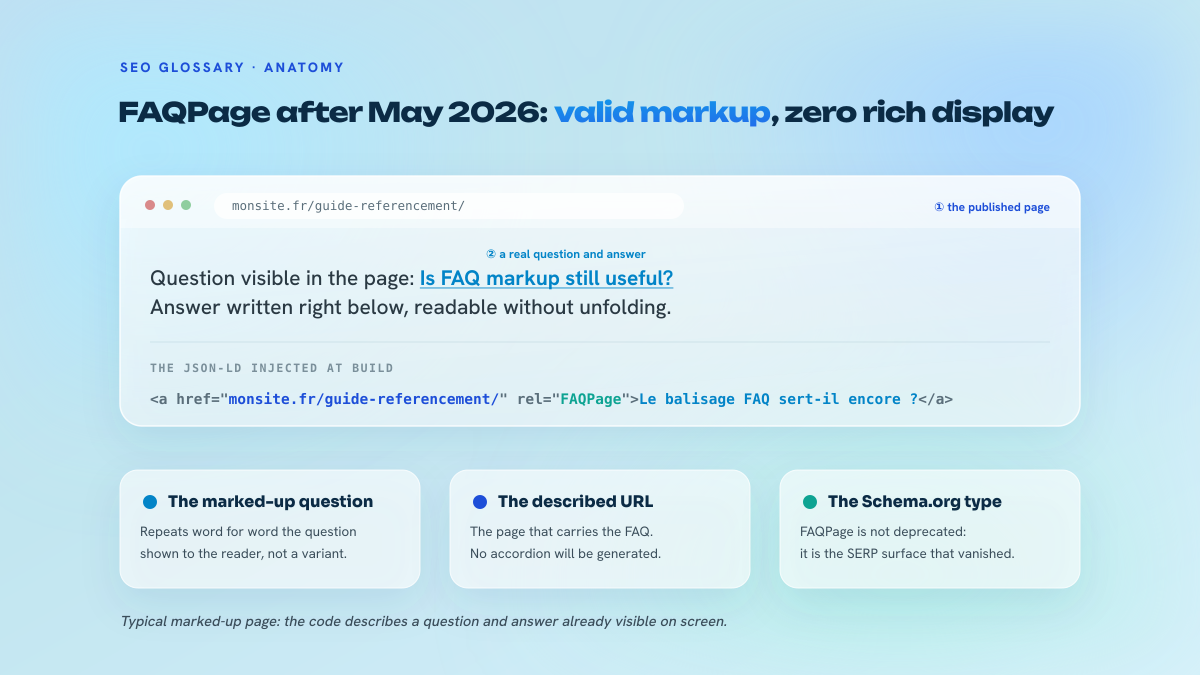
What FAQPage actually is, now that the rich result is gone
FAQPage is a Schema.org type that wraps a list of Question and Answer pairs written by the page publisher, usually serialized in JSON-LD in the head. The defining constraint has always been ownership of the answer: the publisher writes both sides. That is what separates it from QAPage, where a community answers, and it is the clause most implementations quietly break.
For years the type was traded as a click-through lever rather than a semantic one. You added the block, Google rendered an expandable accordion under your listing, your result took up far more vertical space than the competitor above you, and the CTR moved. Nobody implemented FAQPage because they wanted Google to understand their page better. They implemented it because it stole space.
That trade closed on 7 May 2026, when Google added a deprecation notice to its Search Central updates page stating that FAQ rich results would no longer appear in Google Search. It completed a process started in August 2023, when the feature was restricted to well-known authoritative government and health sites. The intermediate state lasted almost three years and produced an entire cohort of pages carrying markup that had not rendered anything since 2023, which nobody noticed because nobody was checking the impression counts by search appearance.
The distinction that matters here, and that most summaries got wrong in May, is between the vocabulary and the consumer. Schema.org did not deprecate FAQPage. Google deprecated its own display feature for it. Google's own wording is that FAQ structured data remains valid and may still help it understand page content, it simply no longer provides visible FAQ real estate. If you think of machine-readable annotation on a page as having two independent jobs, describing and decorating, FAQPage kept the first and lost the second.
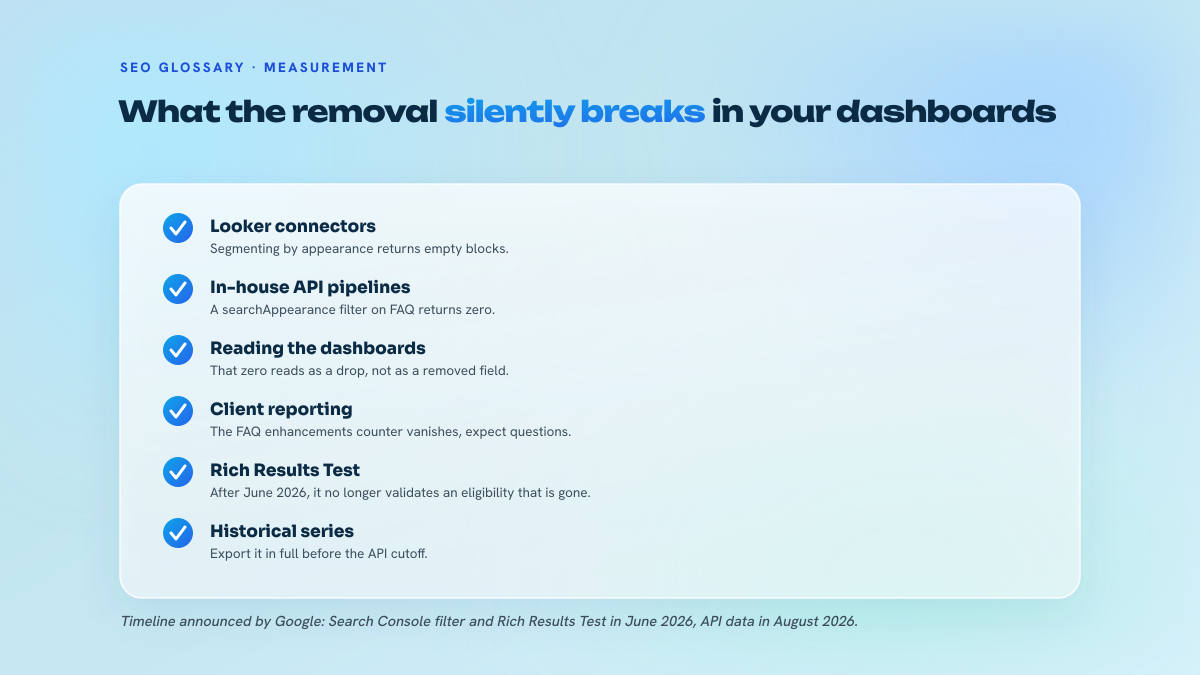
The deprecation timeline and what it breaks in your reporting
The removal is staged, and the second and third stages are the ones that will produce a broken slide in a client deck rather than a change in traffic. June 2026 is scheduled for the removal of the FAQ search appearance filter and report from Search Console, along with FAQ support in the Rich Results Test. August 2026 is scheduled for removal of FAQ rich result data from the Search Console API.
The API date is the one to put in a calendar. A Looker Studio connector or a custom pipeline that filters on the FAQ search appearance dimension does not throw an error when the dimension stops being populated. It returns zero rows, which renders as a clean flat line, which reads as a traffic collapse rather than a schema change. Anyone running year-over-year comparisons across August 2026 needs to export the historical series now and hard-code the cut in the dashboard, otherwise the first person to open that report in September will open an incident instead.
The Rich Results Test change deserves a second of thought too, because it retires the only validation most teams ever ran. Pasting a URL into that tool and getting a green FAQ block back was never really syntax validation, it was eligibility validation. After the June transition it will not answer the eligibility question at all, because there is no eligibility. Syntax checking moves to the Schema.org validator or a crawler, and the useful audit question changes shape entirely: not is this valid, but does the visible page actually contain the Q&A this JSON-LD block claims it contains.
The AI search argument, and why it does not hold
Within days of the May deprecation, the recovery narrative appeared: FAQ schema no longer wins snippets but it feeds AI Overviews and LLM answers, so keep shipping it. This is the part where a senior opinion is worth more than a balanced summary, so here it is. The claim is not supported, and the people making it have not published a methodology.
Google published Optimizing your website for generative AI features on Google Search on 15 May 2026, its first consolidated guidance for AI Overviews and AI Mode. The document says these features are grounded in Google's existing Search ranking and quality systems, that structured data is not required for generative AI visibility, and that there is no special Schema.org markup that unlocks AI Overviews or AI Mode. It also dismisses llms.txt and AI-only content chunks in the same breath. That is about as direct as Google gets on a question like this, and it landed eight days after the FAQ deprecation, which is not a coincidence.
The counter-evidence circulating in industry articles takes the form of figures like 3.2 times greater likelihood of AI Overview inclusion, 44% higher citation rates, or 22% citation lifts for pages carrying structured data. These are correlational or vendor-reported, and the sample design behind them is generally not published. Against them sits an Ahrefs-related analysis of a controlled test on 1,885 pages, which found no citation lift in AI Mode or ChatGPT after schema was added, and a 4.6% decrease for AI Overviews. One number with a stated sample beats three without.
None of which means the underlying demand shift is imaginary. Pew Research Center's analysis published 22 July 2025, covering roughly 68,879 Google searches from a panel of 900 US adults, found users clicked a result on 8% of visits when an AI summary appeared versus 15% when none did, with only about 1% clicking a link inside the summary. Ahrefs, using December 2025 data across 300,000 keywords, reported average position-one CTR on AI Overview triggering queries falling from 0.073% in December 2023 to 0.016% in December 2025, a 58% reduction. BrightEdge tracked AI Overviews rising from roughly 31% to 48% of monitored queries between February 2025 and February 2026, with Healthcare at 88% and B2B Technology at 82% in their February 2026 sample. The pressure on the generative answer layer is real and measurable. The markup is just not the remedy.
Where Q&A blocks still earn their place in a netlinking operation
Separate the content pattern from the annotation, and the picture gets useful again. A genuine question and answer section on an editorial page does several things that have nothing to do with a JSON-LD block: it covers secondary intents the main body skips, it gives an extraction surface written in the interrogative form that matches how people phrase things, and it creates two or three natural sentence positions where a contextual link fits without the anchor looking bolted on.
That last point is operational. On the French editorial media we run in-house, the Q&A section at the foot of an article is often where a link sits most comfortably, because a question is a legitimate reason to point somewhere else for the full answer. It reads as service rather than placement. Whether you are sourcing from a catalogue of media you can inspect before ordering or writing the host article yourself, the brief should ask for the questions to be real ones drawn from the topic, not five paraphrases of the target keyword.
Keeping the FAQPage annotation on top of that block costs nothing and remains defensible. Google says it may still help understand the page, other consumers of Schema.org exist, and removing valid markup describing visible content is busywork. What has changed is that it no longer justifies a project. Nobody should be scoping a sprint around FAQ schema rollout in 2026.
What we see go wrong in audits
The dominant failure by volume is the templated block. A plugin or a theme partial injects the same four questions into every page of a section, and a 400-page site ships 400 identical FAQPage objects. It was tolerated while the rich result existed because Google simply picked one. Now it is pure duplication in the annotation layer with zero upside, and it is the first thing to strip.
Second is markup describing content the reader cannot see. Questions and answers present in JSON-LD, absent from the rendered page, or hidden behind a tab that never expands. That was always a guidelines violation, it just stopped having a visible punishment, which makes it more likely to persist unnoticed.
Third is the FAQPage applied to pages that are not FAQs, typically product or category pages where someone wanted the accordion. Fourth, and this one is subtler, is questions written by scraping People Also Ask verbatim and answering each in forty words. It produces a block that reads like a machine talking to a machine, and after May 2026 there is no longer even a mechanical payoff for it.
Fifth is the reporting habit. Teams that tracked FAQ enhancement counts in Search Console as a quality KPI are tracking a number that stops existing in June. If that metric appears in a monthly report, replace it now rather than explaining a gap later.
What to do with your FAQPage markup this quarter
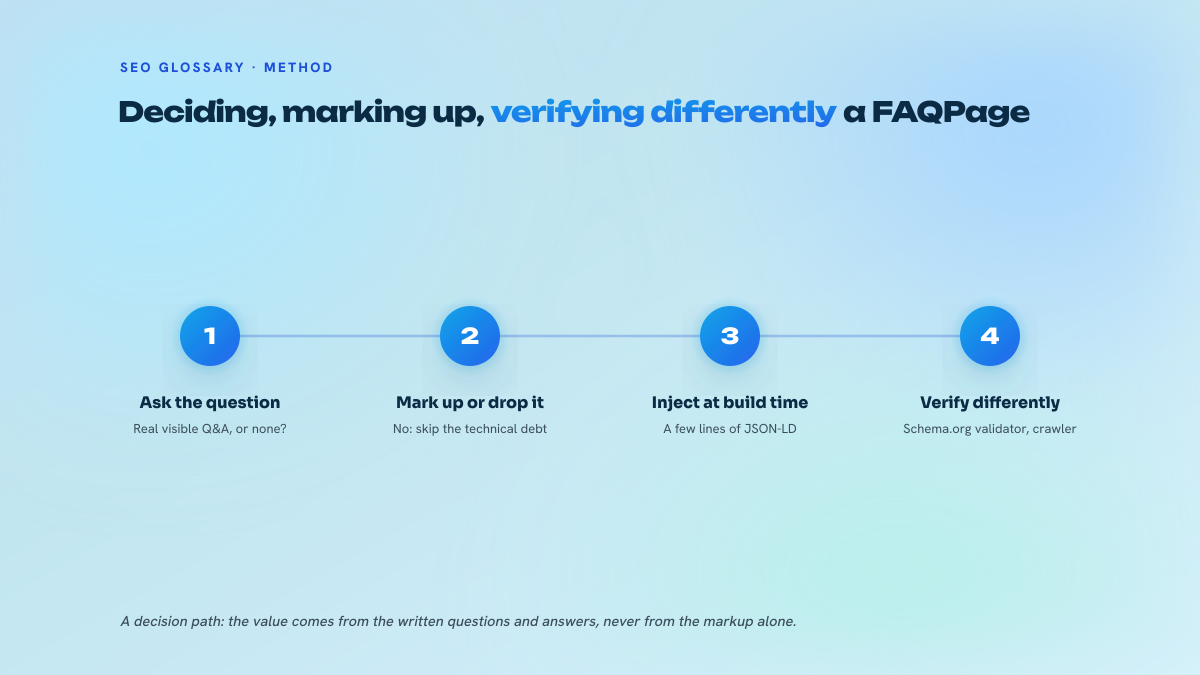
Run one crawl with structured data extraction enabled and answer three questions: how many URLs carry FAQPage, how many distinct question sets exist across them, and how many of those question sets appear on the visible page. Screaming Frog handles this, free up to 500 URLs and around £199 per year for the licence, and its relevance now is coverage and duplication QA rather than proving eligibility for anything.
Then act on the ratio. If distinct question sets are a small fraction of URLs carrying markup, you have a template problem and the fix is to stop injecting rather than to improve the questions. Keep the annotation where a human wrote the Q&A for that specific page. Export your historical FAQ appearance data before August, and re-point measurement at page-level organic CTR, AI Overview citation share and brand mentions, which are the metrics that actually moved.
What we would not do is spend a development sprint on schema refactoring in the name of AI visibility. The hour that was going into re-templating FAQ blocks buys considerably more when it goes into an editorial placement on a page that already ranks, and our rates for that are public and set per media, with no hidden commission. Markup describes what a page is. It has never made a page worth citing.
Nautilinks operates an owned network of editorial media. In-house written articles, transparency disclosures respected, anchor mix calibrated.
Frequently asked questions
Should we remove existing FAQPage markup after the May 2026 deprecation?
No, not where it describes real visible Q&A written by the publisher. Google states the structured data remains valid and may still help it understand the page, and stripping accurate markup is unpaid work. The one case for removal is duplication: identical question sets injected across dozens or hundreds of URLs by a template or plugin. That is annotation noise with no remaining upside, and it is worth a cleanup ticket.
Does FAQPage schema increase the chance of being cited in AI Overviews?
There is no published evidence that it does. Google's 15 May 2026 generative AI guidance says structured data is not required and that no Schema.org markup unlocks AI Overviews or AI Mode. The one test with a stated sample, an Ahrefs-related controlled analysis of 1,885 pages, found no lift in AI Mode or ChatGPT and a 4.6% decrease for AI Overviews. Vendor figures like 3.2x or +44% circulate without methodology.
What breaks in Search Console and when?
June 2026 is scheduled for removal of the FAQ search appearance filter and report in Search Console, plus FAQ support in the Rich Results Test. August 2026 is scheduled for removal of FAQ rich result data from the Search Console API. The API date is the dangerous one: connectors filtering on that dimension return empty rather than failing, so a dashboard shows a flat line that looks like a traffic collapse. Export the history before then.
FAQPage or QAPage for a page with user-submitted questions?
QAPage, and this is not a stylistic call. FAQPage requires the publisher to have written both the question and the answer. A page where a community answers, or where answers can be voted on, is QAPage territory. Using FAQPage there has always been a misdescription of the page, and Google's deprecation of the FAQ display does nothing to make it correct. If the page mixes both, model the section that fits and leave the rest unannotated.
Is a Q&A section still worth writing if the markup does nothing?
Yes, but for content reasons rather than schema reasons. A real question section covers secondary intents the body skipped, phrases the topic the way readers phrase it, and gives two or three natural positions for a contextual link that does not read as placement. Write the questions from the topic and from what readers actually ask, not by copying People Also Ask verbatim. The markup on top is a free extra, not the point.
Test your knowledge
Quiz: FAQPage schema
1/3What exactly did Google's 7 May 2026 notice change about FAQPage?