- →Decay only applies to pages with a real click history. Pages that never earned traffic have a publishing problem, not a decay problem, and mixing them into a decay audit wastes most of the audit.
- →Stable position with falling clicks is not decay in the classic sense, it is displacement. Seer Interactive measured a 61 % drop in organic CTR on informational queries carrying an AI Overview between June 2024 and September 2025. Rewriting the page does not recover those clicks.
- →Freshness is a tiebreaker, not a strategy. A 2026 synthesis of 15 ranking-factor studies puts content freshness at roughly 6 % weighting, behind relevance, backlinks and E-E-A-T. Changing a date without changing substance is measurable by nobody except your own team.
- →Half-life is a real planning number: 67 % of B2B blog posts lose at least half their organic traffic within 18 months (HubSpot Content Performance Study 2024, n = 50 000, compiled by Starr Conspiracy in 2025), with technical content decaying at a ~14-month median.
- →A link is worth what the host page is worth in eighteen months, not what it is worth on delivery day. Whether the publisher maintains its archive tells you more than its DR screenshot.
- →Never delete a decayed URL that carries referring domains. Redirect it into the page that absorbs its intent, and check the redirect target actually ranks before you fire it.
Decay is a relative loss, and that changes the fix
A page that decays rarely gets worse. It stays exactly as it was while the SERP around it moves: someone publishes a more complete resource, the dominant intent behind the query shifts, an update re-scores the whole result set, an AI panel answers the question above the fold. That is the entire mechanic, and it explains why the reflex of « rewriting the article » recovers so little. The document is not defective. Its position in a ranked list is a function of every other document on that list, and those changed while yours did not.
The first thing worth separating: decay is not the same thing as content that never worked. Plenty of published pages receive no organic traffic from Google at all. That is a publishing and demand problem, not a decay problem, and if you run a decay audit across an entire library you will burn most of the effort on pages that never had anything to lose. Segment on pages with a genuine click history first, then look at the slope. A library of 4 000 URLs usually yields 150 to 300 legitimate decay candidates, and the rest belongs in a different conversation about whether it should have been published.
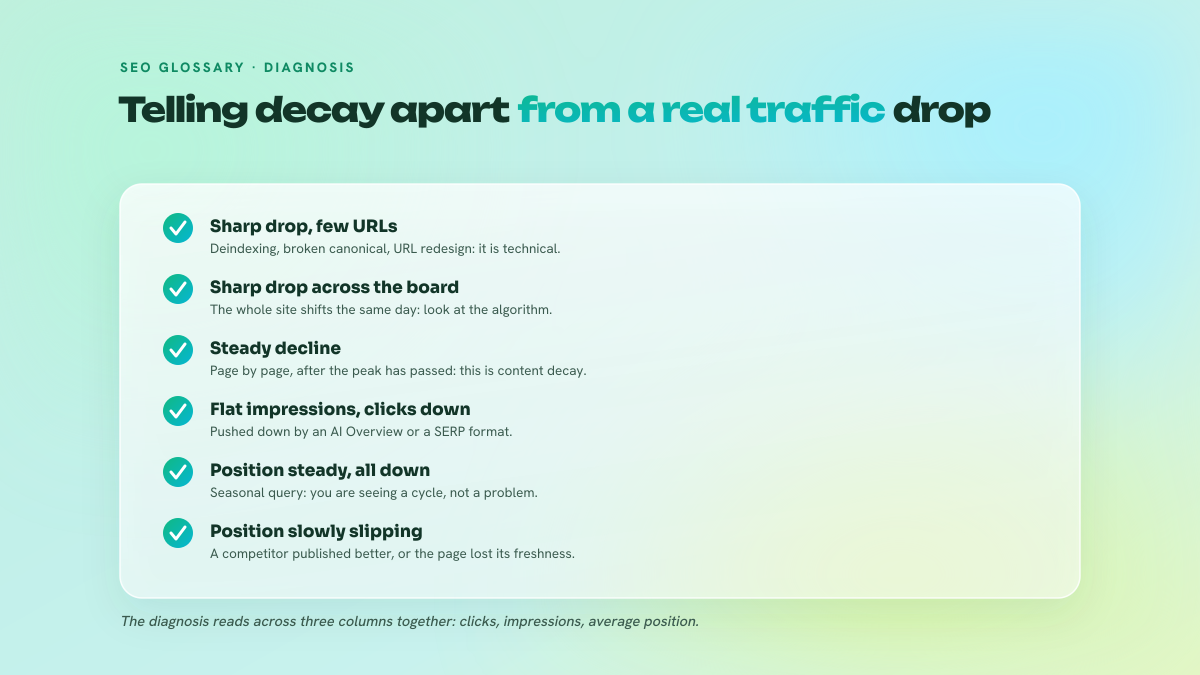
The slope matters more than the drop. A loss concentrated on a single date is an update, a technical event, or a SERP feature appearing. Decay is gradual and boring: a 2026 compilation of refresh studies puts the average rate at roughly 1.21 % of traffic lost per week, and reports that unmaintained decaying pages typically shed 20 to 30 % of their organic clicks over six months. Nobody sees that in a monthly report. Everybody sees it a year later, when a category is down by a third and no individual page looks guilty enough to explain it.
This is also why decay is a maintenance discipline rather than an editorial one. The question is never « is this article good ». It is « does this article still hold the position it earned against what is on the page today », which you answer by looking at the current top ten, not at your own draft.
What actually changed by 2026
Three shifts turned decay from a slow background tax into the dominant traffic story of the last two years, and only one of them is about content quality.
The first is displacement by AI answers. Semrush, analysing more than 10 million keywords, found AI Overviews on 6.49 % of queries in January 2025 and 13.14 % by March 2025, a 102 % relative increase in two months, with about 88.1 % of the triggering queries being informational. Informational is exactly where aging evergreen content lives. Seer Interactive, working from 25.1 million impressions, measured a 61 % fall in organic CTR on informational queries carrying an AI Overview between June 2024 and September 2025. Zero-click behaviour tracks the same curve: SparkToro and Datos put roughly 64 % of Google searches ending without a click, Bain and Dynata measured about 83 % when an AI Overview is present in December 2024, and Semrush reported about 93 % inside AI Mode in September 2025. The operational consequence is a failure mode that did not exist in 2020: your position holds, your impressions hold, and your clicks fall anyway.
The second is update cadence and violence. Google ran four core updates in 2024 and three in 2025. The March 2026 core update touched over half of monitored sites, with declines of 20 to 35 % common and some properties losing more than half the traffic on their strongest pages, at Semrush Sensor volatility of 9.4 to 9.5 out of 10. Every one of these events re-scores quality natively, and a page that was merely adequate does not survive three of them in a row.
The third is freshness itself, and here I would push back on the consensus. A 2026 synthesis of 15 ranking-factor studies ranks content freshness as the sixth Google ranking factor with an estimated 6 % weighting, behind relevance, backlinks, E-E-A-T, technical SEO and user engagement. The same source reports that updated posts see on average 106 % more organic traffic than non-updated ones, aggregating over 500 data points. Read those two numbers together rather than separately: 6 % weighting means freshness alone moves almost nothing, and the +106 % figure is heavily selection-biased because teams refresh the pages that still had something worth defending. The refresh works because of what was added, not because the date moved.
Intent drift deserves its own line because it is invisible in any content audit. The canonical example doing the rounds in 2026 guides is « LLM »: a query that meant Master of Laws and now means large language model. Nothing on the legacy page broke. The query simply stopped pointing at it. Checking the live SERP for your top queries once a quarter catches this. Reading your own article never does.
Measuring decay without fooling yourself
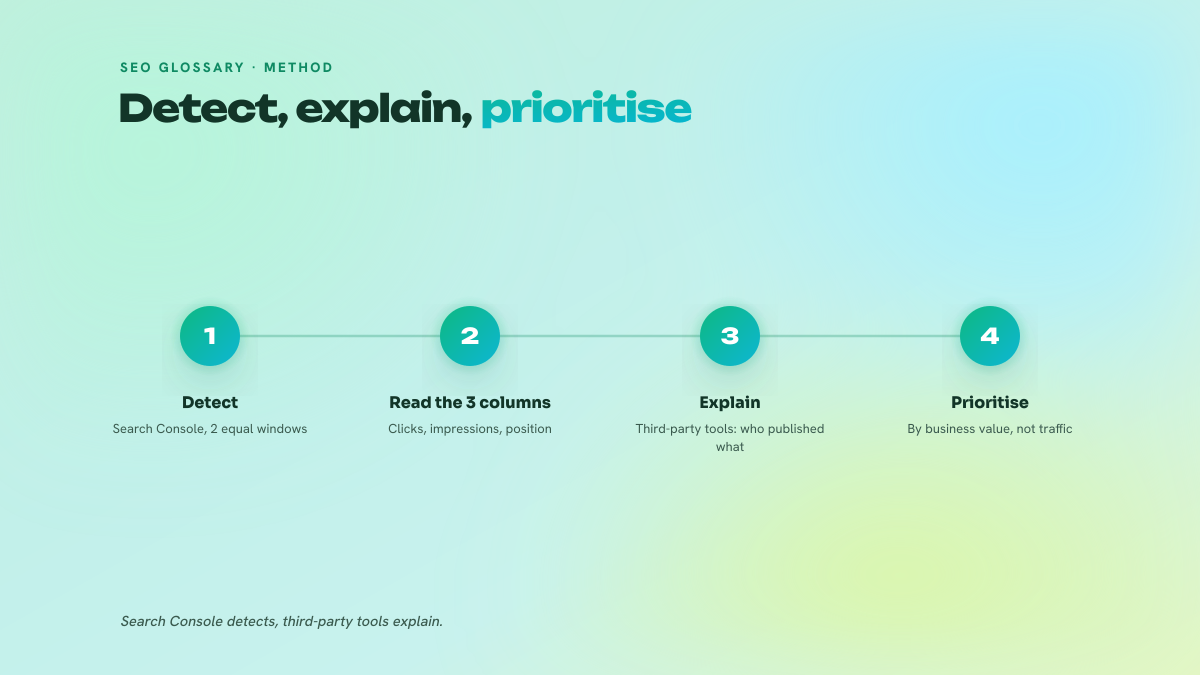
Search Console is enough for the diagnosis, provided you decompose rather than look at a single traffic line. Three signatures cover most of what you will find. Position stable, impressions stable, clicks down means displacement: a SERP feature, an AI Overview, or a competitor stealing the snippet. Position down with impressions down is a genuine competitive or quality loss and a real refresh candidate. Impressions up with position down and clicks flat means your query set is drifting toward adjacent, less qualified terms, which is usually a symptom of a page that has been broadened once too often.
The comparison window is where most audits go wrong. Compare 28 days against the same 28 days of the previous year, not against the previous month, otherwise seasonality writes your conclusions for you. Set a floor of around 100 clicks in the baseline period, below which the noise exceeds the signal. And run the analysis at cluster level rather than URL level, because consolidation, canonical shifts and internal cannibalisation move clicks between your own URLs without anything actually decaying. A page can look like it lost half its traffic when a sibling absorbed it, which is a reporting artefact, not a problem.
The competitor half of the diagnosis needs a rank tracker or a tool like Ahrefs or Semrush, because Search Console cannot tell you who took the position. What you want is the identity of the pages that gained on your losing queries and what they contain that you do not. That is a gap analysis on a query set you already own, which is far cheaper and more reliable than a gap analysis on keywords you have never ranked for.
One threshold we apply in practice: if a page has lost more than 40 % of its clicks year over year and still sits in the top twenty, it is worth real work, because the ceiling is provably reachable. Below position thirty, a refresh is usually a rewrite in disguise and should be budgeted as one.
Where decay hits a netlinking operation
This is the part the ranking guides skip. Decay is not only a content problem, it is a link-value problem on both sides of the transaction.
As a buyer, the article hosting your link decays like any other article on that site. The link itself does not disappear, and it keeps passing whatever it passes, but the document it lives on progressively loses impressions, loses internal prominence as newer content pushes it down the archive, and gets crawled less often. A placement bought on a page that will shed most of its visibility within eighteen months is a depreciating asset. The benchmark to hold in your head comes from the HubSpot Content Performance Study 2024, compiled by Starr Conspiracy in its 2025 B2B benchmarks: 67 % of B2B blog posts lose at least half their organic traffic within 18 months, with technical content decaying at a median of roughly 14 months and higher-level strategic content lasting around 24. Unless the publisher maintains its archive, the half-life of your placement is the half-life of their average post.
Which turns into a selection criterion nobody applies: before buying, look at whether the host still ranks with content it published two or three years ago. That single check separates a media property from a content dump far better than any authority score. It is also why placing an editorial piece that is still earning after its first quarter costs more to produce than a placement on an abandoned archive, and should. Across the owned French editorial media we run in-house, maintenance of the older archive is treated as part of the product rather than as an optional refresh project, because a link sold in January should still sit on a page that matters in December. If you want to judge that for yourself, the useful exercise is to open a catalogue you can filter without creating an account and check the publication dates of the pages that still hold traffic.
The publisher side has the mirror obligation. Decayed pages are also where internal link equity gets stranded: a hub that lost its rankings still distributes links, but it distributes them from a document search engines revisit rarely. Refreshing the pages that carry the most internal links out is usually higher leverage than refreshing the pages that lost the most traffic, and it is one of the few interventions that compounds across a whole cluster built to own a subject rather than helping one URL. When acquisition is planned quarter by quarter rather than in bursts, that maintenance rhythm and the link rhythm can be calibrated against the same content calendar, which is the only version of this that survives a core update.
What we see go wrong in decay audits
Date stamping without substance is the most common and the most useless. Changing the modified date, swapping « 2025 » for « 2026 » in the title and republishing moves a 6 % weighting factor by a fraction of itself. Dates are supposed to reflect real changes, and the practice mainly succeeds at destroying your ability to measure whether real refreshes work, because every page now looks recently updated.
Prioritising by absolute loss instead of by recoverable ceiling comes second. The page that lost 3 000 clicks from position 4 to position 9 is worth attacking. The page that lost 3 000 clicks because the query now triggers an AI Overview is not, at least not through a rewrite: that one needs a different query target or a format the answer panel cannot summarise, typically original data, tooling, or a transactional angle.
Pruning too aggressively is the expensive mistake. A page with zero clicks can still hold referring domains and sit on an internal path that matters. Deleting it converts an asset into a 404 and a lost signal. Redirect into the page that genuinely absorbs the intent, verify that target ranks before firing the redirect, and keep the mapping documented. Consolidation has the same trap in reverse: merging two pages that answer two distinct intents produces one page that answers neither, and the merged URL usually ends up below where the better of the two sat.
The blind spot almost everyone shares is non-editorial decay. Category pages, product pages and commercial landing pages decay too, and it is harder to see because branded and navigational queries prop up the aggregate while the non-branded head terms slide underneath. Split branded from non-branded in Search Console before concluding a commercial page is healthy. Finally, the audit that runs quarterly, produces a spreadsheet and generates no work order is not measurement, it is theatre. Attach a decision rule to each signature before you run it: refresh, retarget, consolidate, redirect, or leave alone. A decay report without a default action gets read once and archived.
Nautilinks operates an owned network of editorial media. In-house written articles, transparency disclosures respected, anchor mix calibrated.
Frequently asked questions
How fast should I expect decay, and what maintenance cadence does that imply?
Plan on halves, not on totals. The HubSpot Content Performance Study 2024 (n = 50 000, compiled by Starr Conspiracy in 2025) found 67 % of B2B posts lose at least half their organic traffic within 18 months, with technical content at a ~14-month median and strategic frameworks closer to 24. That maps to a 12 to 18 month review cycle for most evergreen content and 6 to 12 months for anything touching tools, versions, prices or regulation. Set the cadence per content type, not per site.
My rankings held but clicks fell. Is that content decay?
It is decay in outcome, not in cause, and the distinction dictates the fix. Seer Interactive measured a 61 % drop in organic CTR on informational queries carrying an AI Overview between June 2024 and September 2025 across 25.1 million impressions. If position and impressions are flat while clicks fall, you are being displaced above the fold. Rewriting deeper will not recover the click. Changing the target toward queries an answer panel cannot resolve in three sentences might.
Is decay reversible, or is a rewrite the only real option?
Reversible when the ceiling is still reachable. Our working threshold: a page still in the top twenty that lost more than 40 % of its clicks year over year is worth a substantive update, because the position proves the URL still has standing. Below position thirty, you are not refreshing, you are rewriting, and it should be budgeted and scheduled as new production. The 106 % average lift reported for updated posts in 2026 syntheses comes overwhelmingly from the first category.
Do product and landing pages decay the same way blog posts do?
They decay just as much and get caught later. Branded and navigational traffic masks the slide in aggregate reporting, so the page looks stable while its non-branded head terms fall out of the top ten. Split branded from non-branded queries in Search Console before assessing any commercial page. The causes differ too: for transactional pages, decay usually comes from competitors adding comparison depth, pricing transparency or review volume rather than from stale facts.
Should I update in place or republish at a new URL?
In place, essentially always. The URL carries its backlinks, its internal links, its history and whatever crawl priority it accumulated. Republishing at a new address restarts all of it and adds a redirect hop for no benefit. Change the URL only when the slug contradicts the new intent badly enough to matter, and then redirect the old one and expect a recovery period of several weeks. Keep the publication date, update the modified date, and only if the body genuinely changed.
How do core updates interact with decay, and should I wait one out before acting?
Core updates do not create decay, they reveal and accelerate it by re-scoring a list that has been drifting for months. Google ran four in 2024, three in 2025, and the March 2026 update moved rankings on over half of monitored sites, with 20 to 35 % declines common. Do not wait: work started during a rollout usually gets credited at the next re-scoring, and pages that are already competitive when an update lands are the ones that gain rather than absorb the redistribution.
Test your knowledge
Quiz: Content decay
1/3A page keeps its position and its impressions in Search Console but loses a third of its clicks over a year. What is the most likely cause?