- →SOSEO measures distance to the lexical centre of the current top pages, DSEO measures how far past it you have gone. The second score is the one that protects you, and it is the one most writers never look at.
- →The guide describes what ranks, not why it ranks. On a query where thin affiliate pages occupy the top ten, the guide faithfully reproduces thin affiliate vocabulary.
- →Semantic optimisation has no effect on a page with no incoming links: the tool moves you inside your authority bracket, it does not move the bracket.
- →The internal linking and semantic cocoon features are the underrated half of the product. A cocoon calculation needs at least three guides in the same group (Notuxedo product review, October 2025).
- →The LLM SEO module scores E-E-A-T signals out of 20, which is a proxy for citability, not a measurement of it. Google stated on 21 May 2025 that AI features require no technical eligibility beyond normal indexing.
- →For an agency, the arbitrage is tokens versus subscription: token packs carry no AI tokens, no team functions and no monitoring, so they only make sense for occasional one-off guides.
What a YourText.Guru guide actually contains
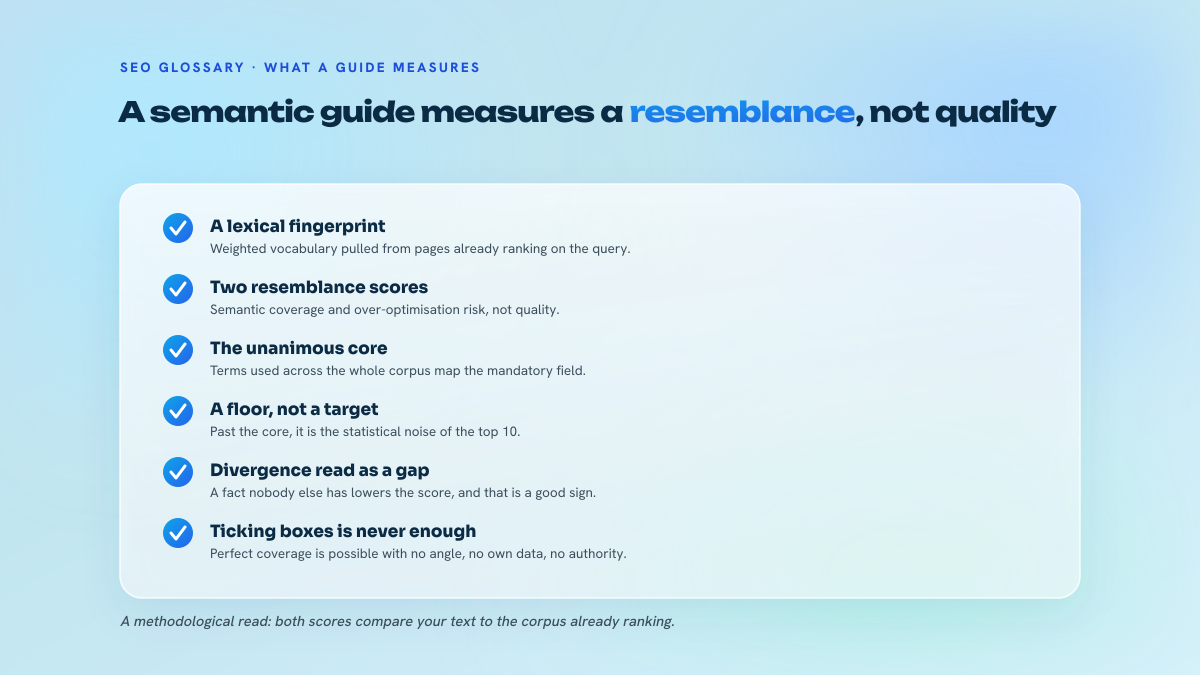
Type a query into the tool and it assembles a corpus from the pages currently ranking on that query, then extracts the vocabulary those pages share: single tokens, bigrams, trigrams, named entities, and a weighting that separates the terms structural to the topic from the ones that are simply frequent. What comes back is called a guide, and a guide is three things at once: a weighted term list, a recommended text length, and a pair of scores that track your draft while you write. SOSEO tells you how close your text sits to the semantic centre of that corpus. DSEO tells you how far past that centre you have pushed, into territory that reads as over-optimisation. The second number is the useful one, and it is the one nobody looks at.
That corpus logic explains both the strength of the tool and its ceiling. YourText.Guru does not know what Google ranks by. It knows what the pages Google currently ranks happen to have in common, lexically. Those are two very different statements, and conflating them is the single most expensive mistake made with this category of tool. When the top ten on a query is a stack of thin affiliate pages, the guide faithfully describes a stack of thin affiliate pages, and hitting it perfectly makes you the eleventh one.
On the French market, the tool occupies the slot that Clearscope and Surfer occupy in English, and our stance after years of running all three is that on French corpora YourText.Guru is the more honest of the set: its n-gram extraction handles French morphology properly, and the DSEO counterweight is a real editorial guardrail rather than a decorative gauge. What it does not do, and does not claim to do, is tell you whether the query is winnable for your domain. That judgement stays with you, and it is mostly a question of links, not of vocabulary. The tool belongs in the same mental drawer as a structured approach to semantic optimisation: it makes the writing measurable, it does not make the page authoritative.
How the tool works in 2026: guides, tokens, LLM SEO
The product has widened well beyond the writing guide. A detailed product review published by Notuxedo in October 2025 documents keyword exploration, content gap analysis against up to six competitors, cannibalisation checks across up to ten queries, semantic cocoon construction, internal PageRank calculation, detection of important 404 URLs that still receive backlinks, duplication detection, SERP monitoring and backlink evaluation. The same review notes that a semantic cocoon calculation requires at least three guides in the same group, which is a small detail with large planning consequences: you cannot cocoon a two-page cluster, so the tool implicitly pushes you toward a minimum viable topical block.
The commercial model runs on two rails. According to the same October 2025 review, subscriptions ranged from Lite at 99 € per month, with 50 guides, 25 000 AI tokens, two members and 50 monitored queries, up to Agency at 799 € per month, while API access was documented at 400 € per month for four guides per minute, 500 € for six, and 850 € for ten. Occasional users can buy token packs instead, reported at 70 € excluding tax for 100 tokens with a guide costing five tokens, valid one year but excluding AI tokens, team functions and monitoring. Those are secondary-source figures, so check the vendor pricing page before you build a budget on them. The arbitrage is simple enough: below roughly ten guides a month, packs win; above that, or as soon as you need monitoring and several seats, the subscription wins, and at agency volume the API is the only sane route because it lets the guide call sit inside your production pipeline rather than inside a browser tab.
The genuinely new piece is the LLM SEO module added during 2025, which scores a page out of 20 on how likely it is to be understood and cited by systems such as ChatGPT or Perplexity, with an E-E-A-T oriented diagnosis and recommendations on missing evidence, structure, expertise and trust signals. Treat that score for what it is: a proxy built on plausible criteria, not a measurement of actual citations. Google was explicit on 21 May 2025 that the same fundamentals apply to AI Overviews and AI Mode as to classic Search, with no additional technical eligibility requirement beyond being indexed and eligible for a normal snippet. And since the documentation update of 10 December 2025, AI Overviews and AI Mode traffic is folded into the Web performance data of the Search Console performance report, which means you can measure the effect of a rewrite there instead of trusting a score out of 20.
Where it earns its seat in a netlinking operation
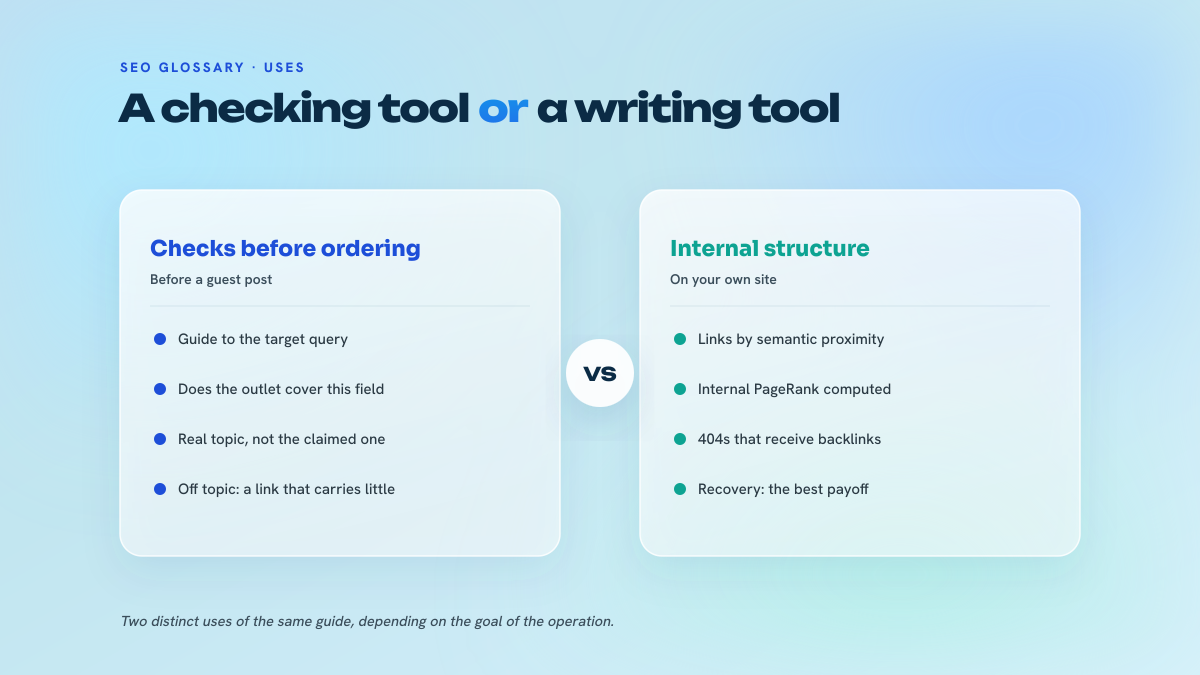
The obvious use, optimising a client money page before pointing links at it, is the least interesting one. The valuable use sits on the other side of the link: on the host article. A sponsored article only transmits anything if the host page is itself understood, indexed and preferably ranking on something. A guest post written blind, without any corpus check, lands in a thematic no-man's-land where it picks up no queries of its own and therefore passes a weak, purely positional signal. Run a guide on the host article before publication and you get a page that ranks on its own long tail, which is what makes the link worth its price two years later. That is the discipline behind every text published across the French editorial media we own and run in-house, and you can see how that stock is organised on the page describing the media we operate ourselves.
The second high-value use is architectural rather than editorial. Internal PageRank calculation and semantic similarity based link recommendations turn the way pages link to each other inside a site from an intuition into a computed decision, and on a 300-page site that is worth more than any single external link you will buy that quarter. The broken link recovery report matters for the same reason: a 404 URL that still receives backlinks is dead equity, and recovering it costs one redirect. Before spending on external acquisition, close those two gaps, then go shopping. When you do go shopping, the useful comparison is between a page that already sits inside a coherent semantic block and one that does not, because the first converts link equity into positions and the second absorbs it. If you want to see what a placement costs before deciding how much of the budget goes to content and how much to acquisition, our grid is published openly with no hidden commission.
What we see go wrong in audits
Chasing a maximal SOSEO is the classic failure. Past a certain point the writer stops writing for a reader and starts feeding a gauge, the DSEO climbs, and the page reads like an inventory. Our operating rule is a comfortable SOSEO with a DSEO kept low, and a text that a peer would actually finish reading. If you have to choose between the two scores, protect the DSEO.
The second failure is running the guide on the wrong query. A guide is generated against one query and its corpus. Optimise a page against a guide built on a query the page is not the best answer to, and you have merely made it a better version of somebody else's page. Cannibalisation checks exist precisely because two pages of the same site optimised on adjacent guides end up competing, and the tool will show you that overlap if you ask it.
The third, and the one that wastes the most money, is expecting semantics to substitute for authority. We audit sites every month where every article scores beautifully and nothing ranks, for the simple reason that the domain has almost no distinct domains linking to it. Optimisation moves you inside your authority bracket. It does not move the bracket. On a query where the incumbents each hold hundreds of referring domains, a perfect guide changes nothing, and the honest conclusion is either to pick a longer-tail query or to fund acquisition. The media stock available on a catalogue you can browse before creating an account exists for that second branch.
Two smaller ones worth naming. The recommended length is a corpus median, not an objective: on a query where the top pages are 3 000 words of padding, writing 1 200 dense words is the better trade. And regenerating every guide after each core update is superstition unless the SERP composition actually changed. The December 2025 core update rolled out over more than 18 days according to Search Engine Land, so a corpus sampled mid-rollout describes a SERP that no longer exists. Wait for the confirmed end of the rollout, then re-sample only the queries whose top ten actually moved.
Working rules for the tool
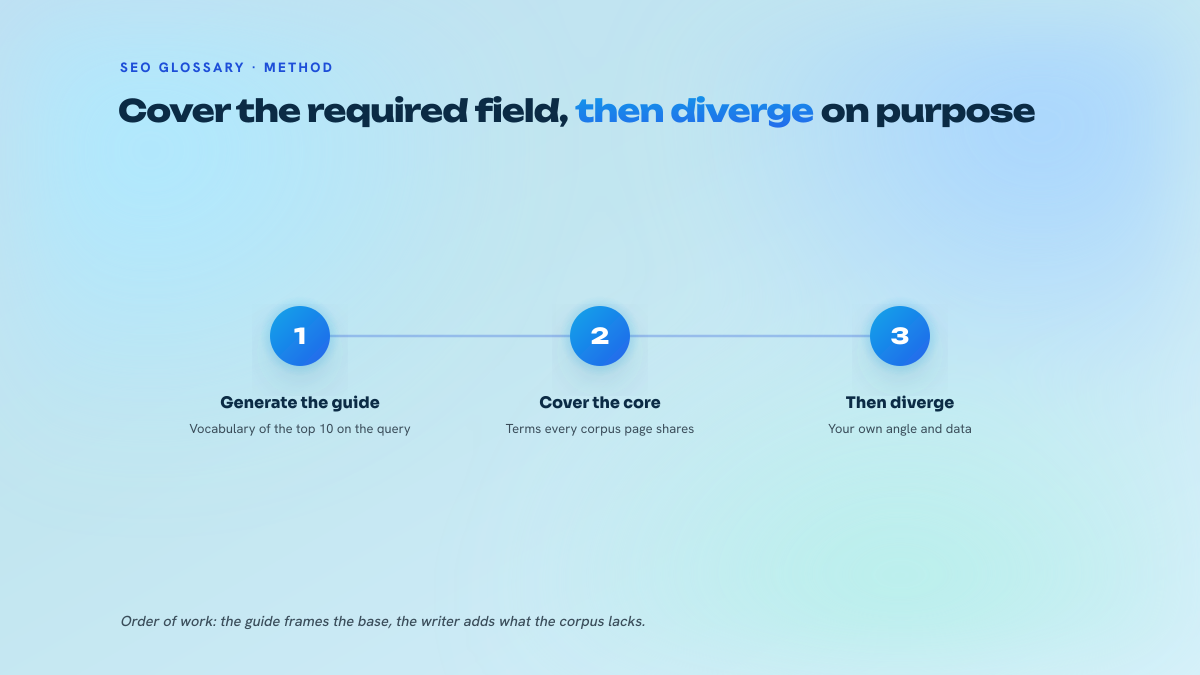
Generate the guide before the outline, not after the draft. Retrofitting vocabulary into finished prose is how DSEO climbs and how texts start to read as machine-assembled. The guide should shape the plan, then disappear from view while the writing happens, then come back for a single verification pass.
Use the AI generation features to produce briefs, not text. The generation module runs on your own OpenAI key, which tells you exactly what it is: a wrapper around a general model, fed a term list. A term list is not knowledge, and a text produced from one carries the vocabulary of the topic without carrying a single verifiable fact. Sourced facts are what earn citations in generative answers, and the Pew Research Center analysis published in July 2025 is the reason that matters commercially: when an AI summary appeared, users clicked a traditional result in only 8 % of visits, against 15 % without a summary, and links inside the summary were clicked in 1 % of visits. The click is being taxed, so the page that gets cited by name is the one that carries evidence.
Finally, keep one query out of the tool per project as a control. Write it the way you would have written it before, publish it in the same batch, and compare the two curves in Search Console 90 days later. Tool vendors never tell you what their tool is not doing for you. A control page does, and it costs one article.
Nautilinks operates an owned network of editorial media. In-house written articles, transparency disclosures respected, anchor mix calibrated.
Frequently asked questions
What SOSEO and DSEO values should I actually target?
There is no published threshold, and any figure quoted as universal is invented. Our working rule from audits: aim for a SOSEO comfortably in the guide's green zone and treat the DSEO as the binding constraint, keeping it low even if that means leaving SOSEO points on the table. A text with a moderate SOSEO and a clean DSEO outperforms a saturated one, because the saturated version usually reads badly and loses on engagement what it gained on vocabulary.
Does hitting the guide make a page rank?
No. The guide describes the lexical profile of pages already ranking, which is a consequence of their position as much as a cause. Optimisation reliably moves a page inside the bracket its link profile allows. It does not move the bracket. If the incumbents hold several hundred referring domains and you hold twelve, the vocabulary is not what is stopping you, and no semantic tool will tell you that.
YourText.Guru or Surfer and Clearscope for a French site?
For French corpora, YourText.Guru. Its n-gram extraction handles French morphology properly, the SERP samples are French rather than translated, and the DSEO counterweight has no equivalent in the English tools, which optimise upward without a stated ceiling. For English-language projects the picture reverses and Clearscope's corpus is the cleaner one. Running both on a bilingual site is defensible; running both on a single-language site is paying twice for the same n-grams.
Tokens or subscription for an agency workflow?
Token packs, reported by Notuxedo in October 2025 at 70 € excluding tax for 100 tokens with a guide costing five, exclude AI tokens, team functions and monitoring. That makes them a tool for occasional one-off guides, not for production. Past roughly ten guides a month, or the moment two people need access, the subscription is cheaper and functionally different. At real agency volume the API tiers, documented from 400 € per month, are the only version that fits inside an automated pipeline.
Is the LLM SEO score a reliable predictor of AI citations?
It is a proxy, built on E-E-A-T style criteria such as evidence, structure and trust signals, scored out of 20. Nobody outside the model providers can measure citation probability directly. Google stated on 21 May 2025 that AI Overviews and AI Mode require no technical eligibility beyond normal indexing and snippet eligibility, so treat the score as a checklist for missing evidence rather than a forecast. Since 10 December 2025, actual AI feature traffic appears in the Search Console Web performance data, which is the measurement that counts.
Should I re-run guides after every core update?
Only where the SERP composition actually changed. A guide is a snapshot of the current top pages, so it goes stale when those pages change, not when Google announces something. The December 2025 core update took more than 18 days to roll out according to Search Engine Land, and a corpus sampled during a rollout describes a SERP in motion. Wait for the confirmed completion, check which of your target queries have a materially different top ten, and re-sample only those.
Test your knowledge
Quiz: Yourtext.guru
1/3What does the DSEO score of a YourText.Guru guide indicate?