- →rel=ugc describes the origin of a link, not its quality: it says a user placed it, and nothing about whether the destination deserves equity.
- →Google's Search Central guidance, refreshed on 10 December 2025, allows combined values such as ugc plus nofollow, and treats all of them as hints, not as crawl directives.
- →John Mueller stated on 18 January 2026 that spam links dropped in comments have no effect, positive or negative, which kills most of the case for mass disavow work on comment noise.
- →Adoption stays marginal: Ahrefs statistics published on 2 June 2026 report that only 0.44 % of referring domains to the top 110,000 sites use rel=ugc, against 10.6 % of backlinks carrying nofollow.
- →Paid placement inside user-generated content is a sponsored link first: labelling it ugc because the form field sits in a forum is the exact misuse Google's spam systems look for.
- →The strategic value of UGC environments in 2026 is entity visibility and referral, not PageRank: community citations feed AI surfaces even when the attribute blocks equity.
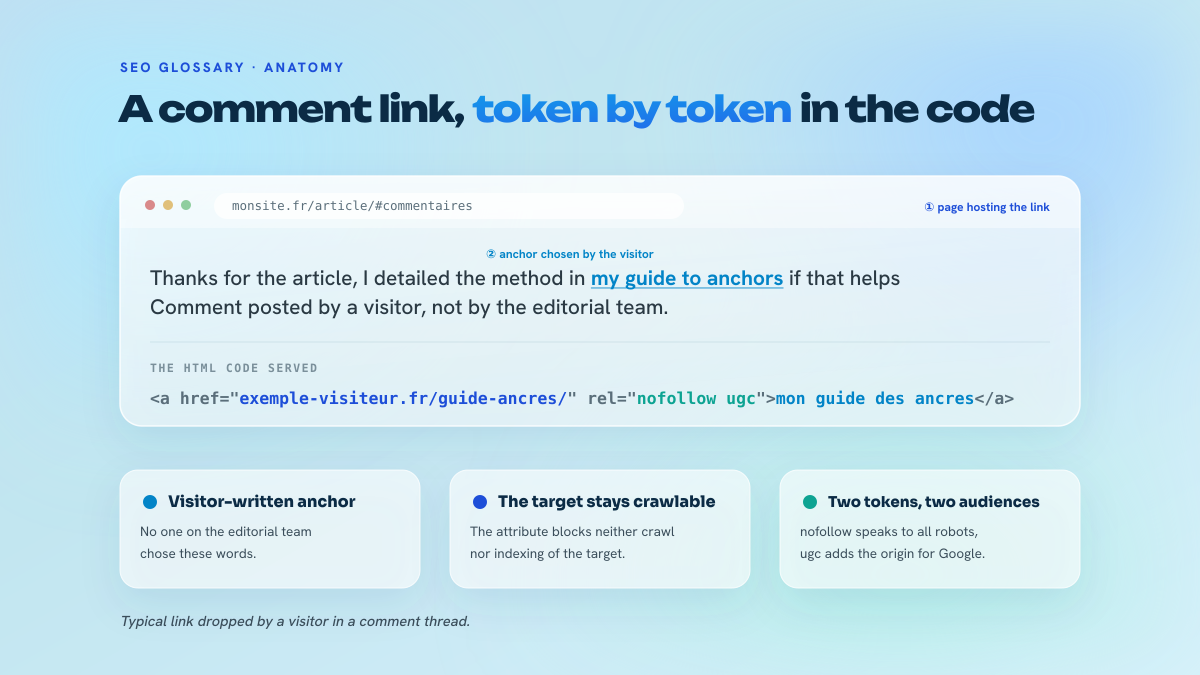
What the attribute actually declares
The rel attribute on an outbound link has one job: describe the relationship between the host page and the destination. When Google split the old binary model and shipped rel=sponsored and rel=ugc alongside nofollow, the point was not to give publishers three ways to say no. It was to let a site tell search engines why a given link exists. rel=ugc means the link was placed by someone other than the editorial team: a commenter, a forum member, a reviewer, a profile owner, anyone posting into a field the site opened to the public.
That distinction matters because the two sides of a link have different interests. For the publisher, an unqualified outbound link in a comments section is an endorsement they never made and cannot vouch for. For the search engine, a page that accumulates thousands of user-placed links is structurally different from a page whose links were chosen one by one. The attribute lets robots read that difference without guessing from the DOM position.
What rel=ugc does not do is grade the destination. A link to a reference paper posted by a knowledgeable member and a link to a pill store dropped by a bot get the same tag if they land in the same comment field. The attribute is metadata about provenance, not a quality score, and reading it as a penalty marker is the first misunderstanding to clear. A link placed inside editorial prose and a link in a forum signature can point at the same URL with the same anchor and still be treated as two completely different objects.
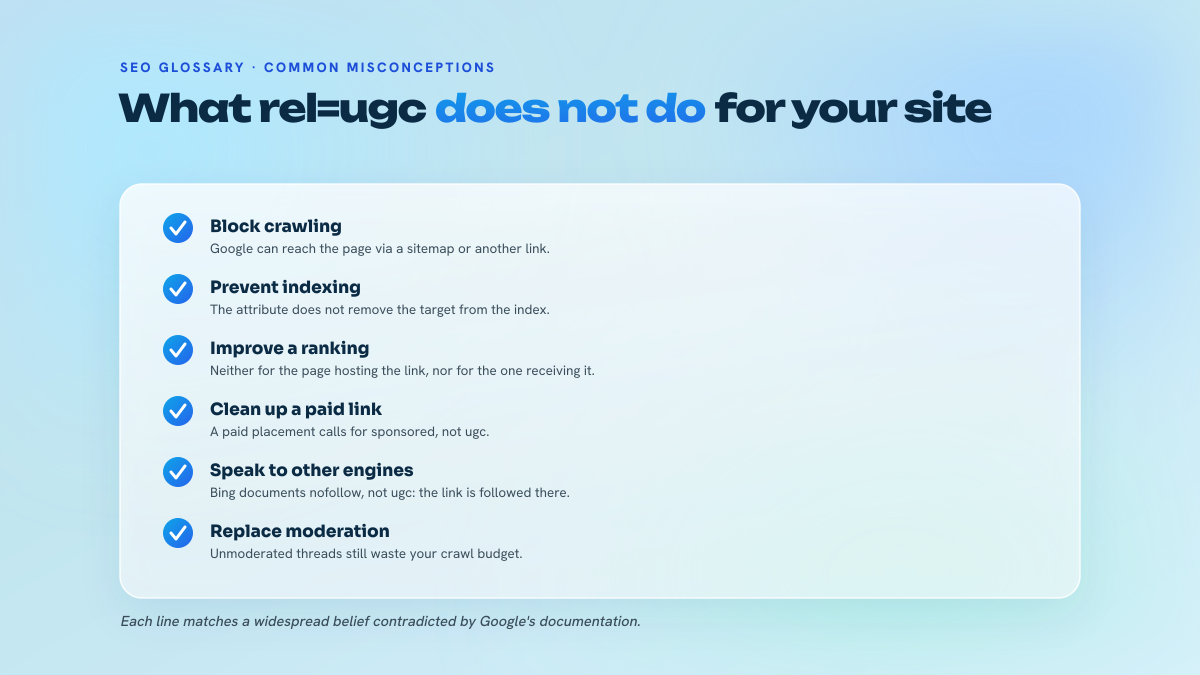
How Google handles it in 2026
Google's Search Central documentation on qualifying outbound links, refreshed on 10 December 2025, still recommends rel=ugc for links in user-generated content and still allows multiple values on the same link, for example ugc combined with nofollow. Three operational details in that guidance are worth reading closely, because they contradict what most tutorials say.
First, these values are hints. Links carrying them will generally not be followed, but Google may still discover the destination through a sitemap or another link elsewhere on the web. The attribute is not the same class of instruction as robots.txt or a noindex tag: it does not block anything, it informs a ranking system that then decides. Second, publishers are explicitly allowed to remove the ugc value from links posted by consistently trustworthy contributors, which tells you Google models the attribute as an editorial judgement about a person, not a mechanical rule about a template. Third, paid placements must carry sponsored, not merely ugc, even when the paid link sits in a user-facing area.
The most useful clarification of the past year came on 18 January 2026, when Google Search Advocate John Mueller said that links dropped by spammers into comments have no effect at all, neither positive nor negative, because Google's systems simply ignore them. That statement should end two habits at once. It ends the residual belief that comment link building produces anything, and it ends the ritual of exporting thousands of junk comment domains into a disavow file every quarter. Neither activity moves rankings. Moderation still matters, but for user experience, trust, crawl efficiency and brand safety, not for algorithmic protection.
Nothing in the 2026 update cycle changed the attribute's status. The May 2026 core update ran from 21 May to 2 June, and the June 2026 spam update from 24 to 26 June, global and all-language, neither announced as touching link attributes. The practical reading is that the correct attribute describes a relationship, it does not sanitise a campaign that was manipulative to begin with.
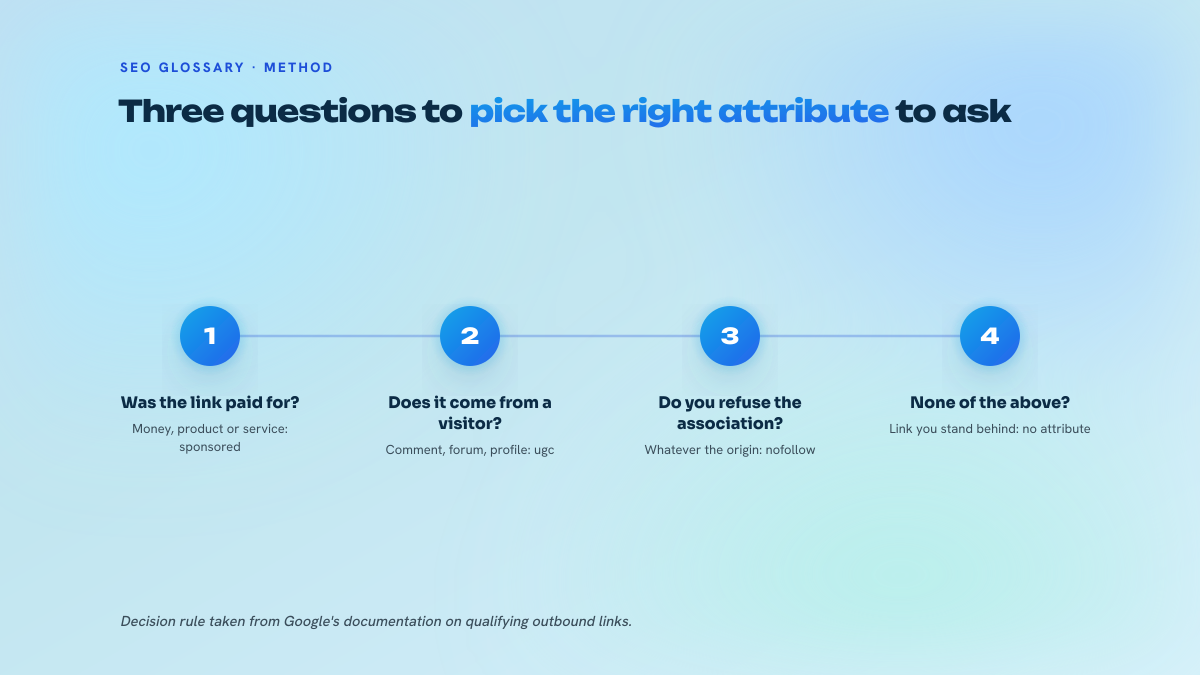
ugc, nofollow, sponsored: choosing the right one
Most published comparisons of the three values stop at a definition line each. The decision rule that actually matters is about precedence: when two descriptions are true at once, money wins. A paid link posted through a public form is sponsored, and the fact that a user typed it is secondary. When in doubt about a destination you would rather not be associated with at all, the older nofollow value remains the fallback Google names in its own documentation.
| Value | What it declares | Typical placement | Equity |
|---|---|---|---|
| rel=ugc | A user placed this link, not the editorial team | Comments, forums, reviews, member profiles, community answers | Not passed in normal cases |
| rel=sponsored | Money or compensation is behind this placement | Advertising, affiliate links, articles commissioned on a host media | Not passed |
| rel=nofollow | No endorsement, and no association wanted | Anything the publisher will not vouch for, plus legacy implementations | Not passed |
| no attribute | Editorial endorsement, chosen by the site | Body copy, curated resources | Passed |
Combining values is legitimate and, on high-volume community platforms, sensible: ugc plus nofollow states both the origin and the absence of endorsement, and costs nothing. Where teams get it wrong is at the other end, applying a blanket ugc to every outbound link on the site including the ones their own writers chose. That silently downgrades the editorial links the site would want counted, and it is a self-inflicted wound you only spot in a crawl.
Where it fits in a netlinking operation
From the buying side, the conclusion is blunt: any acquisition channel that ends in a user-generated field is not a link acquisition channel. Forum posts, blog comments, community profiles and Q&A answers on mature platforms are tagged ugc or nofollow by default, and the ones that are not tagged are usually unmoderated sites where the link sits next to spam. Volume there is easy to produce, which is precisely why it is worth nothing. If a provider's deliverable is a spreadsheet of forum URLs, you are paying for rows.
What holds up instead is the boring answer: editorial placements on real media, dosed over time. That is the logic behind picking the host site yourself with its metrics on the table rather than buying a package of unnamed domains, and it is why the French media we own and operate at Nautilinks carry in-house editorial links with no ugc attribute: the writing is ours, so the endorsement is real and declaring anything else would be false. The counterpart is that the pace has to stay defensible, which is a question of rhythm across the campaign rather than of any single placement.
The one place UGC environments genuinely earn budget in 2026 is visibility rather than equity. A Semrush study published on 16 October 2025 over 1,000 randomly selected domains found nofollow links correlating with mentions in AI assistants at a Pearson coefficient of 0.340 and Spearman 0.509, essentially level with followed links at 0.334 and 0.504. The study did not isolate ugc-tagged links, so it proves nothing specific about the attribute, but it supports a shift practitioners already see: community discussions get retrieved and cited by generative surfaces regardless of whether they pass PageRank. Add the click side, with Ahrefs reporting organic CTR of 0.61 % in September 2025 for queries showing AI Overviews, down 61 % from 1.76 % in June 2024, and the case for being accurately described in the communities that AI systems read is a brand case, not a ranking one. Treat it as a separate line in the plan, measured with mention tracking, and let the campaign side stay focused on placements that actually carry equity.
Adoption figures put all of this in proportion. Ahrefs statistics published on 2 June 2026 report that among referring domains to the top 110,000 sites, 10.6 % of backlinks were nofollow, only 0.44 % of referring domains used rel=ugc, and 0.01 % used rel=sponsored. rel=ugc is concentrated in platforms with forums, comments and reviews. It is not a mainstream feature of ordinary backlink profiles, and a link audit that finds a large ugc share is telling you something about where the links came from.
What goes wrong in implementation
On the publisher side, the recurring failure is trusting the CMS. WordPress adds nofollow to comment author links out of the box and modern versions add ugc as well, but plugin-rendered comment bodies, third party comment systems, review widgets and forum bridges each render their own markup. Disqus, embedded review modules and any JavaScript-injected comment thread need checking individually, in the rendered HTML rather than in the template. A crawl with Screaming Frog listing outbound links by rel value takes ten minutes and regularly finds one widget publishing clean followed links to whatever a bot typed.
The second failure is scope creep in the other direction. Teams applying ugc site-wide through a global filter end up tagging their own resource lists, their partner citations and sometimes internal navigation. Internal links should never carry ugc unless they were genuinely posted by users, and tagging internal links with any of these values is a reliable way to make the equity you already own stop circulating.
The third is the one that gets sites into trouble: using ugc as cover for paid placement. A sponsored post routed through a member account, an affiliate link inside a review a brand paid for, an advertorial published as a community submission. The attribute is a description, and describing a paid link as user content is a misdescription that Google's spam systems are built to detect. Sponsored is the correct value and it costs nothing, since the placement was never going to pass equity anyway.
Last, stop auditing comment spam as if it were a threat. Since the January 2026 clarification, the right response to inbound comment spam is moderation and rate limiting, not disavow files. Spend the recovered time on what still moves: the editorial links you can defend, the anchors you can justify, and the pace at which they arrive.
Nautilinks operates an owned network of editorial media. In-house written articles, transparency disclosures respected, anchor mix calibrated.
Frequently asked questions
Does rel=ugc pass any PageRank at all?
In normal cases, no. Google's guidance updated on 10 December 2025 describes these values as hints: links carrying them will generally not be followed, though Google may still discover the destination through a sitemap or another link. There is no published evidence from the past year that ugc-tagged links transmit ranking equity, and no mechanism in Google's documentation that would let them do so selectively. Plan as if the value is zero.
Should I remove ugc from links posted by trusted community members?
Google explicitly allows it. The Search Central documentation says publishers may drop the ugc value for links posted by consistently trustworthy, high-quality contributors. In practice this is worth doing on communities where reputation is earned over time, since it makes your outbound link graph more informative. It is not worth automating on a karma threshold: the moment the rule is mechanical, someone will farm it, and you inherit the endorsement.
If comment spam has no effect, should I stop disavowing it?
Yes for ordinary automated comment spam. John Mueller stated on 18 January 2026 that links spammers drop in comments have no effect in either direction because Google's systems ignore them. Disavow remains relevant for links you or a provider actually built and now regret, particularly around a manual action. Bulk-uploading scraped comment domains every quarter is maintenance theatre that consumes hours and changes nothing.
Is rel=ugc useful for AI search visibility?
Indirectly, and the evidence is about the environment rather than the attribute. The Semrush study of 1,000 domains published on 16 October 2025 found nofollow links correlating with AI assistant mentions at Pearson 0.340 and Spearman 0.509, close to followed links, without isolating ugc specifically. Read it as confirmation that community citations feed retrieval and entity understanding. Track mentions separately from rankings, and do not expect the attribute itself to be the lever.
What happens if a paid link is tagged ugc instead of sponsored?
You have described the relationship incorrectly, which is the pattern spam systems are designed to surface. Neither value passes equity, so there is no upside to the substitution, only risk. Google's guidance is explicit that paid placements should use sponsored. On a site that publishes commissioned content regularly, the safe policy is a template-level rule: anything with money behind it gets sponsored, whatever page area it lands in.
How do I audit my own outbound rel values quickly?
Crawl the site and export outbound links grouped by rel value, then compare against a list of the page types that accept user input. What you are hunting is the mismatch: comment widgets or review modules publishing followed links, and editorial body copy that a global filter downgraded to ugc. Check the rendered HTML, not the template, since third party comment systems and JavaScript-injected threads write their own markup.
Test your knowledge
Quiz: rel=ugc
1/3According to Google's guidance refreshed on 10 December 2025, what is the status of rel=ugc?