- →QDF is a gate applied to the query, not a score applied to your page: if the query is not freshness-sensitive, republishing with a new date changes nothing.
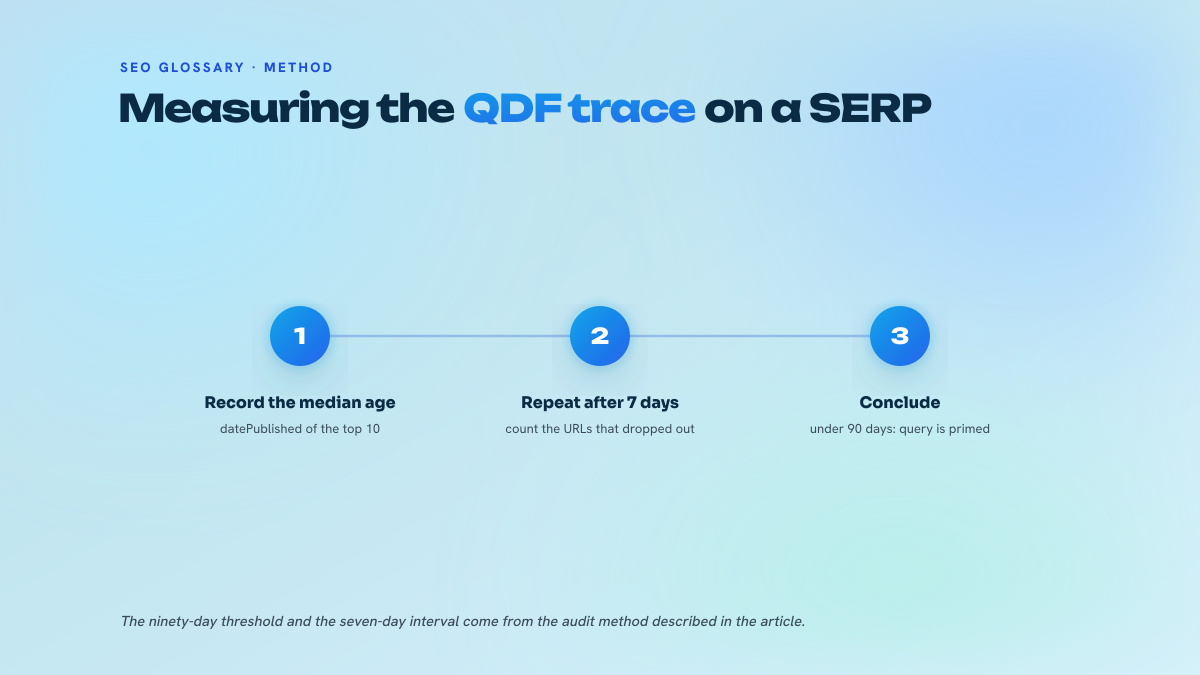
- →Read freshness sensitivity off the SERP itself: age distribution of the top ten, visible date stamps, presence of Top stories. Five or more results under 90 days old is your working threshold.
- →Google announced no QDF update between August 2025 and August 2026. The Search Status Dashboard record for that window is core and spam updates, so blaming a freshness system for a December 2025 or March 2026 drop is usually a misdiagnosis.
- →Ahrefs measured AI-cited URLs at an average of 1,064 days old against 1,432 days for traditional Google organic results, roughly 25.7 % fresher. Recency now buys retrieval, not just ranking.
- →A freshness play only converts if links and citations arrive inside the window. Ordering placements three months after publication funds a page whose QDF boost has already decayed.
- →Split your portfolio deliberately: freshness-gated queries need cadence and speed, stable definitional queries need depth and links, and the two should not share the same editorial calendar.
What QDF actually is, past the dictionary line
Query Deserves Freshness is a gate, not a score. Before Google ranks anything, it makes a judgement about the query string itself: does this search, right now, have a news-shaped demand behind it? When the answer is yes, the freshness signal gets promoted inside the ranking blend and a page published four hours ago can outrank a page that has held position two for three years. When the answer is no, that same recency signal sits close to inert, and pushing a 2019 explainer live again with a 2026 date accomplishes nothing beyond burning a crawl.
The term reached SEO vocabulary as shorthand for a system that watches for a spike in query volume together with a spike in fresh material being published on a topic, and responds by favouring recent documents. Google has never shipped a product page called QDF and has never confirmed the acronym as an internal system name. What is not in dispute is the behaviour itself: freshness matters for some queries and not for others.
That conditional is the entire concept, and it is exactly what most of the ranking content on this topic loses. Article after article treats freshness as a universal virtue and lands on the same recommendation: update everything on a quarterly cadence. That advice is wrong at the level of the mechanism. Freshness is a property Google assigns to the query, so the unit of decision is never your article. It is the intent your article targets. Two pieces on the same subject, one answering « what is a stablecoin » and one answering « stablecoin regulation », live under completely different freshness regimes, and treating them identically wastes the editorial budget on the first while starving the second.
How the freshness layer actually works
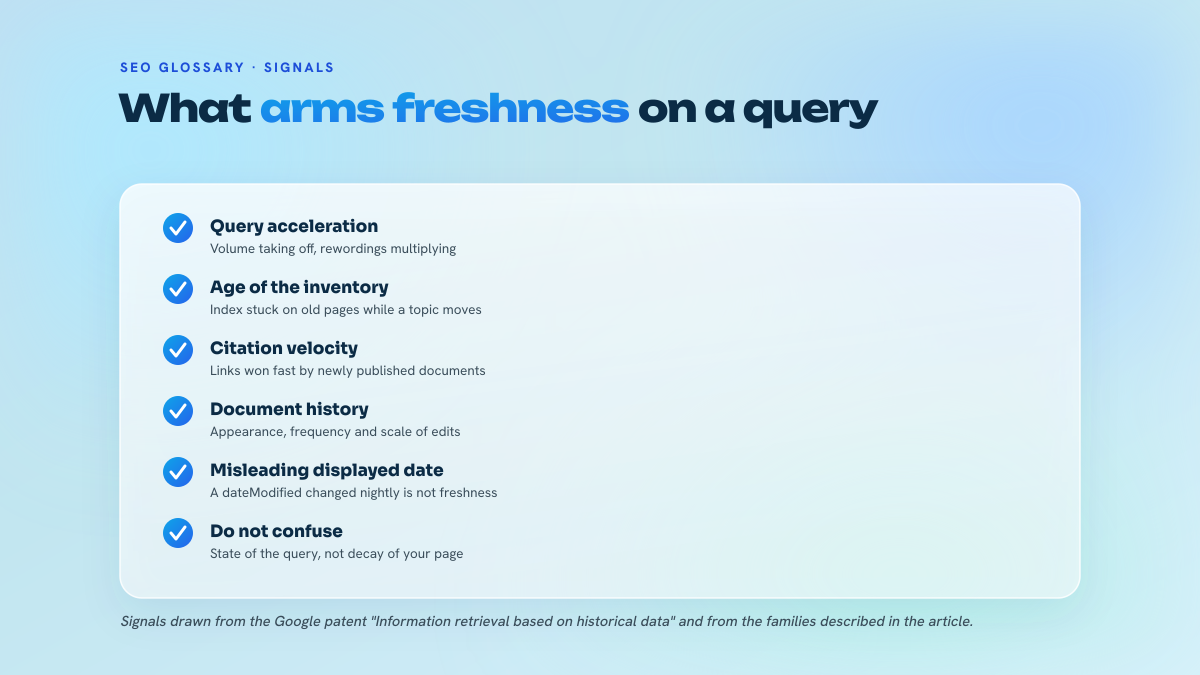
Two families of signals meet. On the query side, Google evaluates whether search volume for a string is spiking against its own historical baseline, whether the web is producing new documents on that topic at an unusual rate, and whether the query carries a seasonal or annual shape that repeats. On the document side, the canonical set is familiar: the inception date of a URL, the rate and the magnitude at which its content changes, the rate at which new links point to it, and the freshness of the anchors used on those links.
The detail that wrecks most audits is that a document's freshness is not its meta date. Google infers document age from first discovery, from the internal linking pattern that surfaces it, from a sitemap lastmod when that sitemap has earned trust, and above all from what genuinely changed in the body. Rewriting the intro and stamping a new publication date is a cosmetic edit, and Google's systems have been reading past cosmetic edits for years. If you want the freshness signal, the substance of the answer has to move.
This walkthrough covers the mechanics end to end and is worth the time if you have never seen the query-side and document-side signals laid out together:
A shorter companion on the freshness signals themselves, useful to hand to a junior on the team:
Measurement is straightforward and nobody does it. Pull the top ten for the query and read the age distribution: how many URLs carry a visible date under 90 days, what the median age of the set is, whether Google is rendering date stamps in the snippets at all, whether Top stories or a news carousel appears. Our working threshold in audits: five or more results under 90 days old, with dates displayed, means the query is freshness-gated and a stale page will not hold there regardless of its link profile. Median age above two years with no date stamps means recency is not the lever and you should stop planning a refresh cycle for it.
Which queries earn freshness, and which never will
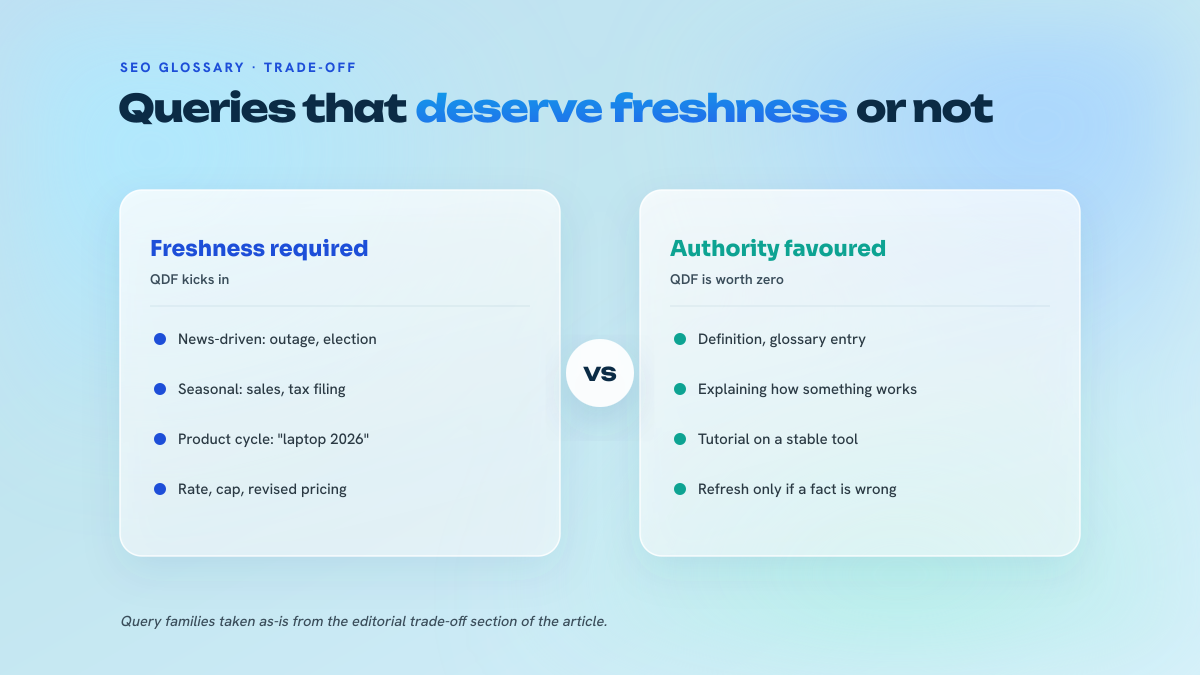
Five clusters reliably trigger the freshness treatment. Breaking events, where the corpus is being written as the query is typed. Recurring events with a known calendar, elections, tournaments, tax deadlines, where Google has learned the annual shape and pre-positions recency. Product cycles, launches, specifications, prices, availability, where the correct answer changes on the manufacturer's schedule rather than yours. Regulatory and legal topics, where a text supersedes another and the old answer becomes actively wrong. And the annual comparison genre, the « best X 2026 » family, where the year in the query is itself the freshness declaration.
Everything else is stable, and this is where the industry loses money. Definitional queries, methodology explainers, historical topics and conceptual pieces do not get a recency promotion, and the correct strategy for them is depth plus authority, which is to say a real content refresh when the substance has aged rather than a scheduled date rotation. The split runs inside a single topic too, which is the part that requires judgement: on a given subject, the head term is often stable while a handful of subqueries are violently time-sensitive. Map that split per SERP, not per site.
The real 2026 shift: freshness moved into retrieval
Start with what did not happen. Between August 2025 and August 2026, Google announced no QDF update and no freshness-specific rollout. The confirmed record on the Search Status Dashboard for that window is the August 2025 spam update, the December 2025 core update at 18 days, the February 2026 Discover update, the March 2026 spam and core updates, the May 2026 core update and the June 2026 spam update. When a client arrives convinced a freshness system demoted them in December, the honest answer is that they moved during a broad quality pass. An SE Ranking analysis of 100,000 keywords found the combined March 2026 spam and core period produced markedly more movement than December 2025, 79.5 % of top-three positions shifting against 66.8 %, and 24.1 % of top-10 URLs falling out of the top 100 against 14.7 %. Because that study merges a spam update and a core update, none of it can be attributed to freshness, and anyone presenting those figures as QDF evidence is guessing.
What genuinely changed sits one layer down, in retrieval. Ahrefs analysed roughly 16.975 million citations across seven AI-search platforms and found AI-cited URLs averaging 1,064 days old against 1,432 days for traditional Google organic results, about 25.7 % fresher. ChatGPT showed the strongest pull toward recency, citing URLs roughly 393 to 458 days newer than comparable Google organic results depending on the measure. The exception is instructive: Google's own AI Overviews cite roughly as old a corpus as classic organic, around 1,432 days, so the recency premium is a property of the assistant, not of AI search as a category.
The second Ahrefs study, across 863,000 keyword SERPs and approximately 4 million AI Overview URLs, reported that only 38 % of cited pages also ranked in the traditional top ten for the same query, down from 76 % in the mid-2025 measurement. Ahrefs itself flags that methodology changes make the two datasets imperfectly comparable, so treat the direction as solid and the exact delta as soft. The operational reading holds either way: a top-ten position is no longer a proxy for citation, and pages sitting at 30 or 60 can be pulled in for a related subquery. Google made this measurable on 3 June 2026 by launching dedicated generative-AI performance reporting in Search Console, separating AI Overview and AI Mode visibility from conventional Search, though without clean click data at launch. Combined with the 6 May 2026 change placing links directly beside the passage they support, freshness now buys retrieval and attribution, not only rank.
Where QDF touches a netlinking operation
Link acquisition and freshness are usually planned in separate spreadsheets, and that is the mistake. On a freshness-gated query the ranking window is short: the document-side signals include the rate at which new links arrive on a URL, which means links landing during the spike compound with the recency promotion, while links landing eleven weeks later arrive on a page whose freshness advantage has already decayed. Ordering placements after the campaign has peaked is the single most common way to pay full price for a fraction of the effect.
That constraint changes what you need from a supplier. A campaign built on a two-week negotiation cycle per placement cannot serve a freshness play at all, which is why an open catalogue you can filter and order from without an account or a sales call is worth more here than a broker relationship. Across the French editorial media we own, publication on a time-sensitive brief runs in days rather than weeks, and that latency is the actual product on a QDF campaign. Budget accordingly: freshness work is repeat spend on a narrow set of URLs rather than one-shot spend spread thin, so check what a placement costs before you size the cadence instead of after.
The inverse case matters as much. On stable definitional queries, speed buys you nothing and the money belongs in durable placements on topically adjacent media, where the link keeps working for years. Using a freshness playbook on an evergreen target is how link budgets evaporate without a ranking to show for it.
What goes wrong, and what to do instead
Four failure patterns account for most of what we see in audits. First, the date rotation: a script updates publication dates across the archive on a schedule, nothing in the body changes, and the site accumulates a signal of churn with no substance behind it. Second, the wrong unit of decision, refreshing pages instead of intents, which produces heavy editorial effort on stable topics and silence on the time-sensitive subqueries that were actually winnable. Third, misattribution, where a core update drop gets diagnosed as a freshness problem and the remediation plan is a republishing sprint that fixes nothing. Fourth, and increasingly expensive, treating the AI citation layer as a byproduct of ranking when Ahrefs' own data shows the overlap has thinned considerably.
This clip is a decent practical framing of how recency feeds into content strategy without tipping into the update-everything advice:
The working method is unglamorous. Classify your query set once by reading SERP age distributions, and mark each cluster freshness-gated or stable. For the gated set, build a monitoring loop on Trends and on the SERP itself, keep a publication path that can ship in under 48 hours, and pre-arrange link placements so they land inside the window rather than after it. For the stable set, refresh only when the substance is genuinely out of date, and put the money into depth and authority instead. Then measure the two separately in Search Console, and keep the generative-AI report in its own view, because a page can lose organic position while gaining citations and the aggregate number will hide both.
One last stance, since the market rarely says it out loud: freshness is the cheapest ranking lever available on a narrow set of queries and a complete waste of budget everywhere else. The skill is not knowing how QDF works. It is knowing which of your queries deserve it.
Nautilinks operates an owned network of editorial media. In-house written articles, transparency disclosures respected, anchor mix calibrated.
Frequently asked questions
Is QDF a confirmed Google system, or industry folklore?
Both, partly. Google has never confirmed QDF as an internal system name and has never shipped documentation under that acronym. What is not in dispute is the underlying behaviour: freshness matters for some queries and not for others. Treat QDF as accurate shorthand for an observable behaviour, not as a named component you can find in Google's release log.
How do I tell whether a specific query is freshness-gated?
Read the SERP, not the keyword tool. Count how many of the top ten carry a visible date under 90 days, note the median age of the set, and check whether Google renders date stamps in snippets or surfaces Top stories. Five or more recent results with displayed dates means recency is weighted heavily and a stale page will not hold. A median above two years with no dates shown means freshness is not your lever and a refresh cycle is misallocated effort.
Did the December 2025 or March 2026 updates change how freshness works?
There is no evidence for that. Google announced no freshness-specific rollout in that window: the Search Status Dashboard record shows the December 2025 core update over 18 days, then spam and core updates in March 2026. SE Ranking measured heavier volatility in the March period, 79.5 % of top-three positions moving against 66.8 % in December, but that study combines a spam and a core update, so it says nothing about QDF. Claims of a documented « fake freshness penalty » are industry interpretation, not Google guidance.
Does freshness matter more for AI citations than for classic rankings?
For assistants, clearly yes. Ahrefs analysed roughly 16.975 million citations across seven AI-search platforms and found cited URLs averaging 1,064 days old against 1,432 days for Google organic, about 25.7 % fresher, with ChatGPT citing content roughly 393 to 458 days newer than comparable organic results. Google's AI Overviews are the exception, citing a corpus around 1,432 days old, close to classic organic. So the recency premium belongs to the assistant layer, not to AI search as a whole.
Should I schedule a quarterly refresh across the whole site?
No, and this is the most common budget leak we see. A calendar-driven refresh applies a freshness playbook to intents that never earn a freshness promotion, producing editorial cost with no ranking movement, while the genuinely time-sensitive subqueries go unserved. Refresh when the substance has changed or when the SERP age distribution says recency is weighted. Date rotation with an untouched body is a cosmetic edit that Google's systems have been reading past for years.
When should links land on a page targeting a freshness-gated query?
Inside the window, which usually means days rather than weeks. The document-side freshness signals include the rate at which new links arrive on a URL, so acquisition during the volume spike compounds with the recency promotion. Links landing two or three months later hit a page whose freshness advantage has already decayed, and you pay the full placement price for a fraction of the effect. If your supply chain needs a two-week negotiation per placement, it cannot serve this play.
Test your knowledge
Quiz: Query Deserves Freshness (QDF)
1/3What is the correct unit of decision when applying QDF thinking to a content portfolio?