- →Refresh is a re-argument on a URL that already holds history and links; a rewrite changes the promise, a merge admits the page never had a job. Confusing the three is how teams spend a quarter editing and move nothing.
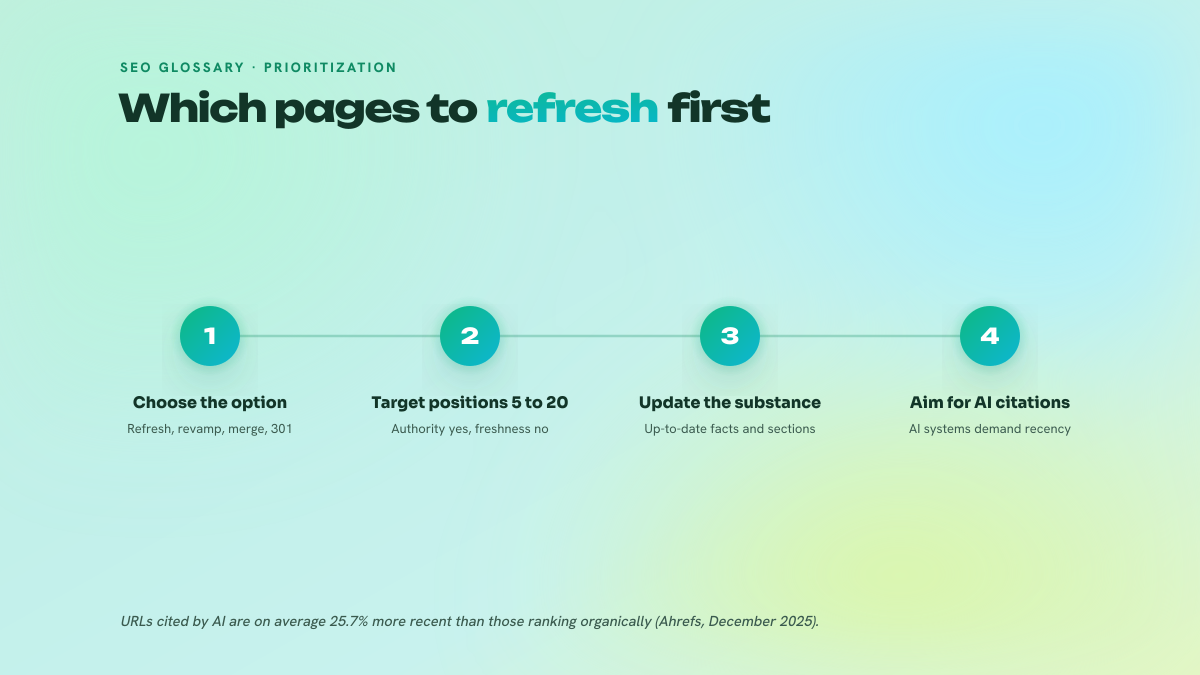
- →Ahrefs (28 July 2025, 16.975 million cited URLs) found AI assistants cite URLs averaging 1,064 days old versus 1,432 for organic results, a 25.7 % gap, while Google AI Overviews cited some of the oldest sources measured. Freshness is an assistant preference, not a Google ranking lever.
- →Measure a refresh on impressions, average position and AI citations, not sessions alone: Seer Interactive (November 2025) measured organic CTR on AI Overview queries falling from 1.76 % to 0.61 %, so a page can hold rank and lose clicks.
- →Refresh the target page before you point links at it, not after. Link equity lands on a URL, and a decayed page wastes it.
- →Images, screenshots and charts age faster than prose. A 2022 tool interface in a screenshot dates a page more visibly to a reader than any publication line.
- →Changing the URL during a refresh is a decision, not a detail: it forces a 301, orphans old internal links and resets nothing you actually wanted reset.
A refresh is a re-argument, not a date bump
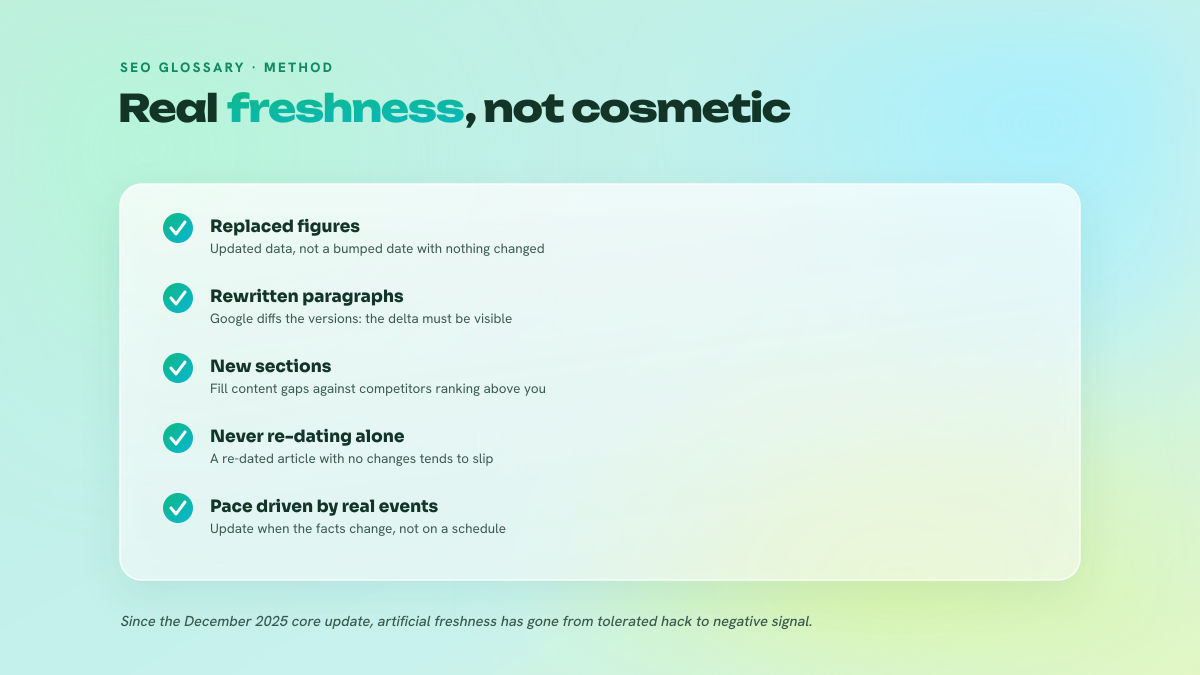
The page ranked. Then it slid to position 9, then 14, and the curve flattened into a slow decline that no single algorithm update explains. That is the moment a content refresh is the right tool: the URL still holds its link history, the topic is still searched, but the argument on the page has stopped matching what the results reward. Refreshing means rebuilding that argument. Editing the publication date is not refreshing, it is lying to a timestamp.
The distinction that matters operationally is refresh versus rewrite versus retire. A refresh keeps the URL, keeps the search intent and upgrades the substance: current data, sections answering questions that surfaced in the SERP since publication, removal of advice that is now wrong, a sharper title tag and meta description, internal links out to the pages published around it since. A rewrite keeps the URL and changes the promise, which usually means the intent was mis-served on day one. Retirement means the page never had a job and belongs merged into a stronger one or removed. Teams that file all three under « refresh » spend a quarter editing and move nothing.
The other half of the definition is diagnostic. A page that decays because the topic moved needs new substance. A page that decays because three competitors published deeper resources needs scope. A page that decays because an AI answer now sits above it needs a different job entirely, closer to being the source that answer cites than the destination that answer replaces. Same symptom, three different interventions, and the audit that skips this step produces a refresh backlog sorted by publication date, which is the least useful sort order available.
Worth naming the adjacent concept properly: what you are fighting is the slow erosion of a page's performance over time, and refresh is one of several answers to it. Consolidation, internal link redistribution and new supporting content are the others.
What freshness actually buys you in 2026
There is no freshness score to optimise. Google applies recency weighting per query, not per page: a query about a tax threshold or a phone model gets recency pressure, a query about a stable concept does not. Refreshing a page whose query carries no recency demand buys you nothing from the date itself. It buys you whatever the new content is worth.
The most useful recent measurement on this comes from Ahrefs, published 28 July 2025, covering 16.975 million cited URLs across ChatGPT, Perplexity, Gemini, Copilot, Google AI Overviews and organic Google results. URLs cited by AI assistants averaged 1,064 days old against 1,432 days for organic SERP URLs, a 25.7 % freshness difference. The gap on last update was narrower: 909 days for AI citations against 1,047 for organic, 13.1 %. The detail that kills the simplistic reading is in the same study: Google AI Overviews' top three citations averaged 1,432 days since publication, among the oldest sources measured. Assistants like ChatGPT skew fresher; Google, in and out of AI features, does not reward recency for its own sake.
So the honest position for 2026: refresh for substance, and treat improved AI citation odds as a secondary effect, not the thesis. Google's own generative-AI guidance, published 15 May 2026, says the same thing in its own words, framing valuable, unique, non-commodity content as what matters for AI features and warning against treating GEO as a separate optimisation system. That is a rare case where the official line and the operational reality agree.
Measurement is where most refresh programmes are weakest. Compare symmetric windows in Google Search Console, same day count before and after, and read impressions and average position before you read clicks. The reason is quantified: Seer Interactive, in a study published November 2025 covering 3,119 informational queries, 42 organisations and 25.1 million organic impressions from June 2024 to September 2025, measured organic CTR on queries showing AI Overviews falling from 1.76 % to 0.61 %, a 61 % decline, with paid CTR falling from 19.7 % to 6.34 %. Queries without AI Overviews sat at 1.62 % CTR, still 41 % lower in the same analysis. A refreshed page can gain three positions and lose sessions, and a clicks-only dashboard will report that as a failed refresh. Since 3 June 2026, Search Console also exposes generative-AI performance reports covering AI Overviews, AI Mode and Discover AI features, with impressions, URLs, countries, devices and hourly to monthly date dimensions, initially for a subset of sites. When you have it, that report is the missing half of a before-and-after comparison.
One last mechanic that costs people weeks: nothing you change exists until it is recrawled. Request indexing on the handful of pages that matter, and if your stack supports it, push the updated URL through IndexNow so Bing and its consumers pick it up without waiting on a crawl cycle.
Where refresh sits in a netlinking operation
Links land on URLs. That single fact makes refresh and netlinking sequential operations, not parallel ones. A page you are about to point eight or ten referring domains at should be the best version of itself first, because the equity you send arrives once and then compounds against whatever is on the page when it arrives. Buying links to a page you plan to refresh next quarter is paying for a result you have decided to postpone.
The reverse pairing is the one that works: refresh the target, then commission a contextual article on a media that already ranks in the theme, and let the new link point at a page whose substance justifies the citation. Editors accept that brief more readily too, because they are linking to something current rather than to a 2022 guide with a broken screenshot in it.
There is a supply-side version of this that most buyers never think about. The media hosting your link decays as well. A host page that loses its own rankings is a link losing value quietly, on someone else's roadmap. We run our own French editorial media at nautilinks, and refreshing host content is part of operating them rather than a favour: the value of a placement is a function of the page it sits on staying alive. When you evaluate the catalogue of media you can browse before ordering, the question worth asking about any host is not only its current metrics but whether anyone still edits it.
Refresh also feeds the depth a site accumulates on a subject. Every refresh is an opportunity to re-wire internal links from the updated page to the cluster around it, which is the cheapest ranking lever available and the one most often skipped because it does not appear in the content brief. If you are calibrating an acquisition plan over several months, the refresh calendar and the link calendar should be the same document.
What we see go wrong on refresh programmes
The most expensive mistake is the one that looks like productivity: refreshing the winners. Top-performing pages are easy to find, easy to improve marginally and easy to report on, and they were not the problem. The pages that need work are the ones with impressions holding and clicks collapsing, or with average position drifting from 5 to 12 over two quarters, and they sit in the unglamorous middle of the export.
Second: treating date and light rewording as a recovery tactic. Google's June 2026 spam update ran globally and across all languages, launching 24 June and completing on 26 June, roughly two days. Scaled shallow updates across a content library are exactly what that class of update is built to catch. If a page is thin, the intervention is substantive improvement or removal, not a fresh timestamp.
Third: deleting the paragraph that was working. The section earning a featured snippet or an AI citation is often a plain, unglamorous definition block that a rewriting pass will smooth away. Before touching a page, note which query it wins and which passage answers it, and protect that passage.
Fourth, and badly under-covered by the guides that rank on this topic: media. Prose ages slower than images. A screenshot of a tool interface from 2022, a chart with three-year-old data, alt text describing a menu that no longer exists, these date a page to a reader faster than any publication line and they carry no benefit from your text edits. Re-shoot the screenshots, re-plot the charts with current figures, rewrite alt text to match what is now in the image.
This walkthrough covers the practical sequence well, including the AI-visibility angle:
Fifth: casual URL changes. Rewriting the slug because the new angle is broader forces a 301, leaves every internal link in your archive pointing at the redirect, and resets nothing you wanted reset. Change the URL only when the page's subject genuinely changes, and when you do, update the internal links at the source rather than relying on the redirect to carry them. Chained redirects from successive refreshes are a real pattern and a real loss.
Sixth: importing benchmarks as forecasts. The frequently quoted 106 % average increase in organic views from optimising older posts is a HubSpot publisher result, a case-study outcome on one library with one starting quality level. Quote it as that. Similarly, the 2026 aggregation reporting that 52 % of pre-2025 articles had never been refreshed is a curated secondary analysis, useful as a backlog indicator, not a population statistic about the web.
Triage: refresh, merge, rewrite or leave alone
Build the inventory once, from Search Console rather than from your CMS, because the CMS knows what exists and Search Console knows what is alive. Pull twelve months of query-level data per URL and sort into four states. Impressions stable and clicks falling points at the SERP layer above you: rework the title and meta description, and check whether an AI answer now occupies the space your click used to come from. Position drifting downward with impressions intact points at substance: competitors deepened, you did not. Both collapsing usually means intent moved, or two of your own pages are competing for the same query, in which case the answer is a merge and a 301, not two refreshes. Flat and negligible from day one means the page never had demand, and refreshing it is the most common way to waste a content quarter.
Our operational rule, from running this on our own properties: a page with fewer than a couple of hundred impressions over ninety days is not a refresh candidate, it is a merge or a deletion candidate. Below that floor there is no signal to recover, and effort spent there is effort not spent on the page sitting at position 11.
Cadence follows content type rather than the calendar. Pages tied to prices, tool interfaces, legal thresholds or platform behaviour need review at least twice a year and immediately after any change in the underlying reality. Conceptual and methodological pages can go eighteen months untouched without harm, which is consistent with the Ahrefs age data. Comparison and listicle formats decay fastest because their premise is a snapshot. Set the review trigger on the data, not on a fixed rotation: a decay alert on position and impressions will find the work earlier than any schedule.
The refresh-versus-new-content arbitration is worth a real answer rather than a preference. Refresh when a URL already ranks somewhere between positions 4 and 20 for a query with real volume, because you are buying back a position you already half own. Write new when the gap between your coverage and the demand around your topic is a subject you have never treated, and when refreshing an existing page to cover it would blur that page's intent. The failure mode in both directions is the same: stretching one URL to serve two intents.
This debate is covered honestly here, including the case for not refreshing:
Competitor analysis belongs in the triage, not in the execution. Look at what the current top results cover that you do not, using whatever crawling and gap tool you already pay for, and treat the output as a list of questions to answer rather than a list of headings to copy. The pages that recover positions after a refresh are the ones that answer something the SERP was not answering, not the ones that match the average of the top ten more closely.
Finally, sequence the deployment. Refresh, verify the change is live and rendered, request reindexing, wait for a full crawl cycle, then measure. Layering a link campaign onto the same page in the same week makes the attribution unreadable, and you will spend the next quarter arguing about which intervention worked.
Nautilinks operates an owned network of editorial media. In-house written articles, transparency disclosures respected, anchor mix calibrated.
Frequently asked questions
Where exactly is the line between a refresh and a rewrite?
The promise of the page. A refresh keeps the URL, the search intent and the core claim, and upgrades evidence, structure, media and internal links. A rewrite keeps the URL but changes what the page is for, which usually means the original intent was mis-diagnosed. Practical test: if the ideal title tag after your work would target a different query, you are rewriting, and you should check for cannibalisation with whatever page already owns that query before publishing.
How fast does Google re-evaluate a refreshed page?
Recrawl comes first and it is the variable you can influence: request indexing in Search Console for the pages that matter and push the URL through IndexNow if your stack supports it. Re-ranking is slower and noisier. Give it a full crawl cycle plus a few weeks, and avoid reading results during a core update rollout. The May 2026 core update ran from 21 May to 2 June, and anything measured inside that window tells you nothing clean.
Does refreshing actually improve the odds of being cited by AI assistants?
Modestly, and unevenly by assistant. Ahrefs, in a study published 28 July 2025 across 16.975 million cited URLs, found AI-cited URLs averaged 1,064 days old against 1,432 for organic results, with a narrower 13.1 % gap on last-update dates. But Google AI Overviews cited among the oldest sources measured. Freshness helps at the margin with assistants like ChatGPT; it does not substitute for being the clearest source on the question.
Should the URL change when the refresh broadens the page's scope?
Usually no. A 301 costs you clean internal links, adds a hop, and stacks into chains across successive refreshes. Change it only when the subject genuinely changed and the old slug would actively mislead. When you do change it, rewrite the internal links at the source rather than leaning on the redirect, and check nothing in your archive still points at the previous URL.
How do I prove a refresh worked when clicks fell?
Read impressions and average position first. Seer Interactive, in November 2025, measured organic CTR on AI Overview queries dropping from 1.76 % to 0.61 %, so a page can gain positions while losing sessions to an answer feature. Compare symmetric before and after windows of equal length, exclude branded queries, and if you have access to the generative-AI reports Search Console added on 3 June 2026, add AI impressions to the scorecard.
What share of a content library is worth refreshing at all?
Far less than a full audit suggests. Pages with negligible impressions over ninety days have no signal to recover and belong in a merge or removal list. The refresh budget goes to pages ranking between roughly positions 4 and 20 on queries with real demand. A 2026 aggregation reported that 52 % of pre-2025 articles had never been refreshed, which is a useful backlog indicator, not a mandate to touch every one of them.
Test your knowledge
Quiz: Content refresh
1/3In the Ahrefs study published 28 July 2025, how did the average age of AI-cited URLs compare with organic SERP URLs?