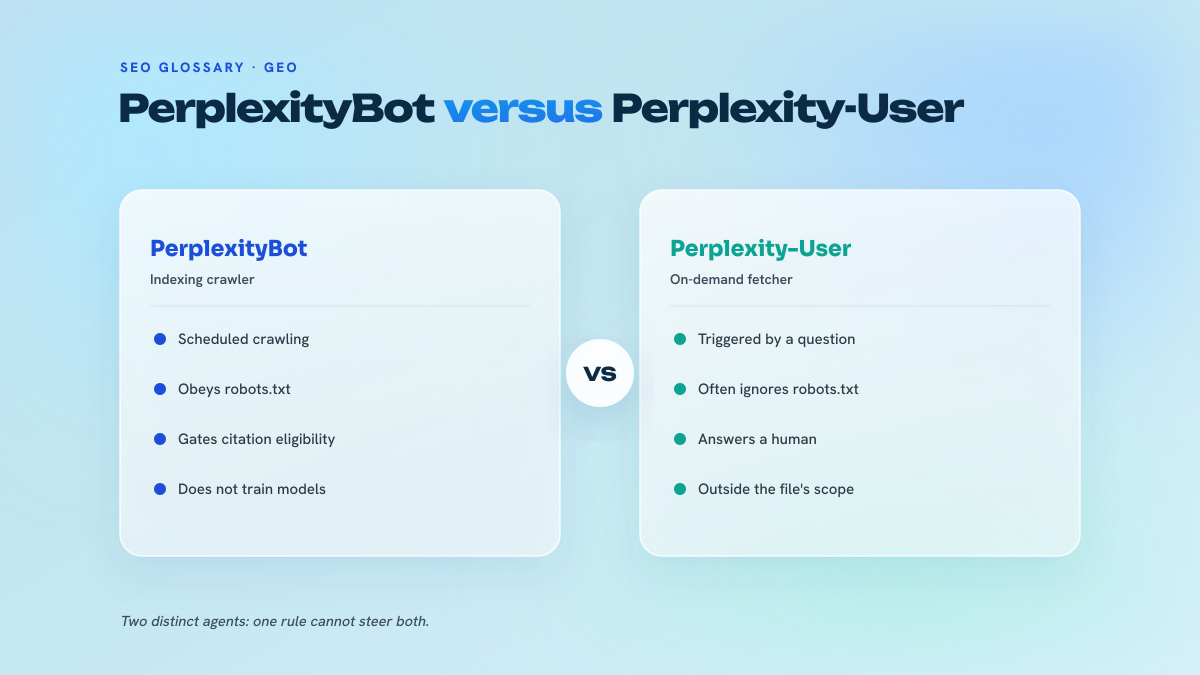
- →PerplexityBot and Perplexity-User are two different agents: the first is the indexing crawler you can allow or disallow, the second is a user-triggered fetcher that, per Perplexity's own crawler documentation, generally ignores robots.txt.
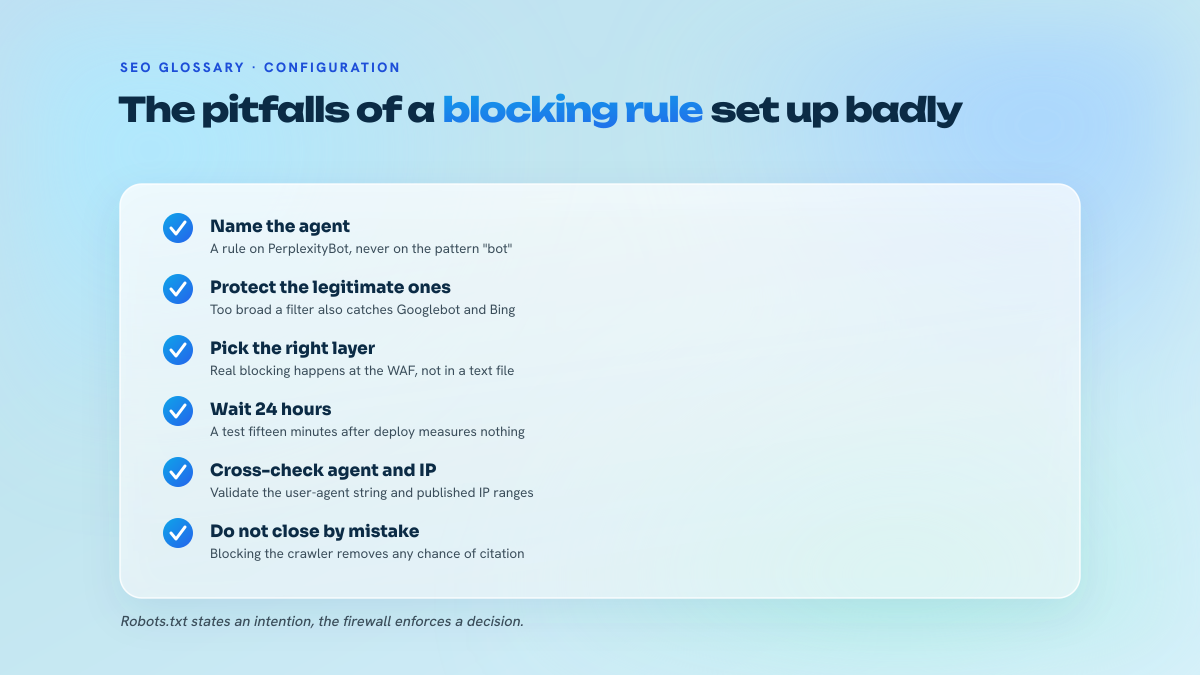
- →A user-agent string is free text and forgeable. Verify PerplexityBot against Perplexity's published IP ranges before you allow-list anything, and before you conclude that a spike of Perplexity hits is real.
- →robots.txt is a declaration of intent, not an access control. If you actually need enforcement, the rule belongs in the WAF or the server config, and you should test that your CDN is not already blocking AI crawlers by default.
- →Perplexity's citations are not automatically correct: the 2025 Tow Center study measured a 37 % citation-error rate, the best of the eight tools tested but still a reason to check what page is being credited for which claim.
- →Crawl eligibility is the cheap half of the work. Being quotable, server-rendered claims, precise numbers, clear attribution, is the half that decides whether the crawl turns into a citation.
- →Measure Google rankings and Perplexity citations as two separate surfaces. Google's Search Status Dashboard documents no PerplexityBot-specific ranking factor, and conflating the two produces reporting nobody can act on.
A retrieval crawler, not a training scraper
Two agents carry the Perplexity name through your access logs, and treating them as one thing is where most access policies break. PerplexityBot is the indexing crawler: it walks the open web on its own schedule, builds the index Perplexity draws on, and, according to Perplexity's crawler documentation, exists to surface and link websites inside answers rather than to feed foundation-model training. Perplexity-User is something else, a fetcher triggered in real time when someone asks a question that needs a live page. The same documentation states that Perplexity-User generally ignores robots.txt, on the reasoning that the request originates from a human rather than from an automated crawl.
That distinction settles an argument many publishers are still having with themselves. If your objection to AI crawlers is that your prose ends up inside model weights, PerplexityBot is not the target you think it is: blocking it removes you from a citation surface and changes nothing about training. If your objection is commercial, that answer engines keep the content and strip the click, the argument holds, but make it deliberately and price what it costs you.
The volume is now high enough for that price to be real. Perplexity's CEO reported roughly 780 million queries in May 2025, around 26 to 30 million per day, growing more than 20 % month over month at that point. Industry compilations citing Similarweb and DemandSage put Perplexity near 45 million monthly active users by late 2025, though those estimates vary a lot by measurement method and deserve to be read as an order of magnitude, not a number. Either way, it is past the threshold where a serious site should be tracking referrals and citations rather than arguing about whether the surface matters.
The user-agent strings, and why you verify them
The documented crawler identity is a single string, and it is worth pinning exactly rather than matching loosely on the word Perplexity:
Mozilla/5.0 AppleWebKit/537.36 (KHTML, like Gecko; compatible; PerplexityBot/1.0; +https://perplexity.ai/perplexitybot)Perplexity-User announces itself separately, which is what lets you treat the scheduled crawl and the user-triggered fetch as two different decisions: allow the indexer while rate-limiting live fetches, or the reverse if your concern is server load during traffic spikes. That separation is the single most useful thing in Perplexity's crawler documentation, and it is the part competitors covering this topic skip fastest.
A user-agent header is free text. Anyone can send that string from a laptop, and plenty of scrapers do precisely that to inherit whatever allow rule you wrote for the real crawler. Perplexity publishes IP ranges and recommends verifying both the user agent and the source address when you build Cloudflare or AWS WAF rules. Do that. An allow rule keyed on user agent alone is not an allow rule for PerplexityBot, it is an allow rule for anyone who read this article. The same logic applies to the OpenAI crawler and to every other declared AI agent hitting your origin.
robots.txt sets policy, the WAF enforces it
For a site that wants citations, the correct posture is explicit rather than implicit. A blanket allow works, but naming the agent makes your intent auditable six months later when someone asks why an AI bot is in the logs:
User-agent: PerplexityBot
Allow: /
Disallow: /panier/
Disallow: /wp-admin/

User-agent: Perplexity-User
Allow: /
Two operational details matter more than the syntax. Perplexity states that robots.txt changes may take up to 24 hours to propagate, so a fix pushed this morning does not prove anything by lunchtime. And the Perplexity-User block above is close to decorative, since that agent generally ignores the file: it documents your position, it does not enforce it. Anyone treating the AI crawler section of robots.txt as an access control has confused a request with a lock.
This short walkthrough covers the practical check, whether the AI crawlers are actually allowed on a given domain:
Nautilinks operates an owned network of editorial media. In-house written articles, transparency disclosures respected, anchor mix calibrated.
Frequently asked questions
Does blocking PerplexityBot hurt my Google rankings?
No. Google's Search Status Dashboard documents no PerplexityBot-related ranking factor, and Googlebot crawls independently of any rule you write for Perplexity. What you lose is presence in Perplexity answers and the referral traffic attached to it. Treat the two as separate surfaces with separate measurements: a robots.txt block scoped to PerplexityBot has no mechanical effect on Google, and inventing a link between them produces reporting nobody can act on.
Why does Perplexity still fetch pages I disallowed in robots.txt?
Almost certainly Perplexity-User rather than PerplexityBot. Perplexity's crawler documentation states that Perplexity-User generally ignores robots.txt because the fetch is triggered by a person asking a question, not by a scheduled crawl. Check the exact user-agent string in your logs. If you need enforcement rather than a declaration of intent, the rule has to sit in your WAF or server config, matched on user agent plus Perplexity's published IP ranges.
Is Perplexity traffic in my logs a security risk?
The declared crawler is not malicious software, it fetches pages like any indexer. The real risk is impersonation: a user-agent header is free text and forgeable. Cloudflare alleged on 4 August 2025 that undeclared crawlers with rotating IPs and Chrome-style user agents were operating after declared ones were blocked, an allegation Perplexity rejected the next day. Verify against the published IP ranges before you trust or allow-list anything.
Should I prioritise Perplexity citations over ChatGPT ones?
Prioritise whichever surface sends you qualified referrals, which you can only know by tracking both. Perplexity is the more citation-native product, it links sources by design, and the widely quoted Semrush analysis of 10 000 answers suggests smaller specialist domains earn citations there more readily than on ChatGPT. That figure is vendor-reported, so use it to justify measuring, not to justify a budget split decided in advance.
How do I allow the indexing crawl but limit live user fetches?
Split the two agents. Allow PerplexityBot in robots.txt for the sections you want indexed, then apply a WAF rate limit keyed on the Perplexity-User agent string combined with the published IP ranges, since robots.txt will not restrain it. That keeps you eligible for citations while capping origin load when a page starts getting pulled repeatedly. Verify with your own logs, not with a checker tool, over a full 24 hours.
My site is allowed and crawled but never cited. What is missing?
Usually extractability or source-worthiness. Fetch the page without executing JavaScript: if the claim you want quoted only appears after client-side rendering, there is nothing to lift. If the HTML is fine, the problem is the writing. Pages that get cited carry specific figures with a named source and a date, unambiguous statements, and clean attribution. Generic prose optimised for keywords gives an answer engine nothing to quote.
Test your knowledge
Quiz: PerplexityBot
1/3What distinguishes Perplexity-User from PerplexityBot in practice?