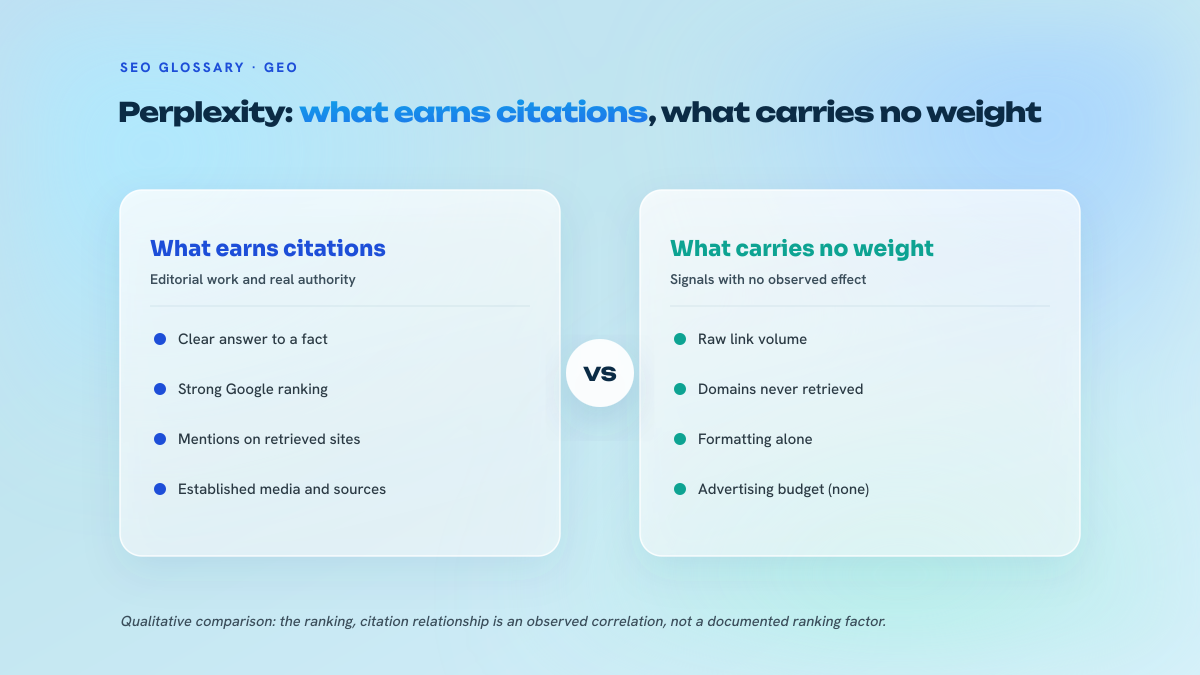
- →There is no paid lane: Perplexity phased out advertising in late 2025 and confirmed in February 2026 that it would not continue the model, so every placement is an earned citation.
- →Classic ranking work is the entry ticket. A recent synthesis of citation research found Perplexity showed the clearest relationship between strong Google rankings and AI citation among the platforms tested, which is correlation, not a disclosed ranking factor.
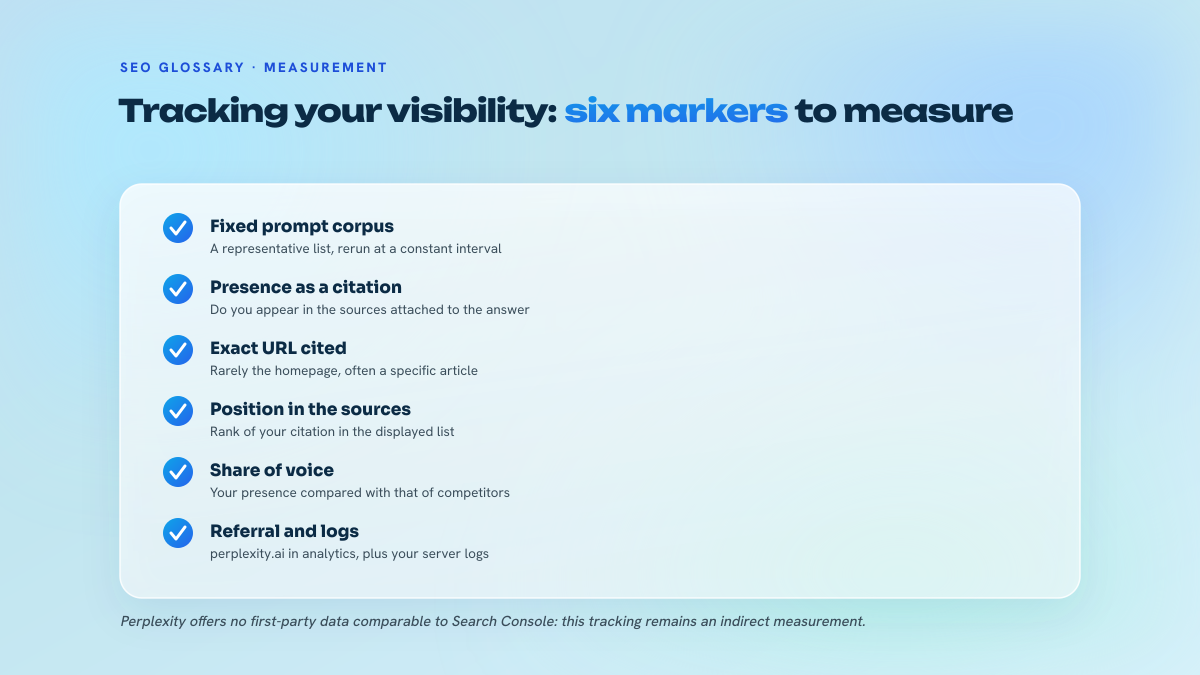
- →Your metric set changes: citation presence, source URL, citation position, share of voice across a fixed prompt panel, and referred conversions. Position tracking has nothing to grip.
- →Bot policy is a visibility setting. Cloudflare alleged on 4 August 2025 that Perplexity used undeclared crawlers with rotating user agents, IPs and ASNs, so a clean PerplexityBot allow rule does not describe your whole exposure.
- →Netlinking acts upstream, not directly: no engine reads your backlink profile at answer time, but links move the rankings and the topical footprint that retrieval leans on.
- →Citation is worth more than absence and far less than the click used to be. Seer Interactive measured organic CTR on AI Overview queries falling from 1.76% to 0.61% between June 2024 and September 2025.
What Perplexity SEO actually is
There is no position 1 in Perplexity. The engine writes an answer and footnotes it with a handful of sources, and your entire visibility surface is whether your URL is one of those footnotes and how high it sits in the source list. That single structural fact reorganises the whole workflow: you are not competing for a slot in a list of ten blue links, you are competing to be the cleanest, most retrievable evidence for a sub-question the user never explicitly typed.
The second structural fact is that you cannot buy your way in. Perplexity phased out advertising in late 2025 and confirmed in February 2026 that it would not continue the model, on the grounds that sponsored results would undermine trust in the answers (Digit.fyi, February 2026). There is no auction, no CPC on citation slots, no managed placement. Anyone selling you a Perplexity ad package in 2026 is selling something else.
Size matters for how much attention this deserves. Perplexity’s chief executive disclosed at Bloomberg Tech on 5 June 2025 that the engine handled 780 million queries in May 2025, growing by more than 20% month over month, roughly 30 million queries per day. Third-party estimates from Similarweb and DemandSage-type datasets put monthly active users somewhere between 22 and 45 million during late 2025 and early 2026, which is a wide band precisely because none of it is audited. Our reading: this is a real channel with a disproportionately qualified audience, not a traffic replacement. Budget for it accordingly, and stop treating a screenshot of one flattering answer as a business case.
How citation selection works in 2026
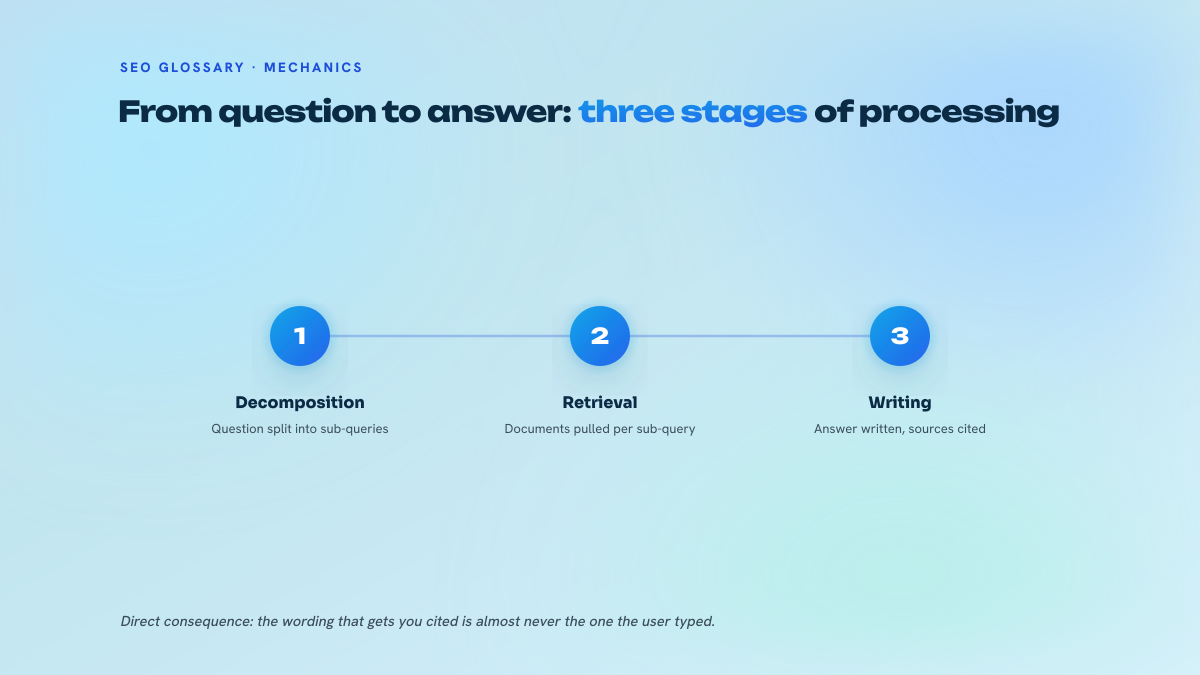
Perplexity is a retrieval-augmented system, so the pipeline is decomposition, retrieval, reranking, synthesis. A single question gets split into several sub-queries, each of which pulls its own candidate documents. That decomposition step is the same mechanic behind the way modern answer engines split one question into many, and it explains why pages that answer one narrow sub-question well often get cited on broad queries they would never rank for.
What you actually control is upstream of the model: being in the candidate pool, and being the least ambiguous source once you are there. Pages that get cited tend to state the claim, the number and the date in the same paragraph, use headings that match how the question is phrased, and avoid burying the answer under three paragraphs of context. This is not a separate discipline. A recent synthesis of citation research across answer engines reported that Perplexity showed the clearest relationship between strong Google rankings and AI citation of the platforms tested. Treat that as correlation rather than a disclosed ranking factor, but act on it: if you are not eligible for a normal Google snippet, you are rarely in the retrieval set either.
Measurement is where most teams improvise badly. Perplexity ships no first-party console. Google moved the other way on 3 June 2026 by giving Search Console its own generative-AI reporting for AI Overviews and AI Mode, which makes the Google side of the surface a first-party metric for the first time. On Perplexity you are left with two honest options: a fixed panel of prompts run on a schedule with a tracker, and referral analysis in your own logs. Build the panel like a survey instrument, freeze the wording, run it weekly, log the full source list and the position of your URL inside it, and read the trend across dozens of prompts. That is what tracking mentions across answer engines means in practice: a sampling protocol, not a demo.
Crawler access is now a visibility setting
On 4 August 2025 Cloudflare alleged that Perplexity used undeclared crawlers, changing user agents, IP addresses and ASNs when its declared crawlers were blocked, and said the activity touched tens of thousands of domains and millions of requests per day. Perplexity disputed the characterisation and said it relied partly on third-party crawlers. Whichever version you find more convincing, the operational lesson is identical and uncomfortable: a tidy allow rule for PerplexityBot in your crawler directives file does not describe your real exposure, in either direction.
So audit the logs rather than the config. We regularly find sites whose marketing team is chasing AI visibility while their infrastructure team enabled a managed WAF ruleset that blocks AI crawlers wholesale, six months earlier, in a ticket nobody linked to the SEO roadmap. The two decisions were never in the same room. Before writing a single « GEO-optimised » page, pull a month of access logs, segment by user agent and ASN, and confirm that retrieval traffic actually reaches your content.
The economics are moving too. On 25 August 2025 Perplexity announced Comet Plus, a subscription at 5 dollars per month with an initial 42.5 million dollar publisher revenue pool and an 80% publisher, 20% Perplexity split, where qualifying usage includes citations in answers, traffic through Comet and assistant tasks using publisher material. For a B2B site the pool itself is irrelevant. The signal is not: Perplexity is paying for editorial legitimacy, which means publisher-grade sources keep a structural advantage in the retrieval set, and a corporate blog post competing against a licensed media article starts behind.
Where it fits in a netlinking operation
No answer engine reads your backlink profile at answer time. Anyone claiming a direct link between referring domains and citation frequency is describing a mechanism nobody has demonstrated. Links still matter here, but one layer up: they move rankings and topical footprint, and retrieval leans on both. That makes netlinking an upstream input to Perplexity visibility, which is a very different budgeting exercise from buying links against a keyword.
Three things editorial links do that are specifically useful on this surface. They create crawlable paths from documents that retrieval infrastructure already visits often. They put your brand name in the same paragraph as the entities you want to be associated with, which feeds the mention-and-citation footprint models are trained and grounded on. And they lift the ranking of the exact pages you want quoted, which is the correlation described above. Language matters more than most teams expect: a French-language question retrieves French-language sources, so an English backlink profile will not put you inside a French answer. That constraint is why we keep the French editorial media we run in-house rather than sourcing across borders, and why the media catalogue you can browse without an account lists language and topic before it lists any metric.
Sequencing beats volume on this surface. A burst of links pointed at a page that is not yet the clearest answer to anything simply raises a page nobody wants to quote. Calibrating the campaign over several months, alongside the rewriting work that makes each target page quotable, produces citations. Buying thirty links in a fortnight produces a spike in a chart.
What we see go wrong
The first failure is treating vendor numbers as ranking rules. Claims such as « Reddit supplies 46.7% of Perplexity citations » or « fresh content receives 3.2 times more citations » come from commercial studies with no published methodology, no sampling frame and an obvious interest in the conclusion. We have watched teams rebuild an entire content calendar around a decimal point nobody can reproduce. Use those studies as hypotheses to test on your own prompt panel, never as inputs to a plan.
The second is confusing answer visibility with traffic. Seer Interactive published an analysis in November 2025 covering 3,119 informational queries, 42 organisations and 25.1 million organic impressions from June 2024 to September 2025: organic CTR on queries showing an AI Overview fell from 1.76% to 0.61%, a 61% decline. In the same dataset, being cited in the AI Overview produced 0.70% CTR against 0.52% when not cited, roughly 35% more clicks. Pew Research found in 2025 that users clicked a traditional result on 8% of searches when an AI summary appeared, against 15% when none did. That is Google data, not Perplexity data, and the direction generalises: citation is clearly better than absence, and clearly worth less than the click used to be. Report it as brand exposure with a small conversion tail, and instrument the referral path so the tail is at least counted.
The third is building a separate estate of « AI pages ». Google has not presented a distinct AI ranking system that replaces ordinary technical and content work, and pages still need to be indexed and eligible for normal snippets to appear as supporting links. Perplexity behaves the same way. A parallel set of thin, question-shaped pages splits your topical signal and gets neither surface.
The fourth is running one-shot checks. Answer engines are stochastic, and the same prompt returns different source lists across sessions. A single query proves nothing, in either direction, and a client who saw themselves cited once on a Tuesday will ask why they vanished on Thursday. Sample, log, and report the share of a fixed panel over time. That is the only version of this work that survives contact with a real reporting cycle.
Nautilinks operates an owned network of editorial media. In-house written articles, transparency disclosures respected, anchor mix calibrated.
Frequently asked questions
Can I pay for placement in Perplexity answers in 2026?
No. Perplexity phased out advertising in late 2025 and confirmed in February 2026 that it would not continue the model, arguing sponsored results would undermine trust in the answers. There is no auction, no CPC on citation slots and no managed placement product. The only adjacent commercial route is the Comet Plus publisher programme announced on 25 August 2025, which pays qualifying publishers from a 42.5 million dollar pool, and which is a revenue-share arrangement rather than a way to buy visibility.
Should I allow or block PerplexityBot?
Decide it as a business trade-off, then verify it in logs. Blocking reduces the probability of being retrieved and cited; allowing has licensing, content-reuse and server-cost implications. The key caveat comes from Cloudflare’s 4 August 2025 allegation that Perplexity used undeclared crawlers with rotating user agents, IPs and ASNs when declared crawlers were blocked, which Perplexity disputed. Either way, your declared-bot rules describe your intent, not necessarily your exposure. Audit access logs by user agent and ASN rather than trusting the config file.
How do I measure Perplexity visibility without a first-party console?
Two sources, combined. Build a frozen panel of prompts that mirror real buying questions, run it on a fixed weekly schedule with a tracker, and log citation presence, the exact source URL, its position in the source list and your share of voice across the panel. Then read referral traffic in your own analytics and tie it to conversions. Google shipped generative-AI reporting in Search Console on 3 June 2026 for AI Overviews and AI Mode; Perplexity has no equivalent, so sampling discipline replaces first-party data.
Do backlinks actually influence Perplexity citations?
Indirectly. No engine reads a backlink profile at answer time, so any claim of a direct relationship is unsupported. Links matter because they move rankings and topical footprint, and a recent synthesis of citation research found Perplexity showed the clearest relationship between strong Google rankings and AI citation among the platforms tested. Practically: links raise the page, the raised page enters the retrieval set, the retrieval set produces citations. Language alignment matters too, since a French question retrieves French sources.
Is Perplexity referral traffic worth reporting to a client?
Report it, but frame it correctly. Volume will be small against Google, and the click economics on answer surfaces have compressed: Seer Interactive measured organic CTR on AI Overview queries falling from 1.76% to 0.61% between June 2024 and September 2025, with cited pages at 0.70% against 0.52% for uncited ones. Report citation share of your prompt panel as the primary metric, referral sessions as secondary, and assisted conversions as the number that decides whether the work continues.
Do I need separate pages optimised for answer engines?
No, and the split usually costs you. Google has not presented an AI ranking system separate from ordinary technical and content SEO, and pages must be indexed and snippet-eligible to be used as supporting links. Perplexity behaves the same way: it retrieves documents, it does not reward a page for announcing that it was written for machines. Improve the pages you already want to rank so each states its claim, its figure and its date in one extractable paragraph.
Test your knowledge
Quiz: Perplexity SEO
1/3What is Perplexity’s commercial model for marketers as of 2026?