- →Panda scored the site, not the page: a strong article on a domain padded with thin templates inherits the domain's quality problem, which is why pruning often moves rankings faster than rewriting.
- →Google folded Panda into its core ranking systems, and its Search Status Dashboard has recorded no Panda entry since; the update history for the last twelve months lists only core, spam and Discover updates.
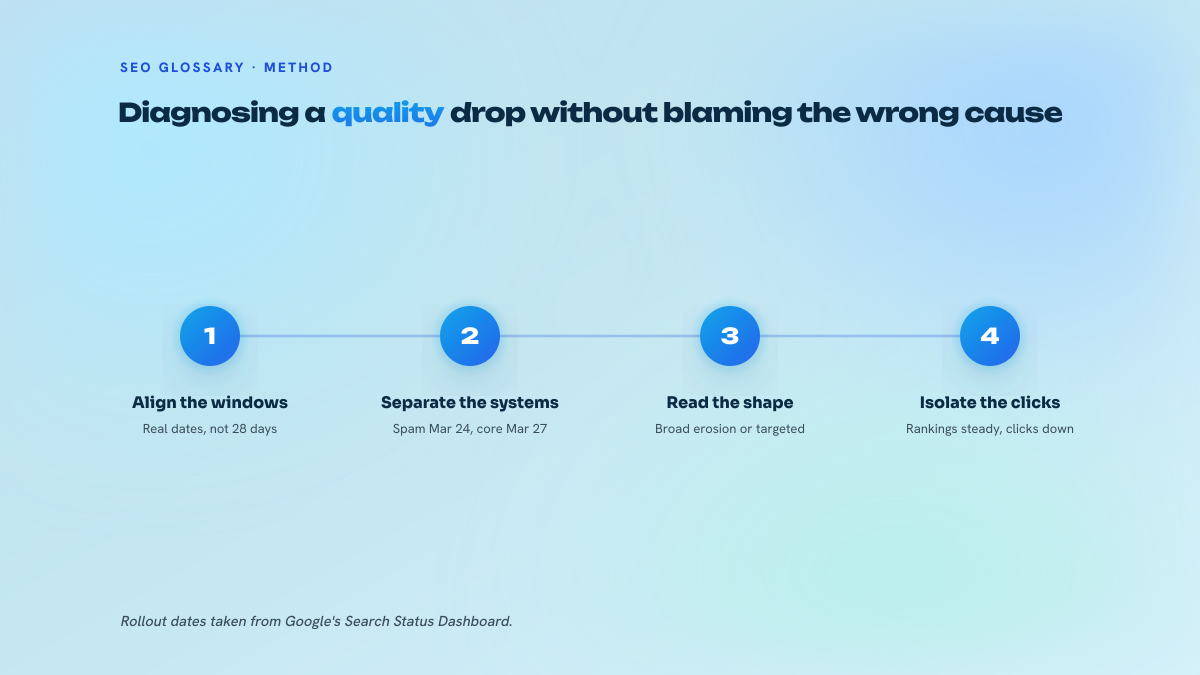
- →The March 2026 spam update (24 March) landed three days before the March 2026 core update (27 March), so any traffic post-mortem covering that window has to segment Search Console data by exact dates or it will attribute the wrong cause.
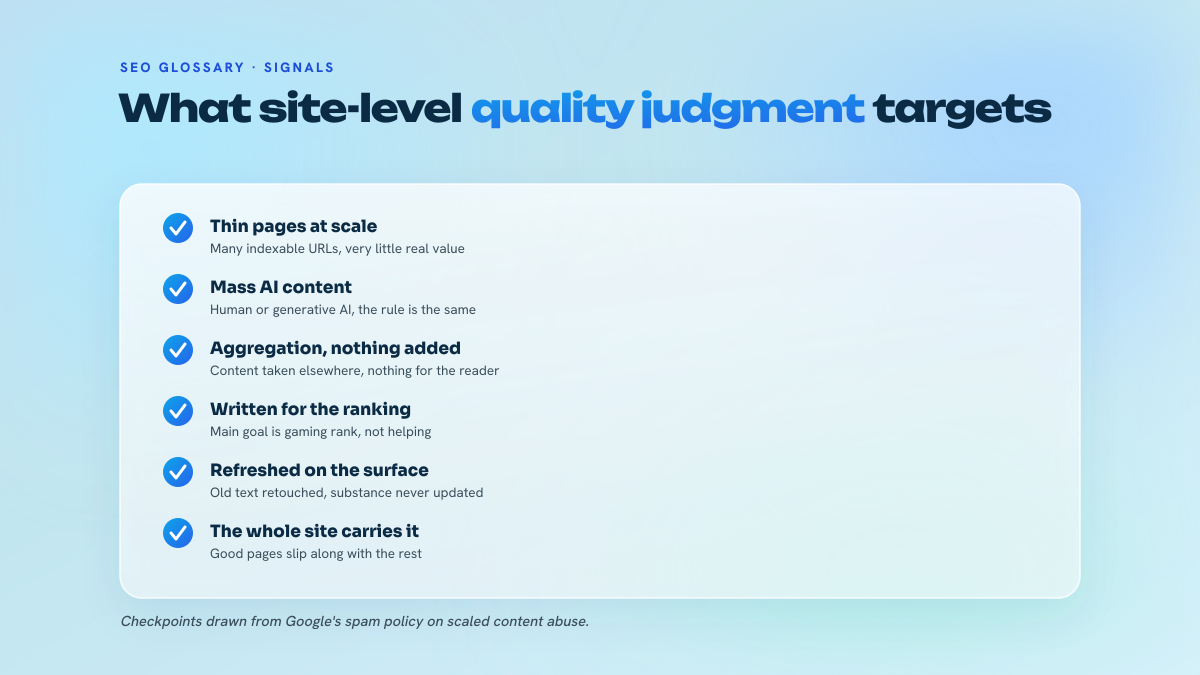
- →Google's spam policies define scaled content abuse by intent and value, not by production method: mass AI pages, scraped or synonymised text and stitched content are treated identically to human-written filler.
- →Since the Pew Research Center's July 2025 study, a quality drop and an AI Overview substitution look nearly identical in a traffic curve, so check impressions and the generative-AI reports Google shipped in Search Console on 3 June 2026 before rewriting anything.
- →Link acquisition inherits the host's quality profile: a contextual link on a thin, ad-stuffed page carries the same risk its host does, whatever the Domain Rating says.
What Panda actually judged
Panda was a quality classifier whose ranking effect applied at the level of the whole domain rather than the individual URL. That single design decision is the reason the term still matters. A well-researched article could lose positions because the site around it carried hundreds of near-duplicate tag pages, syndicated product blurbs or auto-generated location variants. Webmasters who polished their best blog post were optimising the wrong object: the algorithm was scoring a ratio, not an artifact.
The name comes from Navneet Panda, the Google engineer credited internally with the breakthrough that made the classifier scalable, which is a rare case of an algorithm being named after a person rather than an animal chosen by the search quality team. Trivia, but useful trivia: it tells you Panda was a machine-learning quality classifier trained on human rater judgments, not a rulebook of penalties you could reverse-engineer line by line.
Here is a short overview before we get into the mechanics of how it worked.
What it targeted, concretely: content farms producing hundreds of shallow answers per day, scraped pages republishing someone else's work, doorway-style thin pages built to catch a query and nothing more, and sites where advertising or affiliate inserts occupied more of the viewport than the content the user came for. None of that has stopped existing. It has simply stopped being handled by a separately named system.
There is no Panda update left to chase
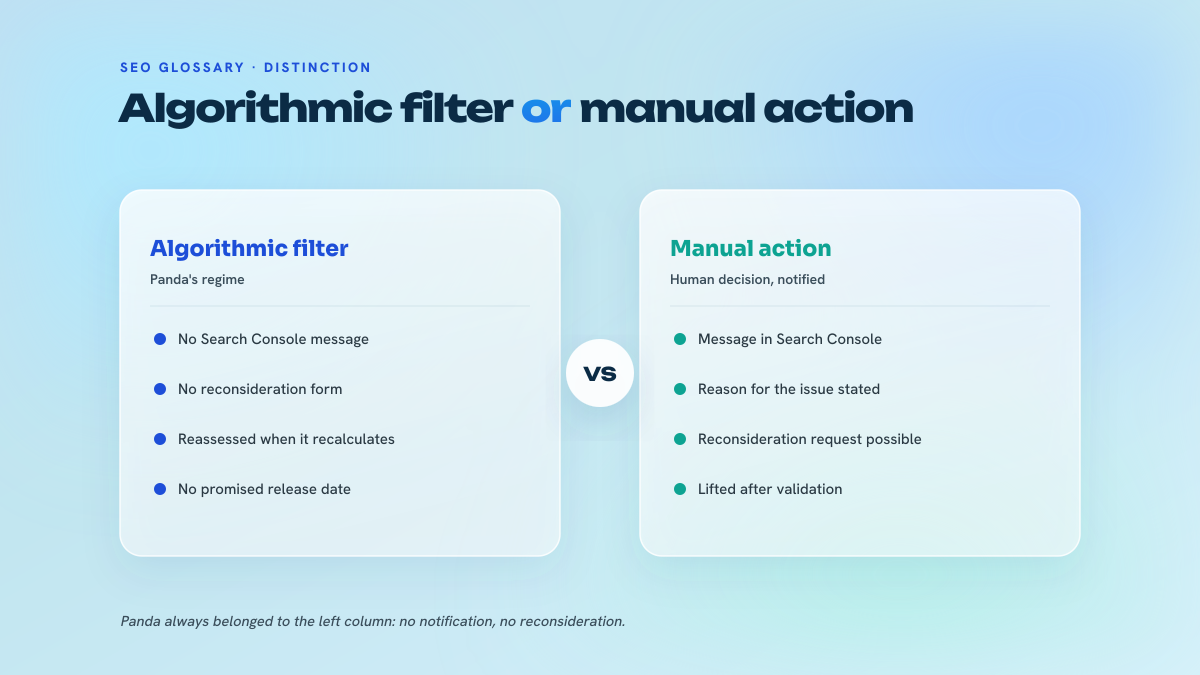
Panda's content-quality concepts are now part of Google's broader core ranking systems. The classifier stopped shipping as a dated, announced event and started refreshing continuously alongside everything else. Anyone telling you in 2026 that a client got hit by Panda is using industry shorthand for « the quality layer moved against us », which is fine as shorthand and useless as a diagnosis.
Check the source of truth rather than the commentary. Google's Search Status Dashboard records the confirmed ranking updates, and its history for the last twelve months contains no Panda entry: an August 2025 spam update starting 26 August, a December 2025 core update starting 11 December, a February 2026 Discover update starting 5 February, a March 2026 spam update on 24 March, a March 2026 core update on 27 March, a May 2026 core update on 21 May and a June 2026 spam update on 24 June. That is the entire confirmed list. The clustering matters more than the count: the March spam update finished rolling out in under twenty hours and the core update began three days later, which makes any traffic post-mortem covering late March unreliable unless you segment Search Console by exact date ranges.
The practical stance: stop naming the animal, start naming the mechanism. A broad core update reassesses how well your pages satisfy the queries they rank for. A spam update enforces a published policy. Those two produce different recovery paths, and confusing them costs quarters.
How content quality gets evaluated in 2026
The successor concept to Panda lives in Google's spam policies and its core quality systems. The policy that does most of the work today is scaled content abuse, which Google defines as generating many pages primarily to manipulate rankings rather than to help users, and which it applies regardless of whether the pages were produced by humans, by generative AI or by any other tool. The documentation lists mass AI pages with no added value, scraped or synonymised content, stitched content and keyword-filled pages as examples. Note what is absent: any threshold on volume, and any judgment on the writing tool. Intent and marginal value are the test.
Alongside it sits site reputation abuse, aimed at third-party content placed on an established domain mainly to exploit that domain's ranking signals. Google is explicit that third-party content is not prohibited as such: editorial work, user-generated forum content, syndicated news, legitimate affiliate content and advertising can all be acceptable when the point of hosting them is not to borrow the host's ranking strength. That is the clearest statement Google has ever published on the difference between an editorial section and a parasite section, and it draws the line at intent, not at format.
For measurement, the helpful content system gave us the vocabulary but Search Console gives us the numbers. Cohort your URLs by template and by publication month, then track impressions per cohort rather than sessions per site. A quality reassessment shows up as an entire cohort losing impressions on the same dates while other cohorts hold. Individual URLs bleeding out slowly over six months is content decay, a different problem with a different fix.
Diagnosing a quality drop without guessing
The diagnostic sequence we run in audits is short and boring. Overlay the confirmed update dates on the impressions curve. Split by query type, branded against non-branded. Split by page template. Then, and only then, look at individual pages. Most self-declared Panda victims turn out to have a technical cause, a template change, or a SERP feature change that removed their click-through without touching their position.
This walkthrough covers the detection tooling side of the same question.
Two confounders now dominate false diagnoses. The first is generative results. The Pew Research Center analysed the browsing activity of 900 US adults across 68,879 Google searches during March 2025 and found an AI summary on 12,593 of them, about 18 %. On visits where a summary appeared, users clicked a traditional result 8 % of the time against 15 % without one, and clicked a source cited inside the summary on 1 % of visits. Browsing ended on 26 % of pages with a summary against 16 % without. Read that as an operational warning: your content can be judged good enough to be cited and still lose the click. Google shipped dedicated generative-AI performance reports in Search Console on 3 June 2026, covering impressions in AI Overviews, AI Mode and generative Discover features with country and device breakdowns, initially for a subset of sites. Until your property gets them, you are partly blind on this axis.
The second confounder is SERP feature removal. FAQ rich results stopped appearing in Search from 7 May 2026, with Google removing the related documentation in June. Sites that had built FAQ blocks into every template lost visible SERP real estate and click-through without losing a single position. That is not a quality problem and no amount of rewriting will fix it.
Where this lands in a netlinking operation
Panda logic is why link acquisition cannot be evaluated on link metrics alone. A contextual link placed in an article on a site that publishes forty near-identical posts a week inherits that site's quality profile, whatever its Domain Rating or Trust Flow reads. Authority metrics are computed on the link graph. Quality classification is computed on the content. The two diverge constantly, and the gap is where most disappointing campaigns live.
Google's link spam policies remain explicit on the transactional side: buying or selling links for ranking purposes, excessive reciprocal linking, automated link creation, and paid advertorial or guest-post links that pass ranking credit are all listed, with the qualifier that paid or sponsored links are acceptable when marked with rel="nofollow" or rel="sponsored". Any professional operating in this market works inside that tension knowingly. What changes the risk profile is not the disclosure attribute, it is whether the host site would survive a quality assessment on its own merits.
That is the reason we run our own French editorial media in-house rather than brokering third-party inventory: when you write the editorial line, the publication rhythm and the internal architecture yourself, the Panda-style variables stay measurable instead of being someone else's undisclosed problem. You can inspect the full catalogue of media we operate, open without an account and check the traffic and content of each one before ordering, and see what a placement actually costs before committing a budget. Vetting a host on its content, not on its metric card, is the single habit that separates campaigns that hold from campaigns that evaporate at the next core update.
Panda, Penguin, RankBrain, core updates
The four get confused constantly, so here is the separation that matters operationally. Panda judged content quality at site level and is now part of core ranking. The Penguin filter judged the link graph, targeting manipulative anchor patterns and low-quality link acquisition, and was likewise folded into the core algorithm, becoming real-time and page-granular rather than site-wide. RankBrain is not a quality judge at all: it interprets queries, especially unseen ones. Broad core updates are the periodic reassessment of everything, which is why they feel like Panda and Penguin firing at once.
This comparison video covers the same landscape if you want the visual version.
The tell for which one you are facing: if the affected pages share a template or a topic and the drop is uniform across the site, look at content. If the affected pages share a backlink profile pattern or an anchor distribution, look at links. If the drop coincides with a dashboard-confirmed spam update and you have a policy violation you can name, fix the violation. If none of those hold, you are probably looking at a competitor who got better, which is the most common answer and the one nobody wants to hear.
Nautilinks operates an owned network of editorial media. In-house written articles, transparency disclosures respected, anchor mix calibrated.
Frequently asked questions
What is the falling panda effect people mention when rankings drop?
It is folklore, not a Google term. The phrase describes the shape of a Panda-era loss: a site-wide, step-function drop in organic search traffic on a single date, hitting good and bad pages alike, rather than the gradual slide of content decay. Since Panda merged into core ranking there is no dated Panda event to attach it to, so the honest framing is a core update reassessment of your content quality at site level.
Does Google still use RankBrain in 2026?
RankBrain does a different job from Panda. It interprets queries, particularly rare or ambiguous ones, mapping them to concepts the engine already understands. It is not a quality filter and there is nothing to recover from with it. If you are trying to explain a traffic loss, RankBrain is almost never the answer; query interpretation shifts show up as changes in which queries you rank for, not in how well you rank overall.
Can AI-written content trigger the modern equivalent of a Panda hit?
Not because it is AI-written. Google's spam policies define scaled content abuse by whether many pages exist primarily to manipulate rankings rather than help users, and state that it applies regardless of whether humans, generative AI or other tools produced them. Mass AI pages with no added value are listed as an example, alongside scraped, synonymised and stitched content. A hundred AI-assisted pages with genuine original research sit outside the policy. Twenty spun rewrites sit inside it.
How do I tell a content quality problem from an AI Overview substitution?
Compare impressions against clicks. A quality reassessment cuts impressions because you lost positions. An AI Overview substitution leaves impressions flat while clicks fall. The Pew Research Center found in July 2025 that traditional-result clicks occurred on 8 % of visits where an AI summary appeared against 15 % where none did, so the gap is large enough to read in normal data. Google's generative-AI reports in Search Console, launched 3 June 2026, make the split explicit where they are available.
Is pruning thin pages still the right recovery move?
It is still the fastest lever when a site carries a large share of pages that serve no query, but noindex and deletion are not interchangeable. Pages with backlinks or ongoing impressions get consolidated and redirected. Pages with neither get removed. Pages that are thin but strategically necessary get expanded. What we see go wrong in audits is mass deletion by word count, which regularly removes pages that were ranking fine and leaves the actual template-level duplication untouched.
Does Panda mean anything outside SEO, in wider digital marketing?
Only as a shorthand for the moment content volume stopped being a growth strategy. Marketing teams that had been briefing writers on output per week had to start briefing on originality and depth, and the shift affected content budgets, agency scoping and editorial hiring well beyond the search channel. That is the durable lesson: publishing capacity without an editorial standard is a liability on a domain.
Test your knowledge
Quiz: Panda algorithm
1/3What structural feature made Panda different from a page-level ranking filter?