- →TF/CF is a seed-distance ratio, not a quality verdict: it tells you what share of a domain's link volume traces back to Majestic's curated trusted set within a few hops.
- →The working band published across 2025 and 2026 industry guides sits between 0.5 and 1.0, with 12AM Agency (May 2026) flagging a CF 40 / TF 10 profile, ratio 0.25, as a spam signal.
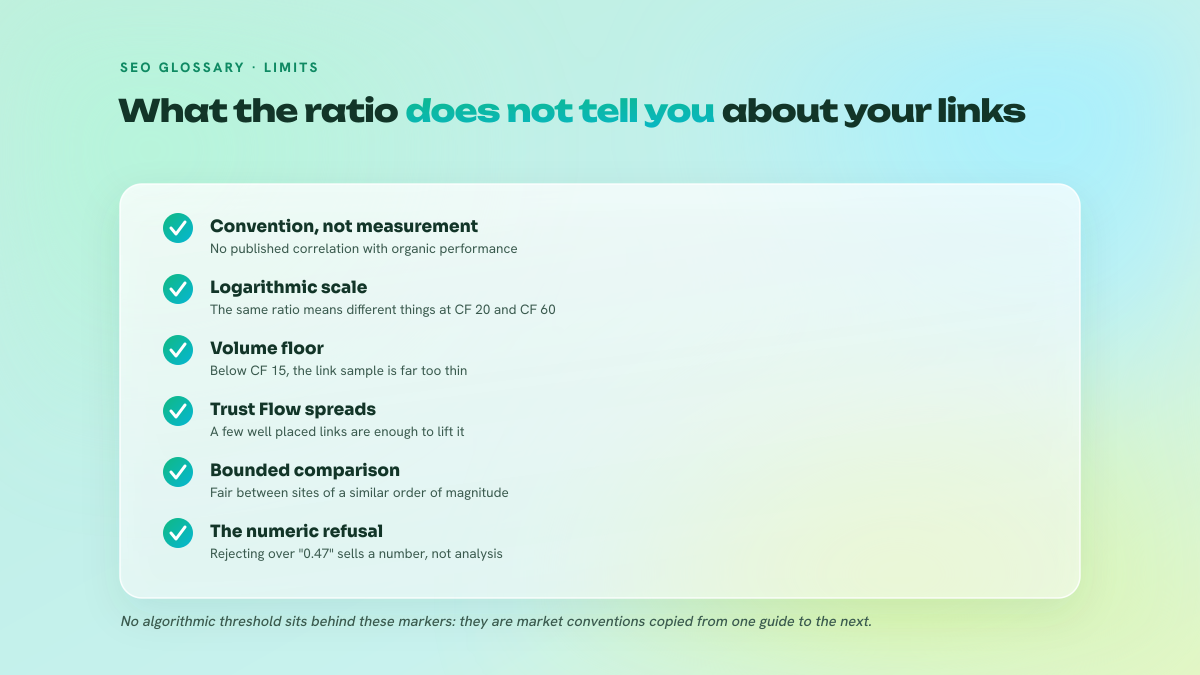
- →The ratio is unreadable below roughly TF 10 and CF 10: a site at TF 3 / CF 3 scores a perfect 1.0 and means nothing.
- →Google has never used Majestic metrics, but the 2024 API leak surfaced a BadBackLinks signal, so a volume-heavy, trust-poor profile correlates with the same underlying reality Google's spam classifiers target.
- →TF is cheaper to inflate than CF: a handful of links close to the seed set moves it fast, which is exactly why sellers optimise it and why the ratio must be read against referring domains and Topical Trust Flow.
- →Treat the ratio's trajectory over 6 to 12 months as more informative than the snapshot, and never buy on a single vendor metric.
What the ratio actually measures
Citation Flow and Trust Flow are both Majestic properties, both scored 0 to 100 on a logarithmic scale, and both computed by propagating a signal through the same crawled link graph. The difference is the starting point. Citation Flow starts everywhere and measures how much link volume reaches a URL, with no opinion whatsoever on where that volume came from. Trust Flow starts from a hand-curated set of seed sites Majestic considers trustworthy and measures how much of that seeded signal survives the hops to reach you.
Divide one by the other and you get a share: the proportion of a domain's link volume that can be traced back, in a small number of hops, to something a human at Majestic once decided was reputable. That framing matters because it removes the mysticism. A ratio of 0.3 does not mean « this site is 30 % trustworthy ». It means the bulk of its inbound signal comes from regions of the web that sit far from the seed set. Sometimes that is a spam network. Sometimes it is a perfectly legitimate site in a vertical the seed set underrepresents, which is a real problem for niche French and German markets where Majestic's seeds skew anglophone and institutional.
The second thing to internalise: this is a vendor metric, not a search engine signal. Majestic still owns and sells it, at $49.99 a month for Lite, $99.99 for Pro and $399.99 for API access according to the 2026 pricing reviews published by ToolJunction and TheStacc. Google has never published anything resembling Trust Flow, and no Google patent describes it. Anyone telling you that improving your TF/CF ratio « improves your rankings » is describing a correlation as a mechanism. What is true is more interesting: both Majestic's seed propagation and Google's own link evaluation are trying to model the same thing, so a profile that looks bad to one often looks bad to the other. That overlap is the entire practical value of the metric, and it is enough.
The numbers professionals use in 2026
The industry has converged on a fairly narrow band. 12AM Agency, in its May 2026 deep-dive on Trust Flow, puts the ideal at roughly 1.0, treats 0.5 as the baseline for a healthy site, and uses a Citation Flow 40 / Trust Flow 10 example, ratio 0.25, as its illustration of a profile stuffed with directory and junk links. BloggingX, writing in October 2025, gives the same shape from the other direction: CF 40 / TF 20 lands at 0.5, and it notes that realistic upper bounds sit around 0.9 rather than a clean 1.0. Prateeksha Web Design, in its December 2025 piece on 2026 metrics, recommends a trust-to-citation ratio of at least 0.5 and warns against extremes in either direction.
So: 0.5 to 1.0 is the working band, and anything under 0.3 deserves a manual look before money moves. That is a useful heuristic and we use it. But three caveats decide whether it is worth anything on a given prospect.
The first is scale. The ratio is a fraction, and fractions of small numbers are noise. A blog at TF 3 / CF 3 scores a flawless 1.0 and tells you precisely nothing, because Majestic's crawl has barely touched it. Below roughly TF 10 and CF 10, stop reading the ratio and go look at the referring domains directly. The second is direction: a ratio above 1.0 happens, usually on sites with very few but very well-placed links, and it is not a bonus, it is a signal that the sample is thin. The third is topicality. Raw Trust Flow says the trust arrived, not that it arrived from anywhere related to your subject. Topical Trust Flow, which splits the score by category, carries far more decision weight in 2026 than the aggregate number, and a site with TF 25 concentrated in the right vertical is worth more than TF 40 scattered across news and gambling.
Where it fits in a netlinking operation
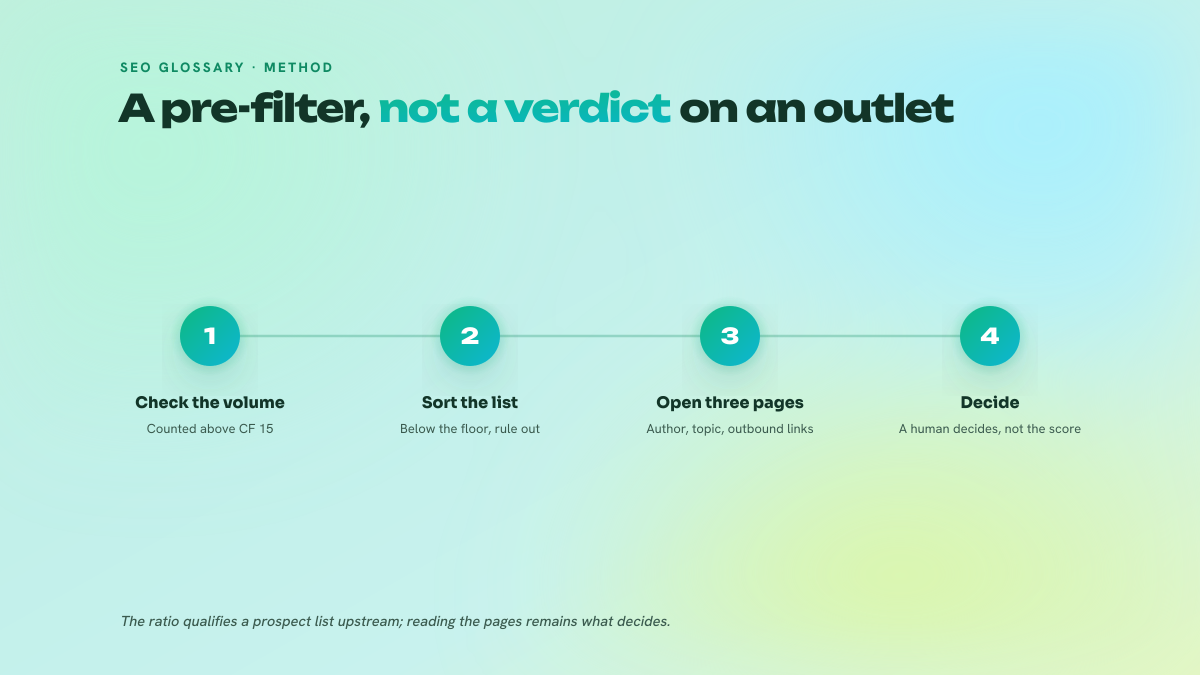
The honest answer is that TF/CF belongs at the top of the funnel and nowhere else. It is a screening filter: run a list of 300 prospects through it, drop everything under 0.3, flag everything between 0.3 and 0.5 for manual review, and you have saved yourself hours without having made a single buying decision yet. It is a triage tool, not a purchase criterion. When you actually decide whether to place a link, you are looking at the page, the surrounding editorial, the outbound link density and whether a real reader would ever land there.
What changed recently is that nobody checks it by hand anymore. AgencyAnalytics markets native Majestic integration, in place as of February 2026, so client dashboards pull TF and CF straight into reporting, and Incremys, in March 2026, centralises Trust Flow, Citation Flow and Topicals in its Backlinks module for link qualification. Convenience has a cost: when a metric becomes a dashboard column, it stops being interrogated. Sellers know which number buyers filter on, and they optimise for that number specifically. If you are building a prospect list, the catalogue where every media's figures are public before you create an account is the sanity check: metrics you can read without a sales call are metrics nobody had a reason to dress up.
On the French editorial media we run in-house, we watch the trajectory rather than the snapshot. A site whose Citation Flow climbs while Trust Flow stays flat is accumulating volume from somewhere the seed set does not reach, and that is worth investigating on our own properties before a client ever asks. The same logic applies when you place a link directly with the publisher rather than through a resale layer: you can see the host's history instead of a broker's screenshot. Teams that run continuous campaigns rather than one-off batches tend to build this check into their monthly review, which is where calibrating acquisition over several quarters earns its keep against a burst of purchases nobody re-audits.
What we see go wrong
The most common failure is treating Trust Flow as expensive to acquire. It is not. Because TF measures proximity to a seed set, a small number of links from domains that already sit one hop from those seeds moves the number sharply, while Citation Flow, which needs raw volume, moves slowly. That asymmetry means a seller can lift a site's ratio from 0.3 to 0.6 with a dozen well-chosen placements without changing anything about the site's actual editorial quality. If a domain's ratio improved in a single quarter while its count of distinct referring domains barely moved, you are looking at cosmetic work.
The second failure is cross-site comparison. Ratios are not portable between verticals or between site ages. A ten-year-old regional press site has decades of directory citations dragging CF up, and its 0.4 ratio is structurally different from a two-year-old blog at 0.4. Compare a domain to itself over time, or to close peers in the same vertical, and the metric behaves. Compare across a mixed list and it lies.
The third is the penalty myth. A low ratio is not a penalty risk in itself, and no Google documentation supports that claim. What is documented is adjacent and worth stating precisely: Google reported that its March 2024 core update cut low-quality, unoriginal content in results by 45 %, exceeding its own 40 % target, and the August 2025 spam update took around 27 days to roll out, which is consistent with classifier-driven evaluation rather than a simple flag flip. Separately, the 2024 Google API documentation leak surfaced an internal signal named BadBackLinks, which suggests spammy links can actively drag performance rather than merely being ignored. None of that reads Majestic data. All of it targets the same thing a poor TF/CF ratio describes, which is why the correlation holds even though the causation does not.
The fourth is disavowing on the strength of TF/CF alone. We have seen teams push disavow files built from a ratio threshold and a second vendor's spam scoring, with no manual sampling. Two proprietary heuristics agreeing with each other is not evidence, it is two tools making similar assumptions.
Reading the ratio like an operator
Read it as a triplet, never alone: the ratio, the absolute TF value, and the Topical Trust Flow category split. Ratio 0.7 at TF 35 with the top topical category matching your client's vertical is a genuinely strong prospect. Ratio 0.7 at TF 7 is a rounding artefact. Ratio 0.7 at TF 35 with the topical split dominated by an unrelated category is a site that earned its trust somewhere you cannot use.
Track the derivative. Pull the ratio at 6 and 12 months back and look at the shape. Steady, slightly rising is what an editorial site producing real content looks like. Flat CF with a step change in TF is intervention. Rising CF with flat TF is volume accumulation from untrusted regions, which is the profile that ages worst under classifier-driven spam updates.
Then sample manually. Take fifteen referring domains at random from the profile, open them, and decide whether a person would read them. Fifteen pages of manual work will tell you more than any two metrics combined, and it is the step almost nobody performs. Finally, hold the metric loosely against the others in your stack. Majestic's ratio, Ahrefs' domain-level authority score and Moz's spam heuristics disagree constantly, and the disagreements are where the interesting prospects hide: a site all three agree on was already picked over by everyone else on your list.
Nautilinks operates an owned network of editorial media. In-house written articles, transparency disclosures respected, anchor mix calibrated.
Frequently asked questions
Does improving my TF/CF ratio actually improve rankings?
No, not directly. Trust Flow and Citation Flow are Majestic's proprietary metrics, computed from Majestic's own crawl and seed set. Google has never used them and no patent describes anything equivalent. What holds is a correlation: both Majestic's seed propagation and Google's link evaluation are modelling link trustworthiness, so profiles that look poor in one often look poor in the other. Optimising the number itself is cosmetic. Fixing the underlying acquisition pattern is what moves rankings.
Why do some legitimate sites score a terrible ratio?
Majestic's trusted seed set skews anglophone and institutional. Niche French, German or Italian publishers can be genuinely authoritative in their vertical while sitting many hops from any seed, which crushes Trust Flow while Citation Flow accumulates normally from local citations and directories. On non-English markets, treat anything between 0.3 and 0.5 as requiring a manual look rather than an automatic rejection, and lean much harder on Topical Trust Flow than on the aggregate.
Is a ratio above 1.0 a good sign?
It is a sign the sample is thin, not that the site is exceptional. Ratios above 1.0 typically appear on domains with very few but very well-placed inbound links, where Trust Flow propagates efficiently and Citation Flow has no volume to accumulate. BloggingX noted in October 2025 that realistic upper bounds sit around 0.9. Above that, stop reading the ratio and count referring domains directly, because you are dividing two small numbers.
Can a seller inflate the ratio before listing a site?
Easily, and it is the main reason to distrust snapshots. Trust Flow responds to a handful of placements on domains already close to the seed set, while Citation Flow needs sustained volume to move. A dozen targeted links can lift a ratio from 0.3 to 0.6 in a quarter without changing the site's editorial reality. Check whether the referring domain count moved in proportion. If the ratio jumped and the domain count did not, the work was cosmetic.
Should TF/CF drive a disavow decision?
Not on its own. A poor ratio describes a distribution, not individual bad links, and disavowing on a threshold will remove perfectly ordinary citations alongside the junk. Use the ratio to decide whether an audit is warranted, then sample the actual referring pages manually. Two vendor heuristics agreeing with each other is not corroboration, since they rest on similar assumptions. The 2024 API leak's BadBackLinks reference suggests Google does its own evaluation, and it is not reading Majestic.
What is the minimum sample size where the ratio becomes meaningful?
As a working floor, both values above 10. Below that, Majestic's crawl coverage of the domain is too shallow for the scores to be stable, and the fraction becomes arithmetic rather than information. A site at TF 3 / CF 3 returns a perfect 1.0 and carries no signal at all. Between 10 and 20 the ratio is indicative, above 20 it is reasonably reliable, and in all cases the topical breakdown carries more decision weight than the aggregate.
Test your knowledge
Quiz: Trust/Citation Flow ratio
1/3A prospect shows Citation Flow 40 and Trust Flow 10. How should a senior consultant read it?