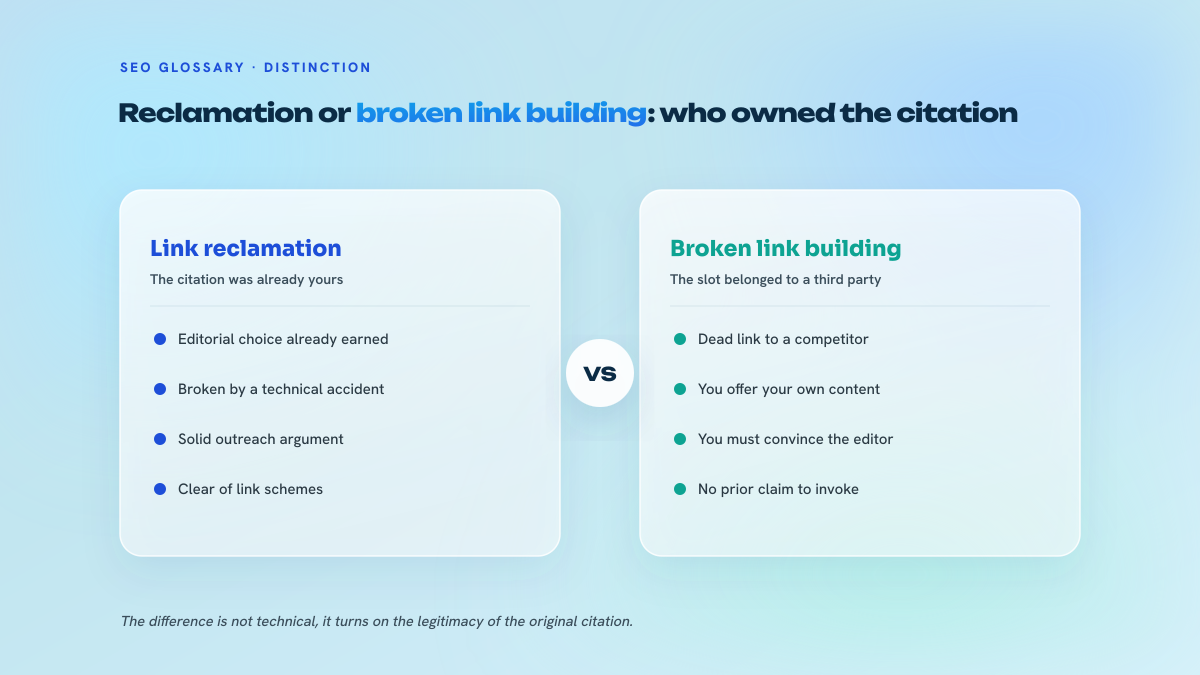
- →A lost link and a broken link are different jobs: the broken one is a technical fix you control unilaterally, the lost one needs a human on the other side to say yes.
- →Verify every candidate against the live referring page before you act. The Google Search Console Links report showed zero links or drops of roughly 85 to 90 % for some properties from 21 May 2026 (Search Engine Land, Search Engine Roundtable), and was reported restored with fresh data on 12 June 2026.
- →Restoring a citation costs a fraction of buying an equivalent placement, and a 2026 survey of 518 SEO professionals put the acceptable price of a high-quality backlink at an average of 508.95 dollars, which is the number your reclamation hours are competing against.
- →Do not read the widely quoted 66.5 % link-rot figure as your recoverable backlog: it covers historical links since January 2013 across 2,062,173 domains, including pages and domains that no longer exist at all.
- →Reclamation stays inside Google's guidelines precisely because it restores an existing editorial decision. The moment you offer money, swap in an optimised anchor or scale the same email to a thousand webmasters, you have left reclamation and entered link-scheme territory.
- →Measure recovered links on citation value, not referral sessions: with AI Overviews compressing clicks, a restored source can matter for entity association long after it stops sending traffic.
What reclamation actually covers
Every link you have already earned sits in one of five states. It points at a working URL. It points at a URL that now returns 404 or 410. It resolves through a chain of hops that dilutes and slows it. It has vanished from the referring page during a redesign, a CMS migration or an editorial cleanup. Or it never existed as a link at all: your brand is named in the body copy with no href around it. Reclamation is the routine of auditing those five states and converting the last four back into the first.
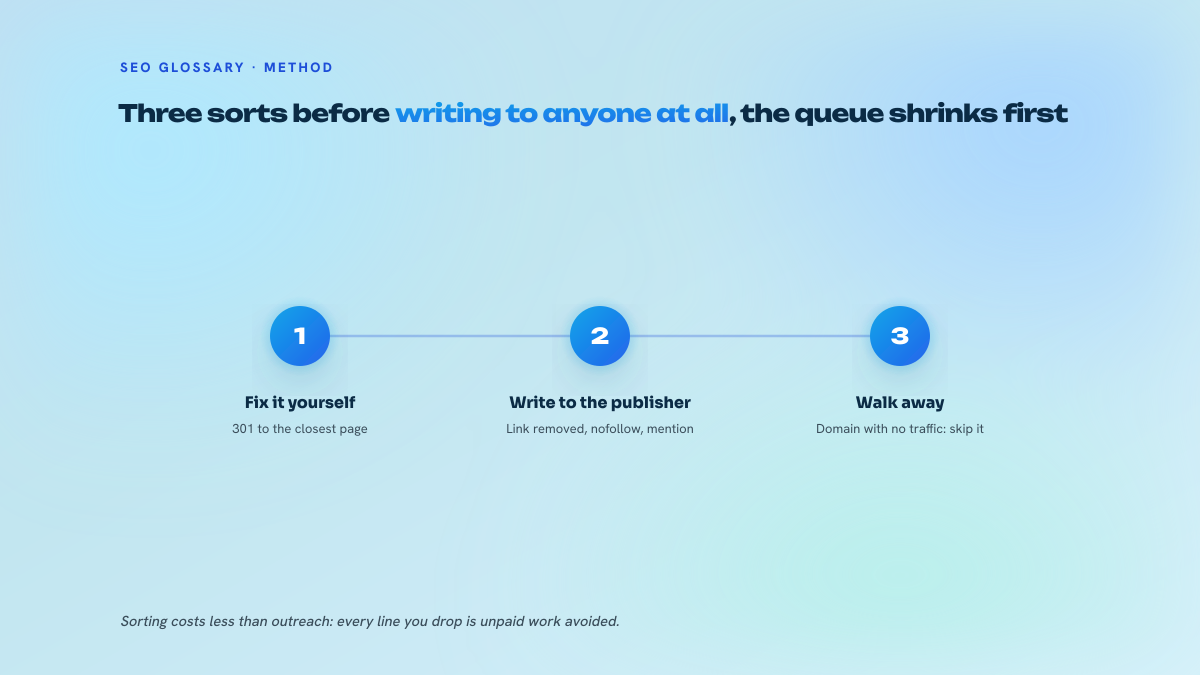
The distinction that matters operationally is who has to act. A target URL returning 404 is yours to fix: you restore the page, or you send it to the closest relevant destination with a permanent redirect, and the equity flows again without anyone else's permission. A link that has been removed from the referring page requires a human on the other side to agree. Those two jobs share a name and almost nothing else: one is a Tuesday afternoon of technical work, the other is outreach with a conversion rate.
This is also where reclamation parts company with broken link building, which hunts for dead links on other people's pages and pitches your content as the replacement. That is acquisition dressed in repair language. Reclamation only touches citations where the editorial decision has already gone in your favour. Ross Hudgens covers the founding logic of the practice in this Whiteboard Friday, which is still the cleanest short explanation of the concept:
The unlinked mention belongs in the same queue for the same reason. A journalist who named your company in a paragraph has already vouched for you; the missing href is an oversight, not a refusal. That is a fundamentally warmer conversation than any cold pitch, and it is why reclamation tends to convert several times better than first-contact outreach on the same publisher list.
The 2026 measurement problem
Reclamation is a data-driven tactic, which makes it hostage to the quality of your link data. 2026 delivered a hard lesson on that front. On 21 May, the Google Search Console Links report began showing zero links, or declines of roughly 85 to 90 %, for some properties. Google said on 23 May that it had switched users back to the previous week's data while it investigated (Search Engine Roundtable and Search Engine Land, May 2026), and the report was reported as restored with fresh data on 12 June. For roughly three weeks, the free tool most teams open first was telling them they had lost most of their backlink profile.
Nothing had been lost. It was a reporting bug, and the timing overlap with the May 2026 core update, which Google's own status dashboard records as a 12-day rollout from 21 May to 2 June, made it look like an algorithmic punishment to anyone who did not read the trade press that week. We saw accounts prepare disavow files over it. The operational rule that comes out of this episode is not complicated and should now be permanent: Search Console link data is a discovery source, never a verdict. Before you redirect anything, email anyone or disavow a single domain, load the referring page and look at the HTML.
The second data trap is link rot at large. A 2026 analysis of Ahrefs data covering 2,062,173 domains, with link data from January 2013 onward, reported that 66.5 % of links were dead under its study definition, a figure the Internet Archive summarised as at least 66.5 % of links to sites over the last nine years being dead. That number gets quoted in sales decks as if two thirds of your current backlinks were sitting there waiting to be recovered. It is nothing of the sort: it is a historical corpus, it counts links whose referring page or entire domain has disappeared, and the Internet Archive itself notes that link-rot studies use different samples and definitions. Your recoverable set is much smaller and much more specific.
Building a queue worth the time
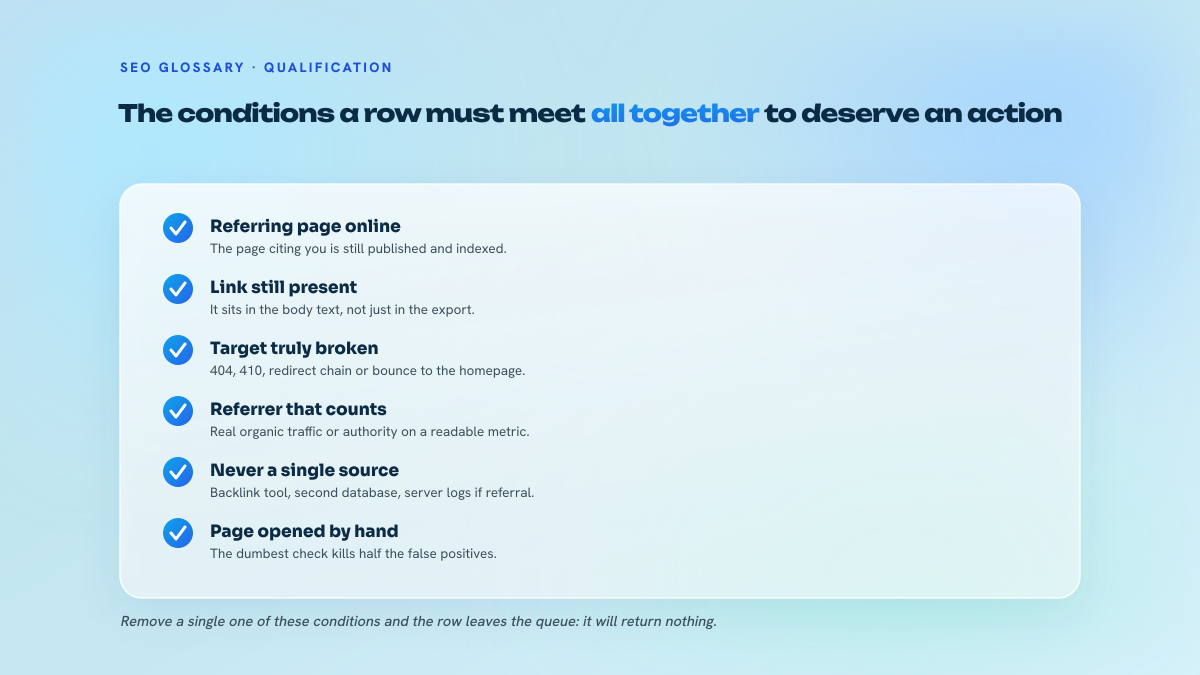
A useful reclamation queue has four filters applied in order, and each one kills a large share of what the tools export. First, the referring page must be live today. If the article is gone, so is the link, and no email brings it back. Second, the original link must have been editorial rather than a footer, a widget or a directory entry, because a publisher who never chose the link will not defend it. Third, the loss must have a mechanism you can name: the target now 404s, the target redirects somewhere irrelevant, the anchor was stripped in a template change, the URL was mistyped. Fourth, the referring domain must have enough traffic or topical relevance to justify the hour it will take.
Tooling covers the mechanical part well. Ahrefs' help documentation, updated 31 October 2025, confirms that its Broken backlinks report surfaces referring pages linking to your 404 URLs, with filtering by anchor, URL and Domain Rating, and recommends either restoring the page or redirecting it to a relevant destination. Semrush's backlink audit and a Screaming Frog crawl of your own 404 log cover the same ground from different angles. What no tool does is tell you whether the link was editorial, and that judgement is the whole value of the exercise. This walkthrough runs the mechanical side end to end if you want to see the workflow in a tool:
Cadence matters more than exhaustiveness. Run the audit monthly on a large site and quarterly on a small one, and run it unconditionally the week after any migration, replatform or URL restructure, because that is when you manufacture your own link rot at scale. A migration that drops fifty inbound target URLs into 404 does more damage in one afternoon than a year of natural attrition.
The economics versus new placements
The case for reclamation is arithmetic. A 2025 and 2026 pricing benchmark reported an average digital PR cost per link of 597 dollars, and a 2026 survey of 518 SEO professionals put the acceptable average price of a high-quality backlink at 508.95 dollars. These are vendor and survey benchmarks rather than universal market prices, but they set the bar your internal hours compete against. Restoring an existing citation from a domain you already qualified costs an email and a follow-up. It also lands on a page that has already accumulated its own signals, which a brand new placement has not.
That does not make reclamation a strategy. It is maintenance, and maintenance has a ceiling: you can only recover what you once earned. Once the queue is clear, growth has to come from somewhere else, whether that is earned press coverage, which BuzzStream's 2025 data summarised in June 2026 found was rated the most effective link-building tactic by 48.6 % of respondents, or paid editorial placements. The honest framing for a client is that reclamation protects the asset base while acquisition grows it, and a plan that only does one of the two eventually stalls. When acquisition is the answer, it helps to know what a placement actually costs on a published grid rather than negotiating blind against those benchmark figures.
The comparison also clarifies what you are buying when you buy. On the French editorial media we own and run in-house, we control the target URLs and the templates, so links we place do not rot through someone else's redesign. That is a structural difference from a link acquired on a third-party site, and it is worth weighing when you plan the campaign rather than when you audit the damage two years later. You can browse the full media catalogue without creating an account and see the metrics before committing anything.
Outreach that actually converts
The reclamation email is short, factual and free of the vocabulary of a pitch. Name the exact article, quote the sentence where your brand appears or where the link sits, state what is broken, give the destination URL, and stop. No compliment about their excellent blog, no paragraph about your company, no request for anything beyond the fix. Anything longer reads as an outreach template, and publishers now filter those on sight.
Three angles cover almost every case. For a broken link, you are reporting a problem on their page that costs them credibility with their own readers, which is the strongest frame available. For a removed link, you reference the original version, and Wayback Machine gives you the proof politely. For an unlinked mention, you simply supply the URL for the brand they already named. Andy Crestodina makes the case for that last angle in under two minutes:
On the legal question that clients occasionally raise: you have no right to a link. Copyright can support a claim about reproduced content and trademark can support a claim about misuse of your name, but neither obliges a publisher to hyperlink a mention. Treat every removal as an editorial decision that you may ask to revisit, once. Escalating past that damages a relationship worth more than the link. If the volume of this work exceeds what your team can carry, it is the kind of ongoing maintenance that fits naturally into having someone run the campaign end to end alongside acquisition.
What we see go wrong
The most expensive mistake is redirecting a 404 target to the homepage. It clears the error from the report and destroys most of the relevance in one move. Send it to the closest equivalent page or restore the original, and if neither exists, accept the loss rather than faking a fix. The second mistake is chaining: the reclaimed URL redirects to a URL that redirects again, usually because nobody cleaned up the previous migration. Audit the whole hop path, not just the first response code.
The third is treating reclamation as a volume play. Exporting eight hundred lost links and mail-merging them turns a legitimate technical courtesy into scaled outreach, which is exactly the pattern Google's link-spam policy targets, and its Search Central update log records new link best-practice guidance added on 15 February 2026. The June 2026 spam update, a two-day rollout per Google's status dashboard, is a reminder that the enforcement side keeps moving. Reclamation is defensible because it restores an existing editorial citation. Offer money, insist on an optimised anchor phrase, or automate the whole thing, and you have quietly changed activity.
The last mistake is measuring the wrong outcome. Teams judge recovered links on referral sessions, which have been declining for reasons that have nothing to do with the link. Ahrefs research from February and May 2026, analysing 300,000 keywords split evenly between those with AI Overviews and comparable informational queries without them, reported a 58 % lower click-through rate for the top organic result when an Overview appeared, up from 34.5 % in its earlier comparison. A restored citation still feeds entity association and source eligibility even as its click contribution shrinks. Judge it on the referring domain count and the quality of the page it sits on, not on the analytics line it produces.
Nautilinks operates an owned network of editorial media. In-house written articles, transparency disclosures respected, anchor mix calibrated.
Frequently asked questions
What recovery rate should I expect on a reclamation campaign?
It splits by type. Broken target URLs you fix yourself, so that portion is effectively 100 % recovered once the redirect or restored page ships. Unlinked mentions convert well because the editorial call is already made in your favour. Deliberately removed links convert worst, since somebody chose to take them out. Rather than chasing a headline percentage, track the three categories separately: a campaign that looks weak overall is often just carrying a large pile of unrecoverable removals.
Does a 301 on the old target pass the same value as getting the link updated?
Close enough that it should be your default, and Ahrefs' own documentation recommends redirecting to a relevant destination when restoring the page is not an option. The caveats are practical rather than theoretical: the destination must be genuinely equivalent in topic, and the hop must be single. A chain of two or three redirects accumulated across migrations slows crawling and muddies the signal. Asking the publisher to update the href is cleaner, but it costs an email and a conversion rate you do not control.
Is link reclamation still safe given how aggressive the link-spam policy has become?
Yes, as long as it stays reclamation. Google's policy targets manipulation: paid links, exchanges, scaled optimised-anchor outreach. Reporting that an article links to a page returning 404 restores a citation the publisher already granted, which is the opposite of manufacturing one. The line gets crossed when payment enters, when you dictate the anchor, or when the same message goes to hundreds of sites unedited. Keep the emails specific and individually written and the tactic stays uncontroversial.
How do I find the right contact when the byline author has left the publication?
Go for the role, not the person. The editorial contact page, the generic editorial inbox and the current section editor beat a chase after a departed writer. On larger publishers, the person who can actually edit a live article is often on the web or production team rather than editorial. If a contact form is the only route, use it and keep the message to three lines: the URL, the broken element, the fix. Successors have no attachment to their predecessor's article and respond to a clean bug report.
Should I reclaim a link if the referring page has lost all its traffic?
If it costs you a redirect, yes, because the marginal effort is zero and the citation still counts as a referring domain. If it costs an email and a follow-up, weigh it against what else that hour buys. A dormant page on a relevant, trusted domain is worth more than an active page on an unrelated one, so relevance and domain trust decide it, not current sessions. What is not worth reclaiming is a link from a domain that has been repurposed or sold since it linked to you.
Can a publisher be made to restore a link that was removed?
No. There is no right to be hyperlinked, and framing a request as a demand is the fastest way to lose the relationship and the link permanently. Copyright can support a claim when your content has been reproduced without attribution, and trademark can support one when your name is misused, but neither compels a hyperlink. Ask once, make it easy to say yes, and drop it if the answer is no.
Test your knowledge
Quiz: Link reclamation
1/3What happened to the Google Search Console Links report in May and June 2026?