- →The inventory of qualified dead URLs is the durable asset; the outreach is the cheap part. Teams that run BLB as a database keep harvesting for years, teams that run it as a campaign quit after two weeks.
- →A Ranktracker roundup published 19 December 2025, using a Pitchbox dataset of 50,000+ campaigns, reports a 41 % reply rate on broken link outreach and 56 % of responders adding the replacement, with 23 % campaign success against 8.5 % for general outreach.
- →Hunter.io publicly skips the tactic after measuring 1.3 % prospect-to-backlink conversion in its 2026 guide. Both figures are true: the spread is entirely explained by how hard you qualify.
- →The multiplier is the number of referring domains pointing at the same dead URL. One asset built, sixty pitches sent, is the only version where the economics work.
- →Adoption sits at 13.3 % of marketers with only 5 % calling it their highest-ROI tactic (LinkPanda 2026 report on 3,000+ backlinks). Treat it as a supplementary channel on top of a predictable editorial baseline, never as the plan.
- →Local and institutional pages outperform high-DR marketing blogs on yield per hour, because the chamber of commerce receives none of these emails and the marketing blog receives forty a month.
The dead URL is the asset, not the tactic
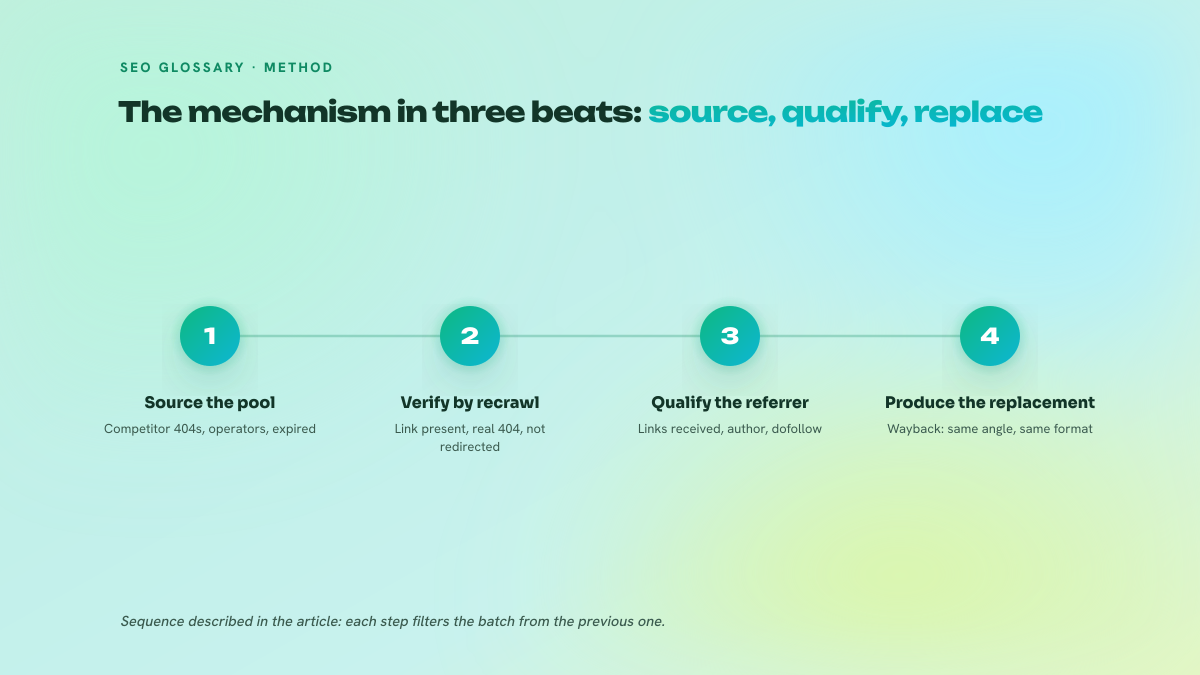
A page dies for boring reasons. The company pivots, the CMS migration ships without redirects, the freelancer who hosted the study stops paying for the server. The page is gone, the links pointing at it are not. Forty editors, sometimes four hundred, still send readers to a URL that answers 404. Broken link building is the operation of turning that residue into placements: you find the dead page, you find who still links to it, you offer a live replacement on the same topic.
The tactic itself is trivial and every guide describes the same three moves. The work is the inventory. A broken link building program is only as good as the list of dead URLs you have assembled and qualified, and that list is a durable asset. It survives campaigns, it can be re-mined every time you publish a new resource, and it does not depreciate the way a generic outreach list of « bloggers in my niche » does. Teams that treat this as a two-week campaign burn out. Teams that treat it as a database keep harvesting for years.
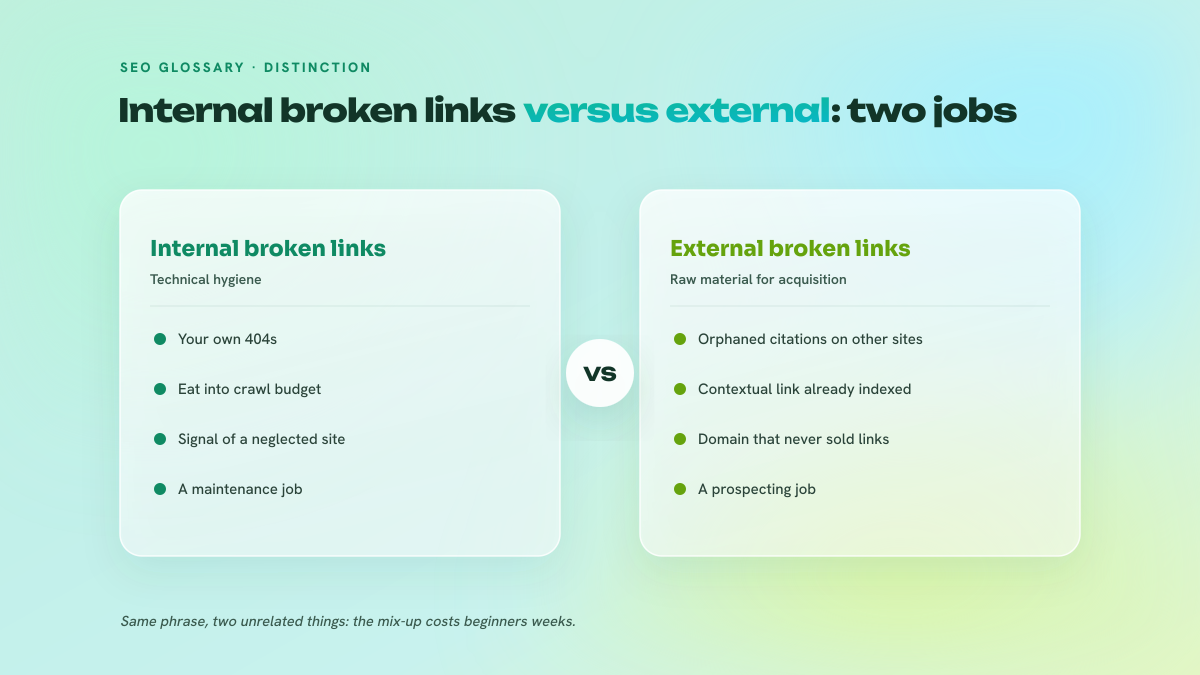
One clarification that matters operationally: not every broken link is a link building opportunity. A 404 on your own site is a technical hygiene problem, and the 2025 and 2026 technical SEO consensus is consistent that large volumes of broken internal links waste crawl budget and make a site read as neglected. That is a different job with a different owner. Broken link building targets external dead pages, on domains you do not control, that other people still cite.
How the pipeline actually runs in 2026
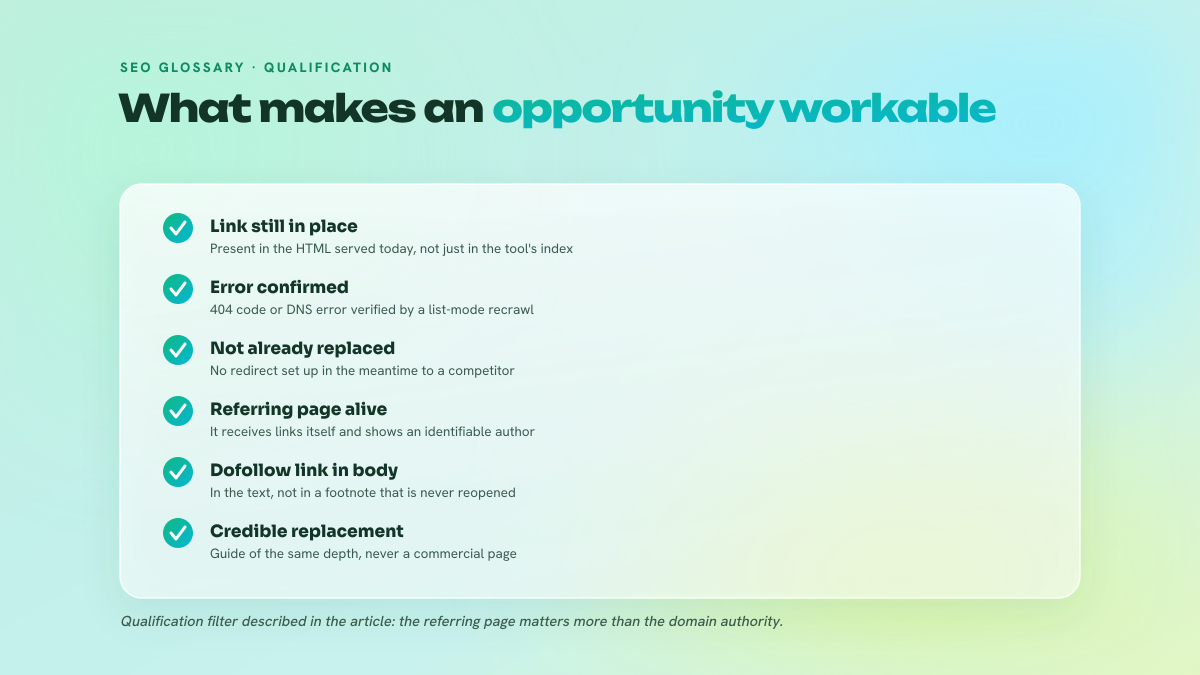
Three sources feed the inventory and they have very different yields. The first is a competitor backlink audit: pull the backlink profile of a domain in your space, filter for target pages returning 404 or 410, and you get dead pages with live referring domains attached. Semrush Backlink Audit and the Ahrefs Best by Links report with a 404 filter both do this; the difference between them is coverage and price, not method. The second is resource pages, those « useful links » roundups nobody has curated since 2019, checked page by page with an extension like Check My Links. The third, which most guides skip, is the whole-site case: an entire domain that dropped, taking hundreds of linked URLs with it. That is also the moment to ask whether buying the expired domain outright beats pitching its backlinks one editor at a time.
Then you qualify, and this is where the value is created or destroyed. For each candidate: does the referring page still get traffic, is it still maintained, does the surrounding context match something you can credibly replace, and how many other sites point at the same dead URL. That last number is the multiplier. A dead study with sixty referring domains is one asset you build once and pitch sixty times, which is the only arithmetic under which this tactic pays for itself.
The conversion data sits well above generic outreach and well below the hype. A backlink statistics roundup published by Ranktracker on 19 December 2025, drawing on a Pitchbox dataset of more than 50,000 campaigns, reports a 41 % average response rate on broken link outreach and 56 % of responding webmasters adding the suggested replacement, with broken link building succeeding in 23 % of campaigns against 18 % for resource page link building and 8.5 % for general outreach. The counterweight deserves naming: Hunter.io states in its 2026 outreach guide that it skips the tactic entirely because its own prospect-to-backlink conversion landed at 1.3 %, roughly 13 links per 1,000 prospects, reasoning that sites worth a link usually monitor and fix their own dead links. Both numbers are honest. The gap between them is the qualification step.
Where it fits in a netlinking operation
Be honest about the ceiling. The 2026 link building statistics report published by LinkPanda, analysing more than 3,000 backlinks alongside aggregated BuzzStream and DemandSage data, puts broken link building at 13.3 % adoption among marketers, with only 5 % rating it their highest-ROI tactic and describing it as a supplementary strategy rather than a primary one. That matches what we see. Nobody builds an acquisition plan on this, because the volume is capped by something outside your control: how many relevant pages happened to die with a usable link profile attached.
What it is genuinely good at is two things. It reaches contexts money cannot easily buy: university resource pages, public sector portals, association directories, the kind of editor who will never answer a cold guest post pitch but will happily fix a broken reference because that is basic housekeeping. And it produces links whose acquisition leaves no commercial trace, which matters more since the spam update Google confirmed in late August 2025 and rolled out over several weeks, explicitly targeting manipulative signals and purchased links.
Run it alongside a predictable channel, not instead of one. The yield curve is lumpy: nothing for three weeks, then six links in a day when one well-cited dead resource finally lands. Editorial placements on media you can actually book give you the flat baseline a campaign plan needs. That is the split we run on the owned French editorial media in our own network: the calendar is planned, the volume is known, and opportunistic tactics sit on top of it. If you want to see what that baseline looks like in practice, the catalogue of media you can browse without creating an account is the version with no sales layer in front of it.
The replacement asset and the pitch
The replacement page decides everything downstream. Three options exist and only two of them work. Recreating the dead resource from the Wayback Machine and republishing it under your own domain is the lazy one, and it fails at any scale because you are asking an editor to link to a photocopy. Updating an existing page of yours so it genuinely covers the dead resource's topic works when the overlap is real and collapses the moment you start stretching the definition of « related ». Building a new resource on purpose, because forty sites just proved there is standing demand for exactly that content, has the highest hit rate and the highest cost. Pick the third one when the multiplier justifies it.
The pitch is one short email and personalisation is not decoration. What separates a 41 % reply rate from near silence is whether the recipient believes a human actually opened their page. Name the URL, name the section, say what the link used to point at, offer the replacement in one line with no adjectives. The reliable failure is the template that opens with two paragraphs of flattery before the ask, which every editor learned to spot years ago.
This walkthrough covers the outreach side with real campaign numbers attached, useful if you want to see the sequencing rather than read about it:
One angle the top results under-serve: local and institutional prospects. A dead link on a regional chamber of commerce page, a city resources list, a sports federation's partners page, converts far better than a dead link on a high-traffic marketing blog, for the simple reason that the marketing blog receives forty of these emails a month and the chamber of commerce receives none. Those links are also harder for a competitor to replicate. Yield per hour on unglamorous local prospecting beats yield per hour on the obvious high-DR list, which is the opposite of what most guides tell you to prioritise.
What we see go wrong
Chasing the dead domain's authority instead of the referring page's. The metric that matters is the quality of the page that will host your link, not the rating of the site that died. A defunct resource with a strong historical profile surrounded by sixty referring pages that are themselves link farms is not an opportunity, it is a list of links you should decline.
Trusting the crawler's 404 flag without checking. Soft 404s, pages that answer 200 with a not-found body, redirect chains that resolve fine for a human, all show up as broken in one tool and healthy in another. Verify manually before you pitch. There is no recovering from an email that tells an editor their working page is broken.
Sending the same asset to sixty editors on the same morning. This tactic is white-hat by construction and that is most of its post-2025 appeal, but a burst of sixty identical pitches followed by sixty new links with an identical anchor inside one week produces an acquisition pattern that has nothing to do with the legitimacy of the method and everything to do with looking automated. Spread it across weeks and vary the anchor.
Skipping the follow-up. A large share of the links in this tactic arrive on the second email, and most teams never send it because the first round already felt like enough work.
Reporting effort instead of outcome. Some teams put the number of prospects contacted in the monthly deck. The only figure that means anything is links live, and still live, ninety days later.
Running it lean
Set a kill threshold before you start. If a batch of 100 properly qualified prospects returns fewer than three live links, the problem is the list or the asset, and sending 400 more emails will faithfully reproduce the same ratio. For calibration, a cold-email link building case study published by Overloop in 2026 reports 500 emails, 47 replies at 9.4 %, and 23 live backlinks for a 4.6 % email-to-link conversion, which it frames as roughly three times its benchmarked average for generic outreach.
Warm up before you ask. SearchX documented a « 3-2-1 » sequence, three interactions, two comments and one custom resource before the request, that moved their outreach conversion from 7 % to 23 % across tactics including broken link outreach. It does not scale to thousands of prospects, and that is precisely the point: it makes a short list beat a long one.
Price your own time honestly. Ahrefs raised prices across all plans in 2025 and moved the Lite plan to a credit-based usage model, with entry plans starting at $129 per month in 2026, and that is before a single hour of qualification or writing. Compute a real cost per acquired link, labour included, then compare it against what a placement on a real editorial site actually costs. On plenty of campaigns broken link building wins on link context and loses badly on cost per link. Knowing which side you land on is what tells you whether to keep it in-house or hand the recurring calendar to a team that does this full time.
This case study puts numbers on whether the tactic still delivers today, success rates included:
Then track four numbers and ignore the rest: links live, referring domains gained net of losses, hours invested per link, and whether the pages hosting your links are still crawled six months later. Everything else in a broken link building dashboard is decoration.
Nautilinks operates an owned network of editorial media. In-house written articles, transparency disclosures respected, anchor mix calibrated.
Frequently asked questions
Does broken link building count as a link scheme under Google's guidelines?
No, and it is one of the few tactics that survived the late August 2025 spam update untouched. Nothing is bought, no exchange is agreed, and the editor keeps full control over whether to link. You are reporting a defect and proposing a fix. The exposure is not the tactic, it is execution: sixty identical anchors landing in one week looks automated regardless of how the links were obtained. Vary anchors, spread the sending, and there is nothing to disclose.
Semrush or Ahrefs for surfacing dead backlinks?
Both find the same dead targets on well-linked domains, so the choice comes down to index coverage on your niche and what you already pay for. Semrush Backlink Audit is more comfortable when you work from a competitor list; the Ahrefs Best by Links report with a 404 filter is faster when you work from a single domain's history. Ahrefs raised prices across all plans in 2025 and moved Lite to credits, so run the cost per usable prospect before committing to either.
Why do reported conversion rates range from 1 % to 23 %?
Because they measure different lists. The Pitchbox data cited by Ranktracker in December 2025 reflects campaigns where the dead URL, the referring page and the replacement asset were all qualified first. The 1.3 % that Hunter.io published for its own attempts reflects volume prospecting on high-authority sites that already monitor their broken links. Same tactic, opposite yields. If your numbers look like the low end, cut the list rather than adding to it.
Is it worth buying the expired domain instead of pitching its backlinks?
Sometimes, and the comparison is arithmetic. Pitching gives you a fraction of the referring domains, editorially placed, with no ongoing cost. Buying gives you the whole link graph but requires rebuilding a credible site on it and carrying the risk that the profile is polluted. Rule of thumb from our own operation: below thirty clean referring domains, pitch. Above that, with a coherent thematic history, price the domain and model both paths.
What does a good replacement asset look like in practice?
It answers the same question the dead page answered, at a comparable or better depth, on a URL that will not itself die in two years. A statistics roundup, a methodology page, a tool comparison, a downloadable dataset. What fails is a commercial page dressed up as a resource: editors who fix broken links are curating, and they can tell. If the multiplier justifies it, build the asset before starting outreach rather than promising it in the email.
How many prospects before I decide the campaign is not working?
One hundred qualified prospects, properly personalised, with one follow-up each. Fewer than three live links out of that batch means the list or the asset is wrong, and volume will not fix either. Compare against the published benchmarks first: a 9.4 % reply rate and 4.6 % email-to-link conversion, as reported in Overloop's 2026 case study, is a working campaign. Under 2 % reply rate usually means your emails are not being read by a human at all.
Test your knowledge
Quiz: Broken link building
1/3In the Pitchbox dataset cited by Ranktracker in December 2025, what share of campaigns did broken link building succeed in, compared with general outreach?