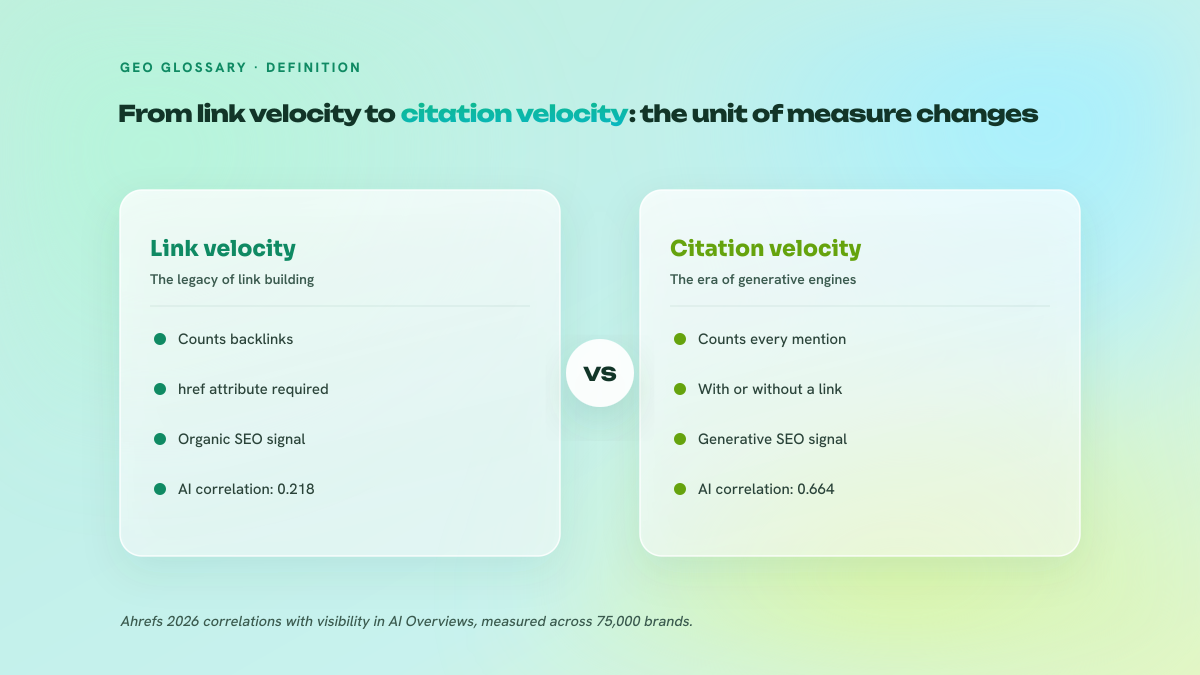
- →Citation velocity is the derivative of your mention graph, not your backlink count. Ahrefs' 75,000-brand analysis (2026) puts web mentions at a 0.664 correlation with AI Overviews visibility, versus 0.218 for backlinks.
- →Steady beats spiky. Analysis of the March 2026 Google spam update found losing sites shared a pattern of short acquisition bursts followed by flat periods, while sites with consistent, topically relevant growth held or improved.
- →Measure on a fixed rolling window, count linked and unlinked citations separately, and read the rate as a percentage of your existing base, not as an absolute number.
- →Nofollow links carry nearly the same weight as followed ones in the AI layer per Semrush's 2025 study of 1,000 domains. A velocity metric that only counts followed links is measuring the wrong decade.
- →Do not concentrate all effort on pages that already rank: BrightEdge and Ahrefs data show only about 17% of URLs cited in AI Overviews also sit in the organic top 10 for the same query.
- →Size-adjust every benchmark. Twenty-five new referring domains in a month reads engineered on a DR 12 site and unremarkable on a DR 75 brand.
What citation velocity actually measures
The term migrated into search marketing from bibliometrics, where it describes how quickly a paper accumulates citations after publication. Researchers care because a paper cited forty times in its first year signals something very different from one that reaches the same count over a decade. The mechanics transfer almost intact to 2026 search: what matters is not the stock of citations a brand holds but the rate at which new ones appear, and the shape of that rate over time.
In an SEO and GEO context, a citation is any retrievable mention of your brand or domain in a source that search systems and answer engines read: a linked reference in an editorial article, an unlinked brand mention in a comparison piece, an entry in a listicle that an LLM later paraphrases. Citation velocity is the first derivative of that graph. It is broader than link velocity, which only tracks the backlink subset, and that distinction stopped being academic once answer engines started assembling responses from retrieved sources rather than ranked pages.
The hard number that reframed the discussion: Ahrefs analyzed 75,000 brands and found a 0.664 correlation between web mentions and visibility in Google's AI Overviews, against 0.218 for backlinks (reported by Machine Relations, 2026). Mentions are roughly three times more predictive of whether an AI answer cites you than your link profile. Our reading, from a decade of operating editorial sites: the industry spent fifteen years optimizing the stock of links because the tools measured stock. The systems on the other side were always watching flow.
How the signal works in 2026
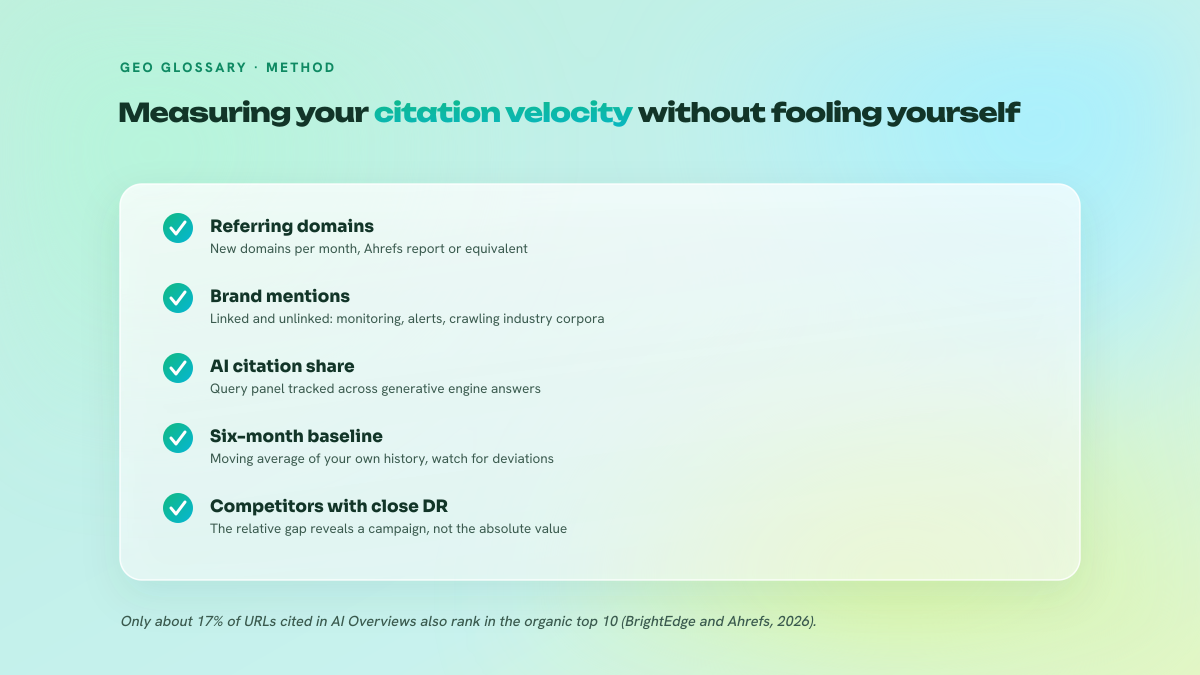
Two mechanisms make velocity operational rather than theoretical. The first is retrieval. AI answer engines do not lift their citations from the classic ranking stack: combined BrightEdge and Ahrefs data from 2026 shows only about 17% of URLs cited in AI Overviews also rank in the organic top 10 for the same query. Five citations out of six come from pages that are not on page one. An engine deciding which sources corroborate a claim leans on how consistently and how recently an entity is cited across its corpus, which is precisely what citation velocity captures and what a static authority score does not.
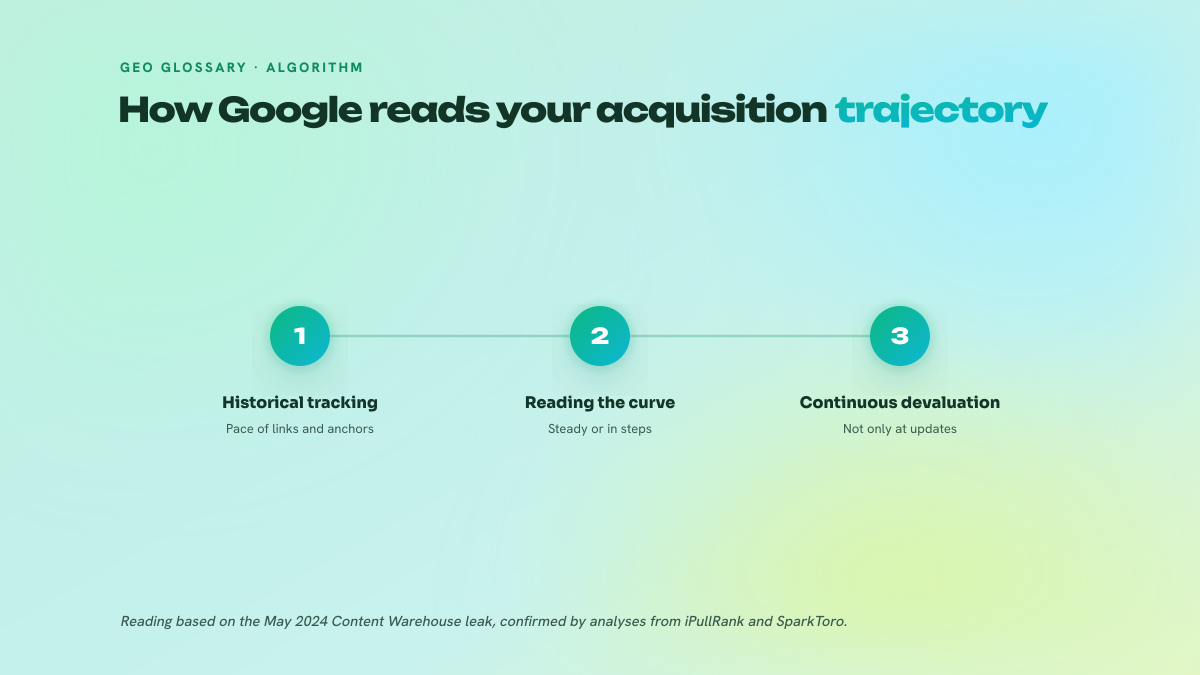
The second mechanism is Google's own modeling of growth curves. The May 2024 Content Warehouse API documentation leak exposed fields like phraseDays, phraseRate and hostAge, plus an IndexingDocjoinerAnchorStatistics module, names independently confirmed across analyses by iPullRank, SparkToro and Search Logistics. The reasonable interpretation: Google stores enough temporal data to model the trajectory of a citation profile, not just its size. A smooth ramp from 10 to 50 referring domains reads organic; the same delta landing in one batch reads engineered.
The enforcement side confirms it. Analysis of the March 2026 spam update (Digital Applied) found that losing sites showed markedly higher rates of velocity anomalies, short bursts of rapid acquisition followed by flat silence, while sites with steady, topically consistent growth held or gained. And the authority question has a documented answer too: Semrush's 2025 study of 1,000 domains found nofollow links carried nearly the same weight as followed ones for AI visibility, because the systems consuming these signals read the whole citation surface, not the PageRank subset. This is the core mechanic behind generative engine optimization: you are feeding a corpus, not sculpting a link graph.
Measuring it without fooling yourself
No tool exports a metric called citation velocity, which is healthy: it forces you to define it. The workable method is a fixed rolling window, 30 days in practice, over which you count three things separately. New referring domains, from Ahrefs or Semrush, for the linked layer. New unlinked mentions, from brand monitoring or Ahrefs' Brand Radar style tooling, for the mention layer. And presence in AI answers, which you can only sample: a stable panel of 30 to 50 prompts run monthly against AI Overviews, ChatGPT and Perplexity, tracking how often and from which sources you get cited. Then express each count as a percentage of the existing base and read the trend line, not the monthly absolute.
Benchmarks exist but demand context. Ahrefs-derived figures circulating in 2025 and 2026 place healthy growth for competitive pages between 5% and 14.5% new followed referring domains per month. Semrush's 2024 « State of Backlinks » research, summarized in Ranktracker's 2025 statistics digest, flags monthly spikes above 50% as the zone where algorithmic checks or manual reviews get triggered. Both numbers only make sense scaled to your base: a 2026 practitioner analysis of sustained-growth sites in Ahrefs data (Link Building Journal) makes the point cleanly, noting that 25 new referring domains in one month looks profoundly unnatural on a fresh DR 12 niche site and entirely mundane on an established DR 75 brand.
One benchmark we would add from running audits across our own network: velocity comparisons are only meaningful against direct competitors on the same query surface. A rate that looks anemic in absolute terms can be the fastest in a slow niche, and that relative position is what retrieval systems appear to reward.
Where it matters in a netlinking operation
Citation velocity is a pacing constraint before it is a KPI. Every placement decision, sponsored article, digital PR hit, listicle inclusion, moves the derivative, and the operational skill is dosing those moves so the curve stays inside what the site's size and history make plausible. In practice this means spreading a quarter's budget across the quarter rather than front-loading it, and mixing linked placements with deliberate unlinked mentions, since the Semrush and Ahrefs data above says the unlinked layer is doing more work for AI visibility than most budgets acknowledge. Structured programs now exist for exactly that layer: building the brand citations AI engines actually retrieve is a different craft from placing followed links, with different site selection logic.
It also changes how you buy. A burst of twenty placements from a marketplace order lands as exactly the step-change the leaked velocity fields are built to catch. The alternative is structural: work with an operator who can pace a campaign across quarters instead of bursts, or run the schedule yourself from a transparent catalogue where you pick publishers one by one and control the calendar directly. At Stringer we run this on the French editorial media we operate in-house, which makes the pacing trivially enforceable: when you own the publication schedule, the velocity curve is a decision, not an accident of when orders clear.
The last operational angle is topical consistency. The March 2026 spam update analysis did not just penalize speed, it spared fast growers whose new citations stayed topically relevant. Velocity and relevance are one combined signal: fifty new citations from your actual thematic neighborhood is a trend, fifty from random directories is a fingerprint.
What we see go wrong
The most common failure is the launch spike. A brand ships a product, buys everything available in a two-week window, then goes silent for a quarter. That exact shape, burst then flat, is what distinguished losers in the March 2026 spam update data, and it wastes money twice: once on links that get dampened, once on the recovery time.
Second, measuring stock instead of flow. Teams report total referring domains and total mentions in their dashboards, numbers that only ever go up and therefore say nothing. If your reporting cannot show the month-over-month rate against the base, you are not measuring citation velocity, you are decorating a slide.
Third, sampling AI visibility once and treating it as a state. Answer engine citations churn heavily as models and retrieval indexes update; a prompt panel run in January describes January. Anything less than monthly measurement on a stable panel produces noise you will misread as signal.
Fourth, over-rotating on pages that already rank. Since roughly five out of six AI Overview citations come from pages outside the organic top 10, a program that only strengthens your ranking URLs ignores most of the citable surface. Deep pages, comparison content and third-party mentions of your brand are where the AI layer actually feeds.
Finally, panic at decay. Citation velocity on any given asset naturally declines as it ages, exactly as it does for academic papers. A falling rate on a two-year-old page is physics; a falling rate across your whole domain while competitors accelerate is a strategy problem. Diagnose at the portfolio level before reacting at the page level.
Nautilinks operates an owned network of editorial media. In-house written articles, transparency disclosures respected, anchor mix calibrated.
Frequently asked questions
Is citation velocity the same thing as link velocity?
No, link velocity is the subset that tracks new backlinks over time. Citation velocity covers the full mention graph: followed links, nofollow links and unlinked brand mentions. The distinction matters because Ahrefs' 75,000-brand analysis found web mentions correlate at 0.664 with AI Overviews visibility versus 0.218 for backlinks, and Semrush's 2025 study found nofollow links carry nearly the same weight as followed ones for AI visibility. If you only track links, you are watching the smaller and less predictive slice.
What is a defensible citation velocity benchmark in 2026?
Ahrefs-derived figures from 2025-2026 place healthy growth for competitive pages at 5% to 14.5% new followed referring domains per month, and Semrush's 2024 « State of Backlinks » research flags monthly spikes above 50% as review territory. But both numbers must be scaled to your base: 25 new domains in a month is an anomaly on a DR 12 site and routine on a DR 75 brand. The only benchmark that consistently matters is your rate relative to direct competitors on the same query surface.
How do I measure citations inside AI answers when there is no index of prompts?
You sample. Build a stable panel of 30 to 50 prompts matching your commercial queries, run it monthly against AI Overviews, ChatGPT and Perplexity, and log which sources each answer cites. The panel must stay fixed across months or you cannot read a trend. Complement it with mention tracking on the open web, since the pages AI engines retrieve are mostly not your own: BrightEdge and Ahrefs data show about 83% of AI Overview citations come from URLs outside the organic top 10.
Can citation velocity decrease without anything being wrong?
Yes, and it usually does. Any single asset's citation rate decays with age, the same pattern bibliometrics documents for papers. Decay only becomes a diagnosis when it shows at the domain level while competitors accelerate, or when it follows a burst-then-flat shape, which is the pattern the March 2026 spam update analysis associated with losing sites. Read velocity at the portfolio level over rolling windows before treating any single-page decline as a problem.
Does buying placements faster ever make sense, for example before a funding round or launch?
Rarely, and never as a batch. The May 2024 Content Warehouse leak exposed fields like phraseDays and phraseRate that suggest Google models the shape of growth, and step-changes are the easiest shape to flag. If an event forces a compressed timeline, spread placements across the weeks you have, keep them topically tight, and weight toward mentions and digital PR rather than followed links, since the mention layer carries the AI visibility upside with less pattern risk.
Test your knowledge
Quiz: Citation Velocity
1/3According to Ahrefs' analysis of 75,000 brands, how do web mentions compare to backlinks as predictors of AI Overviews visibility?