- →Attach the stage to the query, not to the page: one article routinely serves a prospect discovering the problem and a buyer verifying a shortlist, and the SERP tells you which one Google thinks is asking.
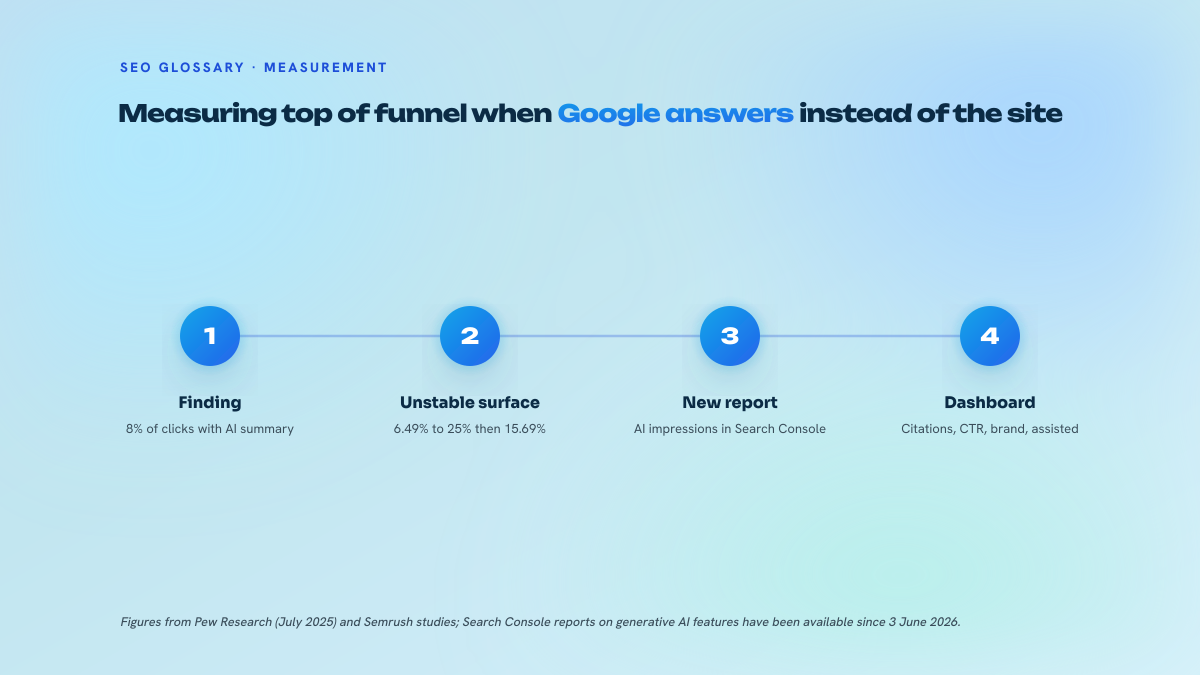
- →Pew Research (July 2025, 68,879 searches) measured clicks on a traditional result for 8% of searches showing an AI summary against 15% without one; awareness queries are where that gap bites hardest.
- →Most sites spend link equity backwards: the awareness pages that earn links naturally sit furthest from the money, while comparison and service pages rank on whatever internal links someone remembered to place.
- →Semrush's June 2025 study found AI-referred visitors converting at 4.4 times the rate of traditional organic visitors, which is a quality signal about who arrives, not a licence to defund the pages that still produce volume.
- →Google's Search Generative AI reports (3 June 2026) expose impressions by page, country, device and date, but no clicks: citation visibility is now measurable, its commercial effect still is not.
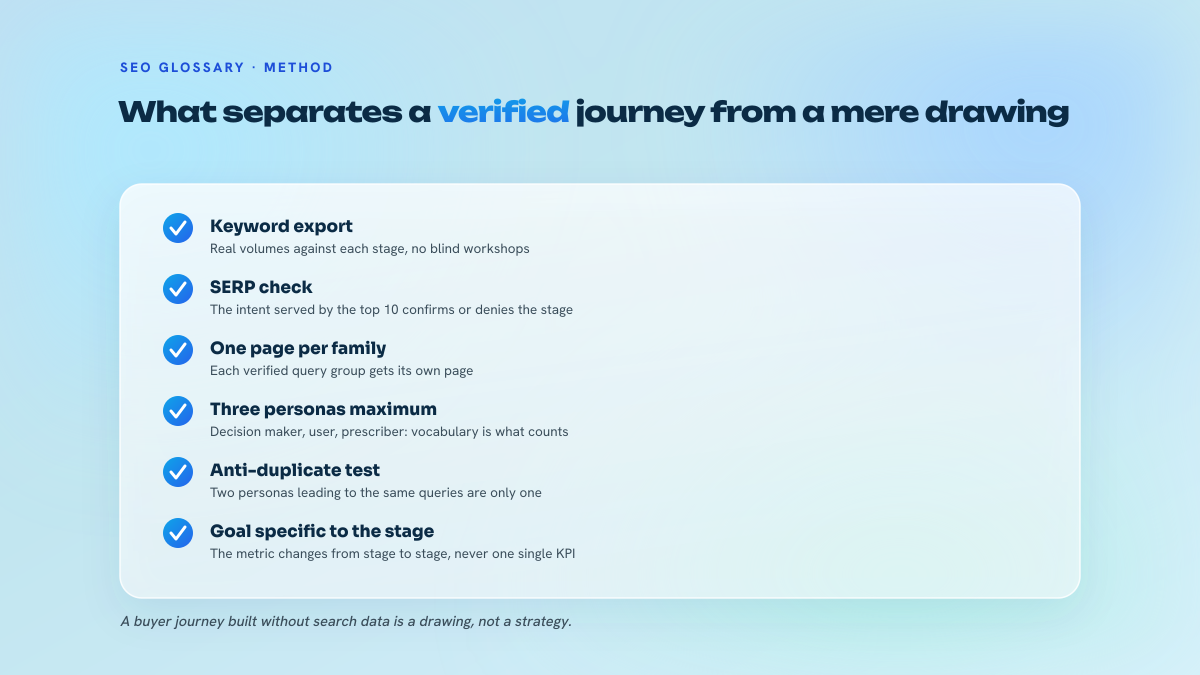
- →Persona workshops produce a document nobody reopens. Sales call transcripts and the ranked results for your commercial queries produce the same insight, with evidence attached.
The buyer journey is a research sequence, not a funnel
Ask ten teams to describe their buyer journey and you get ten redraws of the same three boxes: awareness, consideration, decision. The model comes out of the inbound playbook HubSpot popularised, and it survived because it is easy to draw on a whiteboard and easy to defend in a board meeting. Taken literally, it is also a poor description of how anyone buys anything costing more than a few thousand euros.
What a buyer actually produces is a query trail. A marketing lead who ends up signing a netlinking contract does not walk through three phases in order. They run a long series of searches spread over weeks, loop back to a definition after a sales call, ask a peer in a Slack community, read a comparison, then search the brand name plus the word « avis » two days before the decision. The stages are real as a description of the questions being asked. They are not real as a description of a path.
That distinction changes what you attach a stage to. Most content plans attach it to the page: this article is an awareness piece, that landing page is a decision piece. What you should attach it to is the query. A single page routinely serves a prospect discovering the problem and a buyer verifying a shortlist, and that is fine as long as it answers both in the right order. Reading what the searcher is actually trying to accomplish at the moment of the query is the only stage classifier we have found that survives contact with a real keyword pool. Modifiers are a weak proxy.
The other artefact worth killing early is the persona workshop. Building four fictional characters with first names and hobbies produces a slide deck nobody opens after the kickoff. The SERP already tells you which persona Google believes is asking, in the shape of the pages it chose to rank. If the top ten is made of tutorials and definitions, the query belongs to someone still framing the problem. If it is made of comparison tables and pricing pages, that buyer has moved on and your educational article will not rank there no matter how good it is. Read the results, not the workshop output.
What changed in 2026: awareness stopped producing clicks
The top of the buyer journey has always been the cheapest traffic to acquire and the hardest to attribute. In 2026 it also became the hardest to convert into a visit at all.
The numbers deserve to be stated precisely, because the sloppy version of this argument is repeated everywhere. Pew Research analysed 68,879 real Google searches from a 900-person US panel in July 2025: users clicked a traditional result on 8% of searches that displayed an AI summary, against 15% of searches without one, only 1% clicked a source link inside the summary itself, and browsing sessions ended on 26% of AI-summary searches against 16% otherwise. Ahrefs, working from keyword-level data, reported in its December 2025 update that position-one CTR on AI Overview keywords fell from 7.3% in December 2023 to 1.6% in December 2025, a 58% reduction. Seer Interactive, on a longitudinal set of 5.47 million queries and 2.43 billion impressions across 53 brands, measured AI Overview CTR dropping from 1.76% in June 2024 to 0.61% in September 2025, then recovering to 2.4% in February 2026 while queries without an Overview sat at 3.8%.
Those three datasets measure different objects: user behaviour, keyword CTR, brand-level impressions. Averaging them into one benchmark is how bad slides get made. What they agree on is direction. Informational queries, the awareness end of the journey, increasingly resolve inside the result page. Comparison and verification queries still send visits.
Prevalence moves too. Semrush's ten-million-keyword study logged AI Overviews on 6.49% of tracked queries in January 2025, close to 25% in July, then 15.69% in November 2025. A content roadmap built on a fixed coverage assumption is built on a number that lost about a third of its value between July and November 2025. Google's own May 2026 guidance stopped treating generative surfaces as a separate discipline and folded optimisation for AI Overviews and AI Mode into ordinary search optimisation, which is the correct framing: same pages, same crawlability, different display layer.
The counterweight is worth keeping in view. Semrush's June 2025 study of more than 500 high-value digital marketing topics found AI-referred visitors converting at 4.4 times the rate of traditional organic visitors. Fewer visits, better qualified. That is a statement about who arrives, not evidence that AI traffic replaces organic volume, and reading it as the latter is how teams end up defunding the pages that still pay the bills.
Where the journey decides your netlinking budget
Link equity is a budget with a fixed size, and the buyer journey is the map you use to spend it. Most sites we audit spend it backwards, and the mechanism is almost always the same.
Awareness content earns links on its own, because it is the content other publishers find quotable: definitions, original data, guides. So the pages with the strongest inbound profile end up being the ones sitting furthest from the money. Meanwhile the comparison page and the service page, the two documents a buyer opens with a purchase decision half made, hold whatever internal links someone remembered to place. When those pages fail to rank, the diagnosis is rarely content quality. It is that nothing points at them.
The correction is not subtle: aim acquired links at the consideration and decision layer, and let the awareness layer feed it through internal linking inside a properly wired cluster. An editorial placement that lands mid-journey, inside an article a buyer reads while building a shortlist, does two jobs at once: it passes equity to a page that converts, and it puts the brand in front of a reader already in market. That is the case where placing an article on a media your buyers genuinely read beats ten links from unrelated blogs with a better raw metric.
Stage also dictates depth and selection. Decision pages tolerate fewer direct links than most people assume before the profile starts looking engineered, so volume goes to the cluster around them rather than to the page itself. Relevance does the rest: across the French media we run in-house, the placements that actually move a consideration page are the ones whose audience overlaps the buyer, not the ones with the highest third-party score. If you are sizing this against a quarter, the arbitrage is between many cheap placements at the top of the journey and fewer, better-matched ones close to the decision, which is why our rates per media are public: that trade-off should be made on real numbers, not on a quote you have to ask for.
What we see go wrong in audits
Four failure modes, roughly in order of how often they show up.
Mapping stage by modifier. A spreadsheet that files every query containing « best » under consideration and every « how to » under awareness will misclassify a large slice of any B2B pool. « How to choose a netlinking provider » is a decision query wearing an informational costume, and the ranked results say so. Classify against what ranks, and reclassify after each core update. The May 2026 core update, which ran from 21 May to 2 June 2026 according to Google's Search Status Dashboard, rewrote intent on plenty of mid-journey queries.
Cutting the top of the journey because its click-through rate fell. This is the 2026 version of an old mistake. Awareness pages that no longer earn the click still earn the citation, and the citation still feeds the branded search that arrives two weeks later. Remove them and you discover six months on that your branded volume was downstream of them the whole time.
Writing only for the decision stage. The mirror error, and the more expensive one, because decision queries represent a small fraction of addressable volume and the most contested slice of it. A site made only of bottom-funnel pages has no topical authority to inherit from, so its money pages compete on backlinks alone against competitors who have both.
Planning the journey without the sales team. The objection list that matters already exists, in call recordings and in the questions people ask on the phone before signing. A FAQ transcribed from those calls converts. A FAQ invented in a content meeting fills a schema block and nothing else. The same applies to the content gap exercise: comparing your page inventory against competitors tells you what everyone covers, not what your buyers actually asked and left unanswered.
Measuring a journey that no longer ends in one click
Measurement is where most buyer journey programmes quietly fail, and 2026 gave us one genuine improvement plus one large trap.
The improvement: on 3 June 2026 Google launched dedicated Search Generative AI performance reports covering AI Overviews, AI Mode and generative features in Discover, exposing impressions by page, country, device and date alongside standard Search Console data. Citation visibility is finally native rather than inferred from a third-party tracker. The limit is explicit: the launch reports impressions, not clicks, and Google said additional metrics were under consideration. So you can now see that a page appears during discovery. You still cannot see whether that appearance produced a visit or a customer.
The trap: AI Mode clicks, impressions and positions were merged into standard Performance totals from June 2025 with no filter at first, and Google disclosed a logging error affecting impressions from 13 May 2025. Any year-over-year comparison crossing those boundaries is contaminated. Annotate your reporting or you will attribute a platform change to your own work.
Practically, report by stage rather than in one blended organic line. Discovery answers to impressions, AI citations and branded search growth. Consideration answers to entrances on comparison pages, assisted conversions and returning visits. Decision answers to conversion rate, direct traffic and the self-reported « how did you hear about us » field, which remains the cheapest attribution instrument nobody installs. A falling organic CTR alongside rising branded volume is not a loss, it is the journey relocating upstream. Teams running acquisition at this level usually end up filtering a media catalogue by topic and audience before they look at a single metric, because stage-appropriate relevance is what the reporting keeps pointing at.
Nautilinks operates an owned network of editorial media. In-house written articles, transparency disclosures respected, anchor mix calibrated.
Frequently asked questions
Three stages or five? Which model should a content team actually plan against?
Three is enough for planning, five is useful for reporting. The extended models split post-purchase into retention and advocacy, which matters for SaaS renewal and referral programmes but adds nothing to a search roadmap, since almost no purchase-stage query maps to advocacy. Plan content against awareness, consideration and decision, then report separately on post-sale search demand if your product has a support or renewal query cluster worth owning.
Buyer journey versus customer journey: does the distinction change anything operationally?
It changes ownership more than tactics. The buyer journey ends at signature and belongs to marketing and sales. The customer journey continues through onboarding, support and renewal, and belongs to product and success. For SEO the practical consequence is scope: support queries, integration questions and troubleshooting content sit in the customer journey, generate real search volume, and are almost always excluded from a keyword plan built around acquisition. That exclusion is a choice, not a rule.
If AI Overviews absorb the click, is awareness content still worth funding?
Yes, but funded as citation inventory rather than as a traffic line. Ahrefs measured position-one CTR on AI Overview keywords falling from 7.3% in December 2023 to 1.6% in December 2025. That page still gets cited, still seeds brand recall, and still supports the cluster that carries equity to your commercial pages. What should change is the KPI attached to it and the budget per piece, not its existence. Judge it on impressions, citations and branded search growth.
How do you assign stages to a large keyword pool without a persona workshop?
Pull the top ten for each query and classify by result type. Tutorials and definitions signal discovery, comparison and review pages signal evaluation, pricing pages and branded modifiers signal decision. It is mechanical, it scales, and it is grounded in what Google already decided. Re-run it after each core update on the commercial subset, since intent shifts there first. Modifier-based rules produce roughly the right answer on generic pools and fail badly on B2B vocabulary.
Does the stage of a page change how many links it should receive?
It changes the distribution more than the total. Decision pages absorb fewer direct links before the profile looks manufactured, so most acquisition goes to supporting pages in the same cluster and flows inward through internal links. Consideration content, comparisons and buying guides, is the sweet spot: it accepts editorial links naturally and sits one internal link from conversion. Selecting hosts whose audience overlaps your buyer matters more than the count at every stage.
What is the fastest way to find where a buyer journey is broken on an existing site?
Take your commercial queries, check which of your pages ranks, then follow the internal path from your best-linked article to that page. In most audits the answer appears immediately: the ranking page is an informational one with no route to a commercial page, or the commercial page exists and receives no internal links at all. Fixing internal routing usually moves rankings before any new link is bought.
Test your knowledge
Quiz: Buyer journey
1/3In Pew Research's July 2025 analysis of 68,879 real Google searches, what share of searches produced a click on a traditional result with and without an AI summary?