- →AS is the only major authority metric with estimated organic traffic baked in, so a clean link graph with no traffic scores lower on AS than on DR: that gap is diagnostic information, not noise.
- →Semrush recalculates AS weekly for high-traffic domains and roughly monthly for smaller ones (Linkscope, 2026), so a link campaign shows up in the number weeks after the links land, never days.
- →Semrush's own backlinks and AI search study (1,000 domains, 16 October 2025) found threshold effects: visibility gains cluster once a site crosses into higher authority tiers, which argues for concentrating budget rather than spreading it thin.
- →A Semrush 2026 study of 50,000 brands found domain-level metrics predicted ChatGPT topic ownership only 52.5% of the time, so AS is a weak proxy for topical strength and should never gate a topical decision.
- →AS moves for reasons that have nothing to do with your links: the Toxic Score model was retrained on a larger penalty dataset in Q4 2025, and reference points shift when the model does.
- →Use AS to sort a prospect list, then price the media on traffic, topical fit and referring-domain profile read separately. A single integer cannot carry three decisions.
What the number actually compresses
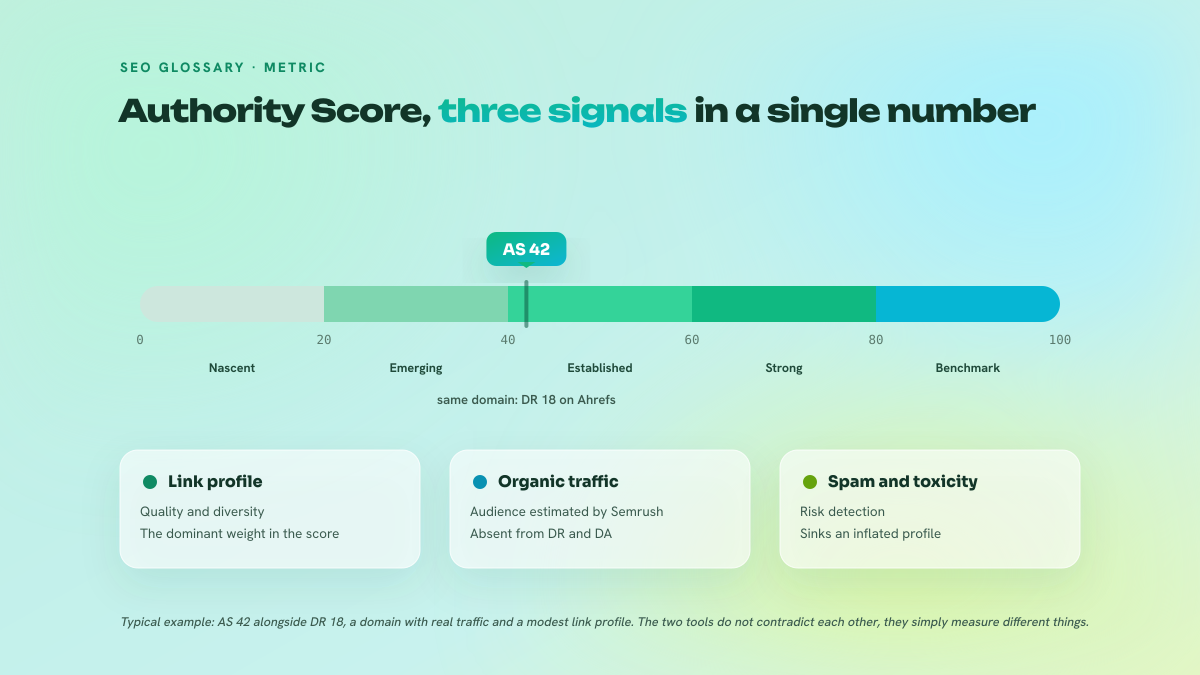
Authority Score is Semrush's attempt to put three unrelated things into one integer. Semrush documents it as a 0-100 compound built from backlink quality and referring domain diversity, estimated organic traffic, and spam or toxicity signals. Its free Website Traffic checker, as documented on 24 June 2026, uses exactly that framing: an estimate of a site's strength and credibility based on backlinks, traffic and other factors. That middle ingredient is the whole story, because it is what separates AS from every other authority metric a netlinking professional touches.
Ahrefs reads the link graph and stops there, which is why a domain rating built purely on link equity can sit at 45 on a site that has not ranked for anything in three years. Moz's DA is a link-based model too. AS is the only one of the three where a dead site with a good historical backlink profile gets marked down, because the traffic component drags it. For anyone buying links on expired or recovered domains, that single design choice makes AS the more honest first read.
The link half of the metric is still doing most of the work. A 2026 benchmark synthesis published by Launchcodex, aggregating Moz, Ahrefs, Semrush and Linkscope data, found that the count of unique referring domains explains roughly 52% of the variance in authority metrics, the quality of those domains another 31%, leaving about 17% to age, content and technical factors. In other words: the raw count of distinct linking domains remains the dominant variable, and everything else is a correction term. Anyone selling you a theory where content quality drives an authority score is describing a rounding error.
What AS cannot tell you is why. It is a compression, and compression is lossy by construction. Two domains at AS 32 can be a small niche publisher with 4,000 monthly organic visits and 180 clean referring domains, or a bloated directory with 900 referring domains and almost no traffic. The number is identical. The value to your campaign is not.
How fast it moves, and why that matters
Update cadence is the operational fact most people get wrong. Linkscope's 2026 documentation states that AS is recalculated weekly for high-traffic domains and about monthly for smaller sites as Semrush recrawls, and a 2026 Semrush tutorial gives a consistent picture: scores typically refresh monthly, or sooner after a major backlink-profile change. So if you place ten links in a fortnight and check the score on day fifteen, you are reading a stale number on a small domain. Measurable movement lags acquisition by weeks.
The scale is not linear in effort either. From what we see running audits across a network of owned media, dragging a site from the low twenties to the low thirties costs a fraction of what it takes to move from 50 to 60. The upper range is crowded with sites that have decades of accumulated referring domains and real traffic, and no realistic campaign budget closes that gap in a quarter. Treat AS gains as a curve that flattens, and plan the campaign around the tier you are trying to reach rather than a target number.
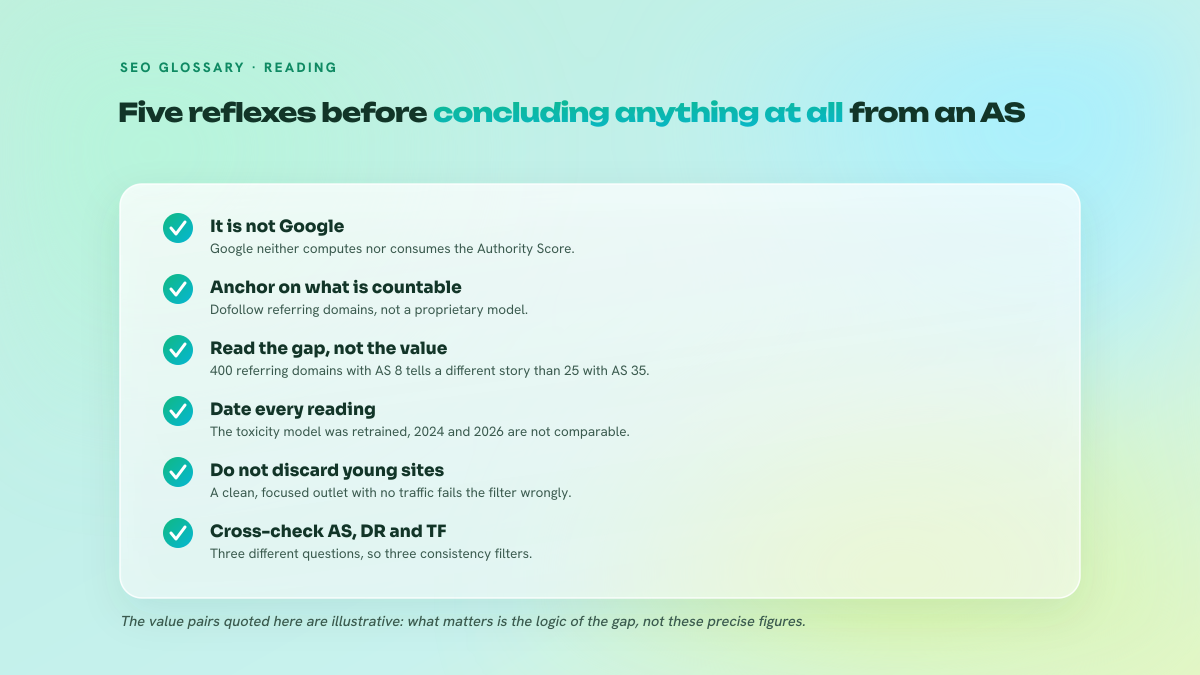
The score also moves for reasons that have nothing to do with your work. A 2026 review of Semrush notes that the Backlink Audit toxic-score model was retrained on a larger penalty dataset in Q4 2025. When the spam model changes, the spam component of AS changes with it, and domains can slip a few points while their link profile stayed identical. That is not a penalty, it is a re-measurement. If you report AS to a client month over month without noting model changes, you will eventually spend an hour explaining a drop you did not cause.
Why AS became the currency of link outreach
Walk any French or European link marketplace and you will find pricing grids indexed on an authority integer. A 2025-2026 Ranktracker roundup reports that 63% of SEO professionals use DA as their primary link-quality metric, with AS and DR treated as close equivalents despite different methodologies. The industry has settled on a single number as its unit of account, and Semrush encourages the pattern: its 2026 link building documentation tells you to check the Authority Score for domain strength and the Toxicity Score for spamminess when qualifying prospects.
Pairing the two is sound advice and most buyers skip the second half. The consequence is a market where a domain sitting at AS 40 sells at a fixed multiple of one at AS 25, regardless of whether the traffic behind those scores is branded, off-niche, or concentrated on three keywords that will not survive the next core update. When you pick a media directly from its published metrics and traffic history, the AS number should be one column among several, not the sort key that decides the invoice.
This is the reasoning behind how we expose data on the owned French editorial media we operate. Authority Score sits next to real traffic, topical scope and the referring-domain profile, because a buyer who only sees the composite cannot tell a well-linked small publisher from a traffic-poor aggregator. That transparency is not generosity, it is self-interest: a client who buys the wrong media for the wrong reason blames the link, not their own filter.
There is a second reason AS keeps mattering. Semrush's backlinks and AI search study of 1,000 domains, published 16 October 2025, used Authority Score as its composite authority variable and found that stronger backlink authority raises the likelihood of being cited in AI-generated answers, with a clear threshold effect: meaningful visibility gains appear only once a site reaches the higher authority tiers. The same study found the correlation with AI visibility was similar for follow and nofollow links, with authority itself dominating. If you are budgeting for AI-answer presence, that argues for concentrating spend to cross a tier rather than sprinkling links to nudge a number.
Do not overread it, though. A Semrush 2026 study of 50,000 brands found that domain-level metrics, AS included alongside organic traffic and branded search, predicted which brand owned a ChatGPT topic only 52.5% of the time. That is barely better than a coin flip. Domain authority buys you eligibility, not topical ownership.
Using it as a filter, not as a verdict
The workable use of AS is comparative and directional. Comparative means you read it against the competitor set for the query you are chasing, not against an absolute benchmark, because the distribution of scores in an insurance vertical and a local artisan vertical have nothing in common. Pull the top ten for your target query, note their scores, and you have a target band. That band is the only benchmark worth having.
Directional means the trajectory carries more signal than the value. A domain that climbed from 18 to 27 over eight months is acquiring links and traffic; one that has sat at 34 for two years is coasting on history. The first is a media whose links will be worth more in six months than they cost today. The second is a media whose price is anchored to a past it is no longer building on. When you review a catalogue of publishers you can inspect before committing, ask for the trend, not the snapshot.
Then decompose. Check the traffic component separately in Domain Overview, where Semrush displays AS alongside organic traffic, paid traffic and backlinks. Check the spam side separately with a toxicity read and, if you use Moz too, a second spam model as a cross-check: two independent spam estimates disagreeing on the same domain is itself a useful flag. Only after those three reads does the composite mean anything specific.
What we see go wrong
Treating AS as a Google signal is the first and most expensive error. It is a vendor model. Google's own internal site-level signal, the siteAuthority attribute surfaced in the documentation leak, is a separate thing that no third-party tool reads, and PageRank descendants are not exposed either. AS correlates with ranking ability because it models similar inputs, not because Google consults it. Any argument that ends with « our AS went up so we will rank » has skipped the step where rankings are the thing you measure.
The second is cross-tool arithmetic. AS, DR and DA all run on the same 1-100 scale and none of them are commensurable. A domain at DR 40 and AS 26 is not contradictory, it is a site with a decent link graph and thin traffic, which is exactly the case AS was designed to catch. Averaging the three, or demanding a domain clear a threshold on all three, filters out the interesting asymmetries.
The third is buying score without buying relevance. A generalist news domain at AS 55 whose traffic sits entirely in politics does nothing measurable for a B2B SaaS page, and the link will be priced as if it did. Topical proximity is not in the AS formula at all. The metric is blind to whether the linking page has anything to do with you.
The fourth is cadence mismatch: running a weekly reporting rhythm on a metric that refreshes monthly for most domains. You will generate noise, explain noise, and eventually make a decision on noise. Report AS quarterly and report placements weekly.
The last is chasing the score itself. AS is a proxy that gets gamed the moment it becomes a KPI. Semrush's spam detection exists precisely because the input, referring domains, is purchasable in volume. A profile assembled to move a number rather than to move rankings tends to look exactly like what the toxicity model was retrained to catch.
Working thresholds and a usable protocol
A rough operational read, based on what we see across campaigns rather than on any published benchmark: below 15 you are looking at a new or dormant domain and should price it as such; 20 to 35 covers most genuine niche publishers and is where the best value sits in the French market; 40 to 60 is established regional and vertical media, priced accordingly; above 60 you are into national press and the price stops tracking the SEO value. Those bands are starting points to be overridden by the competitor set for your actual query.
The check itself needs no subscription for a first pass: Semrush's free website checker returns AS for any domain, which is enough to triage a prospect list before you spend anything. Full access comes with the paid tiers, listed in 2026 pricing guides at $139.95 a month for Pro, $249.95 for Guru and $499.95 for Business on monthly billing, all of which include AS in Domain Overview and the backlink tools. The API exposes authority scores programmatically if you are qualifying at volume. Weigh that tooling cost against what a single placement actually costs you: for anyone buying more than a handful of links a month, the subscription pays for itself on one avoided bad purchase.
The protocol we would defend: triage the prospect list on AS to cut the bottom, then discard the score. Read organic traffic and its keyword spread. Read referring domain count and growth over twelve months. Read topical overlap with your target page. Read a spam estimate from two models. Buy on those four, and use AS only to explain to a stakeholder why the list looks the way it does. The composite is a communication tool and a coarse filter. It was never a decision engine, and the 52.5% predictive rate Semrush found on its own 50,000-brand study is the strongest argument available that its own vendor knows it.
Nautilinks operates an owned network of editorial media. In-house written articles, transparency disclosures respected, anchor mix calibrated.
Frequently asked questions
Is there a defensible answer to what counts as a good Authority Score?
Only relative to the SERP you are targeting. Pull the top ten results for your query, read their scores, and that band is your benchmark. In the French market most genuine niche publishers land between 20 and 35, and that range is where cost per unit of value tends to be best. An absolute threshold applied across verticals will reject good media in low-competition niches and wave through overpriced ones in crowded verticals.
How long after a link campaign should I expect AS to move?
Weeks, not days. Linkscope's 2026 documentation puts recalculation at weekly for high-traffic domains and roughly monthly for smaller sites, and Semrush's own 2026 tutorial says the same thing: monthly, or sooner after a major backlink-profile change. Semrush also has to discover and index the link first. Plan a quarterly reading cadence for AS and track placements and referring-domain count weekly if you need a faster feedback loop.
Why does the same domain score much lower on AS than on Ahrefs DR?
Because AS includes estimated organic traffic and DR does not. DR models the link graph in isolation, so a recovered or expired domain with a strong historical profile and no current traffic keeps a high DR while AS marks it down. That gap is useful signal rather than a tool disagreement: a wide DR-over-AS spread usually means links without an audience behind them, which is exactly the profile you want to price cautiously.
Does Authority Score predict whether a site gets cited in AI answers?
Partly, with threshold effects. Semrush's backlinks and AI search study of 1,000 domains, published 16 October 2025, used AS as its authority variable and found that gains in AI visibility concentrate once a site reaches higher authority tiers, with follow and nofollow links correlating similarly. But its 2026 study of 50,000 brands found domain-level metrics predicted ChatGPT topic ownership only 52.5% of the time. Authority buys eligibility, not topical ownership.
Can AS drop without me losing any backlinks?
Yes, and it happens more often than people expect. The spam component is model-driven, and a 2026 review notes Semrush retrained its toxic-score model on a larger penalty dataset in Q4 2025. When the model changes, scores shift on unchanged profiles. Traffic estimates also move with Semrush's keyword database refreshes. Before investigating a drop as a link problem, check whether referring domains and traffic actually changed.
Should I filter a prospect list on AS alone?
Use it to cut the obvious bottom, then stop. AS carries no topical information at all, so a general-interest domain at 55 with traffic entirely outside your field will score better than a perfectly relevant vertical publisher at 25. Semrush's own link building documentation pairs Authority Score with Toxicity Score for exactly this reason. Add traffic composition and topical overlap before any purchase decision.
Test your knowledge
Quiz: Semrush Authority Score
1/3What distinguishes Semrush Authority Score from Ahrefs DR and Moz DA in terms of inputs?