- →Being cited inside an AI Overview is worth more than ranking below one: Seer Interactive (Jun 2024 to Sep 2025) recorded a 61% CTR drop on AIO queries and a 35% CTR gain for cited pages at equivalent rank.
- →AEO is not a parallel discipline. BrightEdge tracked citation overlap with organic rankings rising from 32.3% in May 2024 to 54.5% in September 2025, so the retrieval corpus is still largely the classic index.
- →Top-10 ranking is neither necessary nor sufficient: roughly 17% of URLs cited in AI Overviews also rank top 10, while about half sit somewhere in the top 100 (BrightEdge data, 2025).
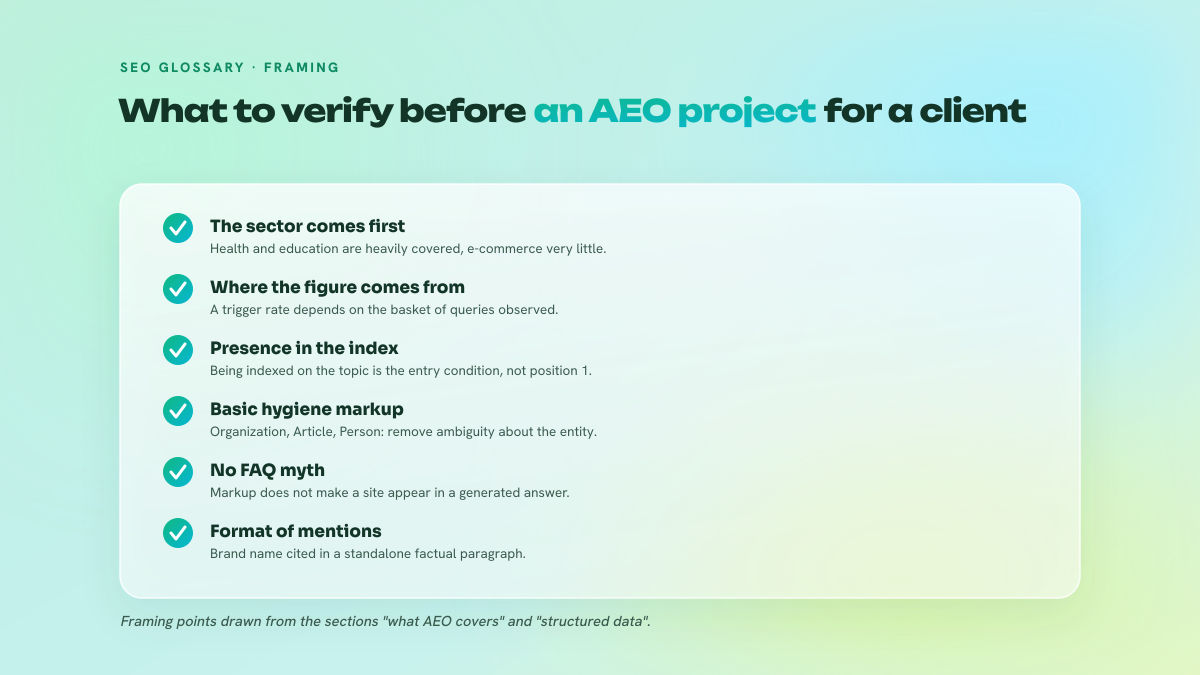
- →Schema helps machines parse, it does not buy citations. Answer engines ground their output on retrieved text passages, so markup is hygiene and corroboration is the lever.
- →Measure citation share and assistant referral traffic separately from Search Console clicks. Seer's 2026 update shows CTR on AIO queries recovering from 1.3% in December 2025 to 2.4% in February 2026, from a much lower base.
- →Off-page still decides most of it: independent corroboration of the same claims across media an engine already trusts is what moves a brand from retrieved to cited.
What AEO really is, past the acronym
Answer engine optimization is the work of being selected as a source inside a generated answer, not merely ranked as a link underneath it. The distinction reads as semantics until you look at where the clicks land. Seer Interactive, tracking 3,119 informational queries across 42 organisations between June 2024 and September 2025, measured organic CTR on queries showing an AI Overview falling 61%, from 1.76% to 0.61%. On those same SERPs, pages cited inside the answer gained 35% organic CTR compared with non-cited pages at equivalent rank. That gap is the entire business case: the ranking still exists, it only pays properly when the engine names you.
Ahrefs put together a solid primer on the concept, worth watching before going deeper:
The surface has grown fast enough that ignoring it is now a positioning choice rather than a technical one. Google shipped AI Overviews to over 100 countries on 28 October 2024. Semrush, studying 10 million keywords, found AI Overviews on 6.49% of queries in January 2025, peaking at 24.61% in July 2025 and settling near 15.69% in November 2025. BrightEdge, tracking nine industries, reports coverage up 58% year over year between February 2025 and February 2026, firing on roughly 48% of the queries it monitors. Sector spread is brutal: by December 2025 BrightEdge saw AI Overviews on 88% of healthcare queries and 83% of education queries, while e-commerce stayed flat and even declined 7.6%. If you sell products, AEO is a secondary front. If you sell expertise, it is the front.
AEO vs SEO: one index, two payouts
The honest answer to the vs question: AEO is a layer on top of search optimization, not a replacement for it, and the vendors selling it as a new discipline with a new toolset are selling you a rebrand. BrightEdge's sixteen-month study found the overlap between AI Overview citations and classic organic rankings climbing from 32.3% at the May 2024 launch to 54.5% in September 2025, a 22.2 point increase. The engines are not building a separate corpus. They are retrieving from the index you already work on, then deciding which of those documents survive into a synthesized answer.
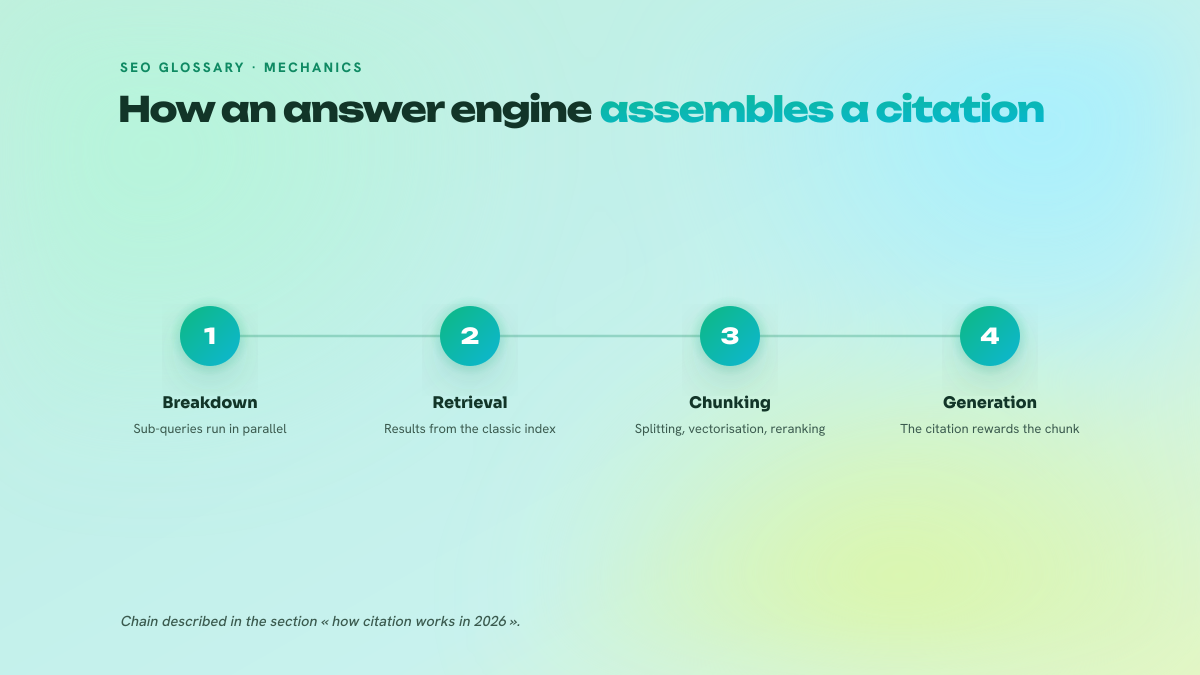
What actually changes is the unit of competition. Classic SEO optimizes a page against a query. AEO optimizes a passage against a sub-question, because the model decomposes the user's intent before it retrieves. That decomposition, the way a single prompt gets split into a dozen parallel retrievals, is why a page that answers one question exhaustively often gets outperformed by a page that answers eight adjacent ones cleanly. It is also why the featured snippet playbook is decaying rather than transferring: Semrush measured snippet and AI Overview co-occurrence dropping from 34% in March 2025 to 18% in November 2025. The answer box is eating its predecessor, not sitting beside it.
Two other things separate the two practices. Position is fuzzy in an answer engine, so there is no rank to defend, only a citation slot to earn, and the number of slots keeps moving: SE Ranking tracked the average number of links inside an AI Overview growing from 6.82 in November 2024 to 15.22 in February 2026. And the query set is different in shape, longer, more conversational, more comparative. Optimizing for AEO without a working understanding of how the answer block itself is assembled and rendered produces content that reads well and never gets retrieved.
How answer engines actually select their sources
Strip the mystique and the pipeline is roughly this: the query is expanded into sub-queries, each sub-query hits a retrieval layer over the search index, candidate passages come back, the model grounds its generated text on the highest-scoring ones, and a subset of those documents gets surfaced as citations. Selection therefore happens twice, once at retrieval and once at attribution, and most content fails at the first stage while its owner is busy optimizing for the second.
The most useful number we have on this comes from BrightEdge, summarized across several outlets: only about 17% of URLs cited in AI Overviews also rank in the top 10 organic results for that query, while roughly 48.7% to 53.1% of cited sources appear somewhere in the top 100. Read that carefully, because it kills two lazy conclusions at once. Being on page one does not buy you a citation. And being invisible in the index does not get you one either. What it means operationally is that broad indexed presence on a topic, several pages each covering a distinct facet, beats a single monolithic page fighting for position three.
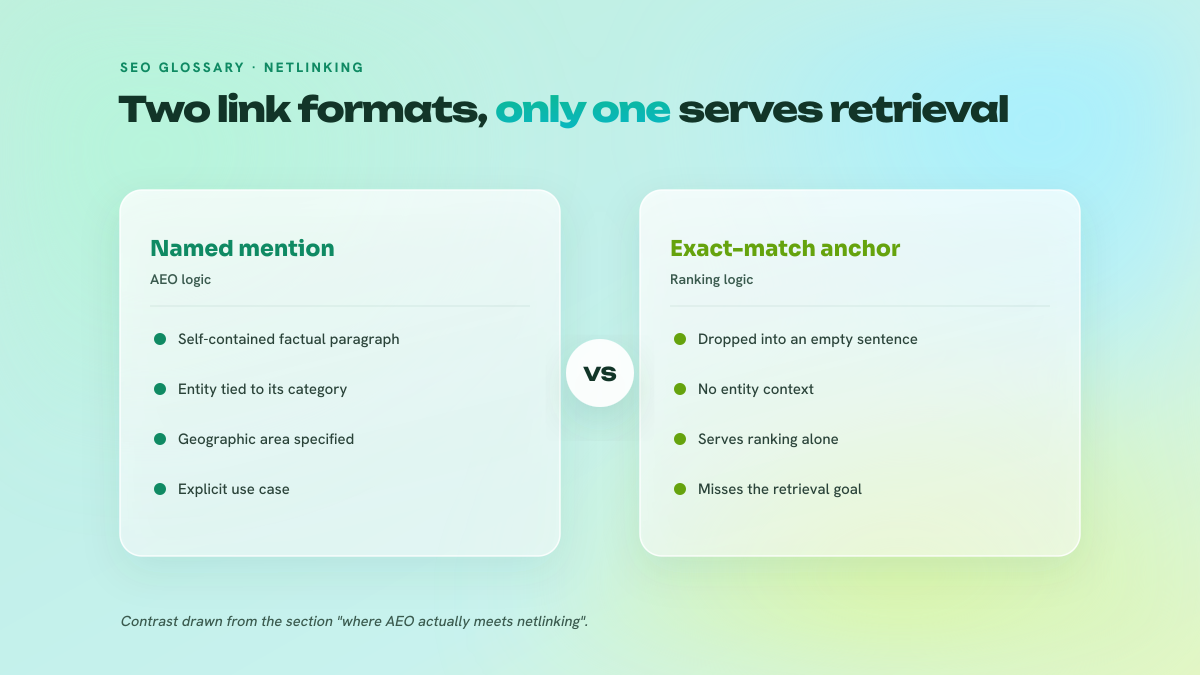
Beyond retrieval, what tips a candidate into being cited is corroboration. Answer engines are risk-averse by construction: an assistant that hallucinates a recommendation carries reputational cost, so the ranking function rewards claims that appear consistently across independent sources. In practice, a brand mentioned in the same context across a dozen distinct domains is a safer thing to name than a brand asserting the same thing on its own site, however well structured that site is. This is where AEO and off-page work converge, and where the broader generative engine optimization discipline stops being a content exercise. If you are working on assistant visibility specifically, our approach to getting a brand named by AI assistants is built on exactly that corroboration logic rather than on markup tricks.
Measuring AEO when the reporting is broken
Search Console does not break out AI Overview impressions from classic ones, and Google has given no indication that it will. So anyone selling you a clean AEO ROI figure is modelling, not measuring. What you can measure honestly falls into three buckets, and you should keep them separate rather than blending them into one vanity score.
Citation share first: for a fixed basket of your priority queries, how often does a given domain appear as a cited source across ChatGPT, Google AI Overviews, Perplexity and AI Mode. Track it as a share against named competitors, monthly, on the same basket. Any tool that samples prompts will do, and rebuilding the basket every month destroys the series, so freeze it. Second, assistant referral traffic, isolated in analytics by referrer host. It is small and it converts unusually well, which makes the absolute volume misleading and the trend line worth watching. Third, branded query volume, which is the lagging indicator that tells you whether being cited is producing demand or just producing impressions.
On thresholds, two anchors help. Sparktoro and Datos found 58.5% of US Google searches in 2024 ended without a click, so a falling click count on informational queries is not automatically an AEO failure. And Seer's 2026 update, covering 53 brands and 5.47 million queries from January 2025 to February 2026, shows organic CTR on AIO-present queries recovering from 1.3% in December 2025 to 2.4% in February 2026. Users are learning the format. Judge your programme against that curve, not against a 2023 baseline that is never coming back.
Where AEO fits in a real netlinking operation
The part competitors under-cover: off-page is not a nice-to-have in AEO, it is the mechanism. This walkthrough covers the brand-side of it well:
Concretely, an AEO programme inside a netlinking operation does three things the pure content approach cannot. It plants the same factual claims about a brand across independent, indexed domains, so the retrieval layer keeps meeting the same association. It targets the comparative and listicle formats that assistants lean on heavily when a prompt is a recommendation request, because those pages get retrieved for a whole family of sub-queries rather than one. And it builds enough topical surface on third-party media that the brand is present in the top 100 for the long tail, which is the pool citations are actually drawn from.
That last point is why we run our own French editorial media in-house rather than brokering placements: controlling the editorial calendar means you can place the same claim in twelve genuinely different contexts, on a schedule, with a real publication behind each one. Whether you do that through a team that pilots the whole campaign for you or by picking media yourself from a public catalogue with the prices shown upfront matters less than the discipline: same entity, same claims, different independent domains, sustained over quarters. Sponsored one-shots produce a spike in retrievability that decays as the page ages out of the freshness window.
What we see go wrong
The tactical layer most programmes skip is platform-specific rather than generic, and this covers it:
The first and most expensive mistake is schema fetishism. Half the AEO content circulating is a schema tutorial, on the assumption that structured markup is what earns citations. It is not. Schema helps a parser disambiguate entities and it is cheap hygiene, so implement Article, Organization and Product properly. But stacking FAQPage markup does not produce visibility. Answer engines ground on text passages, not on JSON-LD. Markup that describes content the page does not actually contain buys nothing.
Second, building a separate AEO content track. We see teams spin up a parallel set of thin question-and-answer pages for the assistants while the main site stagnates. Given the 54.5% overlap BrightEdge measured, that is duplicating effort against the same index with weaker pages. Restructure existing content so each section answers one bounded question in its opening lines, then supports it. That single change does more for retrievability than any new page.
Third, treating every platform as one target. ChatGPT with browsing, Perplexity and Google AI Overviews retrieve from different corpora with different freshness profiles, and a brand strong in one can be absent from another. Check them separately before deciding your programme works. Fourth, chasing AEO in a vertical where it barely fires: the flat e-commerce coverage in BrightEdge's December 2025 data means a product retailer is usually better served putting that budget into conventional acquisition. Fifth, and most common in our audits, expecting results inside a quarter. Corroboration accumulates. The programmes that show citation share moving are the ones running eighteen months, not the ones that bought a batch of placements in March and checked in May.
Nautilinks operates an owned network of editorial media. In-house written articles, transparency disclosures respected, anchor mix calibrated.
Frequently asked questions
Is AEO genuinely different from SEO, or is it consultant rebranding?
It is a layer, not a discipline. BrightEdge measured citation overlap with organic rankings rising from 32.3% in May 2024 to 54.5% in September 2025, so answer engines retrieve mostly from the classic index. What genuinely changes is the unit of competition: you optimize passages against decomposed sub-questions rather than pages against queries, and you compete for a citation slot instead of a position. Anyone selling AEO as a standalone practice with its own separate content stack is selling duplication.
Does schema markup actually get you cited in AI Overviews?
No, it helps parsers disambiguate entities, which is worth doing but is not the selection mechanism. Answer engines ground their output on retrieved text passages, not on the JSON-LD wrapped around them, so stacking markup is not a visibility lever. Implement Article, Organization and Product cleanly as hygiene, then spend the remaining effort on passage structure and on getting the same claims corroborated across independent domains.
How do you measure AEO when Search Console does not separate AI Overview impressions?
Stop trying to force it into one number. Track citation share on a frozen basket of priority prompts across ChatGPT, AI Overviews and Perplexity, monthly, against named competitors. Track assistant referral traffic isolated by referrer host in analytics, watching the trend rather than the volume. Track branded query growth as the lagging demand signal. Any vendor handing you a single clean AEO ROI figure is modelling from assumptions, not measuring.
Do backlinks still matter for being named by an answer engine?
They matter differently. The direct effect runs through retrieval: broad indexed presence on a topic is what puts you in the candidate pool, and roughly half of cited sources sit somewhere in the top 100 rather than the top 10 (BrightEdge, 2025). The indirect effect matters more. Editorial placements that repeat the same factual association across independent domains give the model the corroboration it needs to name a brand rather than merely retrieve it.
Should we build different content for ChatGPT than for Google AI Overviews?
Different content, no. Different verification, yes. The corpora and freshness profiles differ enough that a brand cited constantly in AI Overviews can be invisible in Perplexity, so measure each platform separately before concluding anything. The content answer is the same in all cases: bounded questions answered in the opening lines of a section, factual density, and claims that hold up against other sources. Writing three variants of the same page is duplication with extra steps.
Is AEO worth the budget for an e-commerce site?
Usually not as a priority. BrightEdge's December 2025 sector data shows AI Overviews firing on 88% of healthcare queries and 83% of education queries, while e-commerce coverage stayed flat and declined 7.6%. Transactional product queries still resolve to shopping and classic results. If you sell expertise, services or anything researched before purchase, AEO is where the informational traffic went. If you sell products, that budget performs better in conventional acquisition.
Test your knowledge
Quiz: AEO (Answer Engine Optimization)
1/3According to Seer Interactive's June 2024 to September 2025 dataset, what happened to organic CTR on queries displaying an AI Overview?