- →Carousel presence is a property of the query, not of your page: segment your keyword set by feature presence before writing a single brief, because part of any B2B list will never fire the block.
- →Eligibility runs through video indexing, not through VideoObject. A schema block that validates while the video has no crawlable contentUrl is the single most common failure we see in audits.
- →Google removed support for the Video Collection and Carousel structured data types, a change reflected in the VideoObject documentation update reported on 13 February 2026. Ordinary video carousels remain Google-generated presentations you cannot request.
- →BrightEdge, measuring May 2024 to September 2025, put YouTube at a 29.5 % citation share in Google AI Overviews and roughly 200 times more citations than competing video platforms, with Vimeo and TikTok around 0.1 % each. Self-hosting to chase a carousel slot is misallocated budget.
- →The carousel click usually lands on YouTube, not on your site. Video earns attention and branded search; the target URL, the citations and the editorial link belong on the surrounding page and in the outreach campaign.
- →Do not attribute carousel losses to a video algorithm. The confirmed events in the window were the August 2025 Spam Update and the December 2025 Core Update, neither with video-specific guidance: segment Search Console against the rollout dates instead.
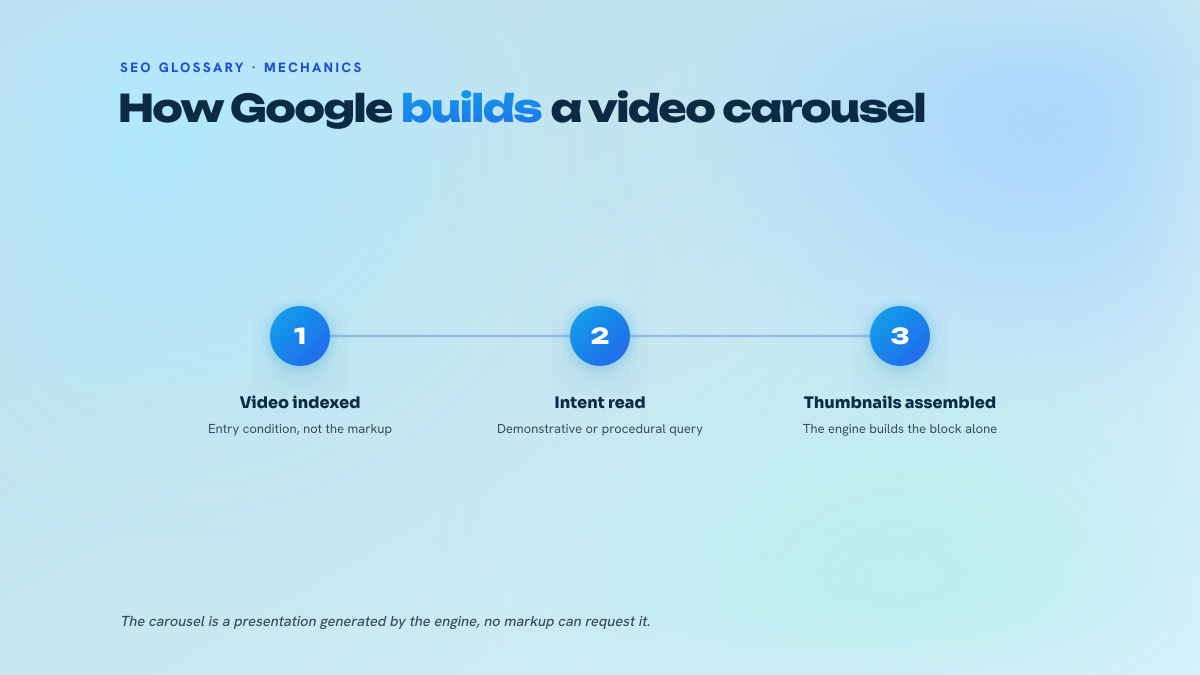
What a video carousel actually is
Strip the SERP-feature naming and a video carousel is one thing: a horizontal strip of video thumbnails that Google injects on a query it judges better served by demonstration than by prose. It sits above the organic block on how-to and comparison queries, buried under six results on informational ones, and increasingly beside or below an AI-generated answer. No markup triggers it. Google no longer supports the Video Collection and Carousel structured data types, a point reflected in the VideoObject documentation refresh reported on 13 February 2026, and those types were never the same object as the video results Google composes itself. The carousel is a presentation decision made by the ranking system, not a rich result you opt into.
That single fact reorganises the whole workflow. Because the block belongs to the query rather than to your page, the first question is never « how do I get my video into the carousel ». It is « does this query fire a carousel at all, and how far up ». Pull your target set, check feature presence at scale in whatever rank tracker you already pay for, then split it three ways: queries with a carousel above the organic block, queries with a carousel pushed below it, queries with none. Those three groups deserve three different content decisions, and the third deserves no video production at all. Skipping that triage is how agencies end up billing for twelve explainer videos that never had a slot to fill.
The second fact is uncomfortable for anyone hosting video on their own domain. In practice the slots are filled by YouTube, and on French B2B queries the exceptions are rare enough to be treated as noise. A carousel is therefore not really a results-page feature you compete for with your website: it is a distribution surface owned by a platform you have to publish on. Accepting that early saves a lot of money on video hosting, players and schema consulting that would have produced nothing.
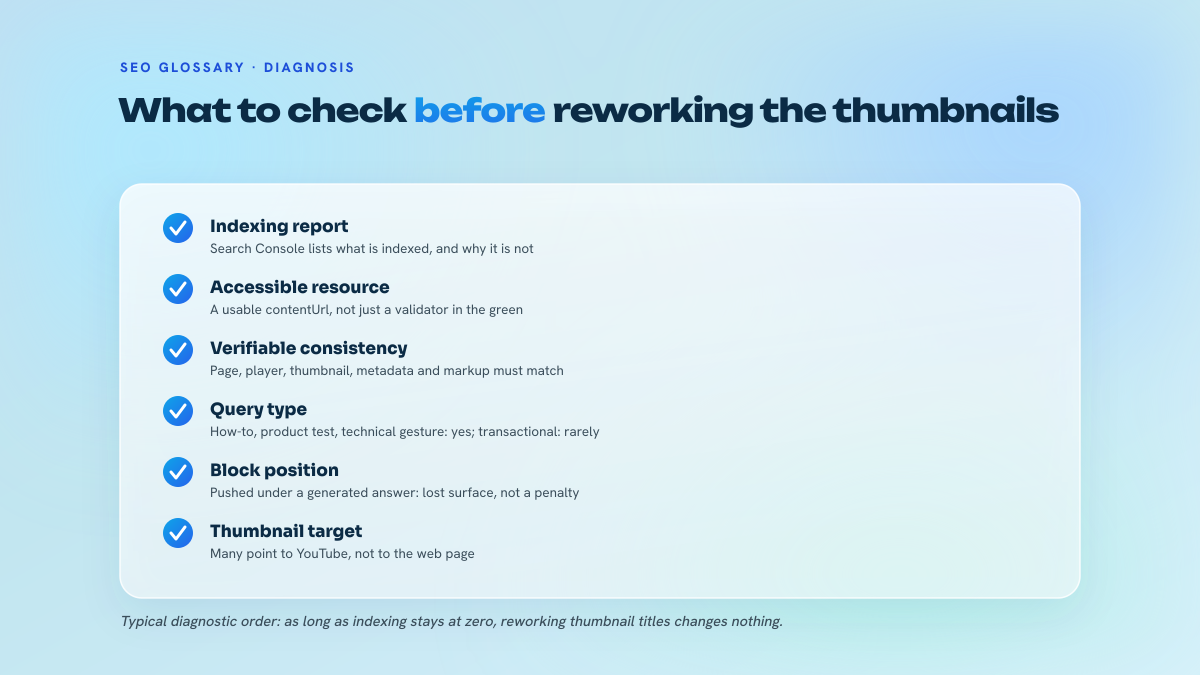
Eligibility and measurement in 2026
Eligibility runs through indexing. Google's Video Indexing report is the diagnostic that matters for owned pages carrying embedded or hosted video: it tells you which videos are indexed, which are not, and why the failures happened. Reported carousel eligibility is tied to that indexing state, not to the presence of a VideoObject block on the page. If the video is not indexed, no amount of structured data will surface it, and no audit finding about your schema is worth acting on until the indexing report is clean.
The recurring technical failure is markup that validates while the video stays unreachable. A VideoObject with a name, a description, an upload date and a thumbnail passes every syntactic check, yet Google cannot index anything if there is no crawlable contentUrl or accessible video resource behind it. Industry testing has flagged this repeatedly and it matches what we see in audits: the validator is satisfied, the indexer is not. Treat contentUrl as an indexing prerequisite and stop treating the markup itself as a ranking lever, because it has never been one. The 2026 guidance pushes the same direction, insisting on consistency between the page, the player, the thumbnail, the video metadata and the structured data. Declare the frame the user actually sees, keep the title in the markup identical to the title on the page, and let the player load without a user interaction.
Measurement changed materially on 7 July 2026, when Google introduced Search Console platform properties for YouTube, Instagram, TikTok and X. They report clicks, impressions and queries for content from those platforms when it appears in Google Search or Discover, including accounts with no associated owned website. Rollout was gradual and Google indicated data can take up to 48 hours to appear after setup. This closes a gap that made video reporting guesswork for a decade: YouTube visibility inside Google now sits in the same table as site performance instead of being inferred from YouTube Analytics or a third-party tracker.
One discipline point on attribution. No Google core update in the last twelve months was announced as targeting video carousels. The confirmed ranking-system events were the August 2025 Spam Update, rolled out from 26 August to 22 September 2025, and the December 2025 Core Update, which ran from 11 to 29 December 2025, roughly eighteen days, and which was described as a broad update aimed at surfacing relevant and satisfying content from all types of sites. Neither came with video-specific guidance. When carousel visibility moves, segment Search Console and rank-tracking data against those rollout dates before you write a single line of diagnosis, and treat any consultant blaming a video algorithm as someone who has not run the before-and-after.
Carousels, AI Overviews and the citation layer
The lazy 2025 narrative was that generative answers would swallow the SERP features. That is not what the data shows for video. Semrush's December 2025 study, built on more than 10 million keywords with an underlying comparison across over 200,000 keywords above 100 in search volume measured between January and October 2025, found that video carousels and discussion or forum blocks stayed prominent alongside the generated answer panels. The same study tracked how unstable that panel's own prevalence was: 6.49 % of keywords in January 2025, close to 25 % in July, back to 15.69 % in November. The carousel did not disappear, it moved down the page, and its click opportunity now depends on what sits above it.
The more consequential number is about citations rather than clicks. BrightEdge analysed citation patterns across Google AI Overviews, Google AI Mode, ChatGPT and Perplexity from May 2024 through September 2025 and reported YouTube at a 29.5 % citation share in Google AI Overviews, an average 20 % share across the measured platforms, and roughly 200 times more citations than competing video platforms, with Vimeo and TikTok each registering around 0.1 %. Read that as an asymmetry, not a ranking. One platform is the video source that generative systems trust; everything else is a rounding error. If a client insists on Vimeo for brand reasons, that is a defensible decision, but it should be made with the citation cost on the table.
This is where video stops being a content-marketing line item and starts behaving like an authority asset. Search Engine Land explicitly compared repeated cross-mentions and creator networks on YouTube with the reinforcing role high-quality backlinks play in classic SEO. Expert appearances, interviews, collaborations and consistent naming across channels build the entity signal that generative systems pick up. That is not a metaphor to be taken loosely: it is the same reasoning that governs how you spread an editorial link campaign across independent domains rather than concentrating it on one.
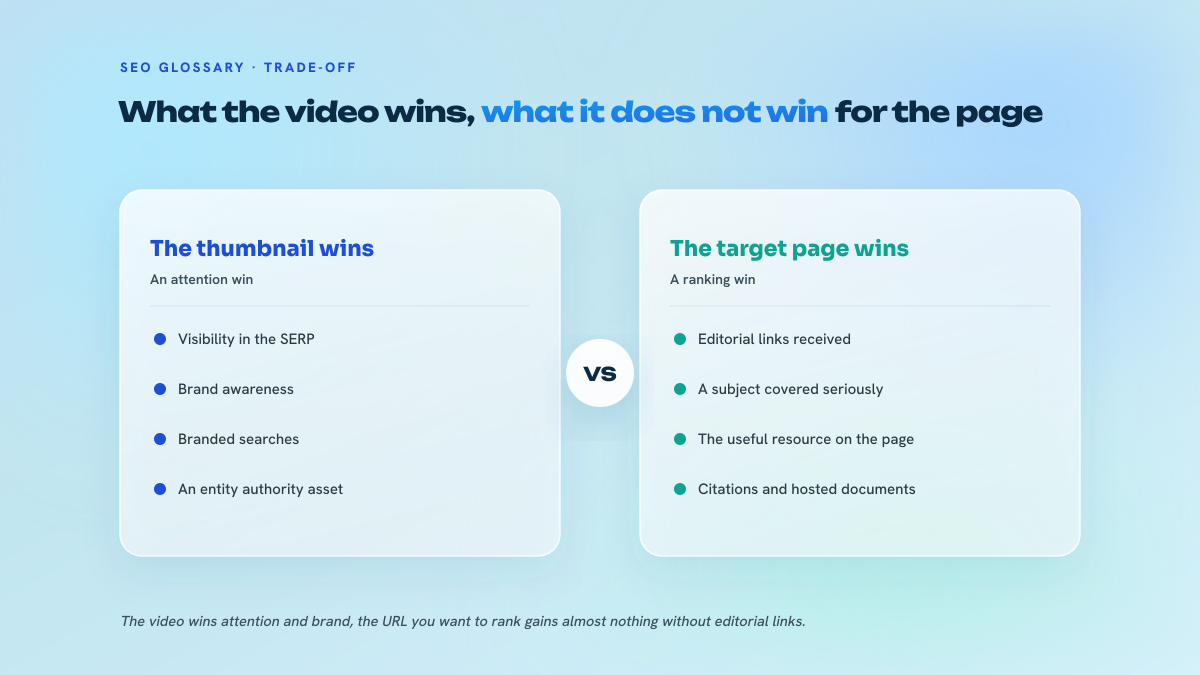
Where it fits in a netlinking operation
The strategic distinction most briefs get wrong: embedding a YouTube video may win a video result, but the click commonly goes to YouTube rather than to the publisher's site. So do not budget video as a traffic channel to your money pages. Budget it as an attention and branded-search asset, and keep the acquisition work where it actually lands: the target URL, the citations, the downloadable assets and the editorially useful resources belong on the surrounding page and in the outreach campaign built around it.
Concretely, a video-led campaign has two separate deliverables. The video earns the carousel slot and the AI citation. A written page, hosted on a site that ranks, carries the link. Across the French editorial media we run in-house, we never place a commercial link in a video description: descriptions are a poor link surface and a worse editorial one. The link goes in the body of an article that has its own traffic, which is the same standard you should apply whether you source placements from a catalogue of media you can filter yourself or from a broker. And when you arbitrate between producing a video and buying three editorial placements, put both against the same sheet: what a placement actually costs is a known number, while video production cost per acquired citation almost never gets measured.
What we see go wrong
The correlation sold as causation comes first. A Wistia dataset cited in 2026 reporting found pages containing video averaged around 6 minutes of time on page against 2.5 minutes for text-only pages. That is an association between page type and engagement, not evidence that adding a video improves rankings. Pages that carry video tend to be the ones someone invested in. Quoting the figure in a deck as proof that video is a ranking factor is the kind of claim that gets an audit rejected by anyone senior.
Then the measurement blind spot. Most rank trackers flatten SERP features into a single position number, so a page that lost a carousel slot and a page that lost organic position 4 look identical in the report. If video matters to the account, track feature presence separately, and now that platform properties exist, reconcile the YouTube side in Search Console rather than arguing from YouTube Analytics, which counts a different universe entirely.
Third, chapters. YouTube tested AI-powered search-result carousels in the United States from 26 June to 30 July 2025, initially for Premium users, placing a carousel at the top of YouTube search results with AI summaries and playable suggestions, and its separate AI-carousel testing pulled relevant portions of videos into carousel-style results. Timestamps and chapters help those systems associate a section with a specific query. That is a test observation, not a published requirement, so chapter your videos because it is cheap and coherent, not because someone promised you a ranking factor.
Last, the scope error: producing video for queries that never fire the block, and self-hosting to chase slots a platform already owns. Both are budget decisions dressed up as technical ones. A working rule that has held up for us: produce video only for queries where a carousel currently sits above the organic block and where the topic genuinely benefits from demonstration, publish it on YouTube, chapter it, and spend the rest on the written asset and its links.
Nautilinks operates an owned network of editorial media. In-house written articles, transparency disclosures respected, anchor mix calibrated.
Frequently asked questions
Can structured data force a video carousel to appear?
No. Ordinary video carousels are presentations Google generates from its own ranking decision, and Google no longer supports the Video Collection or Carousel structured data types, a point reflected in the VideoObject documentation update reported on 13 February 2026. VideoObject markup helps Google understand and index a video, which is a prerequisite for eligibility, but it is not a request mechanism and not a ranking signal. If the block does not fire on a query, markup will not create it.
My VideoObject passes the Rich Results Test but the video is not indexed. Why?
Almost always a missing or unreachable video resource. Markup can validate syntactically while Google has no crawlable contentUrl or accessible video file to fetch, so nothing gets indexed. Check the Video Indexing report in Search Console first: it names the failure reason. Then verify the player loads without user interaction, the declared thumbnail matches the frame actually shown, and the title in the markup matches the page. Consistency across page, player, thumbnail and metadata is the current guidance.
Should we host video ourselves or publish on YouTube for search visibility?
For search and generative visibility, YouTube. BrightEdge, measuring May 2024 through September 2025, reported YouTube at a 29.5 % citation share in Google AI Overviews, an average 20 % across the platforms measured, and roughly 200 times more citations than competing video platforms, with Vimeo and TikTok around 0.1 % each. Self-hosting is defensible for gated or product content where you control the funnel. It is a poor bet if the goal is a carousel slot or an AI citation.
Did AI Overviews kill the video carousel?
No, they rearranged the page. Semrush's December 2025 study, based on more than 10 million keywords with an underlying comparison across over 200,000 keywords above 100 in volume between January and October 2025, found video carousels stayed prominent alongside generated answers. The panel's own prevalence swung hard across 2025: 6.49 % of keywords in January, close to 25 % in July, 15.69 % in November. So the carousel survives, but its vertical position and click opportunity now depend on what renders above it.
How do we now measure YouTube visibility inside Google Search?
Since 7 July 2026, Search Console platform properties cover YouTube, Instagram, TikTok and X, reporting clicks, impressions and queries when that content appears in Google Search or Discover, including accounts with no associated website. Data can take up to 48 hours to appear after setup and rollout was gradual. This is the first reporting surface that lets you sit YouTube visibility in Google next to site performance instead of inferring it from YouTube Analytics or a third-party tracker.
We lost carousel visibility after December. Was it the core update?
Maybe, but nothing in the announcement says so. The December 2025 Core Update ran from 11 to 29 December 2025, roughly eighteen days, and Google published no video-specific guidance for it, just as it published none for the August 2025 Spam Update. Segment Search Console and rank-tracking data against the exact rollout dates, separate feature presence from organic position, and check the Video Indexing report for a technical cause before writing an algorithmic explanation.
Test your knowledge
Quiz: Video carousel
1/3What is the actual prerequisite for a page's video to be eligible for a Google video carousel?