- →SSR gives you no ranking bonus. It removes a dependency: content and links exist before any JavaScript runs, which is a risk reduction, not a growth lever.
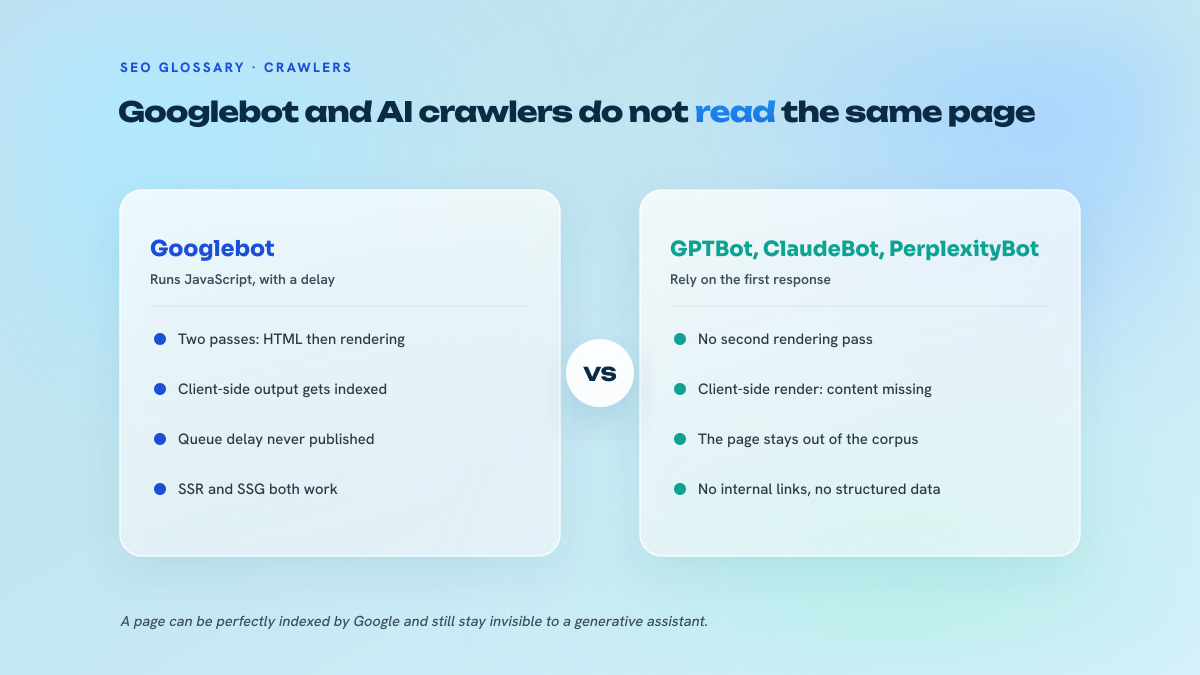
- →The 2026 argument for SSR is crawler diversity. GPTBot, ClaudeBot and PerplexityBot lean far more on the initial HTML than Googlebot does, so a client-rendered page can be indexed by Google and invisible to answer engines.
- →Google published no update in the last twelve months targeting SSR, CSR or JavaScript frameworks. If you lost traffic during the May 2026 core update (21 May to 2 June, per Google’s Search Status Dashboard), stop blaming your framework and segment the data.
- →A paid backlink that only appears after hydration is a backlink you cannot audit. Verify placements with JavaScript disabled, not in a browser tab.
- →SSR shifts cost from the client to the server: TTFB, cache strategy and hydration weight become the real variables, and hydration is where Interaction to Next Paint usually degrades.
- →Static generation beats SSR for editorial content. Reserve true per-request rendering for pages whose HTML genuinely varies per user.
What SSR actually changes, and what it doesn’t
Server-side rendering means the HTML document that leaves your server already contains the article text, the navigation, the canonical, the hreflang cluster and the JSON-LD block. Client-side rendering ships a near-empty shell plus a JavaScript bundle, and everything a crawler cares about is assembled in the browser afterwards. That is the whole distinction. Everything else people attach to SSR, faster rankings, better crawl treatment, algorithmic preference, is either a second-order effect or marketing noise.
The point worth internalising is that SSR is a risk-removal decision, not a performance play. It does not make your content better and it does not add a signal Google weighs. It guarantees that the version of the page a crawler sees on its first fetch is the version you designed. With client-side rendering you are betting that a second, deferred process will run, complete, and produce the same DOM you see in Chrome with a warm cache and a fast connection. Most of the time that bet pays. The interesting question is what happens the rest of the time, and who else is crawling you.
There is also a family resemblance worth naming, because teams confuse the three constantly. Static site generation renders the HTML once at build time and serves a file. SSR renders it per request. Incremental or on-demand regeneration sits between the two, rendering per request but caching the result until something invalidates it. For editorial content, and that includes almost every publisher, media site or blog we work with, static generation is strictly better than SSR: same crawl guarantees, no per-request compute, trivially cacheable at the edge. If you are running true SSR on articles that change once a month, you are paying for a capability you do not use.
How rendering really works in 2026
Google’s own position has been consistent and is worth quoting accurately rather than caricaturing. Its documentation on optimising for generative features states that Google can process JavaScript when it is not blocked, while noting that JavaScript-based sites are more complex to optimise and require the usual JavaScript SEO practices. That is not an endorsement of client-side rendering and it is not a condemnation. It is Google saying: this works, and it costs you margin for error.
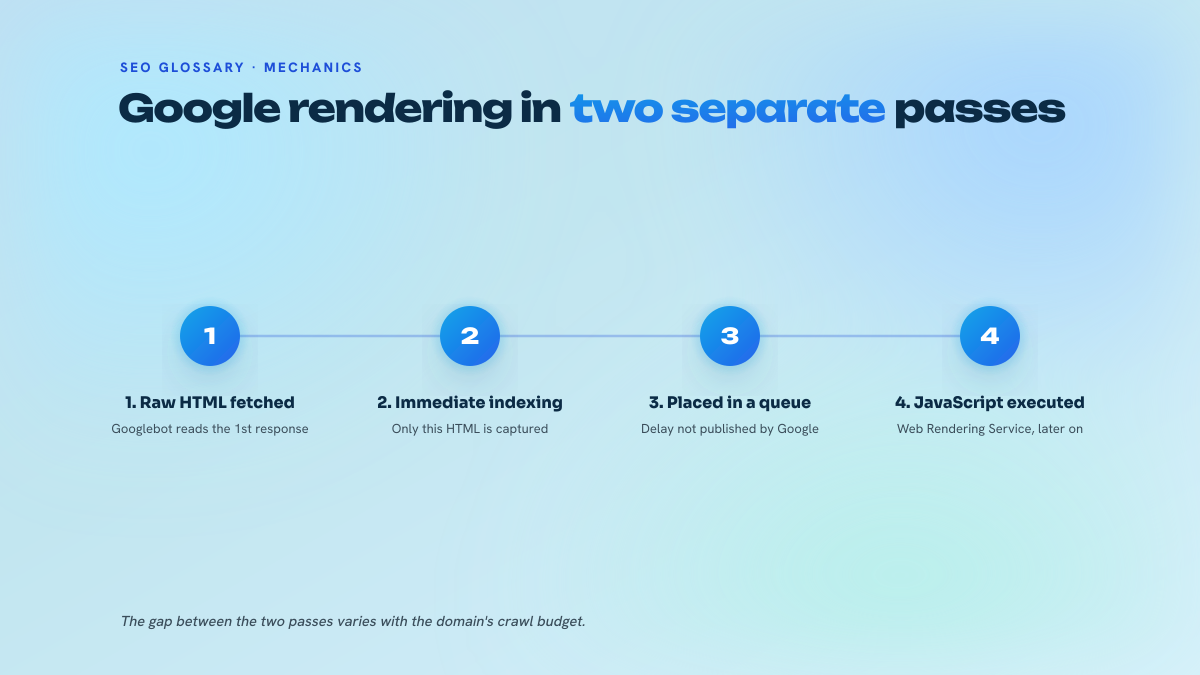
The mechanics behind that sentence have not changed. Googlebot fetches the initial HTML, queues the page for the Web Rendering Service, and executes JavaScript later. On a client-rendered page, your content, your metadata, your internal links and your structured data all live in that deferred stage. On a server-rendered page they do not. Whether the deferred stage is fast or slow for your site is not something you control or can reliably measure, which is precisely why the architectural choice matters more than the benchmark.
What genuinely changed in the last two years is that Googlebot is no longer the only crawler that decides whether you are visible. Technical audits through 2026 consistently report that GPTBot, ClaudeBot and PerplexityBot depend far more heavily on the initial HTML response than Googlebot does. A client-rendered page can therefore be perfectly indexed in Google and functionally empty to the systems that produce answers elsewhere. If you care about being cited by a language model, and the traffic data says you should, the initial HTML is the only surface you can count on.
The traffic data is worth stating precisely, because it is routinely inflated. Semrush analysed more than 10 million keywords across 2025 and found AI Overviews triggering on 6.49 % of them in January 2025, peaking at 24.61 % in July 2025, then falling back to 15.69 % by November 2025. On click behaviour, Pew Research Center tracked 68,879 real Google searches from 900 US adults in March 2025 and published in July 2025 that users clicked a traditional result on 8 % of searches when an AI summary appeared, against 15 % when none did, with roughly 1 % clicking a link inside the summary. An Ahrefs study from February 2026 covering 300,000 keywords reported a 58 % lower CTR for the top-ranking result when an AI Overview was present, up from the 34.5 % decline it measured in April 2025. None of those numbers are about rendering. They are about why the initial HTML now has more than one audience.
One more piece of hygiene: no confirmed Google update in the past year targeted SSR, CSR or JavaScript frameworks. The Discover core update (5 to 27 February 2026), the March 2026 spam update, the May 2026 core update (21 May to 2 June) and the June 2026 spam update are all recorded on Google’s Search Status Dashboard as ranking or spam changes, not rendering changes. Every time a migration coincides with a rollout, someone concludes the framework was penalised. Segment your Search Console data by rollout dates and check rendered HTML, status codes, canonicals and internal links separately before you believe that story.
Where SSR matters in a netlinking operation
Here is the part most rendering articles skip. If you buy links, SSR is an auditability question before it is a technical one.
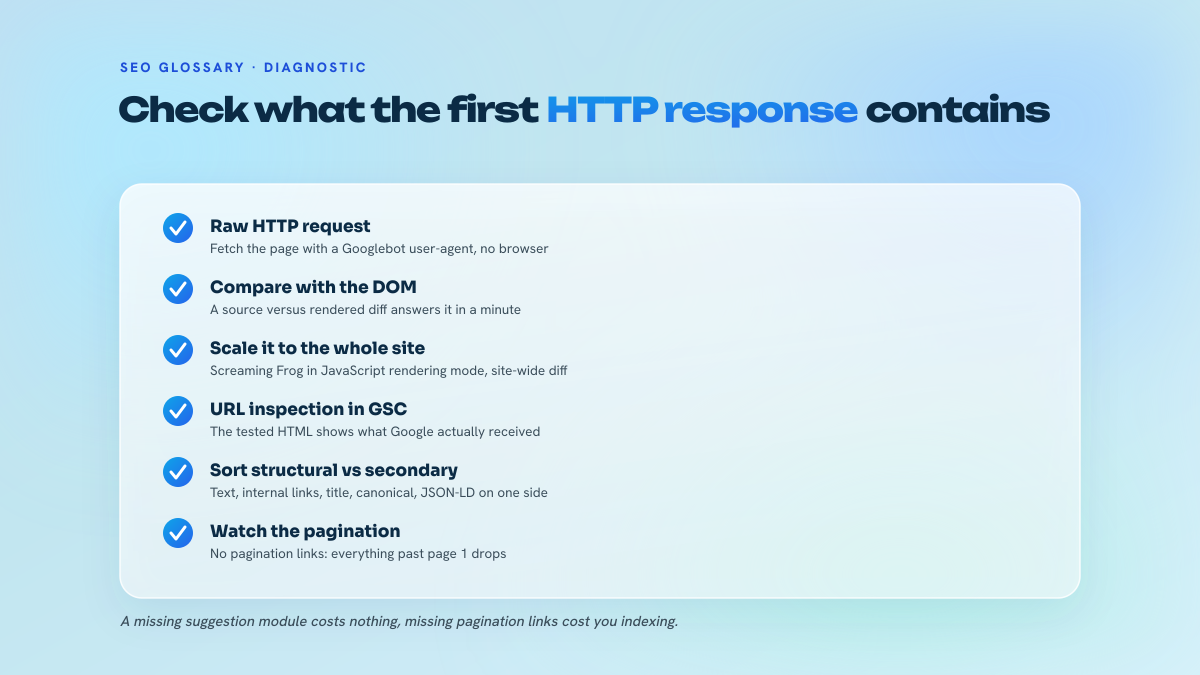
A contextual link inserted into a paragraph that only exists after hydration is a link you cannot verify cheaply and cannot prove was ever counted. It looks fine in your browser. It may well be picked up by Google after the rendering pass. It is invisible to a curl request, invisible to most third-party crawlers, and invisible to the AI crawlers described above. When we assess a host site, the first check is not Domain Rating, it is whether the article body and the outbound link survive with JavaScript disabled. Sites built on client-rendered stacks with lazy-loaded comment or content modules fail that check more often than their metrics suggest.
This is one reason the French editorial media we operate are served as pre-rendered HTML rather than hydrated applications: a link placement that exists in the file on disk is a placement nobody has to take on trust. If you are evaluating hosts yourself, apply the same test to every candidate in the catalogue you are picking media from before you look at any authority metric, and if you want to see how it plays out at scale, the same discipline is what makes an in-house network auditable end to end.
The internal side matters just as much. On a client-rendered site, your own internal link graph is assembled by JavaScript, which means the equity distribution you designed depends on the same deferred process. Menus injected on interaction, paginated archives that require a click, filters that rewrite the URL without a crawlable anchor: each one quietly removes edges from the graph you thought you had.
What we see go wrong in audits
The most common failure is not choosing the wrong rendering mode, it is choosing the right one and then undoing it. A team migrates to SSR, ships correct HTML, and then loads the article body through a client-side content component because the CMS integration was easier that way. The homepage renders server-side, the money pages do not. Half your rendering is server-side and the half that earns money is not.
Second: treating SSR as a performance fix. It is not. It improves the first contentful paint because bytes arrive ready to display, and it can degrade the interaction metrics Google actually measures because the hydration step still has to attach event handlers to everything you just rendered. Interaction to Next Paint is where over-hydrated SSR applications lose. If your framework supports partial or island hydration, use it, and ship JavaScript only for components that need it.
Third: soft failures nobody monitors. SSR moves rendering onto your infrastructure, so a slow database, a timing-out API or an origin under load now produces degraded HTML instead of a slow browser. We have seen server-rendered pages returning a valid 200 with an error placeholder in the body, indexed as-is, for weeks. Monitor the rendered output, not just the status code.
Fourth: dynamic rendering, serving pre-rendered HTML to bots and the client-side app to humans. Google deprecated it as a long-term recommendation years ago and it remains a workaround with a cloaking-shaped risk profile. If your prerender service drifts from your live content, you are serving two different sites and only one of them is the one you audited.
Tactical takeaways for a working SEO
Test with curl -s https://example.com/page/ | grep, not with a browser. If the H1, the body text, the canonical, the JSON-LD and your outbound links are not in that output, they are not in the initial HTML, whatever DevTools shows you. Do this on the templates that matter: article, category, and any page hosting a paid placement.
Pick the cheapest mode that satisfies the requirement. Static generation for editorial and marketing pages, incremental regeneration where content updates frequently, true per-request SSR only for genuinely personalised or real-time output. Client-side rendering is defensible behind a login, where crawling is irrelevant.
Check your rules for AI crawlers at the same time. Serving perfect server-rendered HTML while blocking the agents that read it is a self-inflicted wound we still find on a surprising number of otherwise well-built sites.
Finally, resist the migration reflex. Rewriting a working site to change rendering mode is one of the most expensive projects an SEO can trigger, and the measurable upside on Google alone is usually close to zero. The argument that holds in 2026 is crawler diversity and auditability, not rankings. Make that argument honestly or do not make it.
Nautilinks operates an owned network of editorial media. In-house written articles, transparency disclosures respected, anchor mix calibrated.
Frequently asked questions
Does SSR give a direct ranking advantage over client-side rendering?
No, and nobody credible claims otherwise. Google’s documentation says it can process JavaScript when it is not blocked, while noting JavaScript sites are more complex to optimise. There is no published signal rewarding server-rendered HTML. The advantage is indirect: content, links and structured data exist on the first fetch, so you are not dependent on a deferred rendering pass, and non-Google crawlers that barely execute JavaScript can read the page at all.
SSR, SSG or incremental regeneration for an editorial site?
Static generation, in almost every case. Articles change rarely, so per-request rendering buys nothing and adds origin compute plus a new failure mode. Use incremental or on-demand regeneration when publication volume makes full rebuilds impractical, which is usually past a few thousand pages. Reserve true SSR for output that genuinely varies per request: authenticated dashboards, live pricing, geo-personalised content. Choosing SSR because it sounds more modern is how teams inherit a caching problem they did not need.
How do I verify that a paid backlink is actually visible to crawlers?
Fetch the page without JavaScript and search the raw response for your anchor and destination URL. A curl request piped to grep answers it in seconds. Then confirm the rel attribute in that same raw output, since sponsored or nofollow attributes are sometimes added by a client-side script after purchase. If the link only appears in the rendered DOM, treat it as unverifiable: Google may count it after rendering, but you cannot prove it and AI crawlers will not see it.
Can SSR hurt Core Web Vitals?
Yes, on the interaction side. Server rendering usually improves first paint because usable HTML arrives immediately, but hydration still has to attach handlers to the whole tree, and heavy hydration is the classic cause of poor Interaction to Next Paint. A server-rendered page that ships a large monolithic bundle can feel slower to use than a lighter client-rendered one. Partial or island hydration is the fix: render everything server-side, hydrate only what needs interactivity.
Do AI crawlers execute JavaScript like Googlebot?
Not reliably. Technical audits through 2026 consistently find that GPTBot, ClaudeBot and PerplexityBot depend far more on the initial HTML response than Googlebot, which has a full rendering pipeline behind it. The practical consequence is that a client-rendered page can rank normally in Google and be effectively empty to answer engines. If citation in generative surfaces is part of your objective, the initial HTML is the only delivery you can count on.
We lost traffic right after migrating to SSR. Was there an algorithm update against JavaScript sites?
No confirmed Google update in the past year targeted SSR, CSR or JavaScript frameworks. The updates recorded on Google’s Search Status Dashboard over that window, including the May 2026 core update from 21 May to 2 June, were ranking or spam changes. Migrations break other things: canonicals, redirect chains, internal links dropped from templates, changed URL patterns. Segment Search Console by rollout date and diff the rendered HTML before and after the migration.
Test your knowledge
Quiz: Server-side rendering (SSR)
1/3What is the strongest 2026 argument for server-side rendering, from an SEO standpoint?