- →Core Web Vitals are a tiebreaker and a floor, never a growth lever: they break ties between comparable pages and filter out the very slow, but they will not carry weak content or a weak link profile anywhere.
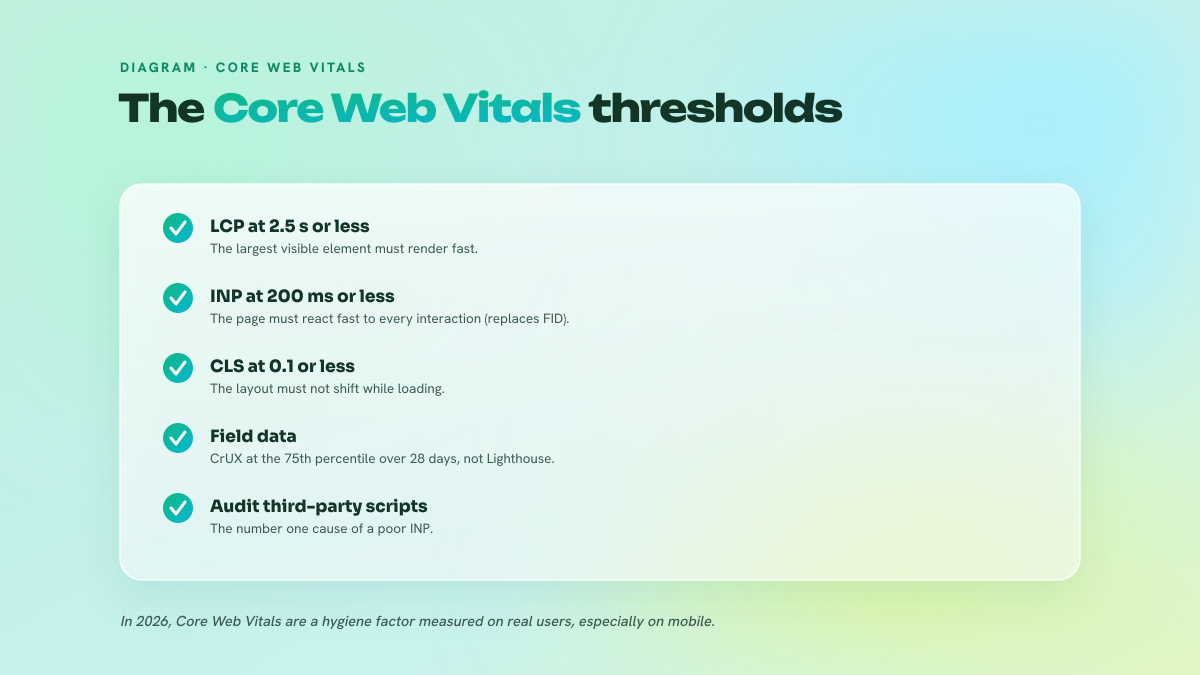
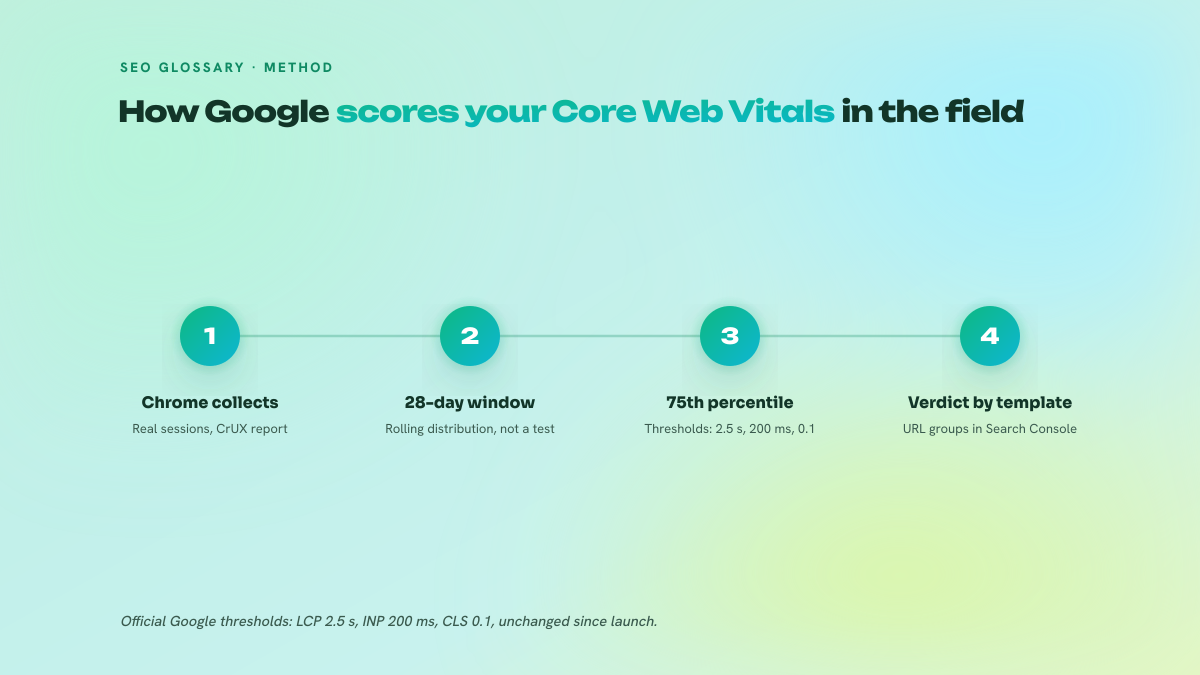
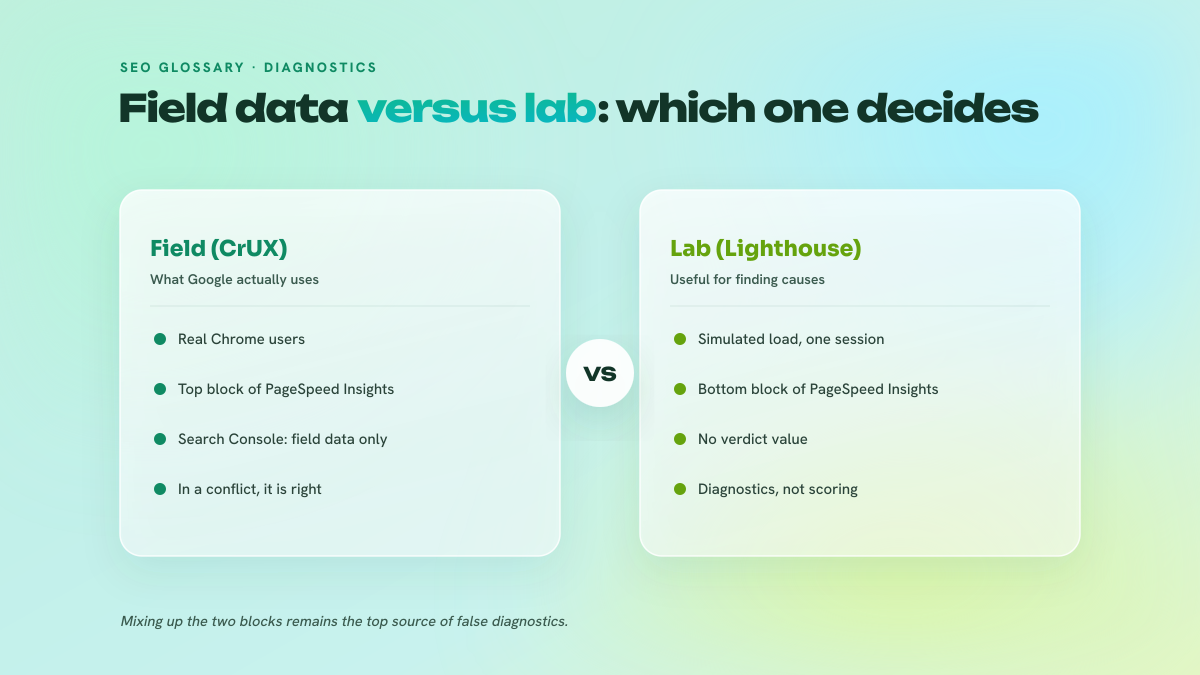
- →Only field data counts: the assessment runs on the 75th percentile of real Chrome users over a rolling 28-day CrUX window. A green Lighthouse score on a developer laptop proves nothing.
- →The dominant failure mode is loading, not responsiveness: on November 2025 HTTP Archive data, WordPress origins pass INP at 85.89 percent yet only 46.28 percent pass all three vitals. Spend the budget on LCP first.
- →Google has tightened nothing officially: LCP 2.5 s, INP 200 ms, CLS 0.1 remain the thresholds. Sub-150 ms INP is a competitive target some agencies sell as a requirement; it is not one.
- →For link buyers, a publisher failing vitals on mobile is a depreciating asset: check the origin's CrUX data in PageSpeed Insights before ordering, not the lab score.
- →Since the December 2025 core update cycle and the January 2026 Search Engine Land AI Overviews study, the operational read is confirmed: performance acts as a penalty filter on both classic SERPs and AI surfaces, not as a visibility engine.
What Core Web Vitals really are
Strip away the developer-relations framing and Core Web Vitals are three things: the only performance signals for which Google publishes explicit pass thresholds, the only ones backed by a public field dataset (the Chrome User Experience Report, CrUX), and therefore the only performance dimension you can audit on a site you do not own. That last property is what makes them operationally interesting for a working SEO. You can pull the real user data of a competitor, a prospect or a publisher you are about to buy a link from, with zero access to their analytics.
The trio covers three distinct failure modes of a page. Largest Contentful Paint measures how long the main content takes to render. Interaction to Next Paint measures how fast the page reacts when a user clicks, taps or types. Cumulative Layout Shift measures how much the layout jumps around while loading. The assessment logic is stricter than most people remember: an origin passes only if all three metrics are « good » at the 75th percentile of real page loads, computed over a rolling 28-day CrUX window (Google's own documentation). That 75th percentile detail is the one that bites in practice. Your median visitor on fiber can have a flawless experience while the p75 user on a mid-range Android phone pushes the origin into « needs improvement », and the failing cohort is the one Google scores.
If you want the mechanics compressed before the 2026 specifics, this seven-minute primer does the job:
The three metrics in 2026: where the bar sits
The official thresholds have not moved since launch: 2.5 seconds for the largest contentful paint of a page, 200 milliseconds for INP, 0.1 for CLS, each judged at the 75th percentile. The one structural change of the current cycle happened on the responsiveness side: Interaction to Next Paint officially replaced First Input Delay as a Core Web Vital and ranking signal on 12 March 2024 (Chrome developer blog). It is a far harder metric to game than FID ever was, because it observes every interaction across the whole page lifecycle rather than just the first input.
Measurement coverage also widened recently: since 12 December 2025, LCP and INP are « Baseline Newly Available » across all major browsers, while CLS remains Chromium-only pending an Interop 2026 proposal. For field data this changes little today, since CrUX still comes from Chrome, but it matters for anyone running their own real-user monitoring on Safari-heavy audiences.
Where do sites actually fail? HTTP Archive data from November 2025 is unambiguous: WordPress origins pass INP at 85.89 percent, yet only 46.28 percent pass all three vitals. The dominant failure mode of the largest CMS on the web is loading, not responsiveness. On the same dataset, Duda origins pass all three at 84.87 percent, a blunt reminder that platform and hosting choices set your ceiling before a single line of your own code runs. If you have one engineering budget to spend this quarter, spend it on LCP.
One correction to current agency noise: several 2026 guides present « INP under 150 ms » or « LCP under 2.0 s » as the new standard. Google has tightened nothing. Those numbers are competitive targets worth having in aggressive niches, not official thresholds, and selling them as requirements inflates audit scopes with no ranking counterpart.
Field data vs lab data
Only field data feeds the assessment. CrUX is the dataset Google evaluates; Lighthouse and the lab half of PageSpeed Insights are diagnostics executed on simulated hardware with simulated throttling. They exist to tell you why a metric fails, never whether it fails. The classic trap we see in audits is a green Lighthouse score on a developer machine coexisting with a failing CrUX origin, because the lab run never resembled the p75 device and network of the real audience. Teams then close the ticket while the assessment stays red for another 28 days.
Adoption numbers give you the competitive context for reading your own report. A June 2026 benchmark on May 2026 CrUX data puts the share of origins passing all three vitals at 55.9 percent. The 2025 Web Almanac, on July 2025 CrUX data, measured 48 percent of mobile origins and 56 percent of desktop origins passing. Mobile remains the harder assessment and the only one worth engineering against, since it is also where the ranking evaluation effectively lives.
The working toolchain is short: Search Console's Core Web Vitals report for URL-group triage, PageSpeed Insights for the field-plus-lab pair on a specific URL, and Chrome DevTools for watching the metrics move live while you interact with the page. That last workflow is underused and this walkthrough shows it well:
Ranking impact: tiebreaker and floor, not lever
Google's own framing has been consistent for years and 2026 has not changed it: page experience signals work as tiebreakers. With comparable relevance and a comparable link profile, the faster page tends to win the position. Core Web Vitals will not push thin content or a weak link profile up a single spot, and any agency deck implying otherwise is selling you a refactoring project dressed as an SEO strategy.
What did change is the floor. Industry analyses of the December 2025 core update converge on technical performance carrying more weight, with poorly performing sites struggling to hold positions despite solid content; the same update cycle reportedly hardened rendering economics, with pages returning non-200 status codes dropped from the rendering queue entirely. On AI surfaces the picture is now quantified: a Search Engine Land study published on 13 January 2026, covering more than 107,000 pages appearing in Google AI Overviews, found only weak negative correlations between vitals and AI visibility, around -0.12 to -0.18 for LCP. The conclusion matches what we observe in audits: performance acts as a penalty filter, not a visibility engine. Very slow pages get filtered out of AI answers; fast pages earn no bonus for being fast.
The senior read: budget Core Web Vitals work as insurance, not growth. Passing keeps you eligible everywhere, classic SERPs and AI surfaces alike. Chasing marginal milliseconds past the thresholds is engineering vanity with no organic return. This video covers the SEO integration angle correctly:
Core Web Vitals in a netlinking operation
For a link buyer the question is never « does my money site pass », it is « does the page that will host my link live on a healthy origin ». Link equity only flows from pages Google crawls, renders, indexes and ranks. A publisher whose template fails vitals badly on mobile is statistically more exposed to every mechanism described above: losing tiebreakers in its own SERPs, filtered from AI answers, deprioritized in rendering. The article carrying your link can be editorially excellent and still be a slowly depreciating asset.
The vetting move costs five minutes: run the publisher's origin through PageSpeed Insights and read the CrUX block, not the lab score, before ordering. On marketplaces that diligence is entirely on you, and from what we see, almost nobody does it. It is one of the reasons we operate a catalogue of owned media whose data anyone can inspect before ordering: when one team controls every template, a vitals regression gets fixed once at template level and propagates to every article, including the ones hosting client links. If you would rather run campaigns through a transparent platform than audit publishers one by one, this is exactly the operational difference to look for: performance guaranteed by ownership, not by a seller's screenshot.
The mistakes we keep seeing in audits
The most expensive one is optimizing the wrong dataset. Teams chase a 100 Lighthouse score on desktop while the assessment runs on p75 mobile field data, the same population mobile-first indexing built its whole logic on. Desktop-only performance work is close to worthless for the ranking assessment.
Second, fixing the fashionable metric instead of the failing one. We still see INP workshops booked for sites whose CrUX shows responsiveness comfortably green and LCP deep red, the exact inversion of what the November 2025 HTTP Archive distribution predicts for most CMS-based sites. Read your own field report before choosing the battle.
Third, one-shot optimization. The 28-day rolling window makes regression detection slow by design: a tag manager container or consent script added in week one surfaces as a failed assessment a month later, long after everyone stopped watching. Recheck CrUX monthly at minimum, or instrument your own real-user monitoring if the site carries revenue.
Fourth, treating third-party scripts as politically untouchable. Consent platforms, chat widgets and ad tech are the usual LCP and INP offenders from what we see in audits, and the fix is a negotiation with marketing, not an engineering ticket. An SEO who cannot open that conversation will keep shipping cosmetic fixes around the actual problem.
Nautilinks operates an owned network of editorial media. In-house written articles, transparency disclosures respected, anchor mix calibrated.
Frequently asked questions
Will improving Core Web Vitals alone move my rankings?
No. Google frames page experience as a tiebreaker: with comparable relevance and link profiles, the faster page tends to win. If your content or link profile is the weak point, vitals work returns nothing visible. Treat passing as eligibility insurance, then invest in the levers that actually rank pages. The exception is a site failing badly enough to hit the floor effects: rendering deprioritization and exclusion from AI surfaces.
Should I check a publisher's Core Web Vitals before buying a link?
Yes, and read the right block: the CrUX field data in PageSpeed Insights, not the lab score. A publisher failing vitals on mobile is more exposed to losing tiebreakers and being filtered from AI answers, which erodes the visibility of the page hosting your link over time. It takes five minutes per origin and almost no buyer does it, which makes it a cheap edge when arbitrating between two similar media.
Lab says green, field says red: which one do I trust?
Field, always. CrUX at the 75th percentile over 28 days is the dataset Google assesses; Lighthouse runs on simulated hardware and only explains causes. A green lab run with red field data usually means your test conditions do not resemble your p75 audience, typically mid-range Android on cellular. Reproduce the failure by throttling DevTools to that profile, then fix against field data and wait out the 28-day window.
Did Google tighten the thresholds in 2026?
No. LCP 2.5 seconds, INP 200 milliseconds and CLS 0.1 remain the official « good » thresholds, unchanged since each metric launched. The « INP under 150 ms is the new standard » framing circulating in 2026 agency content describes competitive targets, not Google requirements. Worth pursuing in aggressive SERPs where everyone already passes, but budgeting it as compliance work misreads how the signal operates.
Do Core Web Vitals affect visibility in AI Overviews?
As a constraint, not a driver. A Search Engine Land study from 13 January 2026 across more than 107,000 pages in AI Overviews found only weak negative correlations, around -0.12 to -0.18 for LCP. Very slow pages rarely appear in AI-generated answers, but good scores buy no bonus placement. The practical rule: pass the thresholds so you stay eligible, and stop expecting performance to earn citations on its own.
Test your knowledge
Quiz: Core Web Vitals
1/3How does Google actually evaluate whether an origin passes Core Web Vitals?